Bani Zeid al-Sharqiya
Script error: No such module "For". Template:Pp-extended Script error: No such module "Settlement short description".Script error: No such module "Infobox".Script error: No such module "Check for unknown parameters".Script error: No such module "Check for conflicting parameters".Expression error: Unexpected < operator Bani Zeid al-Sharqiya (Template:Langx) is a Palestinian town in the northern West Bank, located north of Ramallah in the Ramallah and al-Bireh Governorate. It was formed as a result of a merger of the villages of 'Arura,[1] Mazari al-Nubani, and Abwein, although the latter separated from the municipality. Bani Zeid al-Sharqiya is Script error: No such module "convert". north of Ajjul and other nearby localities include Deir as-Sudan to the southeast, Kafr Ein to the east, and Abwein to the southwest.[2]
History
Script error: No such module "Labelled list hatnote". Both Arura and Mazari al-Nubani were part of the Bani Zeid subdistrict in the Sanjak of Jerusalem. The two villages produced 99 qintars of olive oil, which was the chief agricultural product.[3] Adult males were taxed 649 akçe.Script error: No such module "Unsubst".[4]
'Arura
Script error: No such module "Labelled list hatnote". 'Arura (Template:Langx, ‘Arūrā) Script error: No such module "Coordinates". (Palestine grid 166/160) is situated Script error: No such module "convert". above sea level.[5]
History
Pottery sherds from the IA I, IA II, Persian, Hellenistic, Roman, Byzantine and Crusader/Ayyubid eras have been found here.[6]
Shrines dedicated to Sheikh Radwan, Sheikh Ahmad, and al-Khidr are located in the area. Al-Khidr's shrine, in the center of the village, has no relation to al-Khidr, and commemorates a holy man with the same name. Sheikh Ahmad's shrine is to the west of 'Arura.[7]
The Shrine of Sheikh Radwan bin 'Ulayl al-Arsufi, built during the Ayyubid rule of interior Palestine, is located southwest of the village on a hill roughly Script error: No such module "convert". above sea level. Not much is known about Radwan, except that he was a revered figure who died in Egypt and was transferred to 'Arura for burial. An Arabic inscription written in typical rural Ayyubid style, reads that he was transferred to "blessed Syria." A mosque was constructed adjacent to the shrine.[7]
Pottery sherds from the Mamluk era have also been found here.[6]
Ottoman era
In 1596 'Arura appeared in the Ottoman tax registers as being in the Nahiya of Quds of the Liwa of Quds. It had a population of 62 households, all Muslim, who paid a fixed tax rate of 33,3% on agricultural products, including on wheat, barley, olive trees, vineyards and fruit trees, goats and/or beehives; a total of 12,000 akçe. 1/6 of the revenue went to a Waqf.[8][9]
In 1838 'Arurah was noted as a Muslim village, part of the Beni Zeid area, located north of Jerusalem.[10]
Victor Guérin visited the village in the late 19th century and found 350-400 inhabitants. He also observed fragments of columns and other indications of an ancient town. There were also threshing-floors which appeared ancient.[11]
Socin found an official Ottoman village list from 1870 attesting to 91 houses and a population of 300, although only men were counted.[12][13]
In 1882, the PEF's Survey of Western Palestine described Arara as being a small village on high ground remarkable for having five sacred places on the west side of the village.[14]
In 1896, Arura was estimated to have a combined population of 540.[15]
British Mandate era
In the 1922 census of Palestine conducted by the British Mandate authorities, 'Arura had a population of 426 Muslims,[16] increasing in the 1931 census to 566 Muslim, in 131 houses.[17]
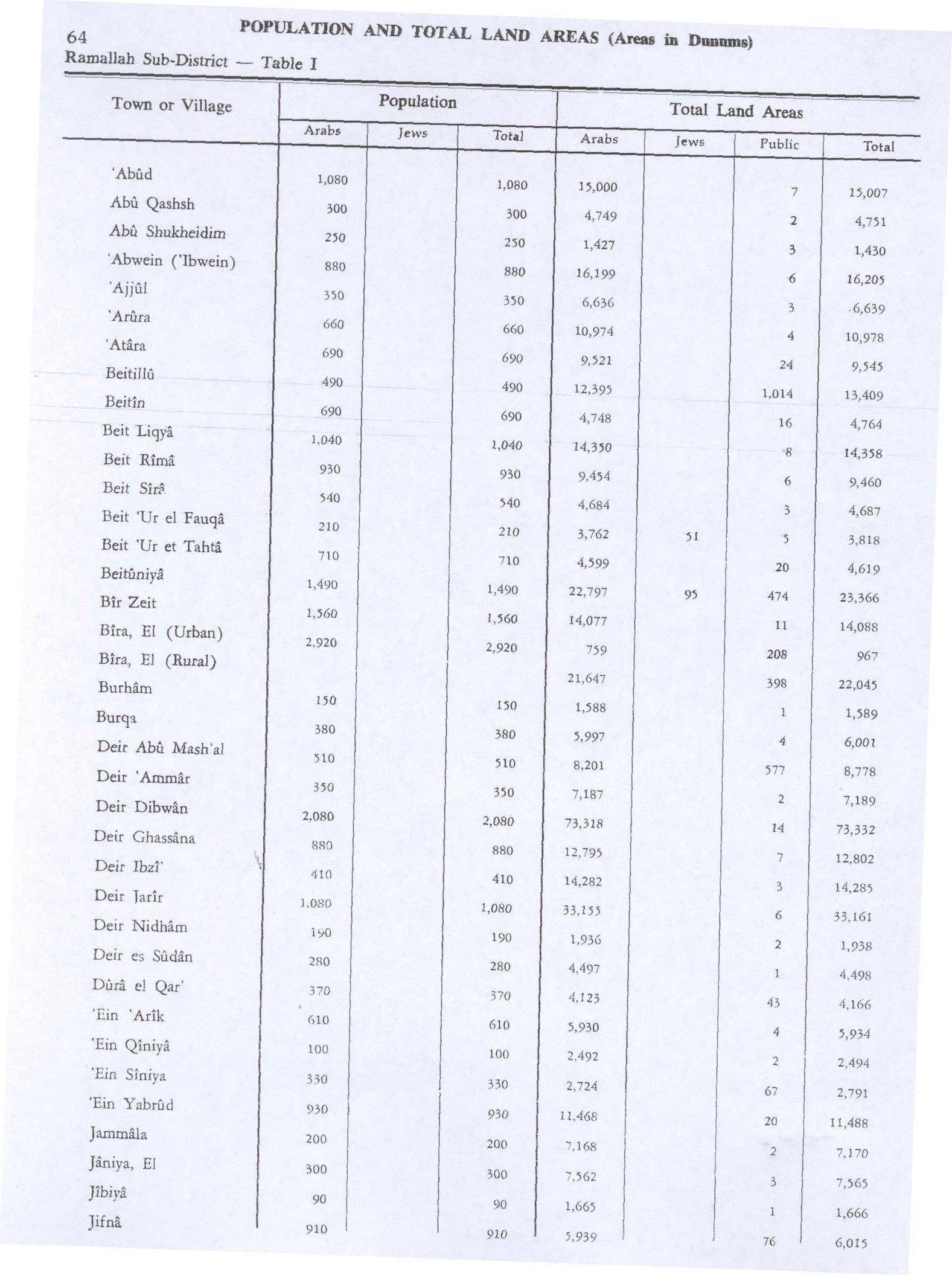
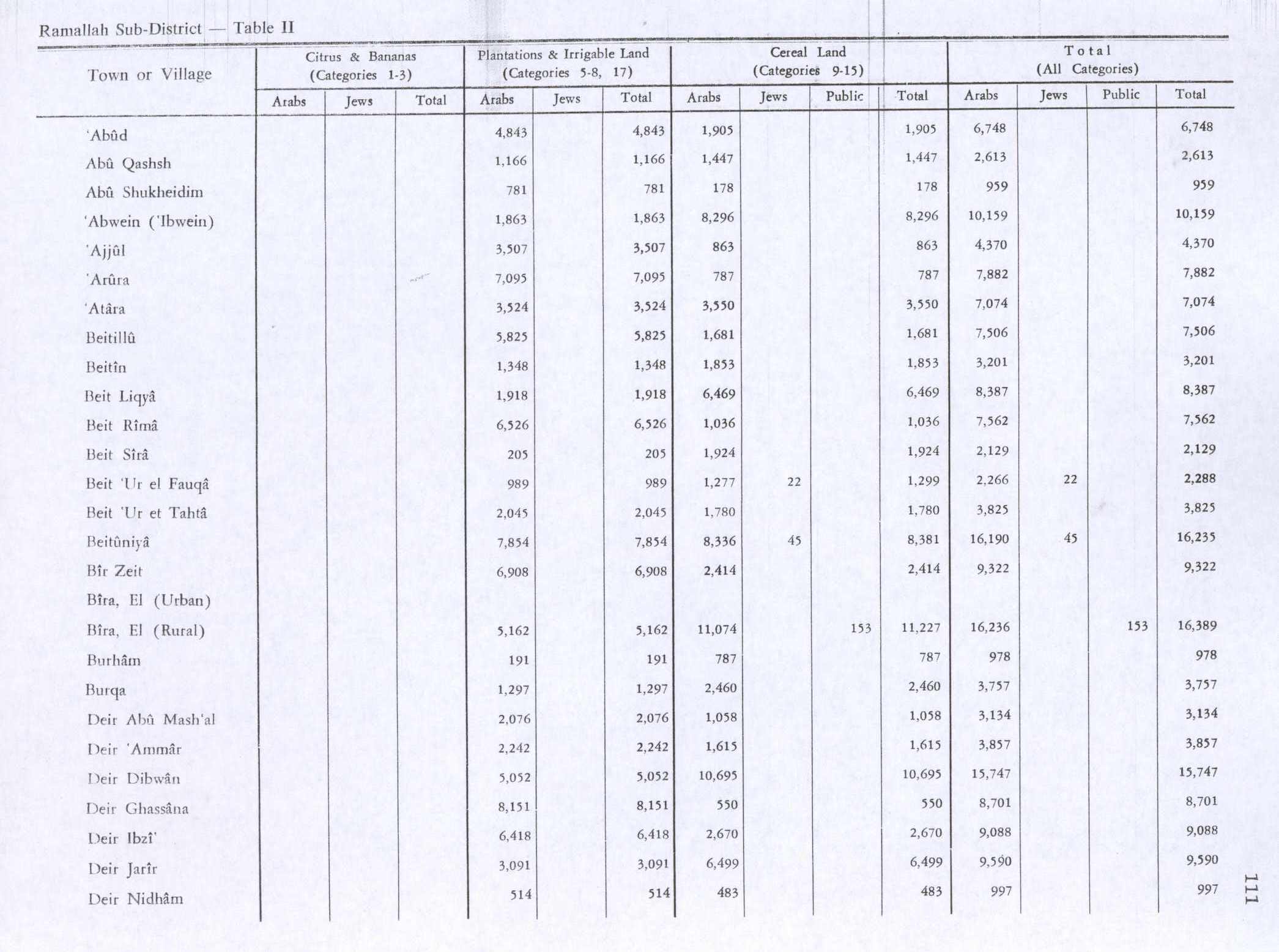
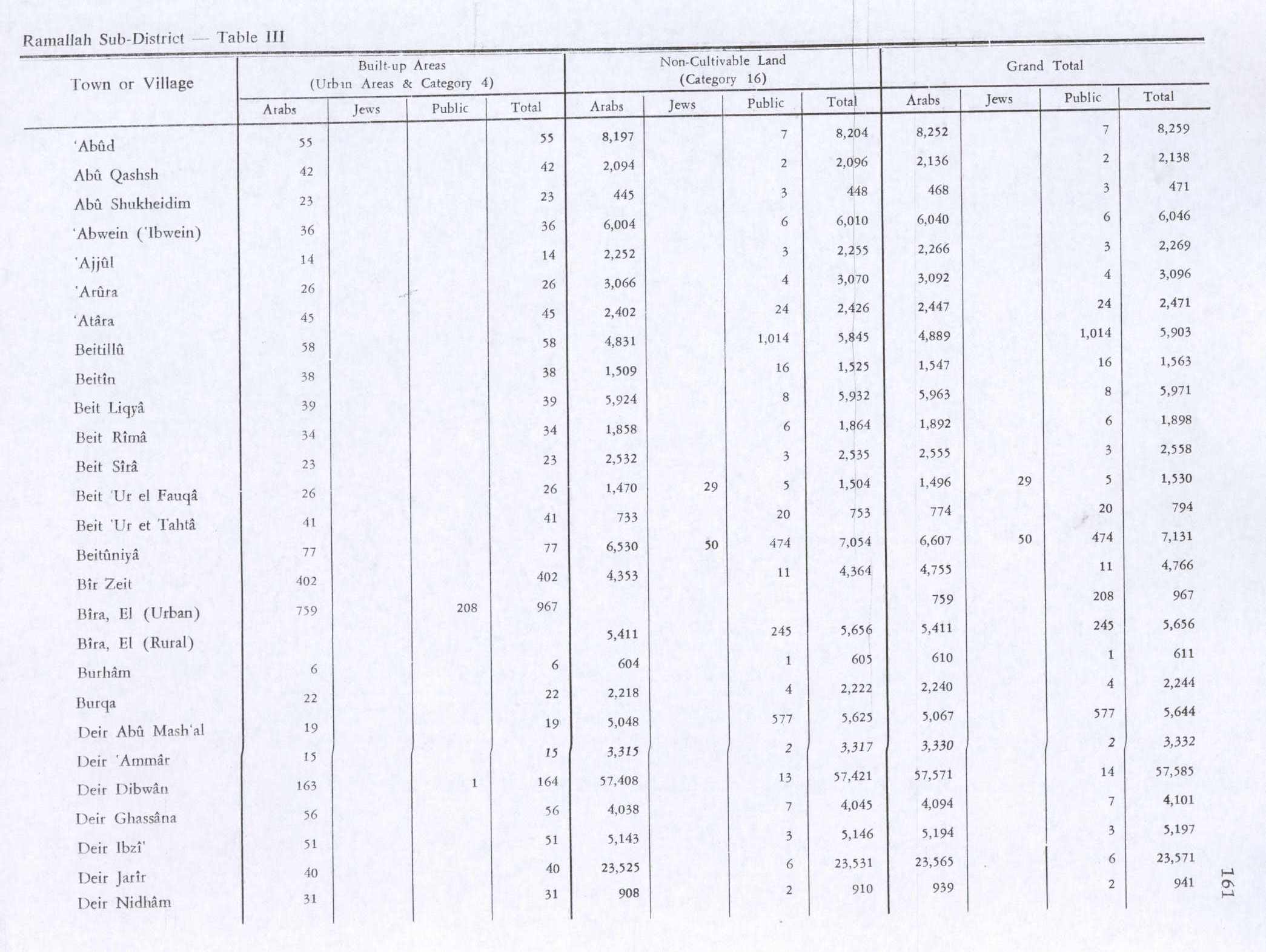
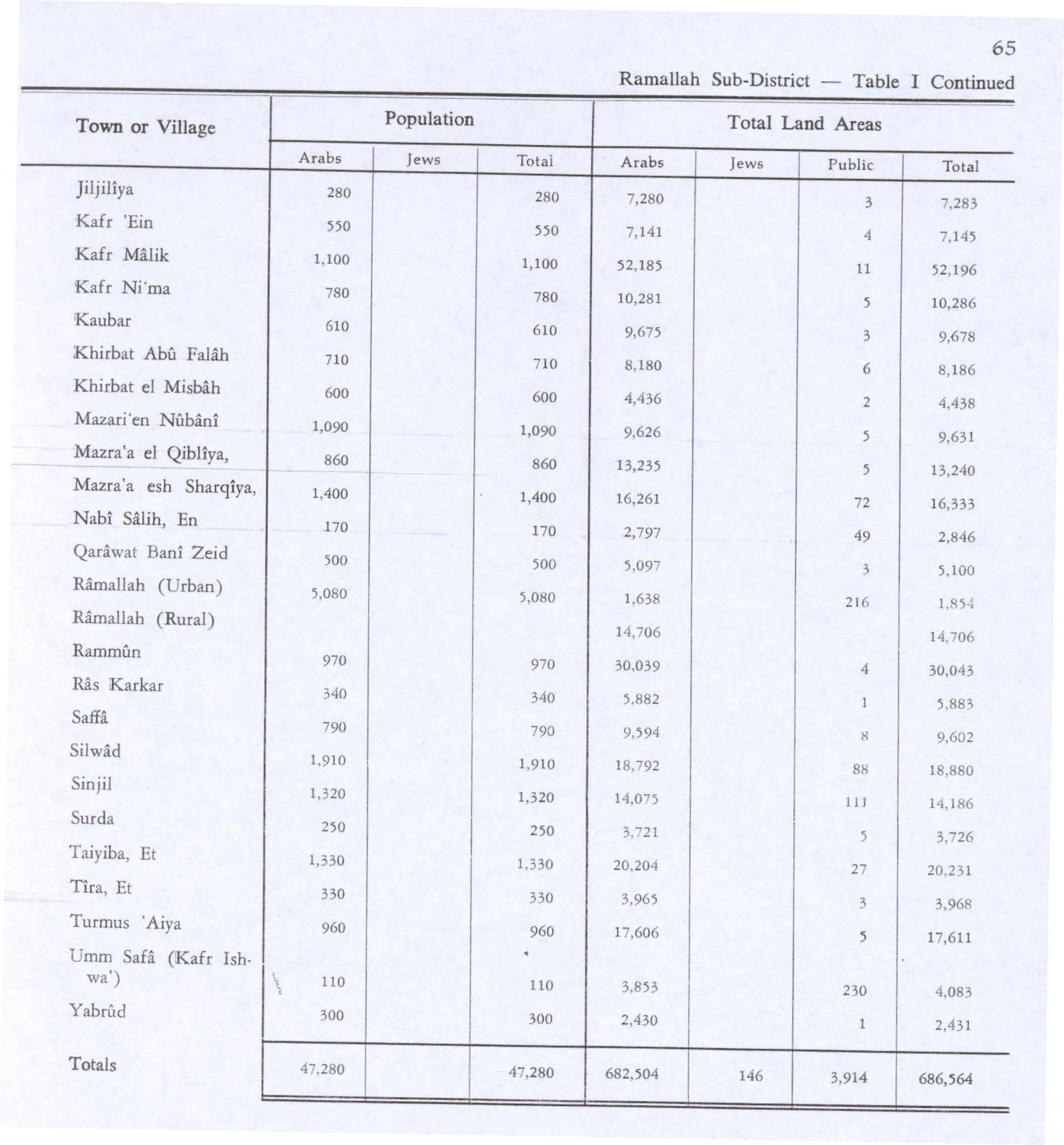
The 1945 statistics found 660 Muslim inhabitants,[18] with a total land area of 10,978 dunams.[19] Of this, 7,095 were used for plantations and irrigable land, 787 for cereals,[20] while 26 dunams were classified as built-up areas.[21]
Jordanian era
In the wake of the 1948 Arab–Israeli War, and after the 1949 Armistice Agreements, 'Arura came under Jordanian rule.
In 1961, the population of 'Arura was 1,337.[22]
Post 1967
Since the Six-Day War in 1967, 'Arura has been under Israeli occupation.
There was a sharp decrease in the population from 1961 to 1982, with nearly half the inhabitants fleeing in 1967.[5] In 1997, 'Arura had a population of 2,087, of whom 30 (1.4%) were Palestinian refugees.[23] The gender make-up was 1,069 males and 1,018 females.[23] According to the Palestinian Central Bureau of Statistics, it had a population of approximately 2,967 in mid-year 2006.[24]
Mazari al-Nubani
Script error: No such module "Labelled list hatnote". Mazari al-Nubani (Template:Langx) Script error: No such module "Coordinates"., (Palestine grid 165/161) is situated along the same height as 'Arura.
History
Mazari al-Nubani was identified by Röhricht, Prawer and Benvenisti) as a Crusader village called Mezera, but Finkelstein et al. disputes this.[25]
Ottoman era
In 1596 Mazra'at al-'Abbas appeared in the Ottoman tax registers as being in the Nahiya of Quds of the Liwa of Quds. It had a population of 60 households and 21 bachelors, all Muslim. Taxes were paid on wheat, barley, olive trees, vineyards and fruit trees, goats and/or beehives; a total of 6,910 akçe. 1/3 of the revenue went to a Waqf.[26][27]
In 1838 el-Mezari'a was noted as a Muslim village, part of the Beni Zeid area, located north of Jerusalem.[10]
When Guérin passed by the village in 1870, he estimated it had a population of about 600.[28] An Ottoman village list from the same year showed Mazari with a population of 560, in 163 houses, though the population count included men only. It was also noted it was located east of Qarawat Bani Zeid.[29][30]
In 1882, the PEF's Survey of Western Palestine described the village, then called Mezrah,[31] as being of moderate size, on high ground.[32]
In 1896 the population of Mezra‘a was estimated to be about 1,008 persons.[15]
British Mandate era
In the 1922 census of Palestine conducted by the British Mandate authorities, Mazarie' al-Nubani had a population of 611 Muslims,[33] increasing in the 1931 census to 864 Muslims, in 193 houses.[34]
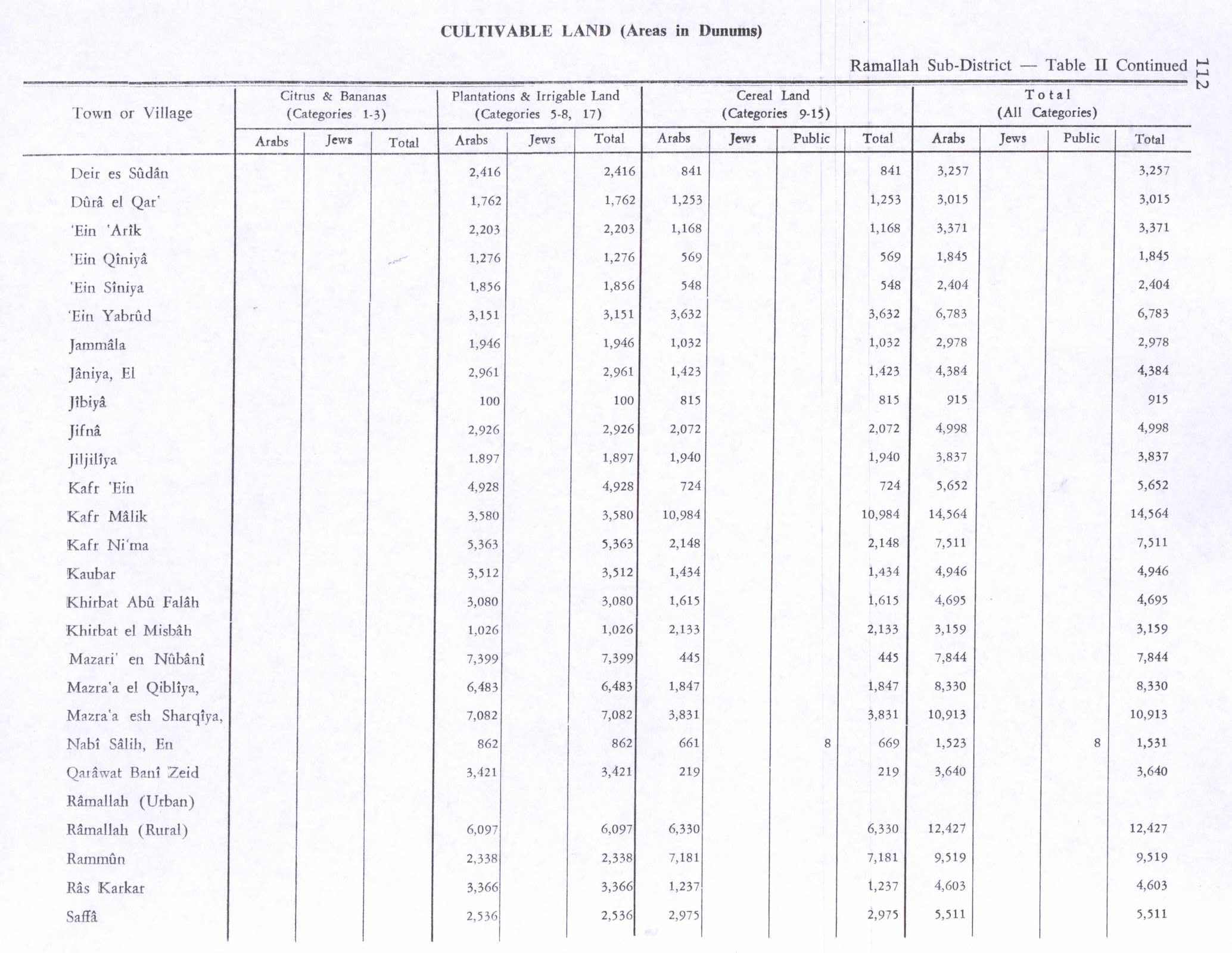
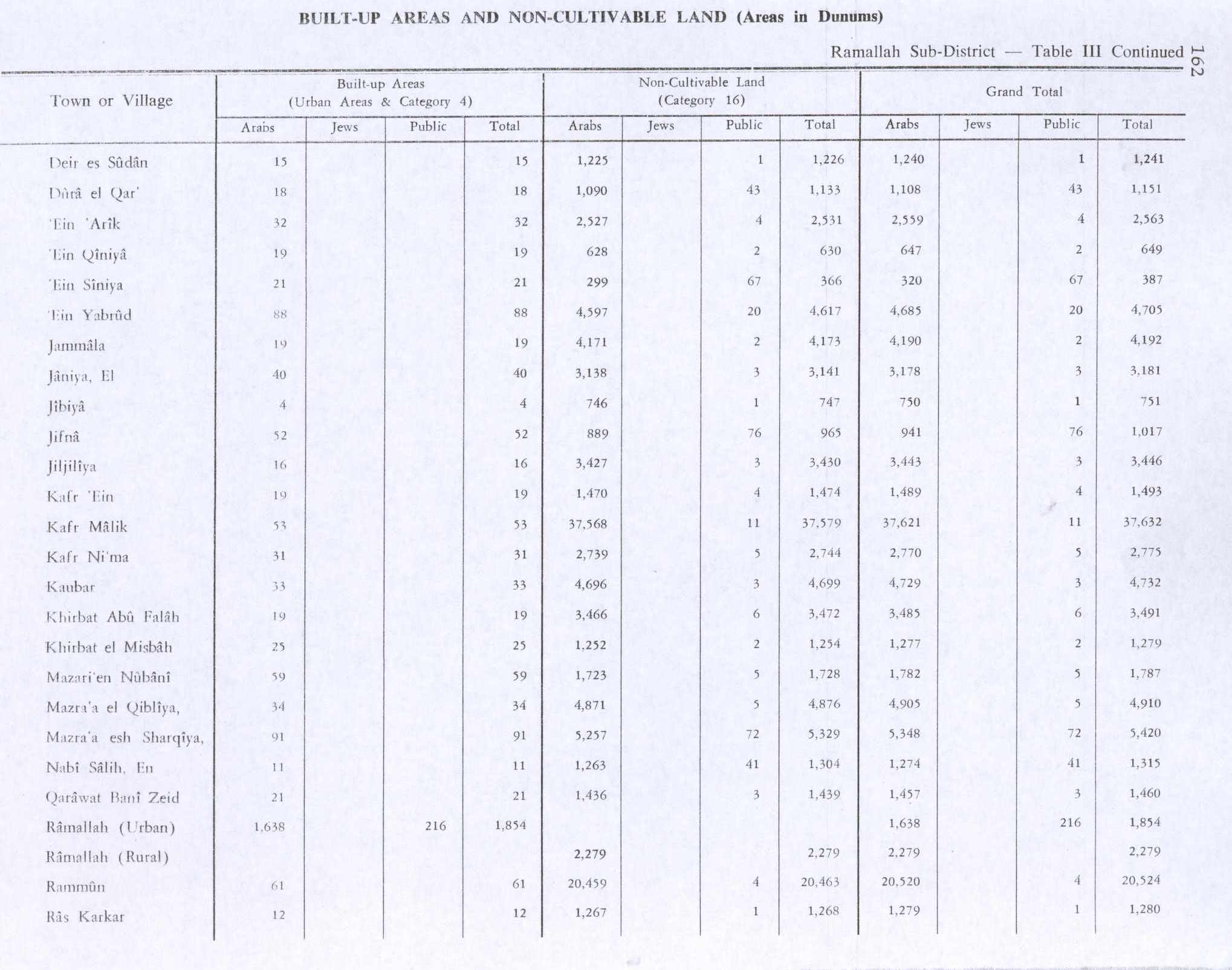
The 1945 statistics found 1,090 Muslim inhabitants[18] with a total of 9,631 dunam of land.[35] Of this, 7,399 were used for plantations and irrigable land, 445 for cereals,[36] while 59 dunams were classified as built-up areas.[37]
Jordanian era
In the wake of the 1948 Arab–Israeli War, and after the 1949 Armistice Agreements, Mazari Nubani came under Jordanian rule.
In 1961, the population of Mazari al-Nubani was 1,358.[22]
Post 1967
Since the Six-Day War in 1967, Mazari al-Nuban has been under Israeli occupation.
According to the Palestinian Central Bureau of Statistics (PCBS), the town had a population of approximately 2,510 inhabitants in mid-year 2006.[24]
Local government
The municipality was formed after a merger of 'Arura, Mazari al-Nubani, and Abwein prior to the Palestinian municipal elections in 2005. During the elections, Fatima Taher Sihweil from Abwein won and the municipality fell apart with only 'Arura and Mazari al-Nubani remaining.Script error: No such module "Unsubst".
The municipality separated in 2020.
References
<templatestyles src="Reflist/styles.css" />
- ↑ from 'Arura, personal name, according to Palmer, 1881, p. 225
- ↑ Satellite view of 'Arura
- ↑ Singer, 1994, p. 78
- ↑ Singer, 1994, p. 59
- ↑ a b Welcome To 'Arura Palestine Remembered.
- ↑ a b Finkelstein, 1997, p. 466
- ↑ a b Sharon, 1997, pp. 121 -123
- ↑ Hütteroth and Abdulfattah, 1977, p. 112
- ↑ Toledano, 1984, p. 288, has 'Arura at location 35°09′50″E 32°02′30″N.
- ↑ a b Robinson and Smith, 1841, vol 3, Appendix 2, p. 125
- ↑ Guérin, 1875, p. 170, partly translated in Conder and Kitchener, 1882, SWP II, p. 303
- ↑ Socin, 1879, p. 144
- ↑ Hartmann, 1883, p. 107 noted 80 houses.
- ↑ Conder and Kitchener, 1882, SWP II, p. 289
- ↑ a b Schick, 1896, p. 124
- ↑ Barron, 1923, Table VII, Sub-district of Ramallah, p. 16
- ↑ Mills, 1932, p. 47.
- ↑ a b Government of Palestine, Department of Statistics, 1945, p. 26
- ↑ Government of Palestine, Department of Statistics. Village Statistics, April, 1945. Quoted in Hadawi, 1970, p. 64
- ↑ Government of Palestine, Department of Statistics. Village Statistics, April, 1945. Quoted in Hadawi, 1970, p. 111
- ↑ Government of Palestine, Department of Statistics. Village Statistics, April, 1945. Quoted in Hadawi, 1970, p. 161
- ↑ a b Government of Jordan, Department of Statistics, 1964, p. 24
- ↑ a b Palestinian Population by Locality and Refugee Status Script error: No such module "webarchive". Palestinian Central Bureau of Statistics (PCBS).
- ↑ a b Projected Mid -Year Population for Ramallah & Al Bireh Governorate by Locality 2004- 2006 Palestinian Central Bureau of Statistics (PCBS).
- ↑ Röhricht, 1887, p. 200, Prawer and Benvenisti, 1970; both cited in Finkelstein, 1997, p. 464. Finkelstein found no old pottery here.
- ↑ Hütteroth and Abdulfattah, 1977, p. 114
- ↑ Toledano, 1984, p. 296, has Mazari at location 35°09′35″E 32°03′00″N.
- ↑ Guérin, 1875, p. 170
- ↑ Socin, 1879, p. 157
- ↑ Hartmann, 1883, p. 107, noted 103 houses
- ↑ meaning "The sown land", according to Palmer, 1881, p. 239
- ↑ Conder and Kitchener, 1882, SWP II, p. 291
- ↑ Barron, 1923, Table VII, Sub-district of Ramallah, p. 17
- ↑ Mills, 1932, p. 50.
- ↑ Government of Palestine, Department of Statistics. Village Statistics, April, 1945. Quoted in Hadawi, 1970, p. 65
- ↑ Government of Palestine, Department of Statistics. Village Statistics, April, 1945. Quoted in Hadawi, 1970, p. 112
- ↑ Government of Palestine, Department of Statistics. Village Statistics, April, 1945. Quoted in Hadawi, 1970, p. 162

Script error: No such module "Check for unknown parameters".
Bibliography
<templatestyles src="Refbegin/styles.css" />
- Script error: No such module "citation/CS1".
- Script error: No such module "citation/CS1".
- Script error: No such module "citation/CS1".
- Script error: No such module "citation/CS1".
- Script error: No such module "citation/CS1".
- Script error: No such module "citation/CS1".
- Script error: No such module "citation/CS1".
- Script error: No such module "citation/CS1".
- Script error: No such module "Citation/CS1".
- Script error: No such module "citation/CS1".
- Script error: No such module "citation/CS1".
- Script error: No such module "citation/CS1".
- Script error: No such module "citation/CS1".
- Script error: No such module "citation/CS1".
- Script error: No such module "citation/CS1".
- Script error: No such module "Citation/CS1".
- Script error: No such module "Citation/CS1".
- Script error: No such module "citation/CS1".
- Script error: No such module "citation/CS1".
- Script error: No such module "Citation/CS1".
- Script error: No such module "citation/CS1".
- Script error: No such module "Citation/CS1".
External links
- Welcome To 'Arura
- Welcome To Mazari' al-Nubani
- Survey of Western Palestine, Map 14: IAA, Wikimedia commons

Script error: No such module "Navbox".