Artemisia ludoviciana
Template:Short description Template:Speciesbox

Artemisia ludoviciana is a North American species of flowering plant in the daisy family Asteraceae, known by several common names, including silver wormwood, western mugwort, Louisiana wormwood, white sagebrush, lobed cud-weed, prairie sage, and gray sagewort.[1][2][3][4]
Ludoviciana is the Latinized version of the word Louisiana.[5]
Description
Artemisia ludoviciana is a rhizomatous perennial growing to heights of Script error: No such module "convert".. The stems bear linear leaves up to 11 cm long. The stems and foliage are covered in woolly gray or white hairs. The top of the stem is occupied by a narrow inflorescence of many nodding (hanging) flower heads. Each small head is a cup of hairy phyllaries surrounding a center of yellowish disc florets and is about 0.5 cm wide. The fruit is a minute achene. Flowers bloom July to October.[6]
Distribution and habitat
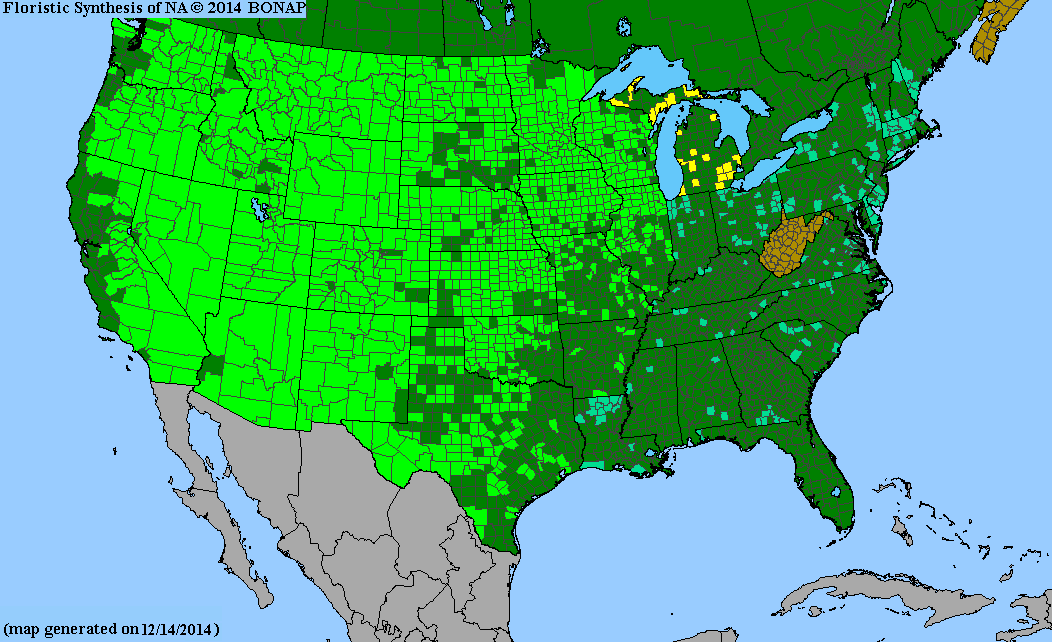
The plant is native to North America where it is widespread across most of the United States, Canada, and Mexico.[1][2][7][8] Some botanists suggest that eastern United States populations have been introduced from the western and central part of the continent.[9] Its habitats include dry slopes, canyons, open pine woods, and dry prairies.[6]
Subspecies
The following subspecies are recognised:[10]
- A. l. subsp. albula (Wooton) D.D.Keck—deserts from California and Colorado to Chihuahua, Sonora, Baja California
- A. l. subsp. candicans (Rydb.) D.D.Keck—Rocky Mountains and Cascade Range from Alberta, British Columbia to California, Colorado
- A. l. subsp. incompta (Nutt.) D.D.Keck—mountains from Alberta, British Columbia, to Mexico
- A. l. subsp. lindleyana (Besser) Lesica—Chihuahua, Sonora, Arizona
- A. l. subsp. ludoviciana—western and central United States and western Canada
- A. l. subsp. mexicana (Willd. ex Spreng.) D.D.Keck— Mexico as far south as Puebla; United States as far north as Colorado and Missouri
- A. l. subsp. redolens (A.Gray) D.D.Keck—Durango, Chihuahua, Arizona, New Mexico, Texas
Uses
Indigenous usage
Indigenous tribes across the continent use the species as a medicinal plant, a source of fiber for crafting household items, and for ceremonial purposes.[11] The Dakota people use this plant in smudging rituals to protect against maleficent spirits. The Apache, Chiricahua and Mescalero use it for spices,[12] while Blackfoot tribe use it as a drug for dermatological use.[13] The Cree and Blackfoot tribes use it in sweat lodges and the sun dance.[4] Gros Ventre also use it for skin curing and as medicine against cold, because it is also antipyretic.[14] The Meskwaki and Potawatomi use a tea made from this species as a treatment for sore throat and tonsillitis.[3]
Cultivation
A. ludoviciana is cultivated as an ornamental plant.[15] Being rhizomatous, it can spread aggressively in some climates and gardens. It grows in dry to medium moisture and well-drained soil. It requires full sun.[5]
Popular cultivars include 'Valerie Finnis' and 'Silver Queen'. Both are hardy to USDA zone 4. 'Valerie Finnis' has held the Royal Horticultural Society's Award of Garden Merit since 1993.[16]
References
<templatestyles src="Reflist/styles.css" />
- ↑ a b National Plant Germplasm System−GRIN.gov: Artemisia ludoviciana Retrieved 26 November 2017.
- ↑ a b Flora of North America Vol. 19, 20 and 21 Page 527 Silver wormwood, white or silver sage Artemisia ludoviciana Nuttall, Gen. N. Amer. Pl. 2: 143. 1818.
- ↑ a b Script error: No such module "citation/CS1".
- ↑ a b Script error: No such module "citation/CS1".
- ↑ a b Script error: No such module "citation/CS1".
- ↑ a b Script error: No such module "citation/CS1".
- ↑ Berendsohn, W.G. & A.E. Araniva de González. 1989. Listado básico de la Flora Salvadorensis: Dicotyledonae, Sympetalae (pro parte): Labiatae, Bignoniaceae, Acanthaceae, Pedaliaceae, Martyniaceae, Gesneriaceae, Compositae. Cuscatlania 1(3): 290–1–290–13
- ↑ Turner, B. L. 1996. The Comps of Mexico: A systematic account of the family Asteraceae, vol. 6. Tageteae and Athemideae. Phytologia Memoirs 10: i–ii, 1–22, 43–93
- ↑ Biota of North America Program: county distribution map Retrieved 26 November 2017.
- ↑ Script error: No such module "citation/CS1".
- ↑ University of Michigan @ Dearborn, Native American Ethnobotany of Artemisia ludoviciana Retrieved 26 November 2017.
- ↑ Script error: No such module "citation/CS1".
- ↑ Script error: No such module "citation/CS1".
- ↑ Script error: No such module "citation/CS1".
- ↑ Las Pilitas Horticulture Database: Artemisia ludoviciana (White Sagebrush) Retrieved 26 November 2017.
- ↑ Script error: No such module "citation/CS1".
Script error: No such module "Check for unknown parameters".
External links
Script error: No such module "Side box".
- Pages with script errors
- Pages with broken file links
- Artemisia (genus)
- Flora of Canada
- Flora of Mexico
- Flora of the Eastern United States
- Flora of the Western United States
- Flora of the Rocky Mountains
- Flora of the Sierra Nevada (United States)
- Plants described in 1818
- Plants used in traditional Native American medicine
- Garden plants of North America
- Flora without expected TNC conservation status