Animal pound
Script error: No such module "redirect hatnote". Script error: No such module "For". Script error: No such module "Unsubst".

An animal pound is a place where stray livestock were impounded. Animals were kept in a dedicated enclosure, until claimed by their owners, or sold to cover the costs of impounding.Script error: No such module "Footnotes".Script error: No such module "Check for unknown parameters".
Etymology
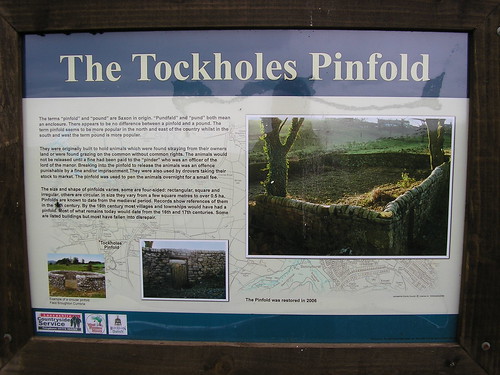
The terms "pinfold" and "pound" are Saxon in origin. Pundfald and pund both mean an enclosure. There appears to be no difference between a pinfold and a village pound.[1]
The person in charge of the pinfold was the "pinder", giving rise to the surname Pinder.
Village pound or pinfold


The village pound was a feature of most English medieval villages,Script error: No such module "Unsubst". and they were also found in the English colonies of North America and in Ireland.
A high-walled and lockable structure served several purposes; the most common use was to hold stray sheep, pigs and cattle until they were claimed by the owners,Script error: No such module "Unsubst". usually for the payment of a fine or levy.[2] The pound could be as small as Script error: No such module "convert". or as big as Script error: No such module "convert". and may be circular or square. Early pounds had just briar hedges, but most were built in stone or brick, making them more stock-proof.Script error: No such module "Unsubst". The size and shape of village pounds varies. Some are four-sided—rectangular, square and irregular—while others are circular. In size they vary from a few square metres (some square feet) to over Script error: No such module "convert".. Pounds are known to date from the medieval period. By the 16th century most villages and townships would have had a pound. Most of what remain today would date from the 16th and 17th centuries. Some are listed buildings, but most have fallen into disrepair.[3]
The Sussex County Magazine in 1930 stated: Template:Quote
Although pounds are most common to England, there are also examples in other countries. In Americans and Their Forests: a Historical Geography, author Michael Williams writes: "There was hardly a town in eighteenth-century New England without its town pound..."[4]

In some mountainous areas of northern Spain (such as Cantabria or Asturias) some similar enclosures are traditionally used to protect beehives from bear attacks.[5]

Cultural references
The artist Andy Goldsworthy has produced a series of sculptures in several of the pinfolds in Cumbria.[6]
See also
- Kraal
- Pen (enclosure)
- Scarisbrick, Lancashire, in which is the hamlet of Pinfold
- List of extant pinfolds in Cheshire
- Village lock-up
- Poundmaster
Notes
<templatestyles src="Reflist/styles.css" />
- ↑ An alternative spelling/pronunciation of pinfold was "poundfield", which implies a relation to the modern English word "(im)pound" (Plaque on pinfold site in Higham, Lancashire)
- ↑ In Brompton the fine was called a "mulct". ("Patrick Brompton church and village" magazine; text by Jane Hatcher)
- ↑ Plaque at Tockholes Pinfold, Lancashire Tockholes Pinfold
- ↑ Script error: No such module "citation/CS1".
- ↑ Script error: No such module "Citation/CS1".
- ↑ "Sheepfolds & Pinfolds, Cumbrian sculpture project by Andy Goldsworthy"
Script error: No such module "Check for unknown parameters".
References
- Script error: No such module "citation/CS1".
External links
Script error: No such module "Side box".
- photos of examples of village pounds today on geograph
- Google maps aerial view of a pinfold in Hougham, Lincolnshire