Allium oleraceum
Template:Short description Template:Speciesbox Allium oleraceum, the field garlic, is a Eurasian species of wild onion. It is a bulbous perennial that grows wild in dry places, reaching Script error: No such module "convert". in height. It reproduces by seed, bulbs and by the production of small bulblets in the flower head (similarly to Allium vineale). Unlike A. vineale, it is very rare with A. oleraceum to find flower-heads containing bulbils only.[1] In addition, the spathe in A. oleraceum is in two parts.[1][2]
Its specific epithet oleraceum means "vegetable/herbal" in Latin and is a form of Template:Wikt-lang (Script error: No such module "Lang".).[3][4]
Description
Allium oleraceum grows to a height of about Script error: No such module "convert".. The underground bulb is up to Script error: No such module "convert". in diameter. The main stem is usually rounded, but is occasionally flattened, and bears two to four leaves and a terminal inflorescence composed of a number of small, stalked, pinkish-brown flowers and sometimes a few bulblets. The papery bracts have long points which often much overtop the flowers, the stamens of which do not protrude.[5]
-
1885 Illustration

.jpg)
Distribution
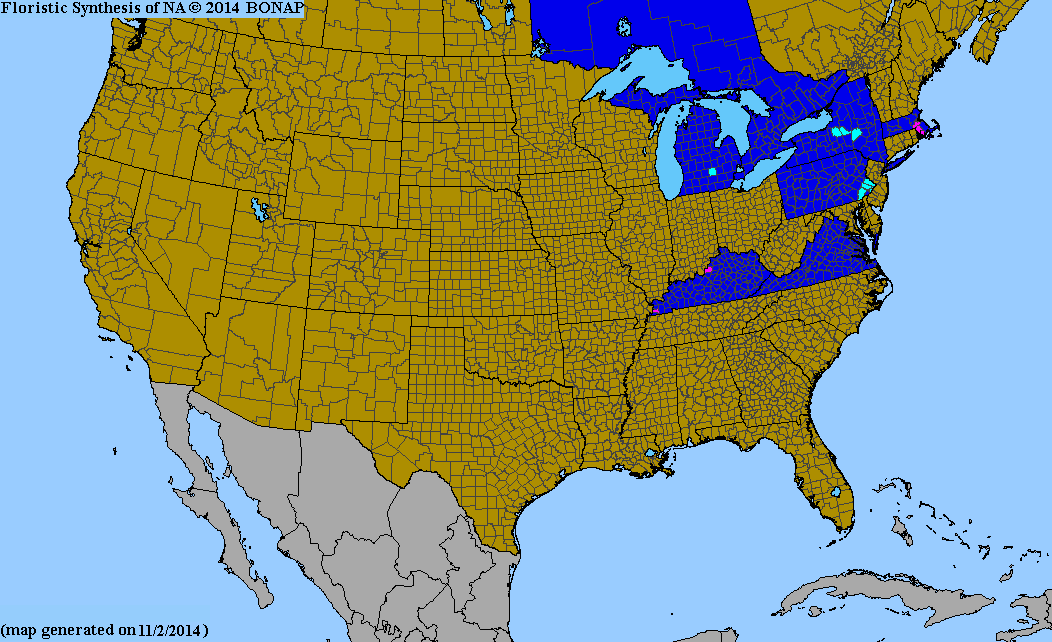
Allium oleraceum is widespread across most of Europe, with additional populations in Turkey and the Caucasus.[6][7] It is sparingly naturalised in scattered locations in North America.[8][9][10]
In the United Kingdom, A. oleraceum is found in dry, grassy places, usually steeply sloping and calcareous soils, and on open sunny banks in river floodplains. A. oleraceum is scattered throughout England and very scattered in Wales, Scotland and Ireland.[11]Template:Rp Erosion of coastal areas leads to a reduction in the available habitat for this species, leading to population declines.[12] The highest altitude from which it has been recorded in Britain is Script error: No such module "convert". in Dovedale, Derbyshire.[13]
Allium oleraceum subsp. girerdii was formerly included, but is now classified as Allium oporinanthum.[7]
See also
References
<templatestyles src="Reflist/styles.css" />
- ↑ a b The Reader's Digest Field Guide to the Wild Flowers of Britain p.382.
- ↑ Linnaeus, Carl von. 1753. Species Plantarum 1: 299.
- ↑ Script error: No such module "citation/CS1".
- ↑ Script error: No such module "citation/CS1".
- ↑ Script error: No such module "citation/CS1".
- ↑ Allium oleraceum L. Altervista Flora Italiana
- ↑ a b Cite error: Script error: No such module "Namespace detect".Script error: No such module "Namespace detect".
- ↑ Flora of North America v 26 p 238, Allium oleraceum
- ↑ BONAP (Biota of North America Program), floristic synthesis, Allium oleraceum
- ↑ Gleason, H. A. & A.J. Cronquist. 1991. Manual of the Vascular Plants of Northeastern United States and Adjacent Canada (ed. 2) i–910. New York Botanical Garden, Bronx.
- ↑ Script error: No such module "citation/CS1".
- ↑ UK Genetic Resources for Food and Agriculture (GRFA) Template:Webarchive.
- ↑ Script error: No such module "citation/CS1".Script error: No such module "Unsubst".
Script error: No such module "Check for unknown parameters".