Ajjah
Template:Short description Template:Pp-extended Script error: No such module "Settlement short description".Script error: No such module "Infobox".Template:Template otherScript error: No such module "Check for unknown parameters".Script error: No such module "Check for conflicting parameters".Expression error: Unexpected < operator.
Ajjah (Template:Langx) is a Palestinian village in the Jenin Governorate of the State of Palestine, in the northern West Bank, located 19 kilometers southwest of Jenin. According to the Palestinian Central Bureau of Statistics, the village had a population of 6,162 in 2017.[1]
History
It has been suggested that this was Aak, or Aaj in the list of places conquered by Thutmose III.[2]
Pottery sherds from Middle Bronze IIB,[3] IA I,[3] IA II,[3] Persian,[3] Hellenistic,[3] early and late Roman,[3] Byzantine[3][4] and early Muslim eras have been found here.[3]
In 1179, Casale Age was mentioned in Crusader sources as among the villages whose revenue were given to the Zion Abbey by Pope Alexander III.[3][5]
Ottoman era
Ajjah, like the rest of Palestine, was incorporated into the Ottoman Empire in 1517. In the census of 1596 it was a part of the nahiya ("subdistrict") of Jabal Sami which was under the administration of the liwa ("district") of Nablus. The village had a population of 13 households, all Muslim. The villagers paid a fixed tax-rate of 33,3% on wheat, barley, summer crops, olive trees, beehives and/or goats, in addition to occasional revenues, a tax for people of liwa Nablus, and a press for olive oil or grape syrup; a total of 3,612 akçe.[6] Pottery sherds from the Ottoman era have also been found here.[3] En-Nabulsi (1641 – 1731), noted Ajjah as "a village on the road from Fahme and er-Rameh".[3]
In 1830, the people of Ajjah fought against the army of Emir Bashir Shihab II during the siege of Sanur.[3] In 1838, 'Ajjeh was noted as being in the District of esh-Sha'rawiyeh esh-Shurkiyeh, the eastern part.[7][8]
In 1870, Victor Guérin described it as a village on a hill with 500 inhabitants, surrounded by olive groves.[9] In 1871 (1288 AH), an Ottoman census listed the village in the nahiya (sub-district) of al-Sha'rawiyya al-Sharqiyya.[10]
In 1882, the PEF's Survey of Western Palestine described Ajjeh as a small village of ancient appearance, on the edge of a hill with olive groves below and a cistern to the southeast.[11]
British mandate era
In the 1922 census of Palestine, conducted by the British Mandate authorities, the village had a population of 500 Muslims,[12] increasing in the 1931 census to 643 Muslims, in 142 houses.[13]
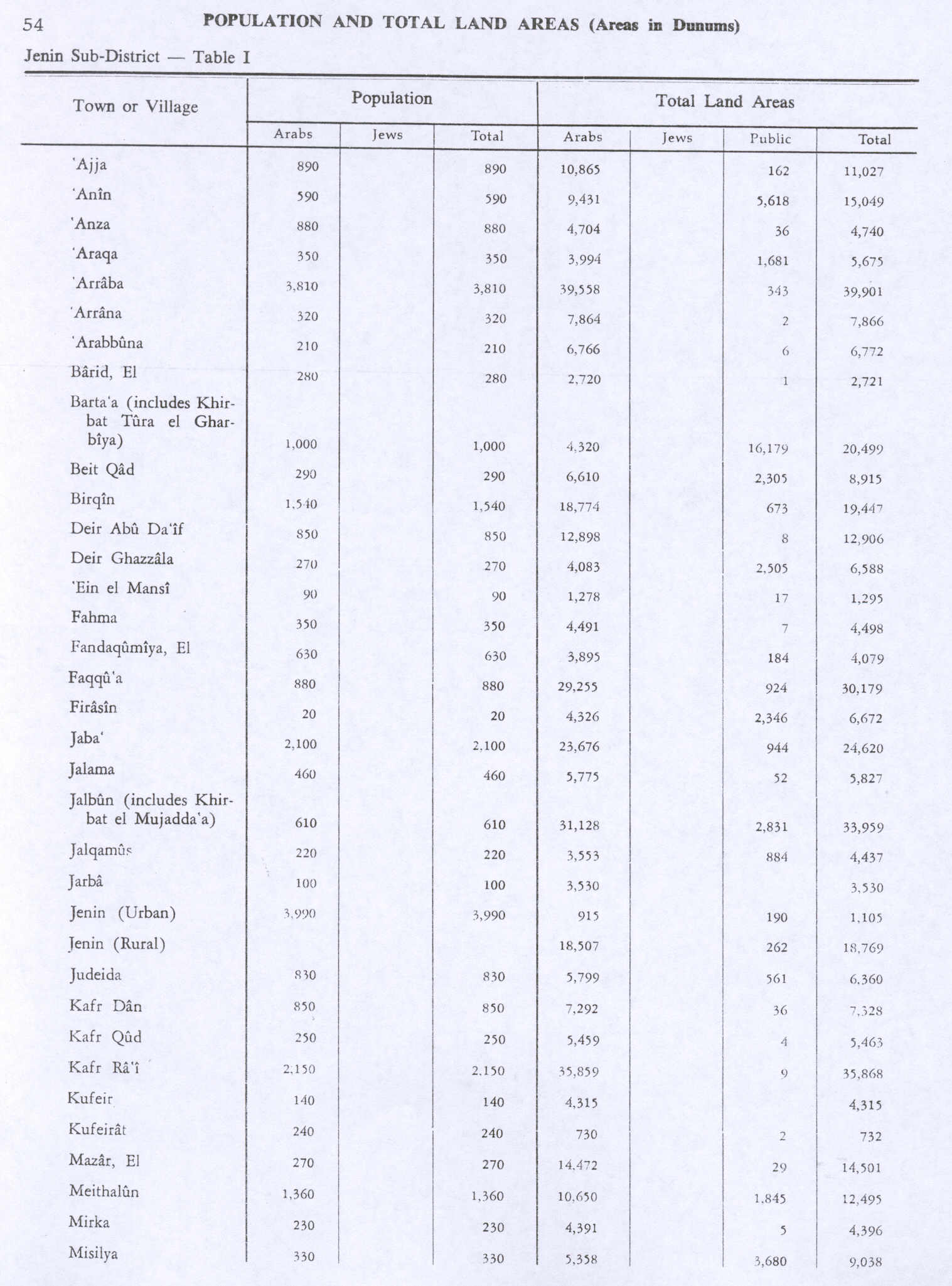
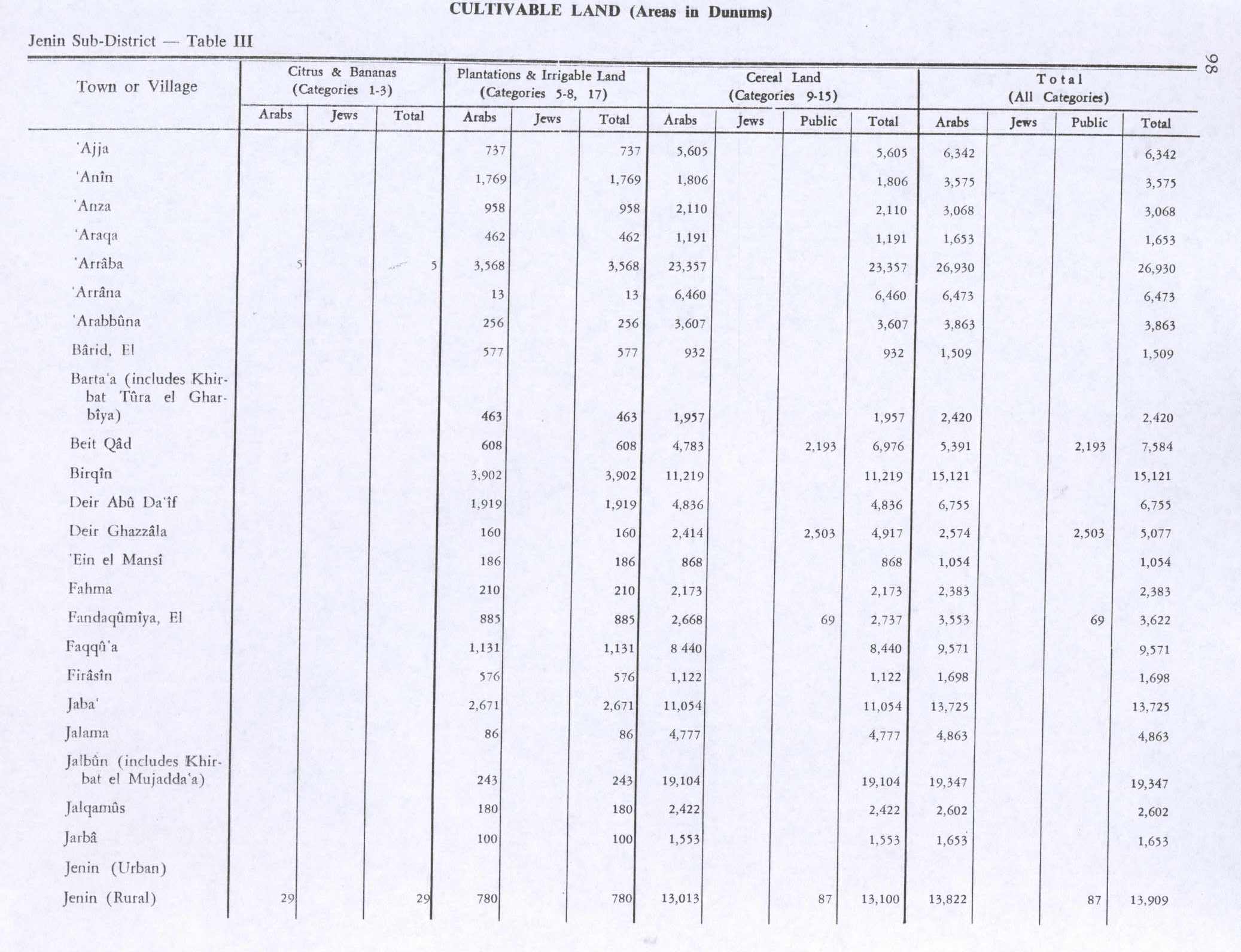
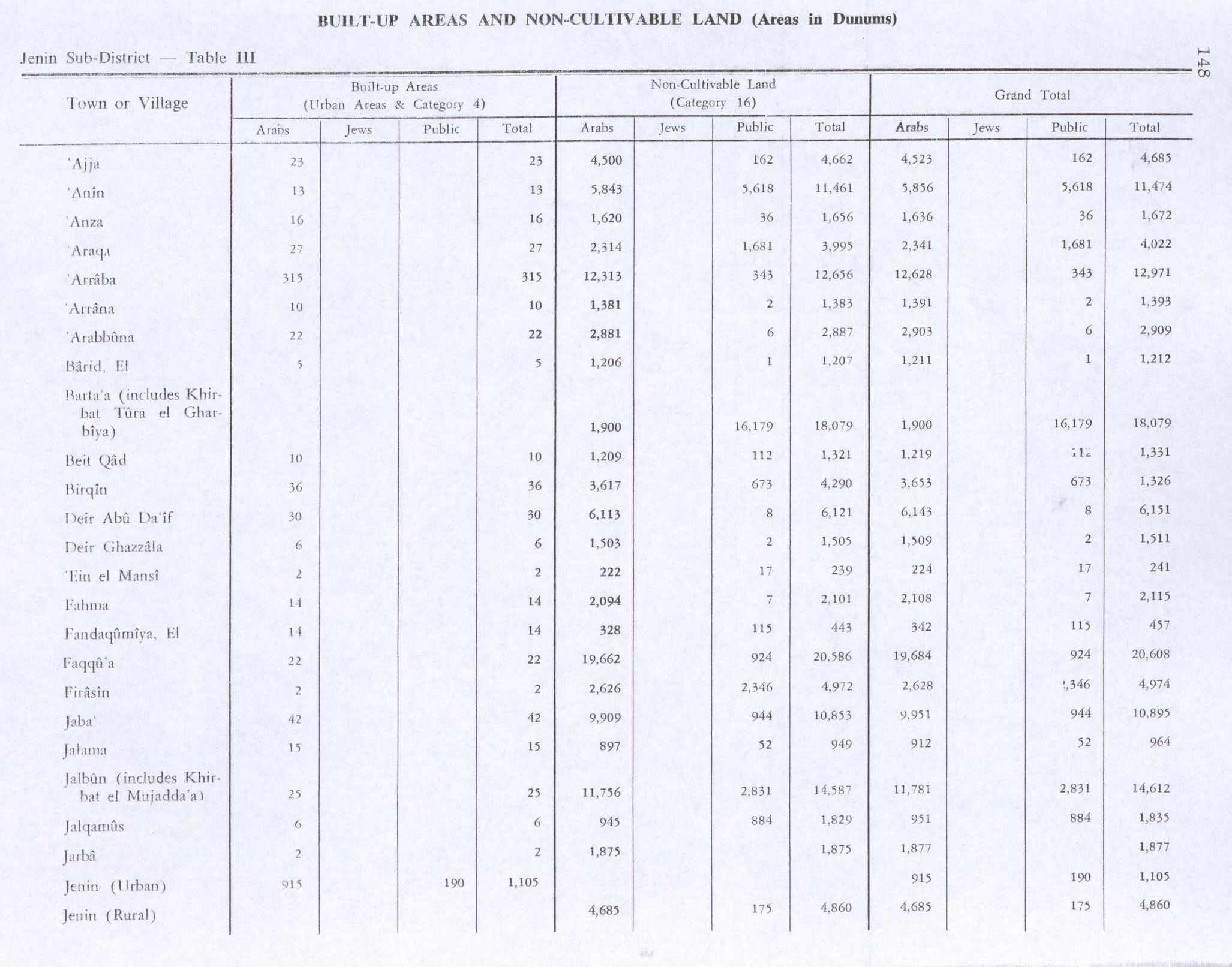
In the 1944/5 statistics the population of Ajja was 890 Muslims,[14] with a total of 11,027 dunams of land, according to an official land and population survey.[15] Of this, 737 dunams were used for plantations and irrigable land, 5,605 dunams for cereals,[16] while 23 dunams were built-up (urban) land.[17]
Jordanian era
In the wake of the 1948 Arab–Israeli War, and after the 1949 Armistice Agreements, Ajjah came under Jordanian rule.
The Jordanian census of 1961 found 1,190 inhabitants.[18]
Post-1967
Since the 1967 Six-Day War, Ajjah has been under Israeli occupation. In 1978, the Medieval fortress still crowned the summit of the village, and around it were buildings from the 16th and 17th CE, and two mosques.[19] Under the Oslo Accords, most of this town was assigned to Area A, with political control and security responsibilities assigned to the Palestinian National Authority.[20]
Demography
Local origins
Residents of Ajjah originally came from many locations, including Jerusalem, Galilee (Alma), and Beita.[21]
References
<templatestyles src="Reflist/styles.css" />
- ↑ Cite error: Script error: No such module "Namespace detect".Script error: No such module "Namespace detect".
- ↑ Conder, 1876, pp.141, 147
- ↑ a b c d e f g h i j k l Zertal, 2004, p. 254
- ↑ Dauphin, 1998, p. 758
- ↑ Röhricht, 1893, RRH, pp. 153-154, No. 576
- ↑ Hütteroth and Abdulfattah, 1977, p. 126
- ↑ Robinson and Smith, 1841, vol 3, 2nd app, p. 129
- ↑ Robinson and Smith, 1841, vol 3, p. 150
- ↑ Guérin, 1875, p. 217
- ↑ Script error: No such module "citation/CS1".
- ↑ Conder and Kitchener, 1882, SWP II, p. 153
- ↑ Barron, 1923, Table IX, Sub-district of Jenin, p. 29
- ↑ Mills, 1932, p. 67
- ↑ Government of Palestine, Department of Statistics, 1945, p. 16 Template:Webarchive
- ↑ Government of Palestine, Department of Statistics. Village Statistics, April, 1945. Quoted in Hadawi, 1970, p. 54 Template:Webarchive
- ↑ Government of Palestine, Department of Statistics. Village Statistics, April, 1945. Quoted in Hadawi, 1970, p. 98 Template:Webarchive
- ↑ Government of Palestine, Department of Statistics. Village Statistics, April, 1945. Quoted in Hadawi, 1970, p. 148 Template:Webarchive
- ↑ Government of Jordan, Department of Statistics, 1964, p. 25
- ↑ Zertal, 2004, p. 253
- ↑ B'Tselem Interactive Map https://www.btselem.org/map
- ↑ Grossman, D. (1986). "Oscillations in the Rural Settlement of Samaria and Judaea in the Ottoman Period". in Shomron studies. Dar, S., Safrai, S., (eds). Tel Aviv: Hakibbutz Hameuchad Publishing House. p. 351

Script error: No such module "Check for unknown parameters".
Bibliography
<templatestyles src="Refbegin/styles.css" />
- Script error: No such module "citation/CS1".
- Script error: No such module "citation/CS1".
- Script error: No such module "Citation/CS1".
- Script error: No such module "citation/CS1".
- Script error: No such module "citation/CS1".
- Script error: No such module "citation/CS1".
- Script error: No such module "citation/CS1".
- Script error: No such module "citation/CS1".
- Script error: No such module "citation/CS1".
- Script error: No such module "citation/CS1".
- Script error: No such module "citation/CS1".
- Script error: No such module "citation/CS1".
- Script error: No such module "citation/CS1".
- Script error: No such module "citation/CS1".
External links
- Welcome to Ajja
- Aja Welcome to Palestine
- Survey of Western Palestine, Map 11: IAA, Wikimedia commons

Script error: No such module "Navbox".