Mogilev: Difference between revisions
imported>JJMC89 bot III m Merging Category:Cities in Belarus to Category:Populated places in Belarus per Wikipedia:Categories for discussion/Log/2025 May 5#Category:Cities in Belarus |
imported>Plac Francyska No edit summary |
||
| (2 intermediate revisions by 2 users not shown) | |||
| Line 2: | Line 2: | ||
{{about|the city in Belarus|the city in Ukraine|Mohyliv-Podilskyi}} | {{about|the city in Belarus|the city in Ukraine|Mohyliv-Podilskyi}} | ||
{{Infobox settlement | {{Infobox settlement | ||
| name = Mogilev | | name = Mogilev | ||
| native_name = {{ | | native_name = {{native name|be|Магілёў}}<br/>{{native name|ru|Могилёв}} | ||
| other_name = Mahilyow | | other_name = Mahilyow | ||
| translit_lang1 | | translit_lang1 = [[Belarusian language|Belarusian]] | ||
| translit_lang1_type1 | | translit_lang1_type1 = [[BGN/PCGN romanization of Belarusian|BGN/PCGN]] | ||
| translit_lang1_info1 | | translit_lang1_info1 = Mahilyow | ||
| translit_lang1_type2 | | translit_lang1_type2 = [[Instruction on transliteration of Belarusian geographical names with letters of Latin script|Official]] | ||
| translit_lang1_info2 | | translit_lang1_info2 = Mahilioŭ | ||
| translit_lang1_type3 | | translit_lang1_type3 = [[Scientific transliteration of Cyrillic|Scholarly]] | ||
| translit_lang1_info3 | | translit_lang1_info3 = Mahilëŭ | ||
| translit_lang1_type4 | | translit_lang1_type4 = [[ALA-LC romanization|ALA-LC]] | ||
| translit_lang1_info4 | | translit_lang1_info4 = Mahili͡oŭ | ||
| translit_lang1_type5 | | translit_lang1_type5 = British<ref>British Standard 2979 : 1958, London: British Standards Institution.</ref> | ||
| translit_lang1_info5 | | translit_lang1_info5 = Mahilëw | ||
| translit_lang1_type6 | | translit_lang1_type6 = [[Łacinka]] | ||
| translit_lang1_info6 | | translit_lang1_info6 = Mahiloŭ | ||
| settlement_type = [[List of cities and largest towns in Belarus|City]] | | settlement_type = [[List of cities and largest towns in Belarus|City]] | ||
| image_skyline = {{multiple image | | image_skyline = {{multiple image | ||
| border = infobox | | border = infobox | ||
| total_width = 270 | | total_width = 270 | ||
| Line 40: | Line 40: | ||
| flag_size = 150 | | flag_size = 150 | ||
| shield_size = 75 | | shield_size = 75 | ||
| map_caption = Location of Mogilev, shown within [[Mogilev Region]] | | map_caption = Location of Mogilev, shown within [[Mogilev Region]] | ||
| pushpin_map = Belarus | | pushpin_map = Belarus | ||
| Line 48: | Line 47: | ||
| subdivision_name1 = [[Mogilev Region]] | | subdivision_name1 = [[Mogilev Region]] | ||
| leader_title = Mayor | | leader_title = Mayor | ||
| leader_name = | | leader_name = [[Sergey Chertkov]] | ||
| established_title = Founded | | established_title = Founded | ||
| established_date = 1267 | | established_date = 1267 | ||
| area_total_km2 = 118.50 | | area_total_km2 = 118.50 | ||
| population_as_of = 2025 | |||
| population_footnotes = <ref name="pop">{{cite web|url=https://www.belstat.gov.by/ofitsialnaya-statistika/solialnaya-sfera/naselenie-i-migratsiya/naselenie/statisticheskie-izdaniya/index_148168/|title=Численность населения на 1 января 2025 г. и среднегодовая численность населения за 2024 год по Республике Беларусь в разрезе областей, районов, городов, поселков городского типа|archive-url=https://web.archive.org/web/20250329210112/https://www.belstat.gov.by/ofitsialnaya-statistika/solialnaya-sfera/naselenie-i-migratsiya/naselenie/statisticheskie-izdaniya/index_148168/|archive-date=29 March 2025|website=belsat.gov.by|access-date=23 June 2025}}</ref> | |||
| population_as_of = | | population_total = 352,896 | ||
| population_footnotes = <ref name="pop">{{cite web|url=https://www.belstat.gov.by/ofitsialnaya-statistika/solialnaya-sfera/naselenie-i-migratsiya/naselenie/statisticheskie-izdaniya/ | |||
| population_total = | |||
| population_density_km2 = auto | | population_density_km2 = auto | ||
| timezone | | timezone = [[Moscow Time|MSK]] | ||
| utc_offset = +3 | | utc_offset = +3 | ||
| coordinates = {{coord|53|55|N|30|21|E|region:BY|display=inline,title}} | | coordinates = {{coord|53|55|N|30|21|E|region:BY|display=inline,title}} | ||
| Line 71: | Line 65: | ||
| blank_info = 6 | | blank_info = 6 | ||
| website = [http://mogilev.gov.by/ City's executive committee's official website] | | website = [http://mogilev.gov.by/ City's executive committee's official website] | ||
}} | }} | ||
'''Mogilev''' | '''Mogilev''', or '''Mahilyow''',<!--See WP:BELARUSIANNAMES-->{{efn|{{IPAc-en|US|m|ə|ɡ|ɪ|l|ˈ|j|ɔ:|f}};<ref>{{cite web | url=https://www.merriam-webster.com/dictionary/mogilev | title=Definition of MOGILEV }}</ref> {{langx|ru|Могилёв|Mogilyov}}, {{IPA|ru|məɡʲɪˈlʲɵf|IPA}}; {{langx|be|Магілёў|Mahilioŭ}}, {{IPA|be|maɣʲiˈlʲou̯|IPA}}.}}<ref>Назвы населеных пунктаў Рэспублікі Беларусь: Магілёўская вобласць: нарматыўны даведнік / І. А. Гапоненка і інш.; пад рэд. {{ill|Valyantsina Lyemuyuhova|be|Валянціна Пятроўна Лемцюгова|lt=В. П. Лемуюгова}}. — Мн.: Тэхналогія, 2007. — 406 с. — {{ISBN|978-985-458-159-0}}. ([http://files.knihi.com/Knihi/Slounik/NNP.djvu.zip/NNP.Mahilouskaja.djvu DJVU]) {{in lang|be}}</ref> is a city in eastern [[Belarus]]. It is located on the [[Dnieper|Dnieper River]], about {{convert|76|km|0|abbr=off}} from the [[Belarus–Russia border|border]] with [[Russia]]'s [[Smolensk Oblast]] and {{convert|105|km|0|abbr=in}} from [[Bryansk Oblast]]. As of 2025, it has a population of 352,896.<ref name="pop"/> In 2011, its population was 360,918,<ref name="belstat2011">{{Cite journal|url=http://belstat.gov.by/homep/ru/publications/2011/bul_population.rar|title=Численность населения на 1 января 2011 года и среднегодовая численность населения за 2010 год по Республике Беларусь в разрезе областей, районов, городов, поселков городского типа|last=Ярковец|first=А.И.|year=2011|format=PDF|publisher=Национальный статистический комитет Республики Беларусь|journal=Статистический бюллетень|page=21|language=ru|access-date=2012-01-13|archive-url=https://web.archive.org/web/20120209082642/http://belstat.gov.by/homep/ru/publications/population/2011/bul_population.rar|archive-date=2012-02-09|url-status=dead}}</ref> up from an estimated 106,000 in 1956. It serves as the administrative centre of [[Mogilev Region]],<ref name="pop"/> and is the [[List of cities and largest towns in Belarus|third-largest city]] in Belarus. | ||
==Name== | |||
The name ''Mogilev'' may be derived from Russian ''mogila'' ({{lit|grave}}) and ''lev'' ({{lit|lion}}); according to folk legend, the city was named after the grave of a young peasant, which was known as the "Tomb of the Lion", and it was around this burial mound that a fortress was built.<ref>{{cite book |last1=Everett-Heath |first1=John |title=Concise Oxford Dictionary of World Place Names |date=22 October 2020 |publisher=Oxford University Press |isbn=978-0-19-190563-6 |url=https://www.oxfordreference.com/display/10.1093/acref/9780191905636.001.0001/acref-9780191905636-e-4845 |language=en |chapter=Mahilyow}}</ref> Its founding has also been linked to [[Galicia (Eastern Europe)|Galician]] prince [[Leo I of Galicia|Lev Danilovich]].<ref>{{cite Efron|Могилев на Днепре}}</ref> | |||
== History == | == History == | ||
| Line 80: | Line 76: | ||
The city was first mentioned in historical records in 1267. From the 14th century, it was part of the [[Grand Duchy of Lithuania]], and since the [[Union of Lublin]] (1569), it has been part of the [[Polish–Lithuanian Commonwealth]], where it became known as ''Mohylew''. In the 16th and 17th centuries, the city flourished as one of the main nodes of the east-west and north-south trading routes. | The city was first mentioned in historical records in 1267. From the 14th century, it was part of the [[Grand Duchy of Lithuania]], and since the [[Union of Lublin]] (1569), it has been part of the [[Polish–Lithuanian Commonwealth]], where it became known as ''Mohylew''. In the 16th and 17th centuries, the city flourished as one of the main nodes of the east-west and north-south trading routes. | ||
In 1577, Grand Duke [[Stefan Batory]] granted it [[Magdeburg law|city rights under Magdeburg law]]. In 1654, during the [[Russo-Polish War (1654–1667)]], the townsmen negotiated a treaty of surrender to the Russians peacefully, if the Jews were to be expelled and their property divided up among Mogilev's inhabitants. [[Alexis of Russia|Tsar Aleksei Mikhailovitch]] agreed. However, instead of expelling the Jews, the Russian troops massacred them after they had led them to the outskirts of the town.<ref>Russia's First Modern Jews | In 1577, Grand Duke [[Stefan Batory]] granted it [[Magdeburg law|city rights under Magdeburg law]]. In 1654, during the [[Russo-Polish War (1654–1667)]], the townsmen negotiated a treaty of surrender to the Russians peacefully, if the Jews were to be expelled and their property divided up among Mogilev's inhabitants. [[Alexis of Russia|Tsar Aleksei Mikhailovitch]] agreed to their proposal. However, instead of expelling the Jews, the Russian troops massacred them after they had led them to the outskirts of the town.<ref>{{cite book |title=Russia's First Modern Jews |publisher=NYU Press |year=1995 |first=David |last=Fishman |page=2 |isbn=0-8147-2614-3 }}</ref> During this war, the city was besieged twice by the [[Grand Duchy of Lithuania|Lithuanian army]]: [[Siege of Mogilev (1655)|in 1655]], and {{ill|Siege of Mogilev (1660)|ru|Осада Могилёва (1660)|lt=in 1660}}. In 1661, residents started {{ill|Mogilev uprising (1661)|lt=an uprising|ru|Могилёвское восстание (1661)}} against the Russian military occupation. The city was set afire by [[Peter the Great]]'s forces in 1708, during the [[Great Northern War]].<ref>{{cite book |last=Катлярчук |first=Андрэй |date=2007 |title=Швэды ў гісторыі й культуры беларусаў |publisher=Ėntsyklapedyks |url=http://www.diva-portal.org/smash/get/diva2:860434/FULLTEXT01.pdf |isbn=978-9856599586 |language=belarusian}}</ref> After the [[Partitions of Poland|First Partition of Poland]] in 1772, Mogilev became part of the [[Russian Empire]] and became the centre of the [[Mogilev Governorate]]. | ||
In the years 1915–1917, during [[World War I]], the [[Stavka]], the headquarters of the [[Russian Imperial Army]], was based in the city <ref>Preclík, Vratislav. Masaryk a legie (Masaryk and legions), váz. kniha, 219 pages, first issue vydalo nakladatelství Paris Karviná, Žižkova 2379 (734 01 Karvina, Czech Republic) ve spolupráci s Masarykovým demokratickým hnutím (Masaryk Democratic Movement, Prague), 2019, {{ISBN|978-80-87173-47-3}}, pages | In the years 1915–1917, during [[World War I]], the [[Stavka]], the headquarters of the [[Russian Imperial Army]], was based in the city <ref>Preclík, Vratislav. Masaryk a legie (Masaryk and legions), váz. kniha, 219 pages, first issue vydalo nakladatelství Paris Karviná, Žižkova 2379 (734 01 Karvina, Czech Republic) ve spolupráci s Masarykovým demokratickým hnutím (Masaryk Democratic Movement, Prague), 2019, {{ISBN|978-80-87173-47-3}}, pages 36–39, 41–42, 111–112, 124–125, 128, 129, 132, 140–148, 184–199.</ref> and the Tsar, [[Nicholas II]], spent long periods there as Commander-in-Chief.<ref>{{cite web|url=https://www.belarus.by/en/press-center/press-release/mogilev-invites-tourists-to-take-a-stroll-with-emperor-nicholas-ii_i_0000051069.html |title=Mogilev invites tourists to take a stroll with Emperor Nicholas II |publisher=Official website of Belarus}}</ref><ref>{{cite book |last1=Massie |first1=Robert |title=Nicholas and Alexandria |orig-date=1967 |year=2000 |publisher=Ballantine Books |location=New York |isbn=0-345-43831-0 |pages=300}}</ref> | ||
Following the [[Russian Revolution]], in 1918, the city was briefly occupied by [[Germany]] and placed under their short-lived [[Belarusian People's Republic]]. In 1919, Mogilev was captured by the forces of [[Russian Soviet Federative Socialist Republic|Soviet Russia]] and incorporated into the [[Byelorussian SSR]]. Up to [[World War II]] and the [[Holocaust]], like many other cities in Europe, Mogilev had a significant [[Jewish diaspora|Jewish]] population: according to the [[Russian census of 1897]], out of the total population of 41,100, 21,500 were Jews (i.e. over 50 percent).<ref>Joshua D. Zimmerman | Following the [[Russian Revolution]], in 1918, the city was briefly occupied by [[Germany]] and placed under their short-lived [[Belarusian People's Republic]]. In 1919, Mogilev was captured by the forces of [[Russian Soviet Federative Socialist Republic|Soviet Russia]] and incorporated into the [[Byelorussian SSR]]. Up to [[World War II]] and the [[Holocaust]], like many other cities in Europe, Mogilev had a significant [[Jewish diaspora|Jewish]] population: according to the [[Russian census of 1897]], out of the total population of 41,100, 21,500 were Jews (i.e. over 50 percent).<ref>{{cite book |first=Joshua D. |last=Zimmerman |title=Poles, Jews, and the politics of nationality |publisher=Univ of Wisconsin Press |year=2004 |isbn=0-299-19464-7 |url=https://books.google.com/books?id=6sbr9cZyw_4C&pg=PA16 |via=Google Books |page=16 }}</ref> In 1938 the leadership of Soviet Belarus decided to move the capital of the country from Minsk to Mogilev because Minsk was too close to the then-Polish-Soviet border. Due to that, the now-{{ill|Mogilev City Council building|ru|Дом Советов (Могилёв)}} was built in 1938–1940 to be the government building. It was designed to resemble the [[Government House, Minsk|Minsk Government building]]. | ||
{{stack|[[File:Bundesarchiv_Bild_101I-138-1091-06A,_Russland,_Mogilew,_jüdische_Frauen_auf_Dorfstraße.jpg|thumb|[[Wehrmacht Propaganda Troops|Wehrmacht propaganda]] photograph of Jewish women in Mogilev, July 1941; Mogilev Jews were murdered by Nazi [[Police Battalion 322]] in October.<ref>{{cite book | {{stack|[[File:Bundesarchiv_Bild_101I-138-1091-06A,_Russland,_Mogilew,_jüdische_Frauen_auf_Dorfstraße.jpg|thumb|[[Wehrmacht Propaganda Troops|Wehrmacht propaganda]] photograph of Jewish women in Mogilev, July 1941; Mogilev Jews were murdered by Nazi [[Police Battalion 322]] in October.<ref>{{cite book | ||
| Line 105: | Line 101: | ||
==Demographics== | ==Demographics== | ||
{{historical populations|1897|43119|1923|41622|1926|46562|1939|99428|1959|121712|1970|202314|1979|290361|1989|359188|1999|356500|2009|358279|2019|356821|align=left|cols=2|source=pop-stat.mashke.org<ref>{{cite web|title=Cities & Towns of Belarus|url=http://pop-stat.mashke.org/belarus-cities.htm|date=2024-04-15}}</ref>}} | {{historical populations|1897|43119|1923|41622|1926|46562|1939|99428|1959|121712|1970|202314|1979|290361|1989|359188|1999|356500|2009|358279|2019|356821|2024|353110|2025|352896|align=left|cols=2|source=pop-stat.mashke.org<ref>{{cite web|title=Cities & Towns of Belarus|url=http://pop-stat.mashke.org/belarus-cities.htm|date=2024-04-15}}</ref><ref>{{cite web|url=https://www.belstat.gov.by/ofitsialnaya-statistika/solialnaya-sfera/naselenie-i-migratsiya/naselenie/statisticheskie-izdaniya/index_89355/|title=Численность населения на 1 января 2024 г. и среднегодовая численность населения за 2023 год по Республике Беларусь в разрезе областей, районов, городов, поселков городского типа|archive-url=https://web.archive.org/web/20240402055418/https://www.belstat.gov.by/ofitsialnaya-statistika/solialnaya-sfera/naselenie-i-migratsiya/naselenie/statisticheskie-izdaniya/index_89355/|archive-date=2 April 2024|website=belsat.gov.by|access-date=13 April 2024}}</ref><ref name="pop"/>}} | ||
{{clear|left}} | {{clear|left}} | ||
| Line 127: | Line 123: | ||
Minor landmarks include the archiepiscopal palace and memorial arch, both dating from the 1780s, and the enormous theater in a blend of the [[Neo-Renaissance]] and [[Russian Revival]] styles. | Minor landmarks include the archiepiscopal palace and memorial arch, both dating from the 1780s, and the enormous theater in a blend of the [[Neo-Renaissance]] and [[Russian Revival]] styles. | ||
At Polykovichi, an urban part of Mogilev, there is a 350 | At Polykovichi, an urban part of Mogilev, there is a {{convert|350|m|ft|adj=mid|-tall}} guyed TV mast, one of the tallest structures in Belarus. | ||
<gallery class="center" perrow="5" widths="200" heights="200"> | <gallery class="center" perrow="5" widths="200" heights="200"> | ||
| Line 370: | Line 366: | ||
[[Category:Holocaust locations in Belarus]] | [[Category:Holocaust locations in Belarus]] | ||
[[Category:Populated places on the Dnieper in Belarus]] | [[Category:Populated places on the Dnieper in Belarus]] | ||
[[Category:Rus' towns]] | |||
Latest revision as of 20:48, 14 November 2025
Template:Short description Script error: No such module "about". Template:Main otherScript error: No such module "Infobox".Template:Template otherScript error: No such module "Check for unknown parameters".Script error: No such module "Check for clobbered parameters".Template:Main other
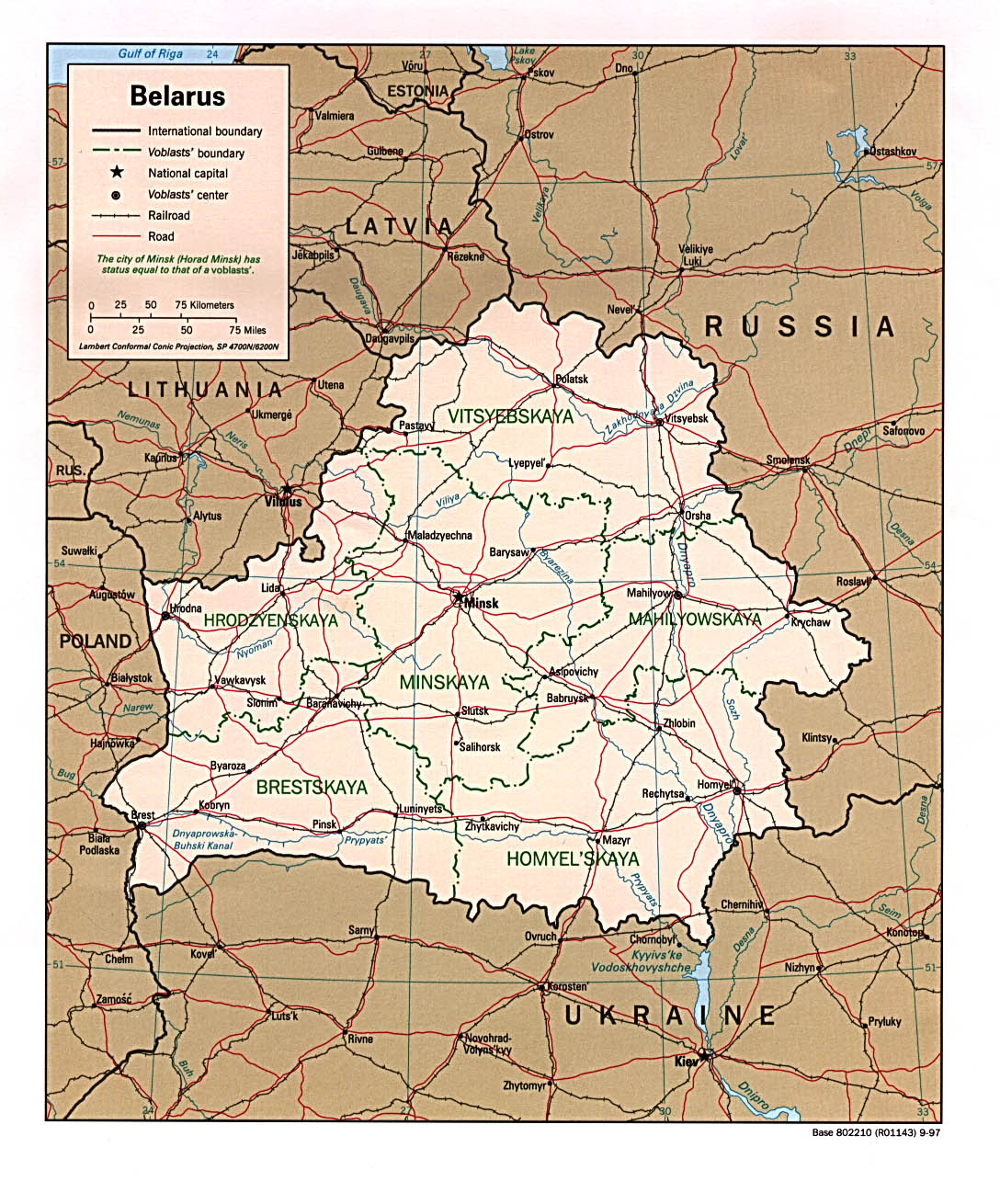
Mogilev, or Mahilyow,Template:Efn[1] is a city in eastern Belarus. It is located on the Dnieper River, about Template:Convert from the border with Russia's Smolensk Oblast and Template:Convert from Bryansk Oblast. As of 2025, it has a population of 352,896.[2] In 2011, its population was 360,918,[3] up from an estimated 106,000 in 1956. It serves as the administrative centre of Mogilev Region,[2] and is the third-largest city in Belarus.
Name
The name Mogilev may be derived from Russian mogila (Template:Lit) and lev (Template:Lit); according to folk legend, the city was named after the grave of a young peasant, which was known as the "Tomb of the Lion", and it was around this burial mound that a fortress was built.[4] Its founding has also been linked to Galician prince Lev Danilovich.[5]
History
Template:Stack The city was first mentioned in historical records in 1267. From the 14th century, it was part of the Grand Duchy of Lithuania, and since the Union of Lublin (1569), it has been part of the Polish–Lithuanian Commonwealth, where it became known as Mohylew. In the 16th and 17th centuries, the city flourished as one of the main nodes of the east-west and north-south trading routes.
In 1577, Grand Duke Stefan Batory granted it city rights under Magdeburg law. In 1654, during the Russo-Polish War (1654–1667), the townsmen negotiated a treaty of surrender to the Russians peacefully, if the Jews were to be expelled and their property divided up among Mogilev's inhabitants. Tsar Aleksei Mikhailovitch agreed to their proposal. However, instead of expelling the Jews, the Russian troops massacred them after they had led them to the outskirts of the town.[6] During this war, the city was besieged twice by the Lithuanian army: in 1655, and Template:Ill. In 1661, residents started Template:Ill against the Russian military occupation. The city was set afire by Peter the Great's forces in 1708, during the Great Northern War.[7] After the First Partition of Poland in 1772, Mogilev became part of the Russian Empire and became the centre of the Mogilev Governorate.
In the years 1915–1917, during World War I, the Stavka, the headquarters of the Russian Imperial Army, was based in the city [8] and the Tsar, Nicholas II, spent long periods there as Commander-in-Chief.[9][10]
Following the Russian Revolution, in 1918, the city was briefly occupied by Germany and placed under their short-lived Belarusian People's Republic. In 1919, Mogilev was captured by the forces of Soviet Russia and incorporated into the Byelorussian SSR. Up to World War II and the Holocaust, like many other cities in Europe, Mogilev had a significant Jewish population: according to the Russian census of 1897, out of the total population of 41,100, 21,500 were Jews (i.e. over 50 percent).[11] In 1938 the leadership of Soviet Belarus decided to move the capital of the country from Minsk to Mogilev because Minsk was too close to the then-Polish-Soviet border. Due to that, the now-Template:Ill was built in 1938–1940 to be the government building. It was designed to resemble the Minsk Government building.

During Operation Barbarossa, the city was conquered by Wehrmacht forces on 26 July 1941 and remained under German occupation until 28 June 1944.[12] Mogilev became the official residence of High SS and police leader (HSSPF) Erich von dem Bach. During that period, the Jews of Mogilev were ghettoized and systematically murdered by Ordnungspolizei and SS personnel.[13] Heinrich Himmler personally witnessed the executions of 279 Jews on 23 October 1941. Later that month, several mentally disabled patients were poisoned with car exhaust fumes as an experiment; the method of killing was thereafter applied in several Nazi extermination camps. Initial plans for establishing a death camp in Mogilev were abandoned in favour of Maly Trostenets.
In 1944, with the Mogilev offensive, the devastated city was liberated by the Red Army and returned to Soviet control. Mogilev then was the site of a labour camp for German POW soldiers.
Since Belarus gained its independence in 1991, Mogilev has remained one of its principal cities.
Demographics
Template:Historical populations
Religion
Mohilev was the episcopal see of the Latin Catholic Archdiocese of Mohilev until its 1991 merger into the Roman Catholic Archdiocese of Minsk-Mohilev.
It remains the see of the Eparchy (Eastern diocese) of Mogilev and Mstsislaw in the Belarusian Exarchate of the Russian Orthodox Church. Script error: No such module "labelled list hatnote".
Economy
After World War II, a huge metallurgy centre with several major steel mills was built. Also, several major factories of cranes, cars, tractors and a chemical plant were established. By the 1950s, tanning was Mogilev's principal industry, and it was a major trading centre for cereal, leather, salt, sugar, fish, timber and flint: the city has been home to a major inland port on the Dnieper river since and an airport since. Since the fall of the Soviet Union and the establishment of Belarus as an independent country, Mogilev has become one of that country's main economic and industrial centres.[14]
Cityscape
The town's most notable landmark is the late 17th-century town hall, named the Ratuša (Rathaus), that was built during the times of the Polish–Lithuanian Commonwealth. The grand tower of the town hall sustained serious damage during the Great Northern War and the Great Patriotic War. It was eventually demolished in 1957 and rebuilt in its pre-war form in 2008.
Another important landmark of Mogilev is the six-pillared St. Stanisław's Catholic Cathedral, built in the Baroque style between 1738 and 1752 and distinguished by its frescoes. It became the episcopal see of the Archdiocese of Mohilev (created in 1772, archdiocese after 1782), once (until 1991) the largest Catholic diocese of the world. Now it's the co-cathedral of the Archdiocese of Minsk-Mohilev.
The convent of St. Nicholas preserves its magnificent cathedral of 1668, as well as the original iconostasis, bell tower, walls, and gates. It is currently under consideration to become a UNESCO World Heritage site.[15]
Minor landmarks include the archiepiscopal palace and memorial arch, both dating from the 1780s, and the enormous theater in a blend of the Neo-Renaissance and Russian Revival styles.
At Polykovichi, an urban part of Mogilev, there is a Template:Convert guyed TV mast, one of the tallest structures in Belarus.
-
The Convent of St. NicholasScript error: No such module "Check for unknown parameters".
-
Church of the Three Holy HierarchsScript error: No such module "Check for unknown parameters".

.jpg)
Geography
Climate
Mogilev has a warm-summer humid continental climate (Köppen climate classification Dfb) with warm summers and cold winters. Template:Weather box
Notable citizens

- Rita Achkina, cross country skier
- Matest M. Agrest, ethnologist and mathematician
- Modest Altschuler, orchestra conductor
- Abe Anellis, microbiologist
- Olga Bogdanova, chemist
- Kanstancin Dziubajla (nom de guerre "Dranik") (1988–2022), Belarusian volunteer killed in action defending Ukraine during the 2022 Russian invasion[16]
- Petr Elfimov, musician
- Svetlana Baitova, gymnast
- Ihar Hershankou, serial killer
- Alyona Lanskaya, singer
- Eugenia Logvinovna Lashnyukova, nun
- Joseph Lookstein, Rabbi and President of Bar-Ilan University
- Leonid Isaakovich Mandelshtam, physicist
- Andrey Melnikov, soldier and recipient of Hero of the Soviet Union award
- Andrej Mryj, satirical writer, journalist, translator and a victim of Stalin's purges
- Ivan Nasovič, author of the first Belarusian dictionary
- Stanisław Julian Ostroróg, Polish count, Crimean War veteran, noted Victorian Photographic portraitist, naturalised British subject
- David Pinski, Yiddish playwright
- Simeon Piščević, major-general and governor of Mogilev (1777)
- Lev Polugaevsky, International Grandmaster of chess
- Leo Rogin, Economist and Writer
- Otto Schmidt, scientist, mathematician, astronomer, geophysicist, statesman, academician
- Issai Schur, mathematician
- Spiridon Sobol, Belarusian enlightener and printer; published the first ABC-book in Belarus in 1631
- Mikałaj Sudziłoŭski, revolutionary and scientist
- Sergey Evtuhov (born 1953), painter
Sports
_-_panoramio.jpg)
City sports teams:
- Football: FC Torpedo Mogilev,[17] FC Dnepr Mogilev and ZhFC Dnepr Mogilev, Nadezhda Mogilev
- Hockey: HK Mogilev
- Volleyball: Mogilev Lions, Kommunalnik
- Handball: Masheka
- Basketball: BC Borisfen
Twin towns – sister cities
Script error: No such module "Labelled list hatnote". Mogilev is twinned with:[18] Template:Div col
- Template:Flagicon Al Rayyan, Qatar
- Template:Flagicon Bursa, Turkey
- Template:Flagicon Changsha, China[19]
- Template:Flagicon Eisenach, Germany
- Template:Flagicon Gabrovo, Bulgaria
- Template:Flagicon Kerch, Ukraine
- Template:Flagicon Kragujevac, Serbia
- Template:Flagicon Mykolaiv, Ukraine
- Template:Flagicon Nanjing, China
- Template:Flagicon Penza, Russia
- Template:Flagicon Sokolinaya Gora (Moscow), Russia
- Template:Flagicon Sumgait, Azerbaijan
- Template:Flagicon Tabriz, Iran
- Template:Flagicon Tula, Russia
- Template:Flagicon Villeurbanne, France
- Template:Flagicon Wittenberg, Germany
- Template:Flagicon Pivdenne, Ukraine
- Template:Flagicon Zhengzhou, China
- Template:Flagicon Zvenigorod, Russia
Notes
References
External links
Template:Sister project Template:Sister project
- Mogilev city executive committee
- Photos on Radzima.org
- Historic images of Mogilev
- Mogilev Jewish Center Template:Webarchive
- Jewish Encyclopedia on Moghilef (Mohilev)
- Template:Cite EB1911
- The murder of the Jews of Mogilev during World War II, at Yad Vashem website
- Template:JewishGen-LocalityPage
- City and regional maps of Mogilev
- Zoomable map of Mogilev and Belarus -> In page click КАРТЫ in middle
- Overview map of roads and railways
- General overview of Baltics, Belarus and east-europe
- Belarus, topographic map
- Script error: No such module "citation/CS1".
- General detail, downloadable PDF map of Belarus
Template:Belarus Seats Script error: No such module "Navbox". Template:Authority control
- ↑ Назвы населеных пунктаў Рэспублікі Беларусь: Магілёўская вобласць: нарматыўны даведнік / І. А. Гапоненка і інш.; пад рэд. Template:Ill. — Мн.: Тэхналогія, 2007. — 406 с. — Template:ISBN. (DJVU) Template:In lang
- ↑ a b Cite error: Invalid
<ref>tag; no text was provided for refs namedpop - ↑ Script error: No such module "Citation/CS1".
- ↑ Script error: No such module "citation/CS1".
- ↑ Template:Cite Efron
- ↑ Script error: No such module "citation/CS1".
- ↑ Script error: No such module "citation/CS1".
- ↑ Preclík, Vratislav. Masaryk a legie (Masaryk and legions), váz. kniha, 219 pages, first issue vydalo nakladatelství Paris Karviná, Žižkova 2379 (734 01 Karvina, Czech Republic) ve spolupráci s Masarykovým demokratickým hnutím (Masaryk Democratic Movement, Prague), 2019, Template:ISBN, pages 36–39, 41–42, 111–112, 124–125, 128, 129, 132, 140–148, 184–199.
- ↑ Script error: No such module "citation/CS1".
- ↑ Script error: No such module "citation/CS1".
- ↑ Script error: No such module "citation/CS1".
- ↑ Script error: No such module "citation/CS1".
- ↑ Script error: No such module "citation/CS1".
- ↑ Script error: No such module "citation/CS1".
- ↑ Script error: No such module "citation/CS1".
- ↑ Script error: No such module "citation/CS1".
- ↑ Script error: No such module "citation/CS1".
- ↑ Script error: No such module "citation/CS1".
- ↑ Script error: No such module "citation/CS1".