Zif, Hebron
Script error: No such module "Settlement short description".Script error: No such module "Infobox".Template:Template otherScript error: No such module "Check for unknown parameters".Script error: No such module "Check for conflicting parameters".Expression error: Unexpected < operator.
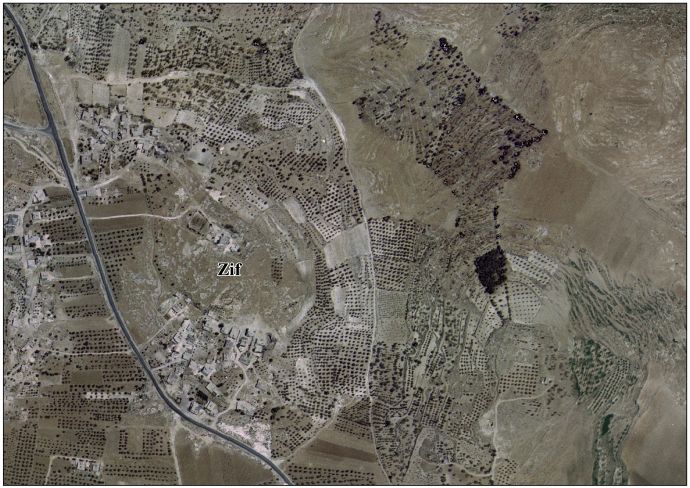
Zif (Template:Langx) is a Palestinian village located Script error: No such module "convert". south of Hebron. The village is in the Hebron Governorate in the southern West Bank. According to the Palestinian Central Bureau of Statistics, Zif had a population of 1,061 in 2017.[1]
History
Tell Ziph near Zif has been identified as the site of ancient Ziph.[2]
Iron Age
Hebrew Bible
Zif is identified with the biblical town of Ziph.[3][4] It appears several times in the Hebrew Bible as a town in the vicinity of Hebron that belongs to Tribe of Judah (Script error: No such module "Bibleverse".). The nearby "Wilderness of Ziph" is mentioned as a place where David hides himself from Saul (Script error: No such module "Bibleverse".). Later, the town of Ziph is said to be fortified by Rehoboam (Script error: No such module "Bibleverse".). Its name was found on a number of royal Judahite LMLK seals along with those of Hebron, Socoh and MMST.[5]
Archaeology
Iron Age remains were found at Tell Ziph, the nearby tell.[6]
Roman and Byzantine periods
Zif existed as a village in the Roman period.[7] Between the Great Jewish Revolt and the Bar Kokhba revolt, it served as the administrative center for the district south of Hebron. Evidence of its Jewish population during this period is found in an inscription on an ossuary from Zif and two documents discovered in the Tze'elim Stream.[8]
In the 4th century, Eusebius described it a place "of the tribe of Judah. It is now a kṓmē in the Daromas in the territory of Eleutheropolis, near Hebron, eight miles to the south. Where David hid".[9] It had a Jewish population until at least the 4th century, but it became Christian during the Byzantine period.[8]
The remains of a Byzantine-era Christian communal church have been discovered at Zif.[2][10] Potsherds from the Byzantine period have also been found here.[11]
Ottoman period
In 1838, Edward Robinson was the first to identify the village Zif and its adjacent Tell Zif with the biblical town of Ziph.[12]
In 1863, Victor Guérin visited and described the ruins.[13]
In 1874, surveyors from the PEF Survey of Palestine visited, and noted about Tell ez Zif: "A large mound, partly natural; on the north side a quarry; on the south are tombs. One of these has a single chamber, with a broad bench running round; on the back wall are three kokim with arched roofs, the arches pointed on the left side wall; at the back is another similar koka. A second tomb was a chamber, 8 feet to the back, 9 feet wide, with three recesses, one on each side, one at the back; they are merely shelves, 8 feet by 5 feet, raised some 2 feet. This tomb has a porch in front, supported by two square rock-cut piers."[14]
1967 and aftermath
In September 2002, a bomb filled with screws and nails, planted by Jewish settlers, exploded in the village's school, wounding five children. A second bomb was found by the school's principal and was detonated by Israeli bomb experts.[15]
Current status
Zif has been under Israeli occupation since 1967. The primary health care facilities in the village itself are designated by the Ministry of Health as level 1 and at nearby Yatta as level 3.Script error: No such module "Unsubst".[16]
References
<templatestyles src="Reflist/styles.css" />
- ↑ Cite error: Script error: No such module "Namespace detect".Script error: No such module "Namespace detect".
- ↑ a b 14539 - ZIPH - Church. A Digital Corpus of Early Christian Churches and Monasteries in the Holy Land. The Hebrew University of Jerusalem. Retrieved 30 Jan 2025.
- ↑ Script error: No such module "citation/CS1".
- ↑ Script error: No such module "Citation/CS1".
- ↑ Script error: No such module "citation/CS1".
- ↑ Script error: No such module "Citation/CS1".
- ↑ Tsafrir et al. (1994), p. 262.
- ↑ a b Magness, 2003, p. 94
- ↑ Script error: No such module "citation/CS1".
- ↑ Bar, Doron "The Christianisation of Rural Palestine during Late Antiquity". Journal of Ecclesiastical History, Vol. 54, No. 3 July 2003. pp. 401-421, 413.
- ↑ Dauphin (1998), p. 962.
- ↑ Robinson and Smith, 1841, vol 2, pp. 191, 195, 200
- ↑ Guérin, 1869, pp. 160-162
- ↑ Conder and Kitchener, 1883, SWP III, p. 379
- ↑ Script error: No such module "citation/CS1".
- ↑ Script error: No such module "citation/CS1".
Script error: No such module "Check for unknown parameters".
Bibliography
<templatestyles src="Refbegin/styles.css" />
- Script error: No such module "citation/CS1". (p. 315)
- Script error: No such module "citation/CS1".
- Script error: No such module "citation/CS1".
- Script error: No such module "citation/CS1".
- Script error: No such module "citation/CS1". (p. 408)
- Script error: No such module "citation/CS1".
- Script error: No such module "citation/CS1".
External links
- Zif Village | قرية زيف on Facebook
- Zif Village (Fact Sheet), Applied Research Institute–Jerusalem, ARIJ
- Zif Village Profile, ARIJ
- Zif aerial photo, ARIJ
- The priorities and needs for development in Zif village based on the community and local authorities’ assessment, ARIJ
- Survey of Western Palestine, Map 21: IAA, Wikimedia commons

Script error: No such module "Navbox". Template:Authority control