Wanda Gág
Template:Short description Template:Use mdy dates Script error: No such module "Infobox".Template:Template otherScript error: No such module "Check for unknown parameters".
Wanda Hazel Gág (Template:IPAc-en Script error: No such module "Respell".; March 11, 1893 – June 27, 1946) was an American artist, author, translator, and illustrator. She is best known for writing and illustrating the children's book Millions of Cats, the oldest American picture book still in print.[1] Gág was also a noted print-maker, receiving international recognition and awards.Template:Sfn Growing Pains, a book of excerpts from the diaries of her teen and young adult years, received widespread critical acclaim.[2] Two of her books were awarded Newbery Honors and two received Caldecott Honors. The New York Public Library included Millions of Cats on its 2013 list of 100 Great Children's Books.[3]
Early years

Wanda Hazel Gág was born March 11, 1893, in the German-speaking community of New Ulm, Minnesota,[4] to Elisabeth (Template:Nee Biebl) Gag and the artist and photographer Anton Gag. The eldest of seven siblings, Wanda was 15 when her father died of tuberculosis.Template:Sfn His final words to her were: "Script error: No such module "Lang"." (Template:Translation)Template:Sfn
Following his death, the family was on welfare and some townspeople thought that Wanda should quit high school and get a steady job to help support her family. Despite this pressure, Wanda continued with her high school education. While still a teenager her illustrated story Robby Bobby in Mother Goose Land was published in The Minneapolis Journal in their Junior Journal supplement.Template:Sfn After graduating in June 1912, she taught country school in Springfield, Minnesota, from November 1912 to June 1913.Template:Sfn
Art school
In 1913, Gág began a platonic relationship with University of Minnesota medical student Edgar T. Herrmann who exposed her to new ideas in art, politics and philosophy.Template:Sfn With a scholarship (and the aid of friends), she attended The Saint Paul School of Art in 1913 and 1914.Template:Sfn From 1914 to 1917 she attended The Minneapolis School of Art under the patronage of Herschel V. Jones.Template:SfnTemplate:Sfn While there, she became friends with Harry Gottlieb and Adolf Dehn.[5] Her first illustrated book commission (as Wanda Gäg) was A Child’s Book of Folk-Lore— Mechanics of Written English by Jean Sherwood Rankin (1917).[6]

New York
In 1917, Gág won a scholarship to the Art Students League of New YorkTemplate:Sfn where she took classes in composition, etching and advertising illustration. By 1919, Gág was earning her living as a commercial illustrator.Template:Sfn
During her time in New York she became a member of the Society of American Graphic Artists. In 1921, she became a partner in a business venture called Happiwork Story Boxes. The boxes were decorated with story panels on its sides.Template:Sfn

An illustration of Gág's was published in Broom: An International Magazine of the Arts in 1921.[7] Gág's art exhibition in the New York Public Library in 1923 was her first solo show. She began signing her name "Gág" around this time.Template:Sfn
In 1924, Gág's work was published in a short-lived folio-style magazine with artist William Gropper.Template:Sfn In 1925 she created a series of illustrated crossword puzzles for children that was syndicated in several newspapers.Template:Sfn She began to sell her lithographs, linoleum block prints, water colors and drawings through the Weyhe Gallery where she had developed a relationship with its manager, Carl Zigrosser.Template:SfnTemplate:Sfn[8] Gág's one-woman-show there in 1927 led to her acclamation as "… one of America’s most promising young graphic artists… " Template:Sfn
In 1927, her article These Modern Women: A Hotbed of Feminists was published in The Nation, drawing the attention of Alfred Stieglitz and prompting Egmont Arens to write: "The way you solved that problem (her relationship with men) seems to me to be the most illuminating part of your career. You have done what all the other ‘modern women’ are still talking about."Template:SfnTemplate:Sfn Gág’s illustrations were published on the covers of the leftist magazines The New Masses and The Liberator.Template:Sfn[9]

In a 1929 New York Times review, Elisabeth Luther Cary described Gág's print Stone Crusher: "Pure imagination leaps out from dusky shadows and terrifies with light, an emotional source difficult to analyze."[10]
For a 1934 auction organized by Langston Hughes to raise funds for the defense of the Scottsboro Boys, Gág contributed an original drawing from ABC Bunny, "'F' is for Frog."[11][12]
Her work was recognized internationally and was selected for inclusion in the American Institute of Graphic Arts Fifty Prints of the Year in 1928, 1929, 1931, 1932, 1936, 1937 and 1938.Template:Sfn Her work was featured in exhibitions at The Whitney Museum of American Art in 1934, 1936, 1938, 1939, 1940, and 1941.[13] In 1939 Gág's work was shown at The Museum of Modern Art exhibition Art in Our Time and at the New York World's Fair American Art Today show.Template:Sfn
Works for children

In 1927 Gág's illustrated story Bunny's Easter Egg was published in John Martin's Book, a magazine for children.[14] Gág's work caught the attention of Ernestine Evans, director of Coward-McCann's children's book division. Evans was delighted to learn that Gág had children's stories and illustrations in her folio and asked her to submit her own story with illustrations. The result, Millions of Cats, had been developed from a story that Gág had written to entertain the children of friends. It was published in 1928.Template:Sfn Anne Carroll Moore wrote:
"It bears all the hallmarks of becoming a perennial favorite among children, and it takes a place of its own, both for the originality and strength of its pictures and the living folk-tale quality of its text. A book of universal interest to children living anywhere in the world… A kinship with all children made her respect their intelligence, and gave them at once ease and joy in her company. With as sure an instinct for the right word for the ear, as for the right line for the eye, Wanda Gág became quite unconsciously a regenerative force in the field of children's books."[15][16]
Millions of Cats won a Newbery Honor award in 1929, one of the few picture books to do so. It is the oldest American picture book still in print.[17] It entered the public domain in the United States in 2024.[18]
In 1935 Gág published the "proto-feminist" Gone is Gone; or, the Story of a Man Who Wanted to Do Housework.[19]
To encourage the reading of fairy-tales, Gág translated and illustrated Tales from Grimm in 1936. English critic Humbert Wolfe, commenting on Gág's translation, wrote: "From the very first page it was clear that Miss Gág was chopping away a perfect brushwood of clumsy phraseology to let in the light."[20] Two years later she translated and illustrated the Grimm story Snow White and the Seven Dwarfs in reaction to the "trivialized, sterilized, and sentimentalized" Disney movie version.Template:Sfn Her essay I Like Fairy Tales was published in the March 1939 issue of The Horn Book Magazine. More Tales from Grimm was published posthumously in 1947. Four of her translated fairy tales were later released with illustrations by Margot Tomes.
Personal life
Gág enjoyed living and working in the country. In the early 1920s she spent summers drawing at various locations in rural New York and Connecticut.Template:Sfn She rented a three-acre farm called "Tumble Timbers" in Glen Gardner, New Jersey, from 1925 to 1930. In 1931 she bought a larger farm she named "All Creation" in Milford, New Jersey.Template:Sfn[21] Two of her siblings, Template:Ill and Howard, lived there with her.[22]
Gág's brother Howard contributed the hand lettering in Millions of Cats and The ABC Bunny.Template:Sfn[23] Gág encouraged her sister Flavia to create illustrated books for children.Template:Sfn
In addition to Earle Humphreys (her long-time paramour and business manager), Gág had, sometimes concurrently, other lovers: Adolph Dehn, Lewis Gannett, Carl Zigrosser, and Dr. Hugh Darby. She married Humphreys on August 27, 1943.Template:Sfn
Gág died from lung cancer in New York City, aged 53, on June 27, 1946.Template:Sfn
Legacy
Memorials

Gág was honored by The Horn Book Magazine in a tribute issue in 1947.[24] Her childhood home in New Ulm, Minnesota has been restored and is now the Wanda Gág House, a museum that offers tours and educational programs.[25]

In 1992, Millions of Cats was featured on the television series Shelley Duvall's Bedtime Stories, narrated by James Earl Jones.[26] A bronze sculpture of Gág (with one of her cats) by Jason Jaspersen was erected at the public library of New Ulm, Minnesota, in 2016.[27][28] In 2017 The Sandbox Theatre in Minneapolis produced In The Treetops, a new play that focused on Gág's childhood years.[29]
Awards
The books Millions of Cats and The ABC Bunny were recipients of a Newbery Honor.[30] Both Snow White and the Seven Dwarfs and Nothing at All received a Caldecott Honor.[31]
Wanda Gág was posthumously honored with The Lewis Carroll Shelf Award in 1958,[32] and the Kerlan Award in 1977.[33]
In 2018, Gág was posthumously honored with the Original Art Lifetime Achievement Award from the Society of Illustrators.[34][35]
The Wanda Gág Read Aloud Book Award is awarded each year by the Minnesota State University Moorhead.[36]
Archives
Gág's prints, drawings, and watercolors are in the collections of The Minneapolis Institute of Arts,[37] The Whitney Museum,[38] The Museum of Modern Art,[39] The Philadelphia Museum of Art,[40] and other museums around the world. Gág's papers, manuscripts and matrices are held in the Kerlan Collection[41] at the University of Minnesota, The New York Public Library, The Free Library of Philadelphia, The Kislak Collection at the University of Pennsylvania Libraries,[42] and the Minneapolis Institute of Art.Template:Sfn
Exhibitions
The Whitney Museum presented a small retrospective (18 prints and two books) of her work, March through December 2024.[43][44]
Works
Books
Writer and illustrator:
- Batiking at Home: a Handbook for Beginners, Coward McCann, 1926
- Millions of Cats, Coward McCann, 1928
- The Funny Thing, Coward McCann, 1929
- Snippy and Snappy, Coward McCann, 1931
- Wanda Gág’s Storybook (includes Millions of Cats, The Funny Thing, Snippy and Snappy), Coward McCann, 1932
- The ABC Bunny, Coward McCann, 1933
- Gone is Gone; or, the Story of a Man Who Wanted to Do Housework, Coward McCann, 1935
- Growing Pains: Diaries and Drawings for the Years 1908–1917, Coward McCann, 1940
- Nothing At All, Coward McCann, 1941
Translator and illustrator:
- Tales from Grimm, Coward McCann, 1936
- Snow White and the Seven Dwarfs, Coward McCann, 1938
- Three Gay Tales from Grimm, Coward McCann, 1943
- More Tales from Grimm, Coward McCann, 1947
Illustrator only:
- A Child’s Book of Folk-Lore— Mechanics of Written English, by Jean Sherwood Rankin, Augsburg, 1917
- The Oak by the Waters of Rowan, by Spencer Kellogg Jr, Aries Press, New York, 1927
- The Day of Doom, by Michael Wigglesworth, Spiral Press, 1929
- Pond Image and Other Poems, by Johan Egilsrud, Lund Press, Minneapolis, 1943
Translator only:
- The Six Swans, illustrations by Margot Tomes, Coward, McCann & Geoghegan, 1974
- Wanda Gág's Jorinda and Joringel, illustrations by Margot Tomes, Putnam, 1978
- Wanda Gag's the Sorcerer's Apprentice illustrations by Margot Tomes, Putnam, 1979
- Wanda Gag's The Earth Gnome, illustrations by Margot Tomes, Putnam, 1985
- The Sweet Porridge, illustrations by Jill McDonald [et al.], Methuen Educational, 1966.
Selected prints
- Airtight Stove, 1933
- Backyard Corner, 1930
- Evening, 1929
- The Forge, 1932.
- Gumbo Lane, c. 1928
- Macy’s Stairway, 1940–41
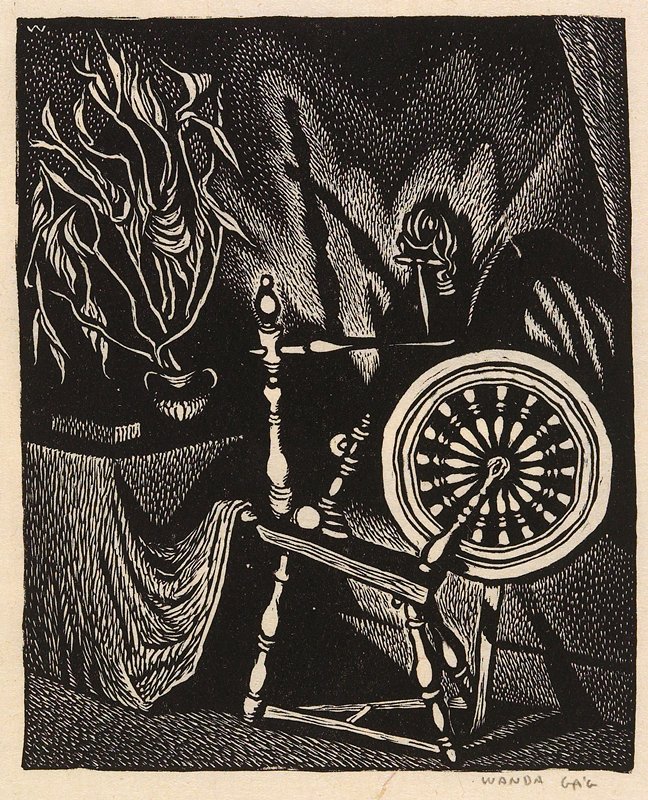
- Spinning Wheel, 1927
- Ploughed Fields, 1936
- Winter Garden, 1936


References
<templatestyles src="Reflist/styles.css" />
- ↑ Gregory, Alice. "Juicy As a Pear: Wanda Gág's Delectable Books". The New Yorker, April 24, 2014.
- ↑ Hoyle, Karen Nelson, "Introduction", in Script error: No such module "Footnotes".
- ↑ Script error: No such module "citation/CS1".
- ↑ Script error: No such module "citation/CS1".
- ↑ Script error: No such module "citation/CS1".
- ↑ Script error: No such module "citation/CS1".
- ↑ Script error: No such module "Citation/CS1".
- ↑ Script error: No such module "Citation/CS1".
- ↑ Script error: No such module "citation/CS1".
- ↑ Script error: No such module "citation/CS1".
- ↑ Script error: No such module "citation/CS1".
- ↑ Script error: No such module "citation/CS1".
- ↑ Script error: No such module "citation/CS1".
- ↑ Script error: No such module "Citation/CS1".Template:Pages needed
- ↑ Millions of Cats dust jacket, second edition, 1928
- ↑ Script error: No such module "citation/CS1".
- ↑ Script error: No such module "citation/CS1".
- ↑ Script error: No such module "citation/CS1".
- ↑ Script error: No such module "citation/CS1".
- ↑ Script error: No such module "citation/CS1".
- ↑ Script error: No such module "citation/CS1".
- ↑ Script error: No such module "Citation/CS1".
- ↑ Script error: No such module "citation/CS1".
- ↑ Script error: No such module "Citation/CS1".
- ↑ Wanda Gág House, accessed June 2012
- ↑ Script error: No such module "citation/CS1".
- ↑ Script error: No such module "citation/CS1".
- ↑ Script error: No such module "citation/CS1".
- ↑ Script error: No such module "citation/CS1".
- ↑ Script error: No such module "citation/CS1".
- ↑ Script error: No such module "citation/CS1".
- ↑ Script error: No such module "Citation/CS1".
- ↑ Script error: No such module "citation/CS1".
- ↑ Script error: No such module "citation/CS1".
- ↑ Script error: No such module "citation/CS1".
- ↑ Script error: No such module "citation/CS1".
- ↑ Script error: No such module "citation/CS1".
- ↑ Script error: No such module "citation/CS1".
- ↑ Script error: No such module "citation/CS1".
- ↑ Script error: No such module "citation/CS1".
- ↑ Script error: No such module "citation/CS1".
- ↑ Script error: No such module "citation/CS1".
- ↑ Script error: No such module "citation/CS1".
- ↑ Script error: No such module "citation/CS1".
Script error: No such module "Check for unknown parameters".
Sources
<templatestyles src="Refbegin/styles.css" />
- Script error: No such module "Citation/CS1".
- Script error: No such module "citation/CS1".
- Script error: No such module "citation/CS1".
- Script error: No such module "citation/CS1".
- Script error: No such module "citation/CS1".
- Script error: No such module "citation/CS1".
- Script error: No such module "citation/CS1".
- Script error: No such module "citation/CS1".
- Script error: No such module "citation/CS1".
Further reading
- Script error: No such module "citation/CS1".
External links
Template:Sister project Template:Wikisource/outer coreScript error: No such module "Check for unknown parameters". Template:Library resources box
- Template:FadedPage
- Wanda Gág in MNopedia, the Minnesota Encyclopedia
- Works by Wanda Gág, National Gallery of Art
- Wanda Gág – Rights and Restrictions Information (Prints and Photographs Reading Room, Library of Congress)
- Wanda Gág House
- Collection summary to the Wanda Gág Papers at the University of Minnesota Libraries Children's Literature Research Collections
- Finding aid to the Wanda Gág papers at the University of Pennsylvania Libraries
- Finding aid to the Wanda Gág papers Template:Webarchive at Penn State University's Special Collections Library
- Template:LCAuth
- Overview of Wanda Gag archives at University of Minnesota Kerlan Collection, All About Kids! TV Series #259 (1998)
- Pages with script errors
- Pages with broken file links
- 1893 births
- 1946 deaths
- 20th-century American illustrators
- 20th-century American painters
- 20th-century American printmakers
- 20th-century American women artists
- American children's book illustrators
- American children's writers
- American fantasy artists
- American people of Czech descent
- American women children's writers
- American women children's book illustrators
- American women printmakers
- Artists from Minnesota
- Deaths from lung cancer in New York (state)
- Illustrators of fairy tales
- Newbery Honor winners
- People from New Ulm, Minnesota
- Writers from Minnesota
- Writers from New Jersey