Umm al-Faraj
Template:Pp-extended Script error: No such module "Settlement short description".Script error: No such module "Infobox".Template:Template otherScript error: No such module "Check for unknown parameters".Script error: No such module "Check for conflicting parameters".Expression error: Unexpected < operator. Umm al-Faraj (Template:Langx, known to the Crusaders as La Fierge), was a Palestinian village, depopulated in 1948.
Location
The village was situated on a flat spot in the Acre plain, Script error: No such module "convert". northeast of Acre.[1]
History
Archaeological remains from the Roman and Byzantine eras have been found here.[2]
Sugar Moulds found here indicate that sugar productions started in the 11th century, under the Fatimid era.[2]
Crusader/Mamluk era
The village was known to the Crusaders as Le Fierge, and belonged to the fief of Casal Imbert.[1] In 1253 King Henry granted the whole estate of Casal Imbert, including Le Fierge, to John of Ibelin.[3][4] Shortly after, in 1256, John of Ibelin leased Az-Zeeb and all its depending villages (including Le Fierge) to the Teutonic Order for 10 years.[5] In 1261, Az-Zeeb, together with Le Fierge and Le Quiebre, were sold to the Teutonic Order, in return for an annual sum for as long as Acre was in Christian hands.[6] In 1283 it was still a part of the Crusader states, as it was mentioned as part of their domain in the hudna between the Crusaders based in Acre and the Mamluk sultan Qalawun.[7][8]
According to al-Maqrizi, it had come under Mamluk rule in 1291, when it was mentioned under the name of Farah when sultan al-Ashraf Khalil allocated the village's income to a Waqf in Cairo.[9][10]
Sugar production continued here during the Crusader and Mamluk eras.[2]
Ottoman era
Incorporated into the Ottoman Empire in 1517 with all of Palestine, it appeared in the 1596 tax registers as Farja, being in the Akka Nahiya (Subdistrict of Acre), part of the Safad Sanjak (District of Safed), with a population of 24 households and 13 bachelors, all Muslim. The villagers paid a fixed tax rate of 20% on agricultural products, including wheat, barley, summer crops, cotton, goats and beehives, in addition to "occasional revenues" and a water mill; a total of 1,576 akçe. Half of the revenues were given to a waqf.[11][12][13] Sugar production continued here to the beginning of the seventeenth century CE.[2]
In 1799, the village was called El Fargi on the map of Pierre Jacotin.[14] An inscription in marble, built into the wall above the gate of the village mosque, dates this building to 1254 H, (1838-39 C.E.).[15]
In May 1875, the French explorer Victor Guérin visited the village. He described it as being surrounded by "delightful" gardens, irrigated with water from Nahr al-Mafshukh. Many houses were built with great care, and some had old pieces of stone built into them. He further noted that "the location of an old demolished church is still to a certain extent recognisable", and that all the 200 villagers were Muslim.[16] In 1881, the PEF's Survey of Western Palestine described it as being built of stone and with a population of 200. The villagers planted fig, olive, mulberry and pomegranate trees.[17]
A population list from about 1887 showed Um el Ferj to have about 690 inhabitants, all Muslims.[18]
British Mandate era
In the 1922 census of Palestine conducted by the British Mandate authorities Umm al Faraj had a population of 322, all Muslims,[19] increasing in the 1931 census to 415, 2 Christians and 413 Muslims, in a total of 94 houses.[20] The older houses in the village were built close together and formed a circle, while the homes build after 1936 were scattered among the orchards.[1] The population of Umm al-Faraj lived by agriculture.[1]
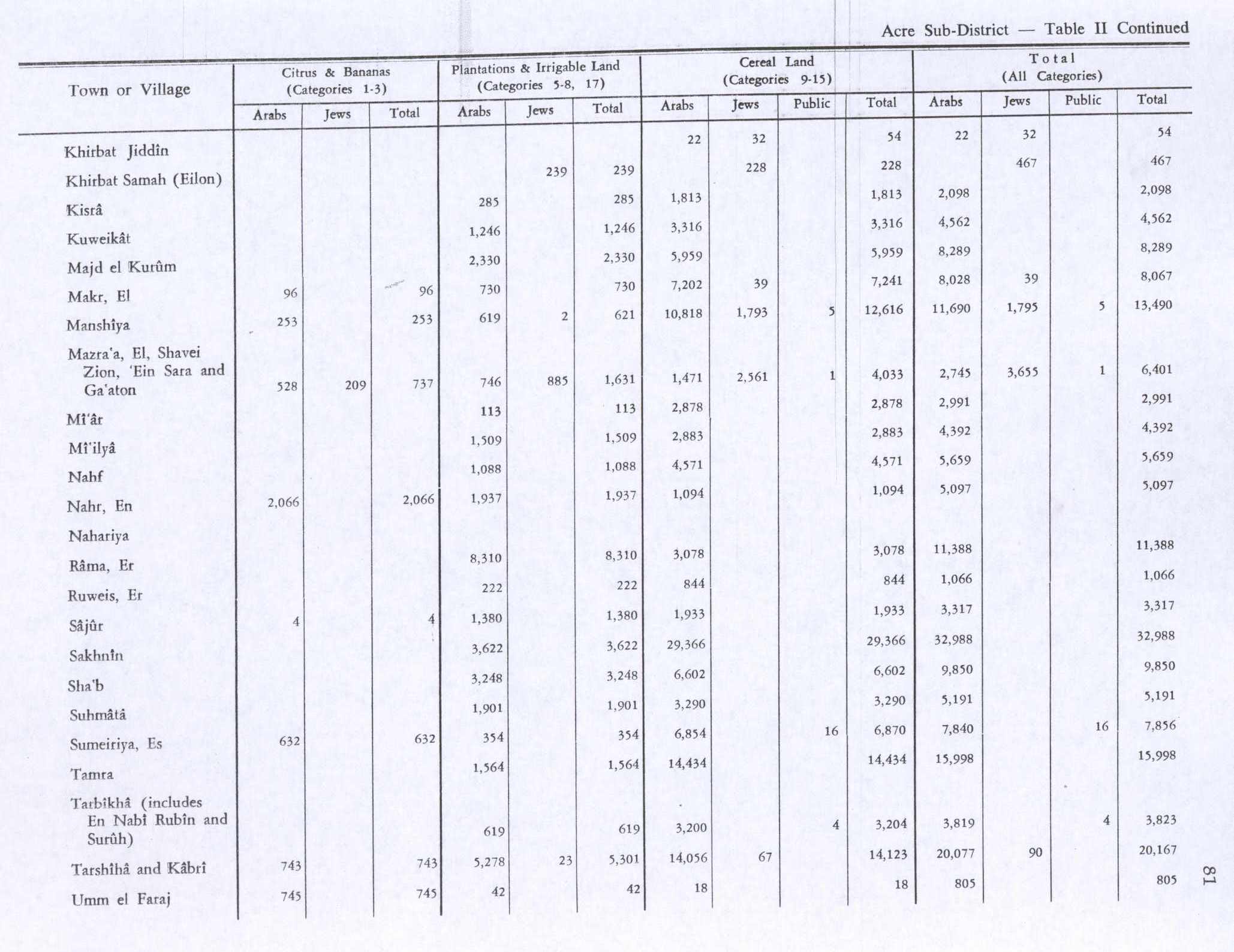
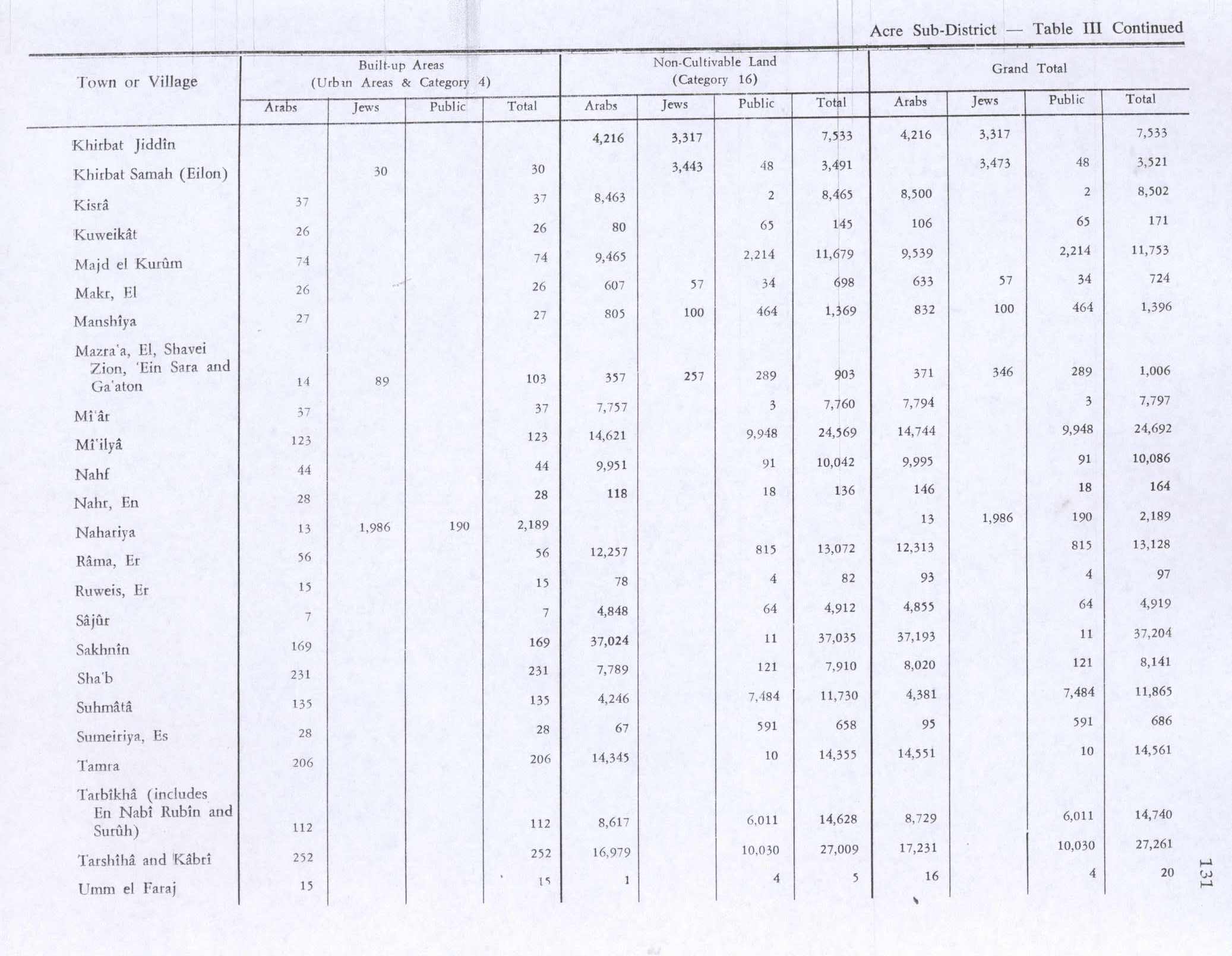
In the 1945 statistics, the population of Umm al-Faraj was 800, all Muslims,[21] with a total land area of 825 dunams.[22] In 1944/45 a total of Script error: No such module "convert". was used for citrus and bananas, Script error: No such module "convert". were used for cereals, Script error: No such module "convert". were irrigated or used for orchards,[1][23] while 15 dunams were built-up (urban) areas.[24]
1948 War and aftermath
Script error: No such module "Labelled list hatnote". During the 1948 Arab-Israeli War, Umm al-Faraj was assaulted by Israel's Carmeli Brigade in the second stage of Operation Ben'Ami. The operational order, issued 19 May 1948, was to "attack with the aim of conquest, the killing of adult males, destruction and torching."[25] The assault came on the 20–21 May 1948, when Carmeli forces attacked Umm al-Faraj together with Kabri, al Tell and Nahar, and then "demolished them," according to Morris.[26]
Following the war the area was incorporated into the State of Israel. The moshav of Ben Ami was established in 1949, in part on village land.[27]
The Palestinian historian Walid Khalidi described the village remains in 1992: "Only the stone mosque remains. It is shut and stands in a state of decay amid tall wild grass. Many trees that might predate the village's destruction can be seen. The nearby lands are cultivated; a banana grove belongs to the Ben Ammi settlement."[27]
See also
References
<templatestyles src="Reflist/styles.css" />
- ↑ a b c d e Khalidi, 1992, p. 34
- ↑ a b c d Getzov, Stern and Shapiro, 2016, Umm al-Faraj (Moshav Ben Ami)
- ↑ Strehlke, 1869, pp. 84-85, No. 105; cited in Röhricht, 1893, RRH, p. 318, No. 1208; cited in Frankel, 1988, p. 264
- ↑ Ellenblum, 2003, p. 68
- ↑ Röhricht, 1893, RRH, p. 328, No. 1250; cited in Frankel, 1988, p. 264
- ↑ Strehlke, 1869, pp. 106-7, No. 119; cited in Röhricht, 1893, RRH, pp. 341-2, No. 1307
- ↑ The al-Qalqashandi version of the hudna, referred in Barag, 1979, p. 204, #24
- ↑ Khamisy, 2014, p. 93, #31
- ↑ al-Maqrizi, 1845, vol 2, p. 131
- ↑ Barag, 1979, p. 203
- ↑ Hütteroth and Abdulfattah, 1977, p. 193, has not identified it
- ↑ Rhode, 1979, p. 77
- ↑ Note that Rhode, 1979, p. 6 Template:Webarchive writes that the register that Hütteroth and Abdulfattah studied was not from 1595/6, but from 1548/9.
- ↑ Karmon, 1960, p. 160 Template:Webarchive
- ↑ Sharon, 1999, pp. 170 -171
- ↑ Guérin, 1880, pp. 45 -46
- ↑ Conder and Kitchener, 1881, SWP I, p.147. Quoted in Khalidi, 1992, p.34
- ↑ Schumacher, 1888, p. 190
- ↑ Barron, 1923, Table XI, Sub-district of Acre, p. 36
- ↑ Mills, 1932, p. 105
- ↑ Cite error: Script error: No such module "Namespace detect".Script error: No such module "Namespace detect".
- ↑ Cite error: Script error: No such module "Namespace detect".Script error: No such module "Namespace detect".
- ↑ Government of Palestine, Department of Statistics. Village Statistics, April, 1945. Quoted in Hadawi, 1970, p. 81
- ↑ Government of Palestine, Department of Statistics. Village Statistics, April, 1945. Quoted in Hadawi, 1970, p. 131
- ↑ Morris, 2004, p. 253, note 727
- ↑ Morris, 2004, pp. 253-254, note 729
- ↑ a b Cite error: Script error: No such module "Namespace detect".Script error: No such module "Namespace detect".
Script error: No such module "Check for unknown parameters".
Bibliography
<templatestyles src="Refbegin/styles.css" />
- Script error: No such module "citation/CS1".
- Script error: No such module "Citation/CS1".
- Script error: No such module "citation/CS1".
- Script error: No such module "citation/CS1".
- Script error: No such module "citation/CS1".(p. 636)
- Script error: No such module "citation/CS1".
- Script error: No such module "citation/CS1". (For future expansion: Chapter 2: Mrs Zamzam in the Rashidieh refugee camp in southern Lebanon recalls Umm al-Faraj)
- Script error: No such module "Citation/CS1".
- Script error: No such module "Citation/CS1".
- Script error: No such module "citation/CS1".
- Script error: No such module "citation/CS1".
- Script error: No such module "citation/CS1".
- Script error: No such module "citation/CS1".
- Script error: No such module "Citation/CS1".
- Script error: No such module "citation/CS1".
- Script error: No such module "Citation/CS1".
- Script error: No such module "citation/CS1".
- Script error: No such module "citation/CS1".
- Script error: No such module "citation/CS1".
- Template:Cite thesis
- Script error: No such module "citation/CS1".
- Script error: No such module "Citation/CS1".
- Script error: No such module "citation/CS1".
- Script error: No such module "citation/CS1".
External links
- Welcome to Umm-al-Faraj
- Umm al-Faraj, Zochrot
- Survey of Western Palestine, Map 3: IAA, Wikimedia commons
- Um Al-Faraj photosTemplate:Category handler[<span title="Script error: No such module "string".">usurped]Script error: No such module "Check for unknown parameters"., from Dr. Moslih Kanaaneh
- Umm Al-Faraj, at Khalil Sakakini Cultural Center

Template:Palestinian Arab villages depopulated during the 1948 Palestine War