Talk:Mehmed VI
<templatestyles src="Module:Message box/tmbox.css"/><templatestyles src="Talk header/styles.css" />
| This is the talk page for discussing improvements to the Mehmed VI Template:Pagetype. This is not a forum for general discussion of the article's subject. |
Article policies
|
| Template:Find general sources |
| Archives: Template:Comma separated entries<templatestyles src="Template:Tooltip/styles.css" />Auto-archiving periodScript error: No such module "Check for unknown parameters".: Template:Human readable duration File:Information icon4.svg |

Script error: No such module "Check for unknown parameters".Script error: No such module "Check for deprecated parameters".
Template:OnThisDay Script error: No such module "Banner shell".
Wrong Statement
I'm sorry, I missed the Mehmeds, Prince Timur is the descendant of Mehmed VI ...
The problem is, that the son of Mehmed VI, (Prince Mehmed Ertogrul) lives in Cairo with a Turkish Woman in Nikah 'urfi marriage.
She was pregnant by him when he got a heart attack and dead, his son was born posthumously, Prince Mehmed Ertogrul was buried in Cairo.
Wrong Statement
He wasn't the 40th Sultan of the Ottoman Empire, he was the 36th. With respect, Deliogul 19:32, 10 August 2006 (UTC)
WikiProject class rating
This article was automatically assessed because at least one article was rated and this bot brought all the other ratings up to at least that level. BetacommandBot 23:44, 27 August 2007 (UTC)
Succession Box
In the succession box at the bottom, for titles in pretense, shouldn't the successor of the title in pretense be listed instead of the fact that the Republic was declared? The fact that the Republic was declared would go into the middle as 'reason for succesion failure.' If anyone has any skills dealing with the succession box, please tell me if I'm correct, thanks. --Sephiroth9611 (talk) 01:40, 25 September 2009 (UTC)
Marriage and issue
What does this even mean? The context seems to suggest 'offspring', but I'm a native English speaker and I have never heard that usage before. —Preceding unsigned comment added by 130.226.217.201 (talk) 20:48, 4 December 2009 (UTC)
Orphaned references in Mehmed VI
I check pages listed in Category:Pages with incorrect ref formatting to try to fix reference errors. One of the things I do is look for content for orphaned references in wikilinked articles. I have found content for some of Mehmed VI's orphans, the problem is that I found more than one version. I can't determine which (if any) is correct for this article, so I am asking for a sentient editor to look it over and copy the correct ref content into this article.
Reference named "EB":
- From Abdul Hamid I: Script error: No such module "citation/CS1".
- From Abdülmecid I: Script error: No such module "citation/CS1".
- From Abdülaziz: Script error: No such module "citation/CS1".
- From Abkhaz people: Script error: No such module "citation/CS1".
- From Abdülmecid II: Script error: No such module "citation/CS1".
- From Abdul Hamid II: Script error: No such module "citation/CS1".
I apologize if any of the above are effectively identical; I am just a simple computer program, so I can't determine whether minor differences are significant or not. AnomieBOT⚡ 19:56, 7 March 2014 (UTC)
Photo of Mehmed VI
I wonder, what is your reasonable ground? On one side, a real portrait photo, on the other side an painting? Please before making any changes, you can contact the negotiation. Maurice07 (talk) 11:16, 11 March 2014 (UTC)
File:Sébah & Joaillier - Sultan Mehmed VI.jpg to appear as POTD

Hello! This is a note to let the editors of this article know that File:Sébah & Joaillier - Sultan Mehmed VI.jpg will be appearing as picture of the day on October 3, 2014. You can view and edit the POTD blurb at Template:POTD/2014-10-03. If this article needs any attention or maintenance, it would be preferable if that could be done before its appearance on the Main Page. Thanks! — Crisco 1492 (talk) 00:51, 13 September 2014 (UTC) Template:POTD/2014-10-03
A Commons file used on this page has been nominated for deletion
The following Wikimedia Commons file used on this page has been nominated for deletion:

Participate in the deletion discussion at the nomination page. —Community Tech bot (talk) 20:29, 13 November 2018 (UTC)
Early life
It says during his brother's reign "he lived. " Yes of course he did but is this intended to show where he lived or in what style or who with?. Perhaps someone could help.Spinney Hill (talk) 08:51, 11 July 2020 (UTC)
Exile and Death.
Can anyone improve on the sentence about what his daughter did. Did she pay for the transport of the body to Syria and the funeral? Foreclosure is to do with mortgages. I know of no other meaning or context. No mortgage has been mentioned in the article.Spinney Hill (talk) 08:11, 12 July 2020 (UTC)
Character
I can't make sense of this paragraph apart from the last sentence. The paragraph seems to have been translated from Turkish but not translated well. This could also be the problem with "exile and death."Spinney Hill (talk) 08:14, 12 July 2020 (UTC)
Who is "Harington"?
On the section "Exile and death," the page reads:
- Harington himself took the last Ottoman ruler from Yıldız Palace.
The page refers to Harington as if we had already established who he was (and his relation to Mehmed), but there is no other mention of Harington in the entire article. The source it cites is in Turkish, and I could only read it by translating it through Google, but it seems like whoever made this edit just transcribed part of the source without proofreading it. The source in question doesn't give much more information on Harington, referring to him as "General Harington." I assume they are talking about Charles Harington Harington, a British general who was active in Turkey during this time, but, as my knowledge on Turkish history is very shallow, I have no way of knowing for sure, so I don't want to edit the page without really knowing if what I'm saying is correct. Can someone with more knowledge than me check the information? Thanks! — Preceding unsigned comment added by Felz1 (talk • contribs) 23:10, 18 August 2020 (UTC)
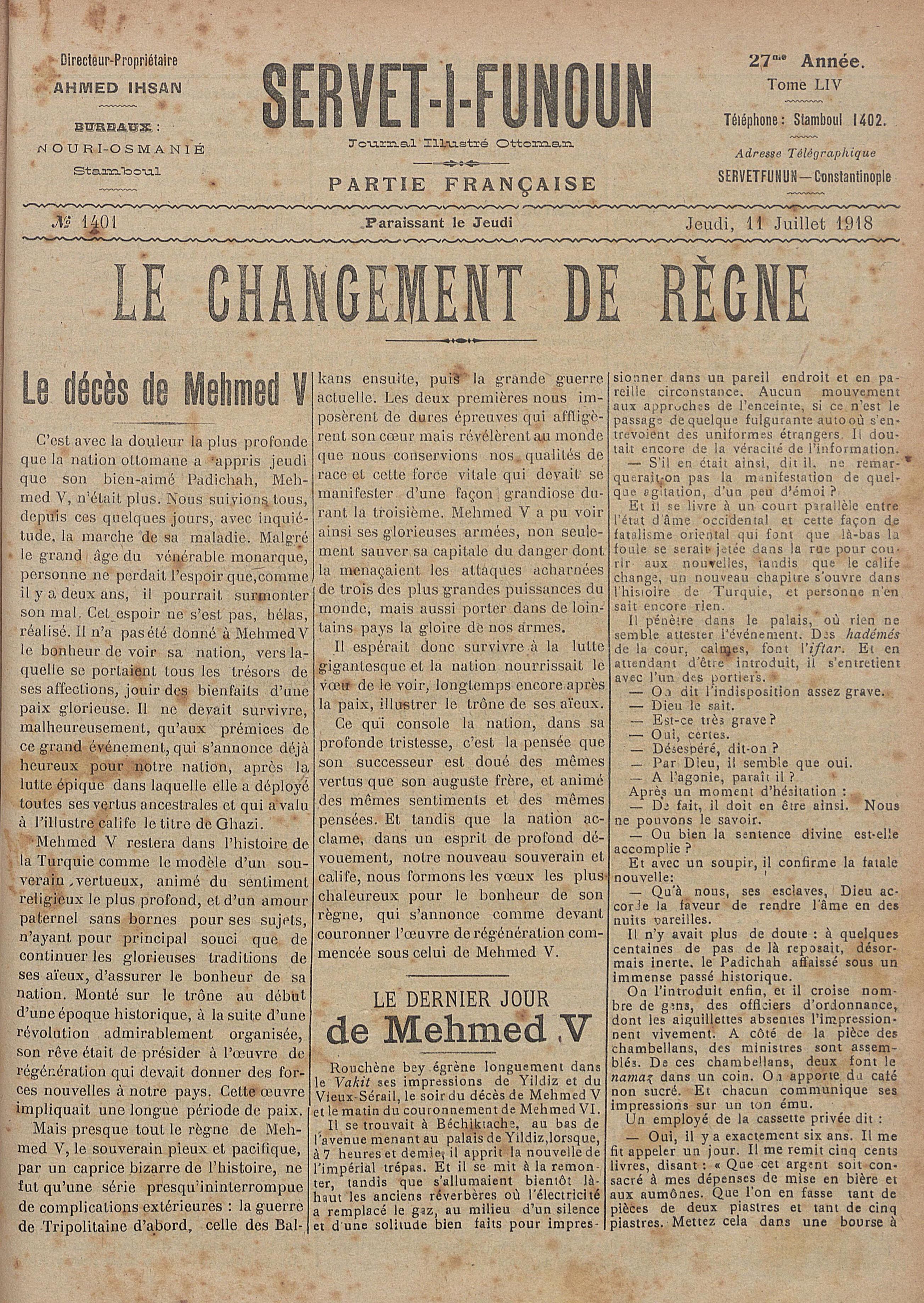
Found a possible public domain image
From Servet-i Funun https://archives.saltresearch.org/bitstream/123456789/129372/524/PFSIF9180711A341%20(1918-07-11).jpg
.jpg)
I wonder if this pic is public domain and/or is eligible for the Commons WhisperToMe (talk) 01:52, 16 March 2021 (UTC)
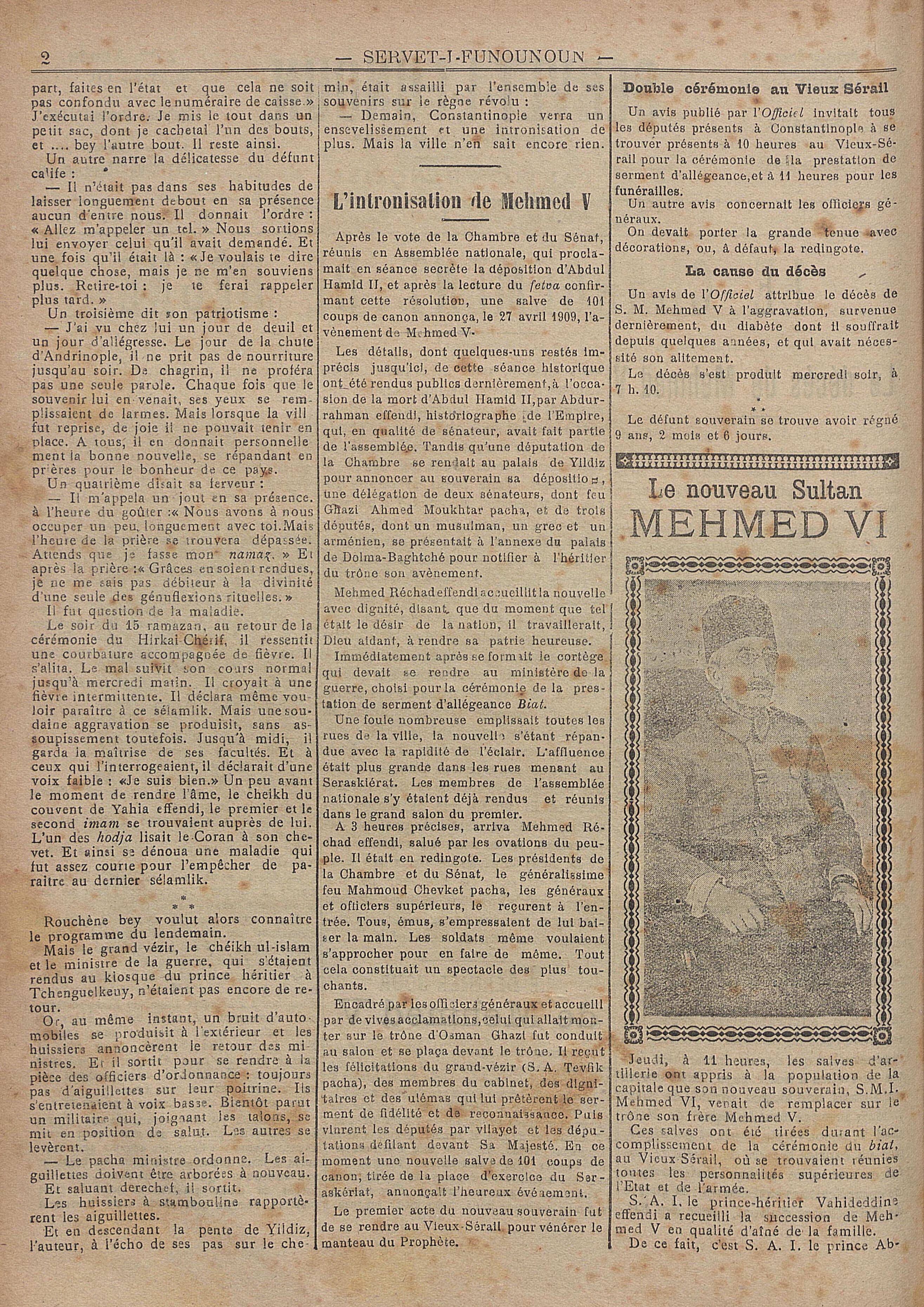
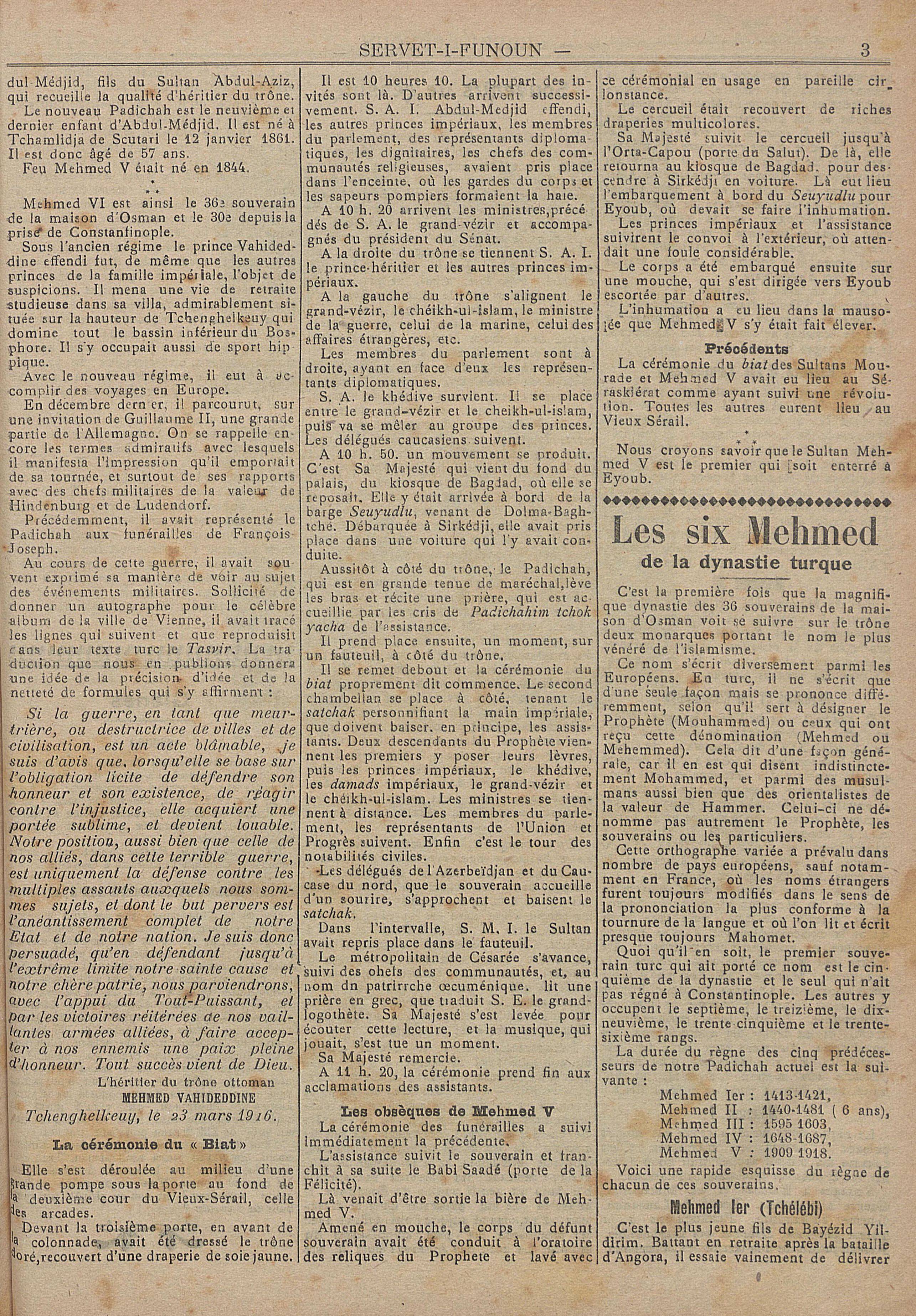
Seems the publication extensively covered Mehmed VI's ascendancy: https://archives.saltresearch.org/bitstream/123456789/129372/544/PFSIF9180718A373%20(1918-07-18).jpg and https://archives.saltresearch.org/bitstream/123456789/129372/540/PFSIF9180711B001.jpg, https://archives.saltresearch.org/bitstream/123456789/129372/541/PFSIF9180711B002.jpg, https://archives.saltresearch.org/bitstream/123456789/129372/542/PFSIF9180711B003.jpg WhisperToMe (talk) 02:00, 16 March 2021 (UTC)
.jpg)
Intro
I'm concerned about the following statement:
Mehmed VI left for a European exile after also being declared persona non grata.
Until recently this said he left for Malta. If that is true there wasn't any reason to change it. If It was wrong the present version is inadequate as he was ruler of Turkey with a capital at Constantinople and a country that was partly in Europe. That city was and is in Europe and Europe is a big place. We need to be more specific. If he didn't. go to Malta (also in Europe) did he go to Britain or Norway or Switzerland or any of the other European countries. Presumably if he was persona non grata in Turkey internal exile in European Turkey was not a possibility. Spinney Hill (talk) 15:19, 2 November 2023 (UTC)Spinney Hill (talk) 00:30, 3 November 2023 (UTC)
Signature vs Tughra
I propose we add Mehmed VI's signature to the infobox. Since a tughra is akin to a royal cypher, it would be more appropriate to place that in the honours, titles, etc section. Wikipedia articles of royals of other countries do this, cyphers are not placed in their infoboxes. If we can find signatures of other Ottoman Sultans it should be appropriate to do the same.

Benlittlewiki (talk) 17:39, 23 February 2025 (UTC)
- Nope. Tughra is a signature. This is probably post sultanate signature. Therefore has no place in the infobox. Beshogur (talk) 13:09, 24 February 2025 (UTC)
- This signature was signed on a telegram to the British government in April 1922, therefore, during his reign. If you read the wikipedia articles Tughra and royal cypher, you will indeed find their descriptions and uses practically the same, to the point there is sentence in the Tughra article noting this. Tughras were regal monograms affixed to official documents, correspondence, laws, and buildings; they were not their personal signatures, that is the intention of that category of the infobox.
- You will see the convention in articles of other royals will display their personal signatures in their infobox, cyphers are placed later in the article in the Honors, Emblems, etc. Therefore if we have the choice of displaying a signature versus a Tughra in the infobox, we should choose the signature, but if not, we can choose the next most similar thing to a signature, which is a Tughra. Since we have Vahdettin's, it should put it there. Benlittlewiki (talk) 19:11, 24 February 2025 (UTC)
"Mehmed VI Vahideddin"
I don't get this Template:Ping. It's not the article name. He is either known as Mehmed or Vahideddin, not Mehmed Vahideddin, rather "Sultan Vahdeddin/Vahideddin". But this is English wiki. Beshogur (talk) 14:37, 22 April 2025 (UTC)
- You're right, have seen English histories call him Mehmed VI or Vahdeddin. I think it makes more sense to call him Vahdeddin in the article, despite Mehmed VI being his regal name. So this is an attempt to combine the two names. This is already done in the lede's intro, might not be necessary in infobox. Appreciate the input. Benlittlewiki (talk) 20:26, 22 April 2025 (UTC)
- Sounds weird. Should be Mehmed VI, also known as Vahideddin. Beshogur (talk) 22:38, 22 April 2025 (UTC)
- The article does not explain why he is called Vahideddin. I think it ought to if we are to include this name rather than Mehmed throughout and we may need a source. Spinney Hill (talk) 22:40, 22 April 2025 (UTC)
- OP did the same with Mehmed V. OP this isn't your personal sandbox. Beshogur (talk) 09:43, 23 April 2025 (UTC)
- The article does not explain why he is called Vahideddin. I think it ought to if we are to include this name rather than Mehmed throughout and we may need a source. Spinney Hill (talk) 22:40, 22 April 2025 (UTC)
- I have done a survey of the English language books on late Ottoman history I have on hand on what they call Mehmed VI Vahdeddin:
- Ryan Gingeras' 2023 The Last Days of the Ottoman Empire introduces him as Mehmed VI Vahdeddin, but prefers Mehmed VI.
- Eugene Rogan's 2015 The Fall of the Ottomans introduces him the same, but does 70% Mehmed VI 30% Vahdeddin.
- Sean McMeekin's 2016 The Ottoman Endgame introduces him as Mehmed VI Vahdeddin, but generally prefers calling him Vahdeddin.
- Andrew Mango's Atatürk, Stamford Shaw's History of the Ottoman Empire, Kieser's Talaat Pasha, and Akçam's A Shameful Act, all call him Sultan Vahdettin/Vahdeddin/Vahideddin exclusively. I can do another survey for Mehmed V Reşad.
- Based on this, there doesn't seem to be a standard convention on what English language literature calls him, though there seems to be a preference in calling him Vahdeddin. I think introducing him as Mehmed VI Vahideddin makes sense in the lede, and calling him Vahdeddin for the rest of the article save for info on his Cülûs. If we want to better reflect the source material, and for variety's sake, we can throw in a couple Mehmeds or Mehmed VIs in the article. Benlittlewiki (talk) 19:32, 23 April 2025 (UTC)
- This can give you an idea. Beshogur (talk) 20:27, 23 April 2025 (UTC)Spinney Hill (talk) 22:15, 23 April 2025 (UTC)
- Thanks Template:Ping for this tool. Seems when you add up the variations of Vahdeddin, the preference between Mehmed VI and Vahdeddin come to about 50/50 . Then I added "Vahdettin" (with two 't's instead of two 'd's) to the query and it firmly tips the scale to Vahdeddin. Link to the new query Benlittlewiki (talk) 22:43, 23 April 2025 (UTC)
- Therefore we should use Vahdeddin because that name is more common in English language histories, though we can certainly sprinkle around Mehmed sometimes. To be frank, I also prefer calling him Vahdeddin in the article because it's a very distinct name compared to Mehmed.
- Another debate we can have is how to render the name: the modern Turkish Vahdettin, the more orthographically accurate Vahideddin, or Vahdeddin which is in the middle, and what I prefer. Benlittlewiki (talk) 03:15, 24 April 2025 (UTC)
- I little thought about this and you might be right since his tughra read this way. But I wonder. Sultan Reshad or Sultan Vahideddin are more common names than their respective orders. Beshogur (talk) 11:19, 25 April 2025 (UTC)
- Thanks Template:Ping for this tool. Seems when you add up the variations of Vahdeddin, the preference between Mehmed VI and Vahdeddin come to about 50/50 . Then I added "Vahdettin" (with two 't's instead of two 'd's) to the query and it firmly tips the scale to Vahdeddin. Link to the new query Benlittlewiki (talk) 22:43, 23 April 2025 (UTC)
- This can give you an idea. Beshogur (talk) 20:27, 23 April 2025 (UTC)Spinney Hill (talk) 22:15, 23 April 2025 (UTC)
- Sounds weird. Should be Mehmed VI, also known as Vahideddin. Beshogur (talk) 22:38, 22 April 2025 (UTC)
Harem
"Even though Vahdeddin was far in the succession" The meaning of that sentence is obscure and it appears to be a not very good translation from Turkish. Can anyone assist? Spinney Hill (talk) 08:18, 30 April 2025 (UTC)
- Clarified this to be the line of succession. Benlittlewiki (talk) 20:10, 30 April 2025 (UTC)