- "Subsequently, it moved ashore on September 2 on the Yucatán Peninsula" The use of both "subsequently" and "on September 2" is redundant. Suggestion: "On September 2, it moved ashore on the Yucatán Peninsula". This also helps by eliminating consecutive prepositional phrases with "on".
- "Initially threatening the major city of New Orleans, it veered westward and made landfall again over marshland" Where did it make landfall? "marshland" is very vague.
- "eventually dissipating over Texas on September 10" Texas is a large state. Perhaps this could be made more specific by including a nearby city or the region, such as "eventually dissipating over eastern Texas on September 10".
- "Carmen originated in a tropical disturbance that emerged from Africa toward the end of August." Those who aren't familiar with storm seasons might not be clear on which year this occurred. If a user were under the false impression that storms occur in the winter, such a user might think that the 1974 hurricane season spanned from August 1973 to March 1974 or something like that. Suggest appending the quoted sentence with "1974" or "of 1974".
-
- Allow me to clarify: the previous sentence mentions that the storm was part of the 1974 storm season, but it doesn't actually specify the year in which the storm occurred. It is not uncommon for a season to stretch across multiple years. The 1974 NFL season, for example, actually ended in 1975. Fiscal years also stretch across multiple calendar years. Unless the reader is already familiar with the formatting for storm seasons, they may not be certain what year this storm took place in. Does this make more sense? --Cryptic C62 · Talk 01:28, 9 June 2010 (UTC)Reply
- Ehh... no offense, of course, but I think that's kind of a stretch. Readers don't have to be spoon-fed the entire article; they're capable of figuring out these little nuances themselves, I think. Juliancolton (talk) 03:47, 9 June 2010 (UTC)Reply
- "The storm trekked through the Caribbean Sea" Is "trekked" an accurate jargon word or did you just want a spicy alternative to "moved"? If it's a jargon word, that's fine, but if not, I suggest using a more familiar word instead.
-
- Trekked has several meanings that do not apply in this context, thereby making it somewhat ambiguous. It is also an uncommon word, whereby it is unlikely to be in the vocabulary of non-native English speakers. Because it is an uncommon word, readers may be led to believe that it is a piece of storm jargon and set off on a futile attempt to find the meaning as it applies to storms. Because trekking is an activity primarily for humans, the use of it may be considered anthropomorphic, which is, in turn, unencyclopedic. All of these potential issues can be avoided simply by changing the word to "moved" or by using the appropriate piece of storm jargon (whatever that may be). --Cryptic C62 · Talk 01:28, 9 June 2010 (UTC)Reply
- "and was named Carmen upon its classification" named by whom?
- "Under favorable outflow produced by an upper-level high pressure area, the system gradually strengthened as it moved through the Lesser Antilles" What does the phrase "favorable outflow" mean? Favorable to whom?
-
- Here's the problem: When the word "favorable" is used with respect to a person, it is very easy to determine what it means. However, when using "favorable" with respect to "outflow", the meaning is not so clear because storms ≠ humans. What about the outflow conditions made them favorable for the strengthening of the storm? Also, I think you meant to include the word "conditions" after "outflow", for "under favorable outflow" seems a bit off without it. --Cryptic C62 · Talk 02:23, 10 June 2010 (UTC)Reply
- Good point. I've changed it around a bit, and gone out a limb with a slightly unusual, yet perhaps more applicant, word. I added "conditions" because I agree it sounds better, although the previous wording is also standard. Juliancolton (talk) 13:18, 10 June 2010 (UTC)Reply
-
- "quickly deteriorating into a tropical storm by September 3" Having a speed-related adverb and a date in the same sentence is a tad redundant. I suggest either dropping the date or perhaps rearranging to "and by September 3, it had deteriorated into a tropical storm. It might also help to remind readers what the storm was before it deteriorated: "quickly deteriorating from a Category 4 hurricane into a tropical storm."
- "although wind speeds at the time were identical to that of the initial peak, the barometric pressure was slightly higher." Does a higher barometric pressure mean it's more intense or less intense? I suspect the latter, but some readers might not be aware of the inverse relation between pressure and intensity.
- "Steering currents became increasingly weaker, and Carmen slowed to a drift." What are steering currents? Also, is there any hard data on how fast the storm moved through the Carribean? Miles per hour or some other measurement would be very helpful considering how often this section uses phrases like "slowed down" and "accelerated". The phrase "slowed to a drift" is especially confusing.
- Currents that steer, I guess... I don't mean to be rude—honestly—but how else can that be explained? Forward speed stats should be easy to find, so I'll add a couple in later. Juliancolton (talk) 03:47, 9 June 2010 (UTC)Reply
- Okay, if "steering currents" is just an intuitive explanation rather than a buzzword, perhaps it can simply be replaced with "The ocean currents that were steering the storm became increasingly weaker" or some such. --Cryptic C62 · Talk 02:23, 10 June 2010 (UTC)Reply
-
-
-
- Better, but I'm not a fan of "quasi-stationary position". I hereby rescind my previous comment that "slowed to a drift" is confusing. I think once there are forward speed statistics, this phrasing is adequately descriptive of the storm's movement, more so than "quasi-stationary" in any case. --Cryptic C62 · Talk 18:55, 11 June 2010 (UTC)Reply
- The first paragraph of Preparations is not in chronological order: "Mexican officials declared an emergency alert by September 2... The following day, the Mexican Army... the Red Cross began preparations for the approaching hurricane by September 2 in Belize"
- "Despite threatening the United States city of New Orleans, the hurricane's western turn prior to landfall spared the area from the most severe damage." Not quite grammatically correct. In the strictest interpretation of this phrasing, the noun that was threatening New Orleans was "the hurricane's western turn". Here are two possible rewrites: "Although it initially threatened the United States city of New Orleans, the hurricane turned west prior to making landfall and spared the area of severe damage." or "Although the United States city of New Orleans was initially threatened, the hurricane's western turn before making landfall spared the area of severe damage".
- "About 60,000 people sought shelter in facilities across the New Orleans region" What kind of "facilities"? That word by itself is somewhat vague.
-
- "shelter facilities" is good enough for me. To avoid unnecessary word repetition, how about "About 60,000 people sought refuge in shelter facilities across the New Orleans region" ? --Cryptic C62 · Talk 22:00, 13 June 2010 (UTC)Reply
-
- "sought refuge in shelter facilities" makes it clear that the facilities were 'official' and intended to be used for this purpose. "sought shelter in facilities" may, in the minds those who remember Hurricane Katrina and storms like it, imply that people were scrambling for shelter in whatever structures they could find. Which is the more accurate connotation? --Cryptic C62 · Talk 03:44, 14 June 2010 (UTC)Reply
- The latter, which is more broad and avoids incorrect assumptions. The sources do not, in my opinion, specify that the facilities housing evacuees were actually "shelter facilities". People likely stayed in churches, schools, hotels, etc. Juliancolton (talk) 15:12, 14 June 2010 (UTC)Reply
- "However, due to a change in the naming scheme of Atlantic hurricanes in 1979, it was not replaced by any particular name." This is really confusing. My educated guess is that hurricane names are cyclical, but when Carmen was retired, there was no name chosen to replace it in the cycle. I suggest either explaining the naming procedure enough for this to make sense or just dropping the sentence altogether.
- "Preparations for Carmen were particularly thorough with 1969's Hurricane Camille in recent memory." This sentence seemed odd to me, so I checked out the source. I don't think this sentence accurately reflects what the source is trying to convey. Perhaps something like "Many Mississippi citizens, having experienced the destruction of 1969's Hurricane Camille, quickly evacuated from their coastal homes of their own accord." would be better.
- The source says "Because of Camille, everybody along the Gulf Coast has deep respect for Carmen", which is accurately rephrased in the article in my opinion. I appreciate the suggestion, but it seems unnecessary to make the article even more dull and the prose less interesting. Juliancolton (talk) 00:28, 14 June 2010 (UTC)Reply
- It's not accurate. "having deep respect" and making "particularly thorough" preparations are not the same. The current sentence could refer to any kind of preparation, such as canned food, emergency generators, walkie-talkies, medical supplies, rain gear, etc. That's not what the source material is about. The source material is specifically about evacuating the area. There's no way for one to be "particularly thorough" about one's own evacuation: one is either there or one is not. The current sentence is also not reflective of the fact that the article in question is only about Mississippi. Whether my suggested sentence is used or not, these inaccuracies should be addressed. --Cryptic C62 · Talk 03:44, 14 June 2010 (UTC)Reply
- The article neither states nor implies that individual people were thorough about their evacuations, so there is no accuracy. A community of people can be meticulous in their preparations for a hurricane. The Carmen–Camille relationship is a general observation rather than a direct statement of technical fact, so we do not need to be as exact in duplicating the source context to a T. Juliancolton (talk) 15:12, 14 June 2010 (UTC)Reply
- I am of the opinion that if you want to keep this sentence as is, you can find a better source for it. Conversely, if you want to use the source, you can find a better sentence to summarize it. --Cryptic C62 · Talk 00:27, 15 June 2010 (UTC)Reply
- I disagree, and while you're of course free to edit the article yourself, I personally do not feel the need to change this particular sentence. From the source currently in use, "'Before Camille they might have been having hurricane parties and things like that, but they are taking things very seriously,' said Sister Pamela, a Catholic nun assisting at a Gulfport refugee center." That quote alone directly backs up the information in the article. Juliancolton (talk) 11:46, 15 June 2010 (UTC)Reply
-
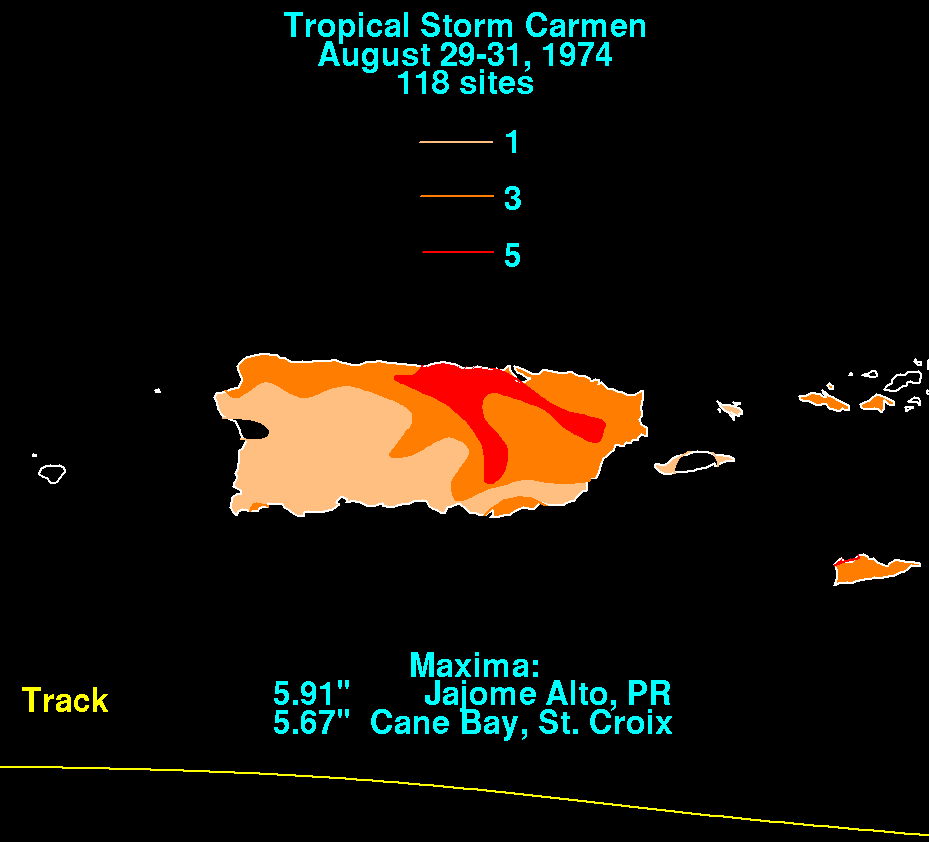
- "Carmen produced moderate rainfall across Puerto Rico and the northern Lesser Antilles, peaking at 5.91 in (150 mm)" From my experience, the word "peak" refers to the point at which the rate of something with respect to another variable is highest. Did you mean to write 5.91 inches per day? Or perhaps the peak refers to the location at which the total rainfall was highest, in which case a location should be specified. If 5.91 inches was the cumulative total, then "peak" is not the correct word.
- This is pretty much standard wording in tropical cyclone articles. Rainfall in the northern Lesser Antilles peaked at 5.91 inches; locations outside of the area of highest precipitation received less. Juliancolton (talk) 11:51, 15 June 2010 (UTC)Reply
- I believe you may have misread the source material. The reference for the aforementioned sentence says that 5.91 inches of rain fell on Jajome Alto, Puerto Rico. I have added this to the article. --Cryptic C62 · Talk 01:13, 16 June 2010 (UTC)Reply
- "Since Carmen had moved ashore over marshland, it caused far less damage than first feared" less damage because the marshland was not heavily populated? Or less damage because marshlands are somehow not affected by hurricanes as strongly as other areas? I suspect the former. How about "Since Carmen had moved ashore over uninhabited marshland, it caused far less damage than first feared" or some such?
- "The storm's greatest impact was the loss of sugar crops in Louisiana." Somewhat subjective unless it is made more specific. How about adding "economic" before "impact" ?
- "Ultimately, the hurricane caused yields to drop 12%" This seems incompatible with the previous sentence that I highlighted. If 20% of the crop was destroyed, how could yields drop by only 12%?
-
-
- See the PR on this issue. The source said yields dropped from 25 to 22 tons, which is 12%. In any case, I just removed the sentence, since I don't think it adds much and the potential is great for misinterpretation of the source material. Juliancolton (talk) 18:59, 17 June 2010 (UTC)Reply
- "An estimated 308,000 acres (125,000 ha) of sugar cane in 16 counties was devastated, and reports indicated as much as 20 percent was destroyed." 20 percent of what? Is there a difference between "devastated" and "destroyed"? Perhaps "An estimated 308,000 acres (125,000 ha) of sugar cane in 16 counties was damaged, nearly 20 percent of which was destroyed altogether." or some such.
-
- Ah, I see. Looking at the source, it is clear now that this means that 20% of the total 1974 crop was destroyed. I think the wording can be made slightly less ambiguous as such: "An estimated 308,000 acres (125,000 ha) of sugar cane was devastated, eliminating about 20 percent of the entire 1974 Louisiana sugar crop." or something like that. --Cryptic C62 · Talk 18:38, 17 June 2010 (UTC)Reply
-
- Actually, upon rereading the source, I've found a different issue: the article currently states that 308,000 acres of sugar cane was devastated, whereas the source simply states that "Louisiana's 16 major sugar cane parishes had an estimated 308,000 acres planted in sugar cane" without indicating how many of those acres were affected. I think our best bet is to drop the acre figure altogether and stick to the percentage to avoid misleading readers as to how much sugar cane was damaged. --Cryptic C62 · Talk 00:52, 18 June 2010 (UTC)Reply
- Argh, I knew there was a reason for my original wording. Devastated does not necessarily mean destroyed, so the 308,000 acres were partially damaged, of which 20% was destroyed. OK, reworded. Juliancolton (talk) 00:59, 18 June 2010 (UTC)Reply
- "the more northern of which became consolidated and organized" I don't know what "organized" means in this context. Also, what happened to the southern part?
- I'm not sure how to further explain what "organized" means... it just indicates that the system... became more organized. Sorry, but I'm not sure what else I can do with that. As for the southern segment of the wave, Thompson (1976) does not specify its ultimate fate. Juliancolton (talk) 03:47, 9 June 2010 (UTC)Reply
- Alas, poor southern segment: we hardly knew ye. Anywho, why don't you just try to explain what "organized" means here for me in laymen's terms, then we'll see if we can work out a way to explain it clearly in the article. --Cryptic C62 · Talk 02:23, 10 June 2010 (UTC)Reply
- Okay, sure. "Organized", in this context, means that the convection, or thunderstorms, has strengthened and become more balanced, symmetrical, and conducive for further intensification of the storm as a whole. It's really the same as the standard definition of the word "organized". Any suggestions on how I could explain this in the article would be much appreciated. Juliancolton (talk) 13:18, 10 June 2010 (UTC)Reply
- Hmm... I'm not entirely sure how to convey that in the article. Perhaps a minor rewording will help: "the more northern of which consolidated into an organized storm system." This doesn't directly explain the term either, but somehow I feel it adds enough context to make the meaning clearer. Thoughts? --Cryptic C62 · Talk 18:55, 11 June 2010 (UTC)Reply
- "Nonetheless, tidal flooding from the Gulf of Mexico and coastal bays, lakes and bayous was severe." The structure of this list is very confusing. Why are there two "and"s but only one comma?
-
- A lot of things make sense to us that don't make sense to other people—we write encyclopedia articles for fun! :P I think this could be made clearer by simply replacing "coastal bays, lakes, and bayous" with "coastal bodies of water" or some other coverall phrase like that. --Cryptic C62 · Talk 18:38, 17 June 2010 (UTC)Reply
- "Winds gusted to 86 mph (138 km/h) at Morgan City, Louisiana, and along the coast tides ran up to 6 ft (1.8 m) above normal." Does this statistic refer to the highest wind speed recorded? Its significance is not made clear in the article.
- I don't think such a statistic needs to signify its significance. The Monthly Weather Review does not list a higher wind velocity, but it gives no indiciation that its list is comprehensive. Juliancolton (talk) 12:41, 17 June 2010 (UTC)Reply
- Here's the thing: If the sentence gives no indication that the statistic is significant (which it is), that implies that the location is significant (which it is not). If the only reason to mention this fact is because this is believed to be the highest recorded wind speed, then that should be made explicit so as to avoid leading readers to believe that Morgan City is somehow relevant to the storm. The other problem is that the sentence may also imply that the extra high tides were related to Morgan City as opposed to Shell Beach. How's this for a rewrite: "Gusts of wind reached speeds as high as 86 mph, and along the coast of Louisiana the tides reached as high as 6 ft above normal levels." This makes it clear that the stats are significant because they're the largest known, but does not specifically imply that they are the definitive the maxima for this storm. --Cryptic C62 · Talk 15:57, 17 June 2010 (UTC)Reply
|

.JPG)