Should there be more in depth list of symptoms this dye can provoke?
Split
I split off the information about the colour into a separate article.Phil | Talk 17:24, Apr 19, 2005 (UTC)
THE FACT THAT BEETLES ARE USED AS FOOD COLORING IS NASTY
Latest comment: 18 May 20125 comments5 people in discussion
Can we please make a list of foods in which carmine food dye can be found? I know it's in "Good and Plenty" yuck >:P
It's not a beetle; it's a scale insect. The classification difference between beetles and scale insects is on the "Order" level, the level where we are classified as primates and not rodents. A small point perhaps. Otherwise, I do know it's present in Dole Ruby Red Grapefruit Juice. Rkitko10:58, 1 February 2006 (UTC)Reply
It's just fucking gross. Make them stop already damnit! 05:44, 17 May 2006
ok. just elect me president of the universe. by the way, your food has allowable concentrations of bug parts. and remember, they are natural, and good for you. unlike coal tar extracts which provide the color for gatorade and doritos. yumm, bug parts.75.61.132.26 (talk) 01:19, 20 April 2012 (UTC)Reply
Horrible. I was eating a danone yogurt, and looked at its color, so artificial-looking and really useless in the yogurt, it doesnt add nothing to it, I was disgusted. and checked on wikipedia was the E-120 stands for... why companies do this? I dont understand. --Pedro (talk) 09:51, 18 May 2012 (UTC)Reply
Three of the main reasons food companies color food are to:
offset color loss due to exposure to light, air, temperature extremes, moisture and storage conditions
correct natural variations in color
enhance colors that occur naturally
provide color to colorless and "fun" foods
Carmine is added to many foods (including yogurt) to do all those things, however the main reason is the first. During the fruit processing, the strawberries loose much of their color and need to have color added back to them to appeal to consumers.
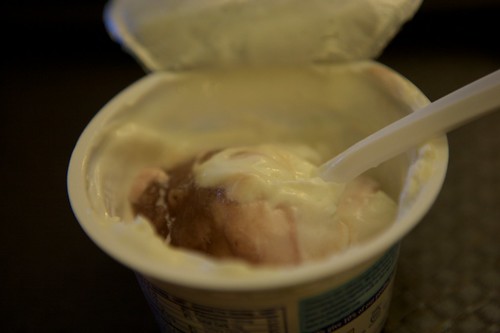
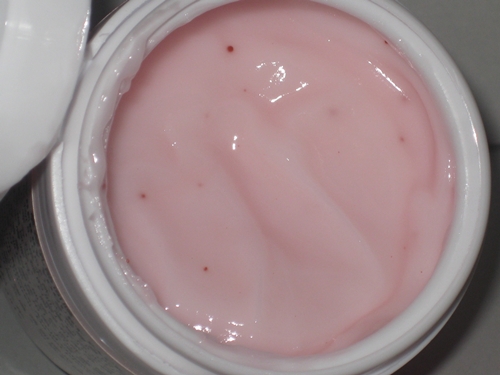
"really useless in the yogurt, doesnt add nothing to it" huh? look at these uncolored yogurts Uncolored 1Uncolored 2 and tell me if the added carmine does not make the yogurt look more like strawberries... Colored (Skoot13 (talk) 12:39, 18 May 2012 (UTC))Reply
Latest comment: 11 May 20156 comments6 people in discussion
This article talk page was automatically added with Template:Tl banner as it falls under Category:Food or one of its subcategories. If you find this addition an error, Kindly undo the changes and update the inappropriate categories if needed. The bot was instructed to tagg these articles upon consenus from WikiProject Food and drink. You can find the related request for tagging here . Maximum and careful attention was done to avoid any wrongly tagging any categories , but mistakes may happen... If you have concerns , please inform on the project talk page -- TinucherianBot (talk) 01:18, 4 July 2008 (UTC)Reply
I had a Rabbi for the Orthodox Union (circle U) explain to me that Carmine Red could be certified as Kosher because the Torah forbids eating "the bugs that crawl upon the earth" and the insects in question never crawl upon the earth. Other organizations (Circle K, Star K) do not agree with this technicality and will not certify it as Kosher. I do not have any paper or internet links to back this up, however. Still, if someone is able to track down a source, it would be an interesting addition. 2 March 2012 — Preceding unsigned comment added by 182.53.248.38 (talk) 11:11, 2 March 2012 (UTC)Reply
Latest comment: 2 March 20122 comments2 people in discussion
There seems to be some confusion about this issue. There is a Red #40, which is an artificial dye. In the introduction to this article, it says that Carmine = cochineal = Natural Red #40. However,in the section on the European Union, it says:
and listed under the names Cochineal, Carminic acid, Carmines and Natural Red 4 as additive E 120 in the list of EU-approved food additives.
Of course, many web pages list it as #40, but that's because they are quoting this introduction verbatim. Does anyone know how to find out what the official names are? Ileanadu (talk) 14:55, 13 April 2011 (UTC)Reply
There used to be a picture on this page of the beetles that are used for carmine. It's now gone. If it was copyrighted, then understood. But did someone take it out for aesthetic reasons? If so that is vandalism. — Preceding unsigned comment added by 76.94.96.248 (talk) 20:41, 16 September 2012 (UTC)Reply
Latest comment: 6 October 20141 comment1 person in discussion
I removed the following paragraph:
The carminic acid used to produce the pigment can also be extracted from various microbes engineered for the purposeScript error: No such module "Unsubst".. Microbes are dissolved in a containment structure separate from their cultivation vats, and then allowed to settle out. The liquid and suspended carminic acid is then siphoned off, and metal salts are then added to give a lake pigment in a procedure that is mostly identical to the procedure for acid extracted from insects.
I searched Google, Google Scholar, Google Books and a professional science library database, and I could find no reference to this process, so I severely doubt that it's a notable source of carmine, or even whether it's been done on anything other than lab scale if at all. --Slashme (talk) 09:06, 6 October 2014 (UTC)Reply
I have just modified 5 external links on Carmine. Please take a moment to review my edit. If you have any questions, or need the bot to ignore the links, or the page altogether, please visit this simple FaQ for additional information. I made the following changes:
When you have finished reviewing my changes, please set the checked parameter below to true or failed to let others know (documentation at Template:Tlx).

_04_ies.jpg)