Iva annua
Template:Short description Template:Speciesbox

Iva annua, the annual marsh elder[1] or sumpweed, is a North American herbaceous annual plant in the family Asteraceae that was historically cultivated by Native Americans for its edible seed.
Description
Iva annua is an annual herb up to 150 cm (5 feet) tall. The plant produces many small flower heads in a narrow, elongated, spike-like array, each head with 11–17 disc florets but no ray florets.[2] Marshelder has a unique odor when the leaves or pollen are touched, but this odor is not present in winnowed seed.
Cultivated varieties of Marshelder (var. macrocarpa) bred by Native Americans possessed seeds 6-9mm in length; whereas wild-type Marshelder has seeds 3 mm in length on average (not exceeding 4.5 mm). [3]
Distribution
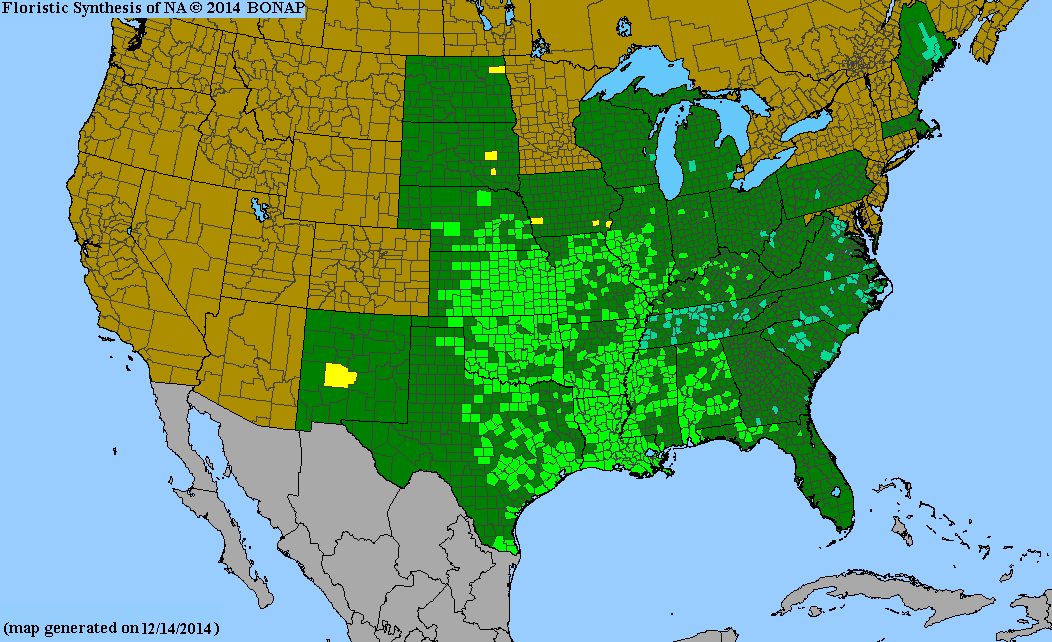
It is native to northeastern Mexico (Tamaulipas) and to the central and southern United States, primarily the Great Plains and Mississippi Valley as far north as North Dakota. There are some populations in the eastern US, but these appear to represent introductions.[4]
Conservation
NatureServe evaluated Iva annua in 1998 as globally secure, G5.[5]
Uses
Iva annua was cultivated for its edible seed by Native Americans around 4,000 years ago[6] in the central and eastern United States as part of the Eastern Agricultural Complex. It was especially important to the indigenous peoples of the Kansas City Hopewell culture in present-day Missouri and Illinois. The edible parts contain 32 percent protein and 45 percent oil.
However, like its relative ragweed, sumpweed possesses many objectionable qualities which include being a severe potential allergen and possessing a unique odor. Probably for these reasons it was abandoned after more pleasant alternatives (such as maize) were available and, by the time Europeans arrived in the Americas, had disappeared as a crop.[7]
See also
References
<templatestyles src="Reflist/styles.css" />
- ↑ Script error: No such module "template wrapper".
- ↑ Flora of North America, Iva annua Linnaeus, 1753.
- ↑ Weiland, A. W., & Gremillion, K. J. (2018). Patterns of Variation in the Seed Morphology of Iva annua var. Macrocarpa, an Extinct North American Domesticate. Ethnobiology Letters, 9(2), 75–89.
- ↑ Biota of North America Program 2014 county distribution map
- ↑ Script error: No such module "citation/CS1".
- ↑ Script error: No such module "citation/CS1".
- ↑ Script error: No such module "citation/CS1".
Script error: No such module "Check for unknown parameters".
External links
- Template:Sister-inline
- Template:Sister-inline
- Plants Profile for Iva annua (annual marsh elder)
- Germplasm Resources Information Network−GRIN: treatment of Iva annua
- Script error: No such module "citation/CS1". Includes photographs.
- Photo of herbarium specimen at Missouri Botanical Garden
- Pages with script errors
- Pages with broken file links
- Iva (plant)
- Pseudocereals
- Flora of the Great Plains (North America)
- Flora of the United States
- Flora of the South-Central United States
- Flora of the Southeastern United States
- Flora of the Great Lakes region (North America)
- Flora of the Appalachian Mountains
- Flora of Tamaulipas
- Flora of Veracruz
- Edible nuts and seeds
- Crops originating from Pre-Columbian North America
- Native American cuisine of the Southeastern Woodlands
- Pre-Columbian Great Plains cuisine
- Crops originating from the United States
- Plants described in 1753
- Taxa named by Carl Linnaeus
- Flora without expected TNC conservation status