Solar eclipse of October 24, 1995
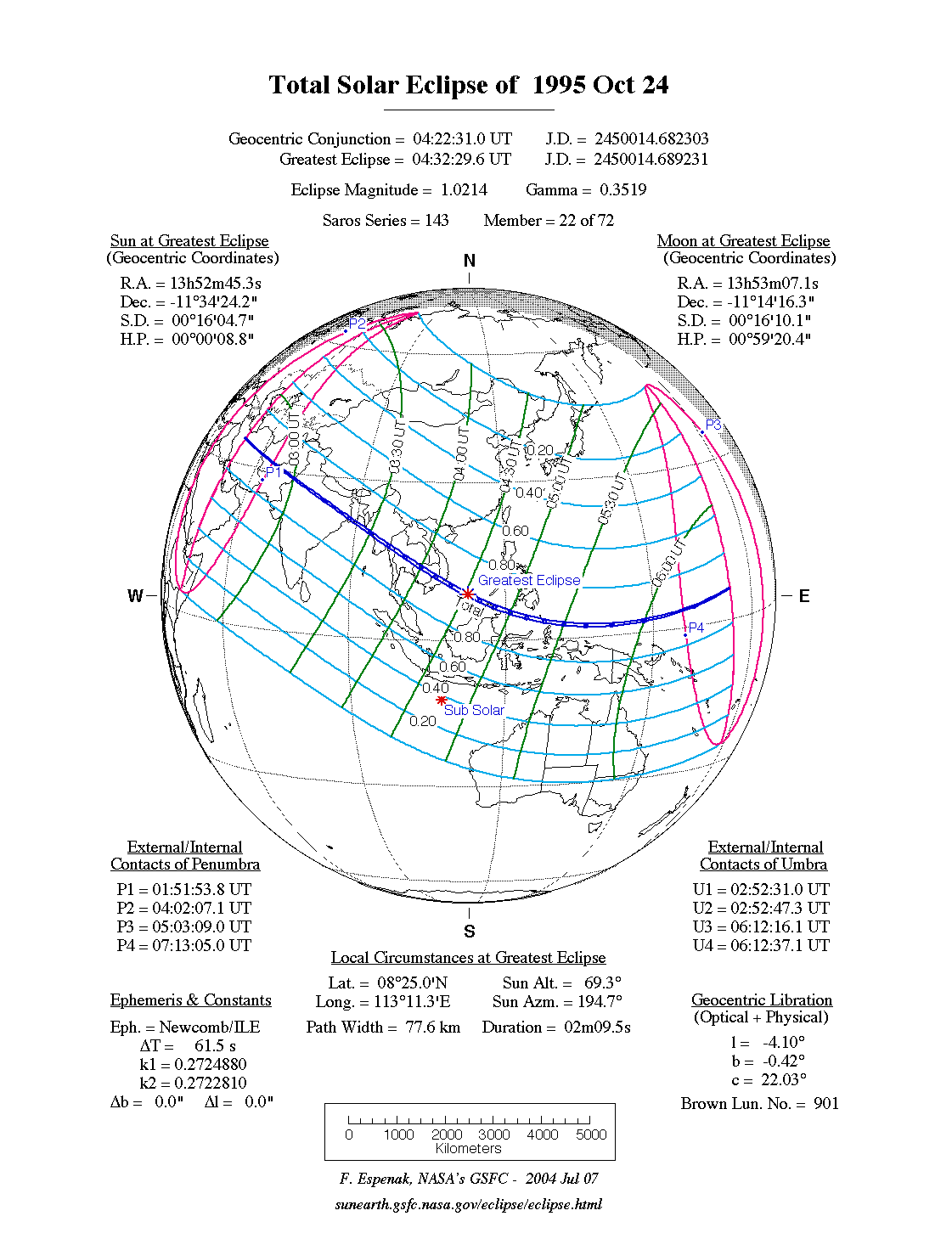
Template:Short description Script error: No such module "Solar eclipse". A total solar eclipse occurred at the Moon's ascending node of orbit on Tuesday, October 24, 1995,[1] with a magnitude of 1.0213. A solar eclipse occurs when the Moon passes between Earth and the Sun, thereby totally or partly obscuring the image of the Sun for a viewer on Earth. A total solar eclipse occurs when the Moon's apparent diameter is larger than the Sun's, blocking all direct sunlight, turning day into darkness. Totality occurs in a narrow path across Earth's surface, with the partial solar eclipse visible over a surrounding region thousands of kilometres wide. Occurring about 2.7 days before perigee (on October 26, 1995, at 21:00 UTC), the Moon's apparent diameter was larger.[2]
The path of totality went through Iran, Afghanistan, Pakistan, India, southwestern tip of Bangladesh, Burma, Thailand, Cambodia, Vietnam, Spratly Islands, northeastern tip of Sabah of Malaysia, Philippines and Indonesia. A partial eclipse was visible for parts of Northeast Africa, Asia, Australia, and northern Oceania.
Observation
India
An aerial observation of this eclipse was done over India,[3] when a MiG-25 reconnaissance aircraft of the Indian Air Force was used to take images of this eclipse at an altitude of 25 km.[4]
The Indian Institute of Astrophysics established camps along the path of totality in Rajasthan, Uttar Pradesh, Iradatganj and Diamond Harbour near Kolkata. Astronomers from other institutions and abroad from the Slovakia, Brazil, Russia, Japan and Germany joined IIA at its camps. An IIA team also photographed the eclipse by chasing the Moon’s shadow in an Indian Air Force plane AN-32 from the crew escape hatch on the roof of the cockpit at an altitude of Script error: No such module "convert". above the sea level, which was the first time efforts made by the institute. Doordarshan and All India Radio made live coverages of the eclipse. The eclipse happened to occur on the day of the Diwali.[5]
China
Within the Spratly Islands claimed by China, only Cuarteron Reef was controlled by China and lay in the path of totality. Instead of going to the faraway island, The Popular Science Committee of the Chinese Astronomical Society, Beijing Astronomical Society, Beijing Planetarium and Beijing Astronomical Observatory (now incorporated into the National Astronomical Observatories of China) jointly organized observations abroad for the first time. A team of 4 was sent to Sikhio district, Nakhon Ratchasima, Thailand by the Beijing Planetarium, and successfully photographed the whole process of the eclipse, the corona at the greatest eclipse, and the Baily's beads at the 2nd and 3rd contact.[6]
In addition, the Chinese Academy of Sciences, Ministry of Electronics Industry, China Earthquake Administration, State Education Commission (now Ministry of Education) and departments in charge of water conservancy and meteorology conducted joint observations on changes of solar radiation, ionosphere, geomagnetic field, radio and acoustic heavy waves, mainly in the Paracel Islands, Sanya, Haikou and Zhengzhou. From all these places, only a partial solar eclipse was visible instead of a total solar eclipse.[7]
List of major cities in the path of totality
- Birjand, Iran
- Lashkargah, Afghanistan
- Bahawalpur, Pakistan
- Sikar, Rajasthan, India
- Alwar, Rajasthan, India
- Mathura, Uttar Pradesh, India
- Bharatpur, Rajasthan, India
- Dholpur, Rajasthan, India
- Auraiya, Uttar Pradesh, India
- Manjhanpur, Uttar Pradesh, India
- Prayagraj, Uttar Pradesh, India
- Mirzapur, Uttar Pradesh, India
- Robertsganj, Uttar Pradesh, India
- Daltonganj, Jharkhand, India
- Purulia, West Bengal, India
- Panskura, West Bengal, India
- Tamluk, West Bengal, India
- Batanagar, West Bengal, India
- Nakhon Sawan, Thailand
- Nakhon Ratchasima, Thailand
- Siem Reap, Cambodia
- Kratié, Cambodia
- Phan Thiết, Vietnam[8]
In popular culture
Phil Whitaker's prize-winning debut novel Eclipse of the Sun published in 1997 and set in India has at its centre a dramatic attempt to organize a public viewing of the eclipse.
Images

Eclipse details
Shown below are two tables displaying details about this particular solar eclipse. The first table outlines times at which the moon's penumbra or umbra attains the specific parameter, and the second table describes various other parameters pertaining to this eclipse.[9]
| Event | Time (UTC) |
|---|---|
| First Penumbral External Contact | 1995 October 24 at 01:52:54.3 UTC |
| First Umbral External Contact | 1995 October 24 at 02:53:31.6 UTC |
| First Central Line | 1995 October 24 at 02:53:39.8 UTC |
| First Umbral Internal Contact | 1995 October 24 at 02:53:47.9 UTC |
| First Penumbral Internal Contact | 1995 October 24 at 04:03:07.3 UTC |
| Equatorial Conjunction | 1995 October 24 at 04:23:32.2 UTC |
| Greatest Eclipse | 1995 October 24 at 04:33:30.5 UTC |
| Ecliptic Conjunction | 1995 October 24 at 04:37:13.7 UTC |
| Greatest Duration | 1995 October 24 at 04:37:39.5 UTC |
| Last Penumbral Internal Contact | 1995 October 24 at 05:04:10.7 UTC |
| Last Umbral Internal Contact | 1995 October 24 at 06:13:17.4 UTC |
| Last Central Line | 1995 October 24 at 06:13:27.9 UTC |
| Last Umbral External Contact | 1995 October 24 at 06:13:38.5 UTC |
| Last Penumbral External Contact | 1995 October 24 at 07:14:06.3 UTC |
| Parameter | Value |
|---|---|
| Eclipse Magnitude | 1.02135 |
| Eclipse Obscuration | 1.04315 |
| Gamma | 0.35176 |
| Sun Right Ascension | 13h52m45.4s |
| Sun Declination | -11°34'24.4" |
| Sun Semi-Diameter | 16'04.7" |
| Sun Equatorial Horizontal Parallax | 08.8" |
| Moon Right Ascension | 13h53m07.2s |
| Moon Declination | -11°14'17.0" |
| Moon Semi-Diameter | 16'10.1" |
| Moon Equatorial Horizontal Parallax | 0°59'20.4" |
| ΔT | 61.4 s |
Eclipse season
Script error: No such module "Labelled list hatnote". This eclipse is part of an eclipse season, a period, roughly every six months, when eclipses occur. Only two (or occasionally three) eclipse seasons occur each year, and each season lasts about 35 days and repeats just short of six months (173 days) later; thus two full eclipse seasons always occur each year. Either two or three eclipses happen each eclipse season. In the sequence below, each eclipse is separated by a fortnight.
| October 8 Descending node (full moon) |
October 24 Ascending node (new moon) |
|---|---|
| File:Lunar eclipse chart close-1995Oct08.png | File:SE1995Oct24T.png |
| Penumbral lunar eclipse Lunar Saros 117 |
Total solar eclipse Solar Saros 143 |


Related eclipses
Eclipses in 1995
- A partial lunar eclipse on April 15.
- An annular solar eclipse on April 29.
- A penumbral lunar eclipse on October 8.
- A total solar eclipse on October 24.
Metonic
- Preceded by: Solar eclipse of January 4, 1992
- Followed by: Solar eclipse of August 11, 1999
Tzolkinex
- Preceded by: Solar eclipse of September 11, 1988
- Followed by: Solar eclipse of December 4, 2002
Half-Saros
- Preceded by: Lunar eclipse of October 17, 1986
- Followed by: Lunar eclipse of October 28, 2004
Tritos
- Preceded by: Solar eclipse of November 22, 1984
- Followed by: Solar eclipse of September 22, 2006
Solar Saros 143
- Preceded by: Solar eclipse of October 12, 1977
- Followed by: Solar eclipse of November 3, 2013
Inex
- Preceded by: Solar eclipse of November 12, 1966
- Followed by: Solar eclipse of October 2, 2024
Triad
- Preceded by: Solar eclipse of December 23, 1908
- Followed by: Solar eclipse of August 24, 2082
Solar eclipses of 1993–1996
This eclipse is a member of a semester series. An eclipse in a semester series of solar eclipses repeats approximately every 177 days and 4 hours (a semester) at alternating nodes of the Moon's orbit.[10]
| Solar eclipse series sets from 1993 to 1996 | ||||||
|---|---|---|---|---|---|---|
| Descending node | Ascending node | |||||
| Saros | Map | Gamma | Saros | Map | Gamma | |
| 118 | May 21, 1993 File:SE1993May21P.png Partial |
1.1372 | 123 | November 13, 1993 File:SE1993Nov13P.png Partial |
−1.0411 | |
| 128 File:Solar Eclipse 1994 (7160293094).jpg Partial in Bismarck, ND, USA |
May 10, 1994 File:SE1994May10A.png Annular |
0.4077 | 133 File:Diamond Ring, Total Solar Eclipse, Bolivia, 1994 (3183977692).jpg Totality in Bolivia |
November 3, 1994 File:SE1994Nov03T.png Total |
−0.3522 | |
| 138 | April 29, 1995 File:SE1995Apr29A.png Annular |
−0.3382 | 143 File:Hao WLCC 941103.jpg Totality in Dundlod, India |
October 24, 1995 File:SE1995Oct24T.png Total |
0.3518 | |
| 148 | April 17, 1996 File:SE1996Apr17P.png Partial |
−1.058 | 153 | October 12, 1996 File:SE1996Oct12P.png Partial |
1.1227 | |


Saros 143
This eclipse is a part of Saros series 143, repeating every 18 years, 11 days, and containing 72 events. The series started with a partial solar eclipse on March 7, 1617. It contains total eclipses from June 24, 1797 through October 24, 1995; hybrid eclipses from November 3, 2013 through December 6, 2067; and annular eclipses from December 16, 2085 through September 16, 2536. The series ends at member 72 as a partial eclipse on April 23, 2897. Its eclipses are tabulated in three columns; every third eclipse in the same column is one exeligmos apart, so they all cast shadows over approximately the same parts of the Earth.
The longest duration of totality was produced by member 16 at 3 minutes, 50 seconds on August 19, 1887, and the longest duration of annularity will be produced by member 51 at 4 minutes, 54 seconds on September 6, 2518. All eclipses in this series occur at the Moon’s ascending node of orbit.[11]
| Series members 12–33 occur between 1801 and 2200: | ||
|---|---|---|
| 12 | 13 | 14 |
| File:SE1815Jul06T.png July 6, 1815 |
File:SE1833Jul17T.png July 17, 1833 |
File:SE1851Jul28T.png July 28, 1851 |
| 15 | 16 | 17 |
| File:SE1869Aug07T.png August 7, 1869 |
File:SE1887Aug19T.png August 19, 1887 |
File:SE1905Aug30T.png August 30, 1905 |
| 18 | 19 | 20 |
| File:SE1923Sep10T.png September 10, 1923 |
File:SE1941Sep21T.png September 21, 1941 |
File:SE1959Oct02T.png October 2, 1959 |
| 21 | 22 | 23 |
| File:SE1977Oct12T.png October 12, 1977 |
File:SE1995Oct24T.png October 24, 1995 |
File:SE2013Nov03H.png November 3, 2013 |
| 24 | 25 | 26 |
| File:SE2031Nov14H.png November 14, 2031 |
File:SE2049Nov25H.png November 25, 2049 |
File:SE2067Dec06H.png December 6, 2067 |
| 27 | 28 | 29 |
| File:SE2085Dec16A.png December 16, 2085 |
File:SE2103Dec29A.png December 29, 2103 |
File:SE2122Jan08A.png January 8, 2122 |
| 30 | 31 | 32 |
| File:SE2140Jan20A.png January 20, 2140 |
File:SE2158Jan30A.png January 30, 2158 |
File:SE2176Feb10A.png February 10, 2176 |
| 33 | ||
| File:SE2194Feb21A.png February 21, 2194 | ||


Metonic series
The metonic series repeats eclipses every 19 years (6939.69 days), lasting about 5 cycles. Eclipses occur in nearly the same calendar date. In addition, the octon subseries repeats 1/5 of that or every 3.8 years (1387.94 days). All eclipses in this table occur at the Moon's ascending node.


Tritos series
Template:Solar Tritos series 2006 September 22
Inex series
Template:Solar Inex series 2024 October 2
Notes
<templatestyles src="Reflist/styles.css" />
- ↑ Script error: No such module "citation/CS1".
- ↑ Script error: No such module "citation/CS1".
- ↑ The MIGnificient Flying Machines - MiG-25R Script error: No such module "webarchive". Bharat Rakshak.com 22 August 2017
- ↑ Script error: No such module "citation/CS1".
- ↑ Script error: No such module "citation/CS1".
- ↑ Script error: No such module "citation/CS1".
- ↑ Script error: No such module "citation/CS1".
- ↑ Script error: No such module "citation/CS1".
- ↑ Script error: No such module "citation/CS1".
- ↑ Script error: No such module "citation/CS1".
- ↑ Script error: No such module "citation/CS1".
Script error: No such module "Check for unknown parameters".
References
- Earth visibility chart and eclipse statistics Eclipse Predictions by Fred Espenak, NASA/GSFC
Photos:
- Prof. Druckmüller's eclipse photography site
- Rušin from Nim Ka Thana, India
- Russian scientist had no successful observation of the eclipse
- Russian scientist had no successful observation of the eclipse (2) Script error: No such module "webarchive".
- The 1995 Eclipse in India
Script error: No such module "Navbox". Script error: No such module "Side box".
- Pages with script errors
- Pages with broken file links
- Total solar eclipses
- 1995 in science
- 20th-century solar eclipses
- October 1995 in Asia
- 1995 in Thailand
- 1995 in Iran
- 1995 in Afghanistan
- 1995 in Pakistan
- 1995 in Bangladesh
- 1995 in India
- 1995 in Myanmar
- 1995 in Cambodia
- 1995 in Vietnam
- 1995 in Malaysia
- 1995 in the Philippines
- 1995 in Indonesia