Solar eclipse of November 23, 2003
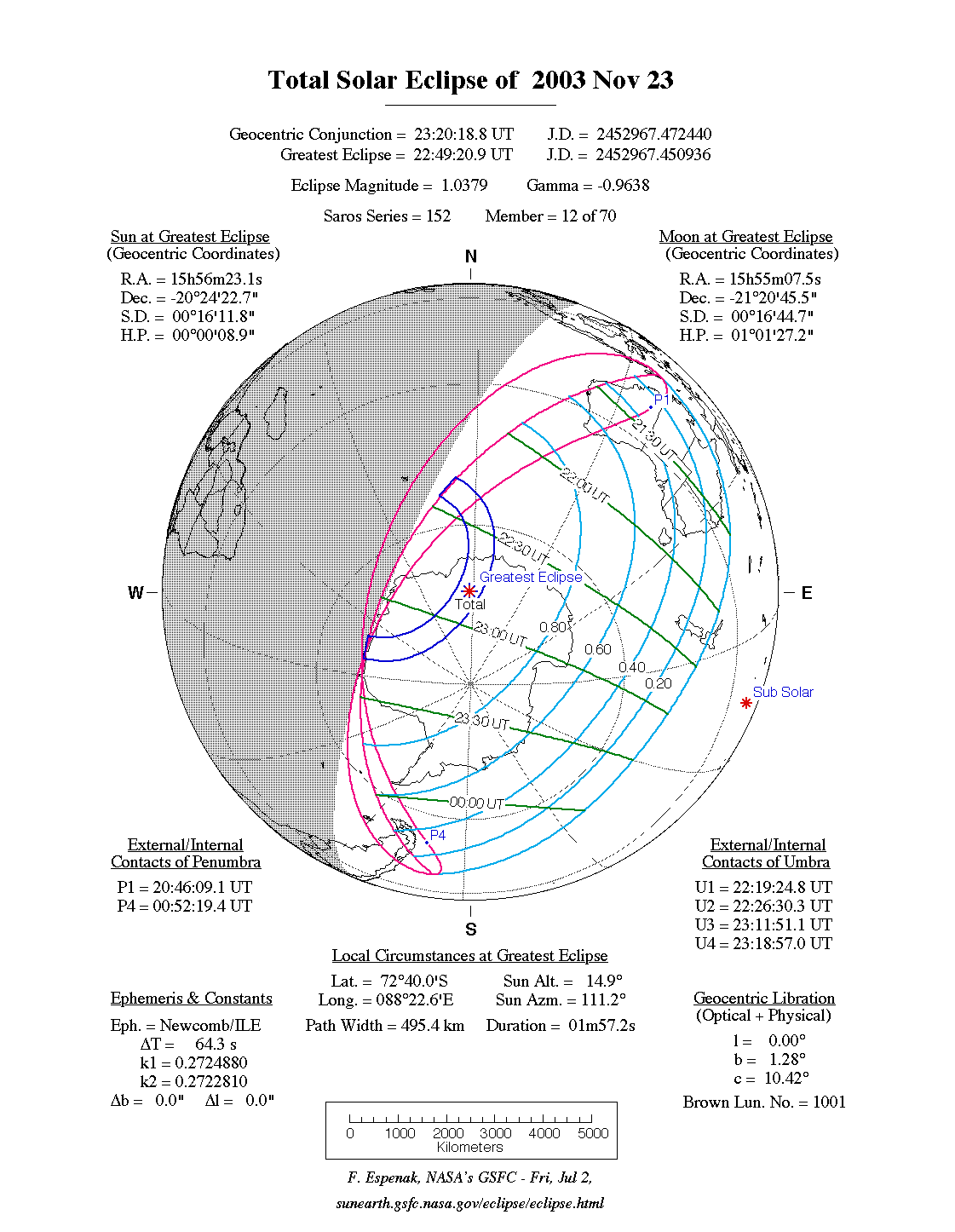
Template:Short description Template:Infobox solar eclipse A total solar eclipse occurred at the Moon's descending node of orbit between Sunday, November 23 and Monday, November 24, 2003,[1][2] with a magnitude of 1.0379. A solar eclipse occurs when the Moon passes between Earth and the Sun, thereby totally or partly obscuring the image of the Sun for a viewer on Earth. A total solar eclipse occurs when the Moon's apparent diameter is larger than the Sun's, blocking all direct sunlight, turning day into darkness. Totality occurs in a narrow path across Earth's surface, with the partial solar eclipse visible over a surrounding region thousands of kilometres wide. Occurring about 25 minutes before perigee (on November 23, 2003, at 23:15 UTC), the Moon's apparent diameter was near its maximum.[3] Perigee did occur just past the greatest point of this eclipse.
For most solar eclipses the path of totality moves eastwards. In this case the path moved south and then west round Antarctica.
Totality was visible from a corridor in eastern Antarctica. A partial eclipse was visible for parts of Australia, New Zealand, Antarctica, southern Chile, and southern Argentina.
Observations
A Russian icebreaker departed from Port Elizabeth, South Africa carrying tourists to observe the eclipse near the Shackleton Ice Shelf and Novolazarevskaya Station, and then sailed to Hobart, Tasmania. About 100 people from 15 countries were on board, including Iranian amateur astronomer Babak Amin Tafreshi, NASA's Goddard Space Flight Center astrophysicist Fred Espenak, Williams College professor Jay Pasachoff. There are also about 200 scientists and tourists taking two commercial charter flights to observe it over Antarctica. This was the first time humans observed a total solar eclipse from Antarctica.[4][5][6]
Images
.jpg)

Eclipse details
Shown below are two tables displaying details about this particular solar eclipse. The first table outlines times at which the moon's penumbra or umbra attains the specific parameter, and the second table describes various other parameters pertaining to this eclipse.[7]
| Event | Time (UTC) |
|---|---|
| First Penumbral External Contact | 2003 November 23 at 20:47:10.0 UTC |
| First Umbral External Contact | 2003 November 23 at 22:20:25.7 UTC |
| First Central Line | 2003 November 23 at 22:23:45.1 UTC |
| First Umbral Internal Contact | 2003 November 23 at 22:27:31.3 UTC |
| Greatest Duration | 2003 November 23 at 22:50:18.7 UTC |
| Greatest Eclipse | 2003 November 23 at 22:50:21.7 UTC |
| Ecliptic Conjunction | 2003 November 23 at 23:00:01.3 UTC |
| Equatorial Conjunction | 2003 November 23 at 23:21:19.7 UTC |
| Last Umbral Internal Contact | 2003 November 23 at 23:12:52.0 UTC |
| Last Central Line | 2003 November 23 at 23:16:38.4 UTC |
| Last Umbral External Contact | 2003 November 23 at 23:19:57.9 UTC |
| Last Penumbral External Contact | 2003 November 24 at 00:53:20.5 UTC |
| Parameter | Value |
|---|---|
| Eclipse Magnitude | 1.03789 |
| Eclipse Obscuration | 1.07721 |
| Gamma | −0.96381 |
| Sun Right Ascension | 15h56m23.2s |
| Sun Declination | -20°24'22.8" |
| Sun Semi-Diameter | 16'11.8" |
| Sun Equatorial Horizontal Parallax | 08.9" |
| Moon Right Ascension | 15h55m07.5s |
| Moon Declination | -21°20'45.7" |
| Moon Semi-Diameter | 16'44.7" |
| Moon Equatorial Horizontal Parallax | 1°01'27.3" |
| ΔT | 64.5 s |
Eclipse season
Script error: No such module "Labelled list hatnote". This eclipse is part of an eclipse season, a period, roughly every six months, when eclipses occur. Only two (or occasionally three) eclipse seasons occur each year, and each season lasts about 35 days and repeats just short of six months (173 days) later; thus two full eclipse seasons always occur each year. Either two or three eclipses happen each eclipse season. In the sequence below, each eclipse is separated by a fortnight.
| November 9 Ascending node (full moon) |
November 23 Descending node (new moon) |
|---|---|
| File:Lunar eclipse chart close-03nov09.png | File:SE2003Nov23T.png |
| Total lunar eclipse Lunar Saros 126 |
Total solar eclipse Solar Saros 152 |


Related eclipses
Eclipses in 2003
- A total lunar eclipse on May 16.
- An annular solar eclipse on May 31.
- A total lunar eclipse on November 9.
- A total solar eclipse on November 23.
Metonic
- Preceded by: Solar eclipse of February 5, 2000
- Followed by: Solar eclipse of September 11, 2007
Tzolkinex
- Preceded by: Solar eclipse of October 12, 1996
- Followed by: Solar eclipse of January 4, 2011
Half-Saros
- Preceded by: Lunar eclipse of November 18, 1994
- Followed by: Lunar eclipse of November 28, 2012
Tritos
- Preceded by: Solar eclipse of December 24, 1992
- Followed by: Solar eclipse of October 23, 2014
Solar Saros 152
- Preceded by: Solar eclipse of November 12, 1985
- Followed by: Solar eclipse of December 4, 2021
Inex
- Preceded by: Solar eclipse of December 13, 1974
- Followed by: Solar eclipse of November 3, 2032
Triad
- Preceded by: Solar eclipse of January 23, 1917
- Followed by: Solar eclipse of September 23, 2090
Solar eclipses of 2000–2003
Template:Solar eclipse set 2000–2003
Saros 152
Template:Solar Saros series 152
Metonic series
Template:Solar Metonic series 1931–2011
Tritos series
Template:Solar Tritos series 2003 November 23
Inex series
Template:Solar Inex series 2003 November 23
Notes
<templatestyles src="Reflist/styles.css" />
- ↑ Script error: No such module "citation/CS1".
- ↑ Script error: No such module "citation/CS1".
- ↑ Script error: No such module "citation/CS1".
- ↑ Script error: No such module "citation/CS1".
- ↑ Script error: No such module "citation/CS1".
- ↑ Script error: No such module "citation/CS1".
- ↑ Script error: No such module "citation/CS1".
Script error: No such module "Check for unknown parameters".
References
- Fred Espenak and Jay Anderson. "Total Solar Eclipse of 2003 November 23". NASA, July 2003.
Template:Solar eclipse NASA reference
Photos:
- Prof. Druckmüller's eclipse photography site. Flight over Antarctica
- Images from Antarctica by Crayford Manor House Astronomical Society Template:Webarchive
- [1] APOD 8/5/2004, An Antarctic Total Solar Eclipse
- [2] APOD 11/27/2003, The Long Shadow of the Moon, Total solar eclipse from satellite over Antarctica
Script error: No such module "Navbox".