Solar eclipse of November 13, 2012
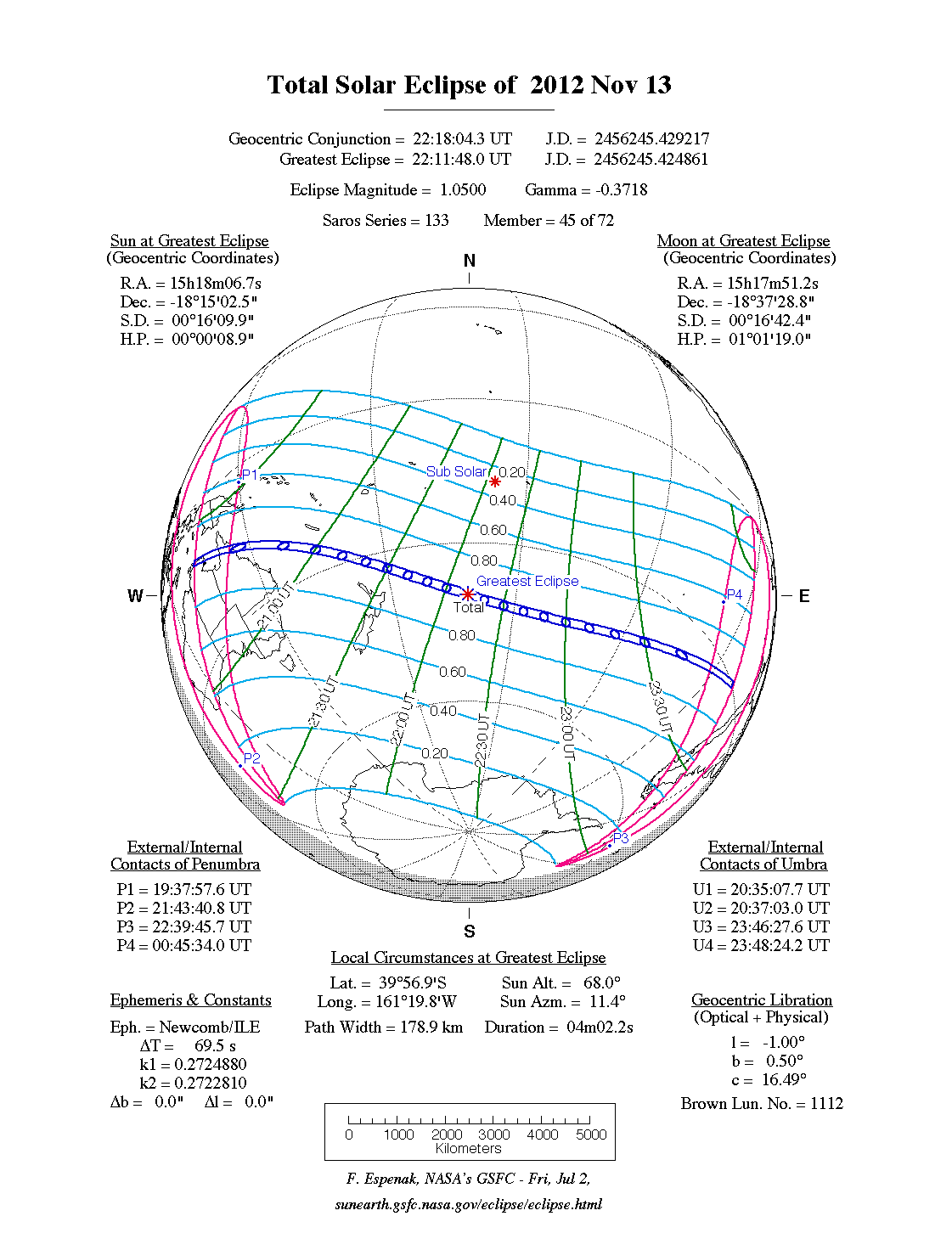
Template:Short description Script error: No such module "Solar eclipse". A total solar eclipse occurred at the Moon's ascending node of orbit between Tuesday, November 13 and Wednesday, November 14, 2012,[1][2][3] with a magnitude of 1.05. A solar eclipse occurs when the Moon passes between Earth and the Sun, thereby totally or partly obscuring the image of the Sun for a viewer on Earth. A total solar eclipse occurs when the Moon's apparent diameter is larger than the Sun's, blocking all direct sunlight, turning day into darkness. Totality occurs in a narrow path across Earth's surface, with the partial solar eclipse visible over a surrounding region thousands of kilometres wide. Occurring about 12 hours before perigee (on November 14, 2012, at 10:20 UTC), the Moon's apparent diameter was larger.[4]
Because it crossed the International Date Line it began in local time on November 14 west of the date line over northern Australia, and ended in local time on November 13 east of the date line near the west coast of South America. Totality was visible from parts of Northern Australia. A partial eclipse was visible for parts of Australia, New Zealand, Oceania, West Antarctica, the Antarctic Peninsula, and southern South America.
Visibility

For this eclipse, totality was visible from northern Australia to about 470 km north of the Chilean Juan Fernández Islands in the southern Pacific Ocean where totality ended. The most populous city to experience totality was Cairns, which had around 2 minutes of totality an hour after daybreak (06:39 AEST, 20:39 UTC) with the sun at an altitude of 14°.[5] Norfolk Island, a small Pacific island east of Australia, experienced a partial eclipse with a maximum eclipse of 98% of the sun obscured at 08:37 NFT and an altitude of 42°.
New Zealand experienced a partial eclipse. Auckland had 84.8% of the sun obscured, whereas Wellington, Christchurch and Dunedin respectively had 71.2%, 61.9% and 52.9% of the sun obscured. Maximum eclipse over New Zealand occurred around 10:30 NZDT (21:30 UTC), with Auckland at 10:27, Wellington at 10:34, Christchurch at 10:35 and Dunedin at 10:36.[6][7]
Most of Chile and parts of Argentina saw a partial eclipse at sunset. In some places over half the sun was obscured. In Chile, Talcahuano in Biobío saw 72% obscured, Castro in Los Lagos saw 56% obscured. Chilean coastal locations were ideally situated to observe an eclipsing sunset over the Pacific Ocean. Points further north, up to about Chañaral, saw the eclipse begin as the sun was setting.
West of the International Date Line the eclipse took place on the morning of November 14. The maximum eclipse totality, of duration 4 min 2 sec, occurred east of the International Date Line on November 13, approximately 2,000 km east of New Zealand, and 9,600 km west of Chile.
On the morning of November 14, skies in Auckland were cloudy, obscuring much of the eclipse, which peaked at 10:27 NZDT.[8] Cloud also obscured the moment of totality at Cairns, disappointing many tourists that had flocked to the area. Eclipse chasers along the northern beaches up through to Port Douglas generally got a clear view, however.
Photo gallery
-
Video of total eclipse in Far North Queensland
-
Screenshot of NASA video viewed from northern Australia
-
Totality from Mount Carbine, Queensland, 20:33 UTC
-
Totality from Mount Mulligan, Queensland, 20:39 UTC
-
Totality from Port Douglas, Queensland, 20:40 UTC
-
Totality with Baily's beads in Mossman Gorge, Queensland, 20:40 UTC
-
Totality from Trinity Beach, Queensland, 20:41 UTC
-
Partial from Redcliffe, Queensland, 20:46 UTC
-
Partial from Adelaide, Australia, 20:47 UTC
-
Partial from Brisbane, Australia, 21:07 UTC
-
Partial from Eltham, Victoria, 21:07 UTC
-
Partial from Nouméa, New Caledonia, 21:09 UTC
-
Partial from Melbourne, Australia, 21:12 UTC
-
Partial from Tauranga, New Zealand, 21:23 UTC
-
Partial from Christchurch, New Zealand, 21:29 UTC
-
Eclipse projection from Wellington, New Zealand
-
Progression from Auckland, New Zealand

.jpg)
.jpg)
.jpg)
_(8201566986).jpg)
.jpg)
.jpg)
.jpg)
.jpg)
.jpg)
_(8183360973).jpg)
.jpg)


.jpg)

Eclipse details
Shown below are two tables displaying details about this particular solar eclipse. The first table outlines times at which the moon's penumbra or umbra attains the specific parameter, and the second table describes various other parameters pertaining to this eclipse.[9]
| Event | Time (UTC) |
|---|---|
| First Penumbral External Contact | 2012 November 13 at 19:39:04.9 UTC |
| First Umbral External Contact | 2012 November 13 at 20:36:15.3 UTC |
| First Central Line | 2012 November 13 at 20:37:12.9 UTC |
| First Umbral Internal Contact | 2012 November 13 at 20:38:10.6 UTC |
| First Penumbral Internal Contact | 2012 November 13 at 21:44:49.3 UTC |
| Ecliptic Conjunction | 2012 November 13 at 22:09:06.9 UTC |
| Greatest Eclipse | 2012 November 13 at 22:12:55.2 UTC |
| Greatest Duration | 2012 November 13 at 22:15:06.9 UTC |
| Equatorial Conjunction | 2012 November 13 at 22:19:11.7 UTC |
| Last Penumbral Internal Contact | 2012 November 13 at 22:40:51.6 UTC |
| Last Umbral Internal Contact | 2012 November 13 at 23:47:34.6 UTC |
| Last Central Line | 2012 November 13 at 23:48:32.9 UTC |
| Last Umbral External Contact | 2012 November 13 at 23:49:31.1 UTC |
| Last Penumbral External Contact | 2012 November 14 at 00:46:41.3 UTC |
| Parameter | Value |
|---|---|
| Eclipse Magnitude | 1.05004 |
| Eclipse Obscuration | 1.10259 |
| Gamma | −0.37189 |
| Sun Right Ascension | 15h18m06.7s |
| Sun Declination | -18°15'02.6" |
| Sun Semi-Diameter | 16'09.9" |
| Sun Equatorial Horizontal Parallax | 08.9" |
| Moon Right Ascension | 15h17m51.2s |
| Moon Declination | -18°37'29.5" |
| Moon Semi-Diameter | 16'42.4" |
| Moon Equatorial Horizontal Parallax | 1°01'19.0" |
| ΔT | 66.8 s |
Eclipse season
Script error: No such module "Labelled list hatnote". This eclipse is part of an eclipse season, a period, roughly every six months, when eclipses occur. Only two (or occasionally three) eclipse seasons occur each year, and each season lasts about 35 days and repeats just short of six months (173 days) later; thus two full eclipse seasons always occur each year. Either two or three eclipses happen each eclipse season. In the sequence below, each eclipse is separated by a fortnight.
| November 13 Ascending node (new moon) |
November 28 Descending node (full moon) |
|---|---|
| File:SE2012Nov13T.png | File:Lunar eclipse chart close-2012Nov28.png |
| Total solar eclipse Solar Saros 133 |
Penumbral lunar eclipse Lunar Saros 145 |


Related eclipses
Eclipses in 2012
- An annular solar eclipse on May 20.
- A partial lunar eclipse on June 4.
- A total solar eclipse on November 13.
- A penumbral lunar eclipse on November 28.
Metonic
- Preceded by: Solar eclipse of January 26, 2009
- Followed by: Solar eclipse of September 1, 2016
Tzolkinex
- Preceded by: Solar eclipse of October 3, 2005
- Followed by: Solar eclipse of December 26, 2019
Half-Saros
- Preceded by: Lunar eclipse of November 9, 2003
- Followed by: Lunar eclipse of November 19, 2021
Tritos
- Preceded by: Solar eclipse of December 14, 2001
- Followed by: Solar eclipse of October 14, 2023
Solar Saros 133
- Preceded by: Solar eclipse of November 3, 1994
- Followed by: Solar eclipse of November 25, 2030
Inex
- Preceded by: Solar eclipse of December 4, 1983
- Followed by: Solar eclipse of October 25, 2041
Triad
- Preceded by: Solar eclipse of January 14, 1926
- Followed by: Solar eclipse of September 14, 2099
Solar eclipses of 2011–2014
This eclipse is a member of a semester series. An eclipse in a semester series of solar eclipses repeats approximately every 177 days and 4 hours (a semester) at alternating nodes of the Moon's orbit.[10]
The partial solar eclipses on January 4, 2011 and July 1, 2011 occur in the previous lunar year eclipse set.
.jpg)


.jpg)


Saros 133
This eclipse is a part of Saros series 133, repeating every 18 years, 11 days, and containing 72 events. The series started with a partial solar eclipse on July 13, 1219. It contains annular eclipses from November 20, 1435 through January 13, 1526; a hybrid eclipse on January 24, 1544; and total eclipses from February 3, 1562 through June 21, 2373. The series ends at member 72 as a partial eclipse on September 5, 2499. Its eclipses are tabulated in three columns; every third eclipse in the same column is one exeligmos apart, so they all cast shadows over approximately the same parts of the Earth.
The longest duration of annularity was produced by member 25 at 1 minutes, 14 seconds on November 30, 1453, and the longest duration of totality was produced by member 61 at 6 minutes, 50 seconds on August 7, 1850. All eclipses in this series occur at the Moon’s ascending node of orbit.[11]
| Series members 34–55 occur between 1801 and 2200: | ||
|---|---|---|
| 34 | 35 | 36 |
| File:SE1814Jul17T.png July 17, 1814 |
File:SE1832Jul27T.png July 27, 1832 |
File:SE1850Aug07T.png August 7, 1850 |
| 37 | 38 | 39 |
| File:SE1868Aug18T.png August 18, 1868 |
File:SE1886Aug29T.png August 29, 1886 |
File:SE1904Sep09T.png September 9, 1904 |
| 40 | 41 | 42 |
| File:SE1922Sep21T.png September 21, 1922 |
File:SE1940Oct01T.png October 1, 1940 |
File:SE1958Oct12T.png October 12, 1958 |
| 43 | 44 | 45 |
| File:SE1976Oct23T.png October 23, 1976 |
File:SE1994Nov03T.png November 3, 1994 |
File:SE2012Nov13T.png November 13, 2012 |
| 46 | 47 | 48 |
| File:SE2030Nov25T.png November 25, 2030 |
File:SE2048Dec05T.png December 5, 2048 |
File:SE2066Dec17T.png December 17, 2066 |
| 49 | 50 | 51 |
| File:SE2084Dec27T.png December 27, 2084 |
File:SE2103Jan08T.png January 8, 2103 |
File:SE2121Jan19T.png January 19, 2121 |
| 52 | 53 | 54 |
| File:SE2139Jan30T.png January 30, 2139 |
File:SE2157Feb09T.png February 9, 2157 |
File:SE2175Feb21T.png February 21, 2175 |
| 55 | ||
| File:SE2193Mar03T.png March 3, 2193 | ||


Metonic series
The metonic series repeats eclipses every 19 years (6939.69 days), lasting about 5 cycles. Eclipses occur in nearly the same calendar date. In addition, the octon subseries repeats 1/5 of that or every 3.8 years (1387.94 days). All eclipses in this table occur at the Moon's ascending node.
| 21 eclipse events between June 21, 1982 and June 21, 2058 | ||||
|---|---|---|---|---|
| June 21 | April 8–9 | January 26 | November 13–14 | September 1–2 |
| 117 | 119 | 121 | 123 | 125 |
| File:SE1982Jun21P.png June 21, 1982 |
File:SE1986Apr09P.png April 9, 1986 |
File:SE1990Jan26A.png January 26, 1990 |
File:SE1993Nov13P.png November 13, 1993 |
File:SE1997Sep02P.png September 2, 1997 |
| 127 | 129 | 131 | 133 | 135 |
| File:SE2001Jun21T.png June 21, 2001 |
File:SE2005Apr08H.png April 8, 2005 |
File:SE2009Jan26A.png January 26, 2009 |
File:SE2012Nov13T.png November 13, 2012 |
File:SE2016Sep01A.png September 1, 2016 |
| 137 | 139 | 141 | 143 | 145 |
| File:SE2020Jun21A.png June 21, 2020 |
File:SE2024Apr08T.png April 8, 2024 |
File:SE2028Jan26A.png January 26, 2028 |
File:SE2031Nov14H.png November 14, 2031 |
File:SE2035Sep02T.png September 2, 2035 |
| 147 | 149 | 151 | 153 | 155 |
| File:SE2039Jun21A.png June 21, 2039 |
File:SE2043Apr09T.png April 9, 2043 |
File:SE2047Jan26P.png January 26, 2047 |
File:SE2050Nov14P.png November 14, 2050 |
File:SE2054Sep02P.png September 2, 2054 |
| 157 | ||||
| File:SE2058Jun21P.png June 21, 2058 | ||||


Tritos series
Template:Solar Tritos series 2001 December 14
Inex series
This eclipse is a part of the long period inex cycle, repeating at alternating nodes, every 358 synodic months (≈ 10,571.95 days, or 29 years minus 20 days). Their appearance and longitude are irregular due to a lack of synchronization with the anomalistic month (period of perigee). However, groupings of 3 inex cycles (≈ 87 years minus 2 months) comes close (≈ 1,151.02 anomalistic months), so eclipses are similar in these groupings.
| Series members between 1801 and 2200 | ||
|---|---|---|
| File:SE1810Apr04A.gif April 4, 1810 (Saros 126) |
File:SE1839Mar15T.gif March 15, 1839 (Saros 127) |
File:SE1868Feb23A.gif February 23, 1868 (Saros 128) |
| File:SE1897Feb01A.gif February 1, 1897 (Saros 129) |
File:SE1926Jan14T.png January 14, 1926 (Saros 130) |
File:SE1954Dec25A.png December 25, 1954 (Saros 131) |
| File:SE1983Dec04A.png December 4, 1983 (Saros 132) |
File:SE2012Nov13T.png November 13, 2012 (Saros 133) |
File:SE2041Oct25A.png October 25, 2041 (Saros 134) |
| File:SE2070Oct04A.png October 4, 2070 (Saros 135) |
File:SE2099Sep14T.png September 14, 2099 (Saros 136) |
File:SE2128Aug25A.png August 25, 2128 (Saros 137) |
| File:SE2157Aug05A.png August 5, 2157 (Saros 138) |
File:SE2186Jul16T.png July 16, 2186 (Saros 139) |
|


Notes
<templatestyles src="Reflist/styles.css" />
Script error: No such module "Check for unknown parameters".
References
<templatestyles src="Reflist/styles.css" />
- ↑ Script error: No such module "citation/CS1".
- ↑ Script error: No such module "citation/CS1".
- ↑ Script error: No such module "citation/CS1".
- ↑ Script error: No such module "citation/CS1".
- ↑ Script error: No such module "citation/CS1".
- ↑ Script error: No such module "citation/CS1".
- ↑ Total Solar Eclipse of 2012 November 14 in Australia Xavier M. Jubier
- ↑ Script error: No such module "citation/CS1".
- ↑ Script error: No such module "citation/CS1".
- ↑ Script error: No such module "citation/CS1".
- ↑ Script error: No such module "citation/CS1".
Script error: No such module "Check for unknown parameters".
External links
Script error: No such module "Side box".
- Earth visibility chart and eclipse statistics Eclipse Predictions by Fred Espenak, NASA/GSFC
- www.eclipser.ca: Jay Anderson 2012 November 13 Total Solar Eclipse
- timeanddate.com Nov 13 - Nov 14, 2012 Total Solar Eclipse — Animated eclipse viewer
- NASA video of eclipse, shot in northern Australia
Script error: No such module "Navbox".