Solar eclipse of November 10, 1920
Template:Short description Script error: No such module "Solar eclipse". A partial solar eclipse occurred at the Moon's ascending node of orbit on Wednesday, November 10, 1920,[1] with a magnitude of 0.742. A solar eclipse occurs when the Moon passes between Earth and the Sun, thereby totally or partly obscuring the image of the Sun for a viewer on Earth. A partial solar eclipse occurs in the polar regions of the Earth when the center of the Moon's shadow passes above or below the Earth.
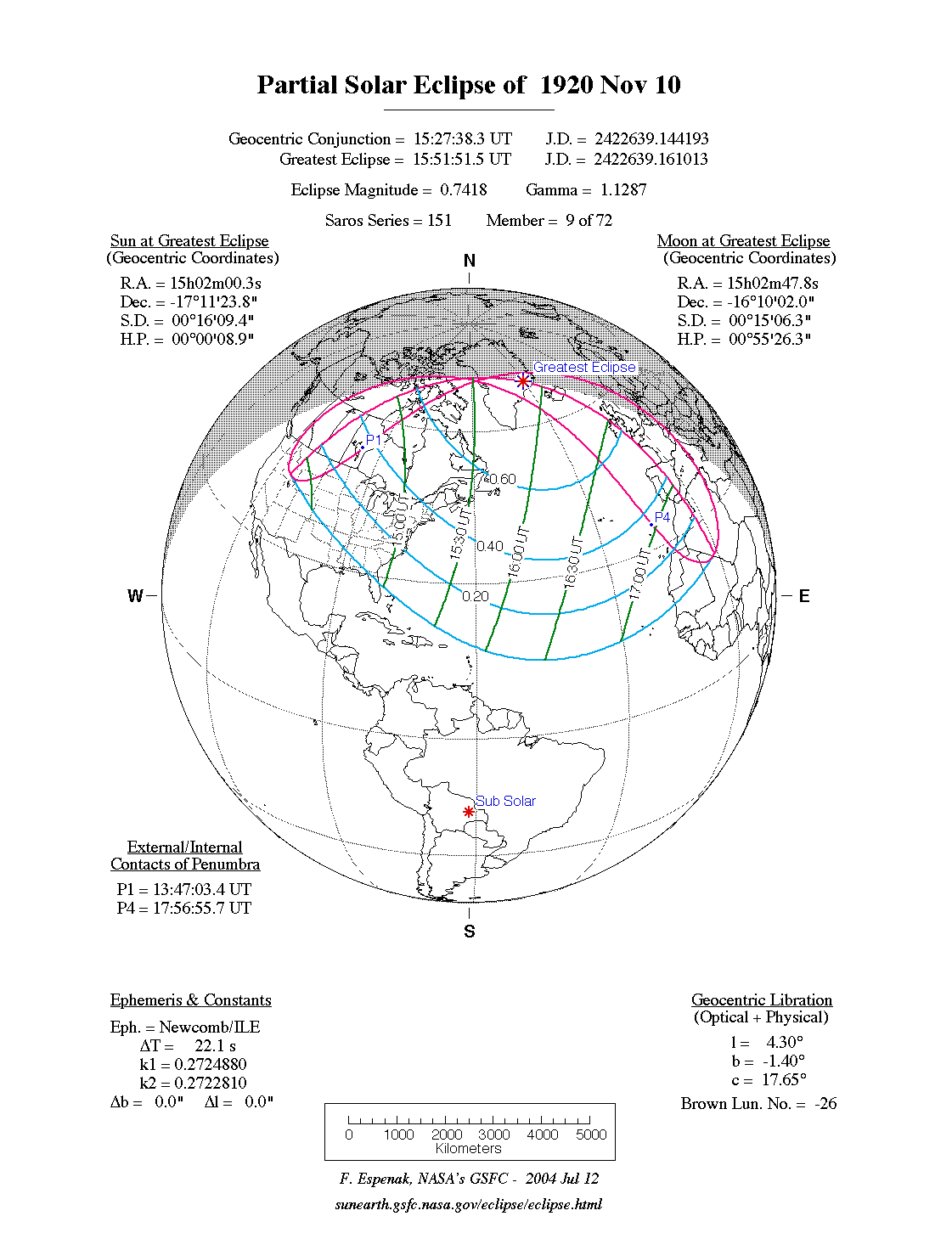
A partial eclipse was visible for parts of Canada, the United States, Northwest Africa, and Western Europe.
Eclipse details
Shown below are two tables displaying details about this particular solar eclipse. The first table outlines times at which the moon's penumbra or umbra attains the specific parameter, and the second table describes various other parameters pertaining to this eclipse.[2]
| Event | Time (UTC) |
|---|---|
| First Penumbral External Contact | 1920 November 10 at 13:47:26.5 UTC |
| Equatorial Conjunction | 1920 November 10 at 15:28:01.8 UTC |
| Greatest Eclipse | 1920 November 10 at 15:52:15.0 UTC |
| Ecliptic Conjunction | 1920 November 10 at 16:05:10.6 UTC |
| Last Penumbral External Contact | 1920 November 10 at 17:57:19.7 UTC |
| Parameter | Value |
|---|---|
| Eclipse Magnitude | 0.74201 |
| Eclipse Obscuration | 0.65874 |
| Gamma | 1.12869 |
| Sun Right Ascension | 15h02m00.4s |
| Sun Declination | -17°11'23.8" |
| Sun Semi-Diameter | 16'09.4" |
| Sun Equatorial Horizontal Parallax | 08.9" |
| Moon Right Ascension | 15h02m47.8s |
| Moon Declination | -16°10'02.1" |
| Moon Semi-Diameter | 15'06.3" |
| Moon Equatorial Horizontal Parallax | 0°55'26.3" |
| ΔT | 22.1 s |
Eclipse season
Script error: No such module "Labelled list hatnote". This eclipse is part of an eclipse season, a period, roughly every six months, when eclipses occur. Only two (or occasionally three) eclipse seasons occur each year, and each season lasts about 35 days and repeats just short of six months (173 days) later; thus two full eclipse seasons always occur each year. Either two or three eclipses happen each eclipse season. In the sequence below, each eclipse is separated by a fortnight.
| October 27 Descending node (full moon) |
November 10 Ascending node (new moon) |
|---|---|
| File:Lunar eclipse chart close-1920Oct27.png | File:SE1920Nov10P.png |
| Total lunar eclipse Lunar Saros 125 |
Partial solar eclipse Solar Saros 151 |


Related eclipses
Eclipses in 1920
- A total lunar eclipse on May 3.
- A partial solar eclipse on May 18.
- A total lunar eclipse on October 27.
- A partial solar eclipse on November 10.
Metonic
- Preceded by: Solar eclipse of January 23, 1917
- Followed by: Solar eclipse of August 30, 1924
Tzolkinex
- Preceded by: Solar eclipse of September 30, 1913
- Followed by: Solar eclipse of December 24, 1927
Half-Saros
- Preceded by: Lunar eclipse of November 6, 1911
- Followed by: Lunar eclipse of November 17, 1929
Tritos
- Preceded by: Solar eclipse of December 12, 1909
- Followed by: Solar eclipse of October 11, 1931
Solar Saros 151
- Preceded by: Solar eclipse of October 31, 1902
- Followed by: Solar eclipse of November 21, 1938
Inex
- Preceded by: Solar eclipse of December 1, 1891
- Followed by: Solar eclipse of October 21, 1949
Triad
- Preceded by: Solar eclipse of January 9, 1834
- Followed by: Solar eclipse of September 11, 2007
Solar eclipses of 1916–1920
This eclipse is a member of a semester series. An eclipse in a semester series of solar eclipses repeats approximately every 177 days and 4 hours (a semester) at alternating nodes of the Moon's orbit.[3]
The solar eclipses on February 3, 1916 (total), July 30, 1916 (annular), January 23, 1917 (partial), and July 19, 1917 (partial) occur in the previous lunar year eclipse set.
| Solar eclipse series sets from 1916 to 1920 | ||||||
|---|---|---|---|---|---|---|
| Ascending node | Descending node | |||||
| Saros | Map | Gamma | Saros | Map | Gamma | |
| 111 | December 24, 1916 File:SE1916Dec24P.png Partial |
−1.5321 | 116 | June 19, 1917 File:SE1917Jun19P.png Partial |
1.2857 | |
| 121 | December 14, 1917 File:SE1917Dec14A.png Annular |
−0.9157 | 126 | June 8, 1918 File:SE1918Jun08T.png Total |
0.4658 | |
| 131 | December 3, 1918 File:SE1918Dec03A.png Annular |
−0.2387 | 136 File:1919 eclipse positive.jpg Totality in Príncipe |
May 29, 1919 File:SE1919May29T.png Total |
−0.2955 | |
| 141 | November 22, 1919 File:SE1919Nov22A.png Annular |
0.4549 | 146 | May 18, 1920 File:SE1920May18P.png Partial |
−1.0239 | |
| 151 | November 10, 1920 File:SE1920Nov10P.png Partial |
1.1287 | ||||


Saros 151
Template:Solar Saros series 151
Metonic series
Template:Solar Metonic series 1837–1928
Tritos series
This eclipse is a part of a tritos cycle, repeating at alternating nodes every 135 synodic months (≈ 3986.63 days, or 11 years minus 1 month). Their appearance and longitude are irregular due to a lack of synchronization with the anomalistic month (period of perigee), but groupings of 3 tritos cycles (≈ 33 years minus 3 months) come close (≈ 434.044 anomalistic months), so eclipses are similar in these groupings.
| Series members between 1801 and 1964 | ||||
|---|---|---|---|---|
| File:SE1811Sep17A.gif September 17, 1811 (Saros 141) |
File:SE1822Aug16T.gif August 16, 1822 (Saros 142) |
File:SE1833Jul17T.gif July 17, 1833 (Saros 143) |
File:SE1844Jun16P.gif June 16, 1844 (Saros 144) |
File:SE1855May16P.gif May 16, 1855 (Saros 145) |
| File:SE1866Apr15P.gif April 15, 1866 (Saros 146) |
File:SE1877Mar15P.gif March 15, 1877 (Saros 147) |
File:SE1888Feb11P.gif February 11, 1888 (Saros 148) |
File:SE1899Jan11P.gif January 11, 1899 (Saros 149) |
File:SE1909Dec12P.png December 12, 1909 (Saros 150) |
| File:SE1920Nov10P.png November 10, 1920 (Saros 151) |
File:SE1931Oct11P.png October 11, 1931 (Saros 152) |
File:SE1942Sep10P.png September 10, 1942 (Saros 153) |
File:SE1953Aug09P.png August 9, 1953 (Saros 154) |
File:SE1964Jul09P.png July 9, 1964 (Saros 155) |


Inex series
Template:Solar Inex series 2007 September 11
Notes
<templatestyles src="Reflist/styles.css" />
Script error: No such module "Check for unknown parameters".
References
- Earth visibility chart and eclipse statistics Eclipse Predictions by Fred Espenak, NASA/GSFC
External links
Script error: No such module "Navbox".