Solar eclipse of March 9, 2016
Template:Short description Script error: No such module "Solar eclipse". A total solar eclipse occurred at the Moon's descending node of orbit between Tuesday, March 8 and Wednesday, March 9, 2016,[1][2][3][4][5] with a magnitude of 1.045. A total solar eclipse occurs when the Moon's apparent diameter is larger than the Sun's and the apparent path of the Sun and Moon intersect, blocking all direct sunlight and turning daylight into darkness; the Sun appears to be black with a halo around it. Totality occurs in a narrow path across Earth's surface, with the partial solar eclipse visible over a surrounding region thousands of kilometres wide. Occurring about 1.25 days before perigee (on March 10, 2016, at 7:00 UTC), the Moon's apparent diameter was larger.[6]
Totality was visible from parts of Indonesia, Micronesia, and the Marshall Islands. A partial eclipse was visible for parts of Southeast Asia, East Asia, Alaska, northwestern Australia, and Hawaii. If viewed from east of the International Date Line (for instance from Hawaii), the eclipse took place on March 8 (Tuesday) (local time) and elsewhere on March 9 (Wednesday).[7]
The eclipse was clearly visible in many parts of Indonesia, including Central Sulawesi and Ternate, but obscured by clouds and smokes in Palembang, the largest city on the path of totality.[8][9] The eclipse coincided with Nyepi, a public holiday in Indonesia and the end of the Balinese saka calendar. Because Nyepi is normally a day of silence, Muslims in Bali had to be given special dispensation to attend special prayer services during the eclipse.[10]
Path of the eclipse
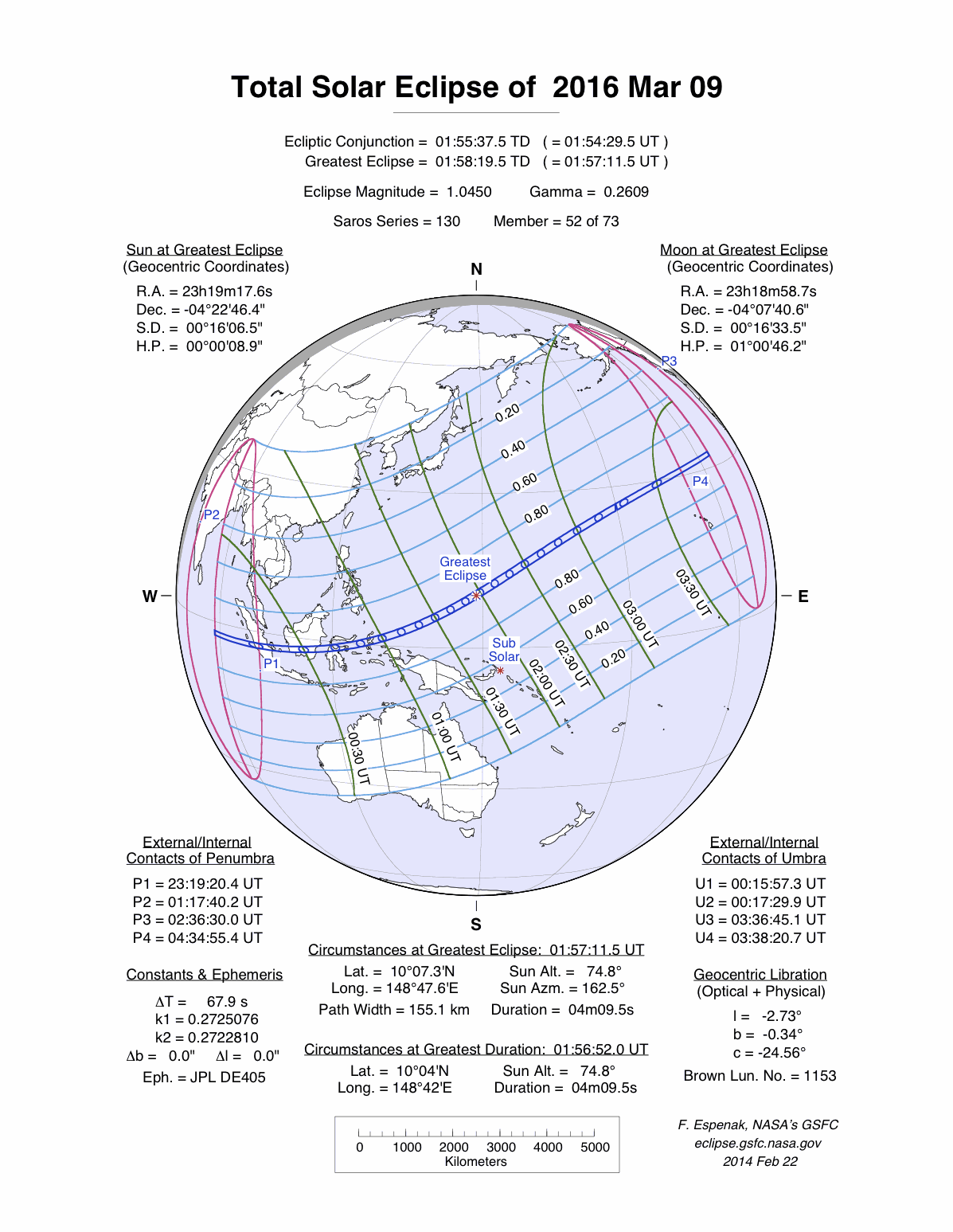
On March 9, 2016, a large area of the Pacific, covering Indonesia, Borneo, but also large parts of Southeast Asia and Australia, witnessed a partial solar eclipse. It was total in multiple islands of Indonesia, three atolls of the Federated States of Micronesia (Eauripik, Woleai and Ifalik) and the central Pacific, starting at sunrise over Sumatra and ending at sunset north of Hawaii. In the Eastern Pacific Ocean, the totality exceeded a duration of more than 4 minutes.[11] ed, and much of East Asia witnessed more than 50% partial eclipse.[11][12]
The largest city along the path of totality was Palembang in southern Sumatra (Script error: No such module "convert". from Jakarta and Script error: No such module "convert". from Singapore).[9]
In order to watch the total solar eclipse, Alaska Airlines adjusted the flight plan for Flight 870. The flight passed through the umbral shadow about Script error: No such module "convert". north of Hawaii.[13]
Maps
| File:Solar eclipse animate (2016-Mar-09).GIF | File:An EPIC Eclipse.gif Animation assembled from 13 images acquired by NASA's Earth Polychromatic Imaging Camera atop the DSCOVR satellite. |
| File:Global path of the total solar eclipse 2016-03-09.png Path of the eclipse in Southeast Asia | |
| File:Path of the total solar eclipse of 2016-03-09 in Indonesia.png Path of the eclipse in Indonesia | |


Gallery
-
Partial in Jakarta, Indonesia, 0:23 UTC
-
Partial in Nanyang Technological University, Singapore, 0:23 UTC
-
Partial in Ho Chi Minh City, Vietnam, 0:26 UTC
-
Partial in Marina Bay, Singapore, 0:26 UTC
-
Partial in Dompu, Indonesia, 0:38 UTC
-
Diamond ring effect in Tanjung Pandan, Indonesia. 0:42 UTC
-
Partial in Khon Kaen University, Thailand, 0:46 UTC
-
Partial in Nonthaburi, Thailand, 0:52 UTC
-
Partial in Jerudong, Brunei, 1:01 UTC
-
Partial in Langkawi, Malaysia, 1:16 UTC
-
Partial in Hefei, China, 1:40 UTC


Eclipse details
Shown below are two tables displaying details about this particular solar eclipse. The first table outlines times at which the moon's penumbra or umbra attains the specific parameter, and the second table describes various other parameters pertaining to this eclipse.[14]
| Event | Time (UTC) |
|---|---|
| First Penumbral External Contact | 2016 March 08 at 23:20:28.3 UTC |
| First Umbral External Contact | 2016 March 09 at 00:17:05.3 UTC |
| First Central Line | 2016 March 09 at 00:17:51.5 UTC |
| First Umbral Internal Contact | 2016 March 09 at 00:18:37.8 UTC |
| First Penumbral Internal Contact | 2016 March 09 at 01:18:48.1 UTC |
| Ecliptic Conjunction | 2016 March 09 at 01:55:37.5 UTC |
| Greatest Duration | 2016 March 09 at 01:57:59.8 UTC |
| Greatest Eclipse | 2016 March 09 at 01:58:19.5 UTC |
| Equatorial Conjunction | 2016 March 09 at 02:06:49.1 UTC |
| Last Penumbral Internal Contact | 2016 March 09 at 08:37:36.7 UTC |
| Last Umbral Internal Contact | 2016 March 09 at 03:37:53.0 UTC |
| Last Central Line | 2016 March 09 at 03:38:40.8 UTC |
| Last Umbral External Contact | 2016 March 09 at 03:39:28.6 UTC |
| Last Penumbral External Contact | 2016 March 09 at 04:36:03.3 UTC |
| Parameter | Value |
|---|---|
| Eclipse Magnitude | 1.04499 |
| Eclipse Obscuration | 1.09200 |
| Gamma | 0.26092 |
| Sun Right Ascension | 23h19m17.6s |
| Sun Declination | -04°22'46.4" |
| Sun Semi-Diameter | 16'06.5" |
| Sun Equatorial Horizontal Parallax | 08.9" |
| Moon Right Ascension | 23h18m58.7s |
| Moon Declination | -04°07'40.6" |
| Moon Semi-Diameter | 16'33.5" |
| Moon Equatorial Horizontal Parallax | 1°00'46.2" |
| ΔT | 68.1 s |
Eclipse season
Script error: No such module "Labelled list hatnote". This eclipse is part of an eclipse season, a period, roughly every six months, when eclipses occur. Only two (or occasionally three) eclipse seasons occur each year, and each season lasts about 35 days and repeats just short of six months (173 days) later; thus two full eclipse seasons always occur each year. Either two or three eclipses happen each eclipse season. In the sequence below, each eclipse is separated by a fortnight.
| March 9 Descending node (new moon) |
March 23 Ascending node (full moon) |
|---|---|
| File:SE2016Mar09T.png | File:Lunar eclipse chart close-2016Mar23.png |
| Total solar eclipse Solar Saros 130 |
Penumbral lunar eclipse Lunar Saros 142 |


Related eclipses
Eclipses in 2016
- A total solar eclipse on March 9.
- A penumbral lunar eclipse on March 23.
- A penumbral lunar eclipse on August 18.
- An annular solar eclipse on September 1.
- A penumbral lunar eclipse on September 16.
Metonic
- Preceded by: Solar eclipse of May 20, 2012
- Followed by: Solar eclipse of December 26, 2019
Tzolkinex
- Preceded by: Solar eclipse of January 26, 2009
- Followed by: Solar eclipse of April 20, 2023
Half-Saros
- Preceded by: Lunar eclipse of March 3, 2007
- Followed by: Lunar eclipse of March 14, 2025
Tritos
- Preceded by: Solar eclipse of April 8, 2005
- Followed by: Solar eclipse of February 6, 2027
Solar Saros 130
- Preceded by: Solar eclipse of February 26, 1998
- Followed by: Solar eclipse of March 20, 2034
Inex
- Preceded by: Solar eclipse of March 29, 1987
- Followed by: Solar eclipse of February 16, 2045
Triad
- Preceded by: Solar eclipse of May 9, 1929
- Followed by: Solar eclipse of January 8, 2103
Solar eclipses of 2015–18
This eclipse is a member of a semester series. An eclipse in a semester series of solar eclipses repeats approximately every 177 days and 4 hours (a semester) at alternating nodes of the Moon's orbit.[15]
The partial solar eclipse on July 13, 2018 occurs in the next lunar year eclipse set.


Saros 130
This eclipse is a part of Saros series 130, repeating every 18 years, 11 days, and containing 73 events. The series started with a partial solar eclipse on August 20, 1096. It contains total eclipses from April 5, 1475 through July 18, 2232. There are no annular or hybrid eclipses in this set. The series ends at member 73 as a partial eclipse on October 25, 2394. Its eclipses are tabulated in three columns; every third eclipse in the same column is one exeligmos apart, so they all cast shadows over approximately the same parts of the Earth.
The longest duration of totality was produced by member 30 at 6 minutes, 41 seconds on July 11, 1619. All eclipses in this series occur at the Moon’s descending node of orbit.[16]
| Series members 41–62 occur between 1801 and 2200: | ||
|---|---|---|
| 41 | 42 | 43 |
| File:SE1817Nov09T.gif November 9, 1817 |
File:SE1835Nov20T.gif November 20, 1835 |
File:SE1853Nov30T.gif November 30, 1853 |
| 44 | 45 | 46 |
| File:SE1871Dec12T.gif December 12, 1871 |
File:SE1889Dec22T.png December 22, 1889 |
File:SE1908Jan03T.png January 3, 1908 |
| 47 | 48 | 49 |
| File:SE1926Jan14T.png January 14, 1926 |
File:SE1944Jan25T.png January 25, 1944 |
File:SE1962Feb05T.png February 5, 1962 |
| 50 | 51 | 52 |
| File:SE1980Feb16T.png February 16, 1980 |
File:SE1998Feb26T.png February 26, 1998 |
File:SE2016Mar09T.png March 9, 2016 |
| 53 | 54 | 55 |
| File:SE2034Mar20T.png March 20, 2034 |
File:SE2052Mar30T.png March 30, 2052 |
File:SE2070Apr11T.png April 11, 2070 |
| 56 | 57 | 58 |
| File:SE2088Apr21T.png April 21, 2088 |
File:SE2106May03T.png May 3, 2106 |
File:SE2124May14T.png May 14, 2124 |
| 59 | 60 | 61 |
| File:SE2142May25T.png May 25, 2142 |
File:SE2160Jun04T.png June 4, 2160 |
File:SE2178Jun16T.png June 16, 2178 |
| 62 | ||
| File:SE2196Jun26T.png June 26, 2196 | ||


Metonic series
The metonic series repeats eclipses every 19 years (6939.69 days), lasting about 5 cycles. Eclipses occur in nearly the same calendar date. In addition, the octon subseries repeats 1/5 of that or every 3.8 years (1387.94 days). All eclipses in this table occur at the Moon's descending node.
| 21 eclipse events between May 21, 1993 and May 20, 2069 | ||||
|---|---|---|---|---|
| May 20–21 | March 9 | December 25–26 | October 13–14 | August 1–2 |
| 118 | 120 | 122 | 124 | 126 |
| File:SE1993May21P.png May 21, 1993 |
File:SE1997Mar09T.png March 9, 1997 |
File:SE2000Dec25P.png December 25, 2000 |
File:SE2004Oct14P.png October 14, 2004 |
File:SE2008Aug01T.png August 1, 2008 |
| 128 | 130 | 132 | 134 | 136 |
| File:SE2012May20A.png May 20, 2012 |
File:SE2016Mar09T.png March 9, 2016 |
File:SE2019Dec26A.png December 26, 2019 |
File:SE2023Oct14A.png October 14, 2023 |
File:SE2027Aug02T.png August 2, 2027 |
| 138 | 140 | 142 | 144 | 146 |
| File:SE2031May21A.png May 21, 2031 |
File:SE2035Mar09A.png March 9, 2035 |
File:SE2038Dec26T.png December 26, 2038 |
File:SE2042Oct14A.png October 14, 2042 |
File:SE2046Aug02T.png August 2, 2046 |
| 148 | 150 | 152 | 154 | 156 |
| File:SE2050May20H.png May 20, 2050 |
File:SE2054Mar09P.png March 9, 2054 |
File:SE2057Dec26T.png December 26, 2057 |
File:SE2061Oct13A.png October 13, 2061 |
File:SE2065Aug02P.png August 2, 2065 |
| 158 | ||||
| File:SE2069May20P.png May 20, 2069 | ||||


Tritos series
Template:Solar Tritos series 2005 April 8
Inex series
Template:Solar Inex series 2016 March 9
Notes
<templatestyles src="Reflist/styles.css" />
- ↑ Script error: No such module "citation/CS1".
- ↑ Script error: No such module "citation/CS1".
- ↑ Script error: No such module "citation/CS1".
- ↑ Script error: No such module "citation/CS1".
- ↑ Script error: No such module "citation/CS1".
- ↑ Script error: No such module "citation/CS1".
- ↑ Script error: No such module "citation/CS1".
- ↑ Script error: No such module "citation/CS1".
- ↑ a b Script error: No such module "citation/CS1".
- ↑ Script error: No such module "citation/CS1".
- ↑ a b Script error: No such module "citation/CS1".
- ↑ Script error: No such module "citation/CS1".
- ↑ Script error: No such module "citation/CS1".
- ↑ Script error: No such module "citation/CS1".
- ↑ Script error: No such module "citation/CS1".
- ↑ Script error: No such module "citation/CS1".
Script error: No such module "Check for unknown parameters".
References
Script error: No such module "Side box".
- Earth visibility chart and eclipse statistics Eclipse Predictions by Fred Espenak, NASA/GSFC
- F. Espenak, J. Meeus: Five Millennium Catalog of Solar eclipses, NASA/TP-2009-213174
- Script error: No such module "citation/CS1".
- hermit.org: Total Solar Eclipse: March 9 2016
- Interactive map of the eclipse with local circumstances and diagram
- EU project Stars4All: Eclipse online broadcast from Palu (Indonesia)
- Template:Replace on YouTubeScript error: No such module "Check for unknown parameters".
External links
- High-resolution animation of eclipse shadow by Seán Doran from JAXA's Himawari imagery
Script error: No such module "Navbox".