Solar eclipse of March 7, 1970
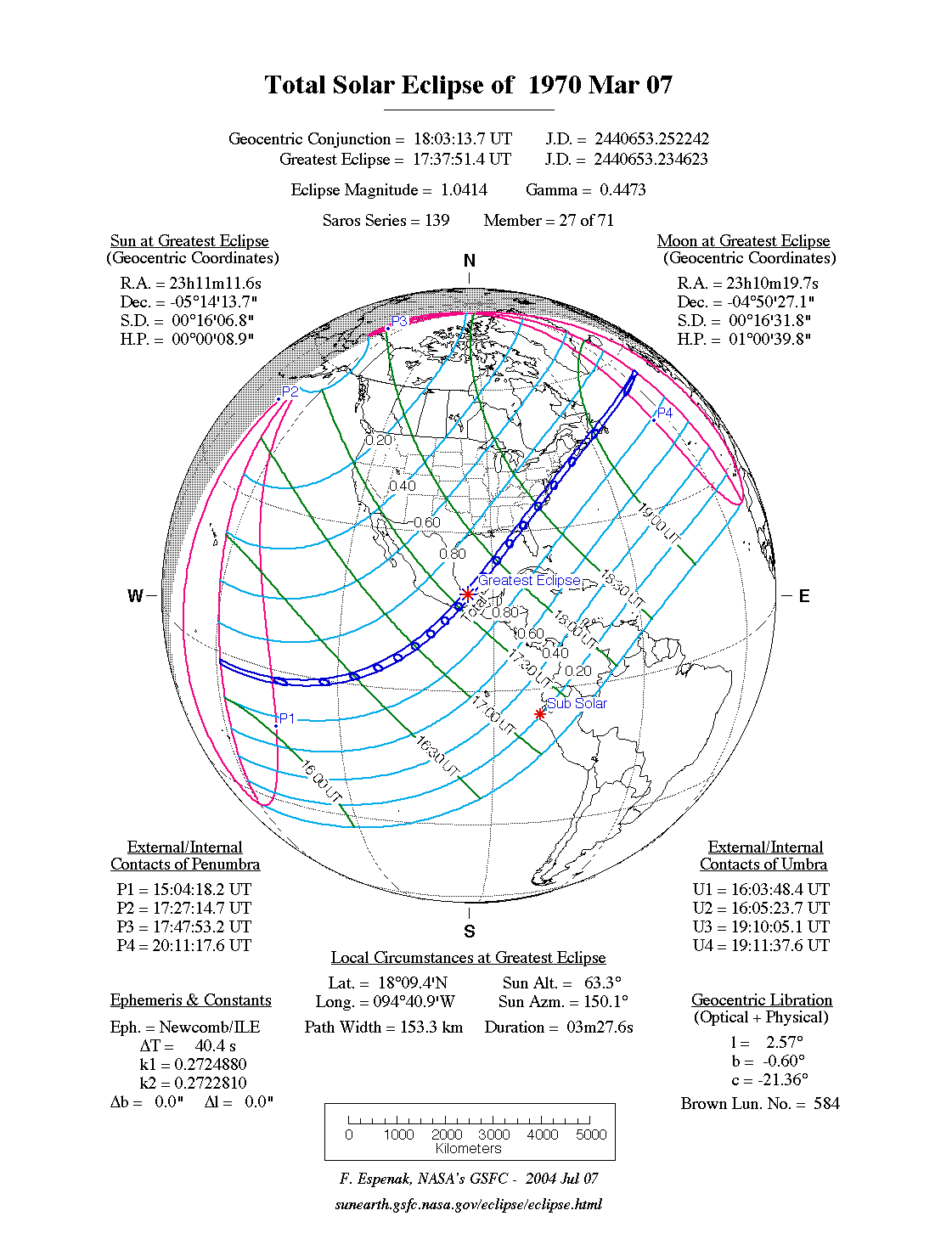
Template:Short description Script error: No such module "Solar eclipse". A total solar eclipse occurred at the Moon's ascending node of orbit on Saturday, March 7, 1970,[1][2][3][4][5][6] with a magnitude of 1.0414. A solar eclipse occurs when the Moon passes between Earth and the Sun, thereby totally or partly obscuring the image of the Sun for a viewer on Earth. A total solar eclipse occurs when the Moon's apparent diameter is larger than the Sun's, blocking all direct sunlight, turning day into darkness. Totality occurs in a narrow path across Earth's surface, with the partial solar eclipse visible over a surrounding region thousands of kilometres wide. Occurring about 1.3 days after perigee (on March 6, 1970, at 10:30 UTC), this eclipse occurred when the Moon's apparent diameter was larger.[7]
The greatest eclipse occurred over Mexico at 11:38 am CST, with totality lasting 3 minutes and 27.65 seconds. Totality over the U.S. lasted up to 3 minutes and 10 seconds.[8] The media declared Perry as the first municipality in Florida to be in the eclipse direct path.
Inclement weather obstructed the viewing from that location and most of the eclipse path through the remainder of the southern states. There was not an eclipse with a greater duration of totality over the contiguous U.S. until April 8, 2024, a period of 54 years.
Totality was visible across southern Mexico and the Gulf of Mexico, Florida, Georgia, South Carolina, North Carolina, Virginia, Maryland, and Nantucket, Massachusetts in the United States, northeast to the Maritimes of eastern Canada, and northern Miquelon-Langlade in the French overseas collectivity of Saint Pierre and Miquelon.[9] A partial eclipse was visible for parts of Hawaii, North America, Central America, the Caribbean, and northern South America.
Scientific effects
This eclipse slowed a radio transmission of atomic time from North Carolina to Washington, D.C.[10]

Observations
An observation team from the Swiss Federal Observatory observed the total eclipse in Nejapa and Miahuatlán, Mexico. The weather conditions were good at both locations. Miahuatlán offered particularly good observation conditions with an altitude of 1,620 metres above sea level, high air quality and solar zenith angle of 63° at the time of the eclipse. The team took images of the corona and analyzed them with a polarizing filter.[11] Austrian-American physicist Erwin Saxl and American physicist Mildred Allen reported anomalous changes in the period of a torsion pendulum when observing a partial solar eclipse with a magnitude of 0.954 from Harvard, Massachusetts, called the "Saxl Effect".[12]
In popular culture

CBS showed the first color broadcast of a total eclipse.[13][14][15][16][17][18][19][20]
This eclipse might be referenced in the second episode of the first season of The Mary Tyler Moore Show when a guest of Mary's accidentally exposes a roll of film that Howard Arnell, an ex-boyfriend of Mary's, says, "It's just the pictures I took of the total eclipse of the sun."
The eclipse may be referenced in the hit popular song “You're So Vain” by Carly Simon,[21] although in context, the lyrics more closely align with a different eclipse two years later.[22]
Eclipse details
Shown below are two tables displaying details about this particular solar eclipse. The first table outlines times at which the moon's penumbra or umbra attains the specific parameter, and the second table describes various other parameters pertaining to this eclipse.[23]
| Event | Time (UTC) |
|---|---|
| First Penumbral External Contact | 1970 March 7 at 15:04:56.2 UTC |
| First Umbral External Contact | 1970 March 7 at 16:04:26.6 UTC |
| First Central Line | 1970 March 7 at 16:05:14.2 UTC |
| First Umbral Internal Contact | 1970 March 7 at 16:06:01.9 UTC |
| First Penumbral Internal Contact | 1970 March 7 at 17:27:53.7 UTC |
| Greatest Duration | 1970 March 7 at 17:35:20.9 UTC |
| Greatest Eclipse | 1970 March 7 at 17:38:29.7 UTC |
| Ecliptic Conjunction | 1970 March 7 at 17:43:07.4 UTC |
| Last Penumbral Internal Contact | 1970 March 7 at 17:48:30.7 UTC |
| Equatorial Conjunction | 1970 March 7 at 18:03:52.1 UTC |
| Last Umbral Internal Contact | 1970 March 7 at 19:10:43.5 UTC |
| Last Central Line | 1970 March 7 at 19:11:29.8 UTC |
| Last Umbral External Contact | 1970 March 7 at 19:12:16.1 UTC |
| Last Penumbral External Contact | 1970 March 7 at 20:11:56.2 UTC |
| Parameter | Value |
|---|---|
| Eclipse Magnitude | 1.04145 |
| Eclipse Obscuration | 1.08461 |
| Gamma | 0.44728 |
| Sun Right Ascension | 23h11m11.6s |
| Sun Declination | -05°14'13.6" |
| Sun Semi-Diameter | 16'06.8" |
| Sun Equatorial Horizontal Parallax | 08.9" |
| Moon Right Ascension | 23h10m19.7s |
| Moon Declination | -04°50'27.0" |
| Moon Semi-Diameter | 16'31.8" |
| Moon Equatorial Horizontal Parallax | 1°00'39.8" |
| ΔT | 40.4 s |
Eclipse season
Script error: No such module "Labelled list hatnote". This eclipse is part of an eclipse season, a period, roughly every six months, when eclipses occur. Only two (or occasionally three) eclipse seasons occur each year, and each season lasts about 35 days and repeats just short of six months (173 days) later; thus two full eclipse seasons always occur each year. Either two or three eclipses happen each eclipse season. In the sequence below, each eclipse is separated by a fortnight.
| February 21 Descending node (full moon) |
March 7 Ascending node (new moon) |
|---|---|
| File:Lunar eclipse chart close-1970Feb21.png | File:SE1970Mar07T.png |
| Partial lunar eclipse Lunar Saros 113 |
Total solar eclipse Solar Saros 139 |


Related eclipses
Eclipses in 1970
- A partial lunar eclipse on February 21.
- A total solar eclipse on March 7.
- A partial lunar eclipse on August 17.
- An annular solar eclipse on August 31.
Metonic
- Preceded by: Solar eclipse of May 20, 1966
- Followed by: Solar eclipse of December 24, 1973
Tzolkinex
- Preceded by: Solar eclipse of January 25, 1963
- Followed by: Solar eclipse of April 18, 1977
Half-Saros
- Preceded by: Lunar eclipse of March 2, 1961
- Followed by: Lunar eclipse of March 13, 1979
Tritos
- Preceded by: Solar eclipse of April 8, 1959
- Followed by: Solar eclipse of February 4, 1981
Solar Saros 139
- Preceded by: Solar eclipse of February 25, 1952
- Followed by: Solar eclipse of March 18, 1988
Inex
- Preceded by: Solar eclipse of March 27, 1941
- Followed by: Solar eclipse of February 16, 1999
Triad
- Preceded by: Solar eclipse of May 6, 1883
- Followed by: Solar eclipse of January 5, 2057
Solar eclipses of 1968–1971
This eclipse is a member of a semester series. An eclipse in a semester series of solar eclipses repeats approximately every 177 days and 4 hours (a semester) at alternating nodes of the Moon's orbit.[24]
The partial solar eclipse on July 22, 1971 occurs in the next lunar year eclipse set.
| Solar eclipse series sets from 1968 to 1971 | ||||||
|---|---|---|---|---|---|---|
| Ascending node | Descending node | |||||
| Saros | Map | Gamma | Saros | Map | Gamma | |
| 119 | March 28, 1968 File:SE1968Mar28P.png Partial |
−1.037 | 124 | September 22, 1968 File:SE1968Sep22T.png Total |
0.9451 | |
| 129 | March 18, 1969 File:SE1969Mar18A.png Annular |
−0.2704 | 134 | September 11, 1969 File:SE1969Sep11A.png Annular |
0.2201 | |
| 139 File:C72pct (4321372614).jpg Totality in Williamston, NC USA |
March 7, 1970 File:SE1970Mar07T.png Total |
0.4473 | 144 | August 31, 1970 File:SE1970Aug31A.png Annular |
−0.5364 | |
| 149 | February 25, 1971 File:SE1971Feb25P.png Partial |
1.1188 | 154 | August 20, 1971 File:SE1971Aug20P.png Partial |
−1.2659 | |


.jpg)


Saros 139
This eclipse is a part of Saros series 139, repeating every 18 years, 11 days, and containing 71 events. The series started with a partial solar eclipse on May 17, 1501. It contains hybrid eclipses from August 11, 1627 through December 9, 1825 and total eclipses from December 21, 1843 through March 26, 2601. There are no annular eclipses in this set. The series ends at member 71 as a partial eclipse on July 3, 2763. Its eclipses are tabulated in three columns; every third eclipse in the same column is one exeligmos apart, so they all cast shadows over approximately the same parts of the Earth.
The longest duration of totality will be produced by member 61 at 7 minutes, 29.22 seconds on July 16, 2186. This date is the longest solar eclipse computed between 4000 BC and AD 6000.[25] All eclipses in this series occur at the Moon’s ascending node of orbit.[26]
| Series members 18–39 occur between 1801 and 2200: | ||
|---|---|---|
| 18 | 19 | 20 |
| File:SE1807Nov29H.png November 29, 1807 |
File:SE1825Dec09H.png December 9, 1825 |
File:SE1843Dec21T.png December 21, 1843 |
| 21 | 22 | 23 |
| File:SE1861Dec31T.png December 31, 1861 |
File:SE1880Jan11T.png January 11, 1880 |
File:SE1898Jan22T.png January 22, 1898 |
| 24 | 25 | 26 |
| File:SE1916Feb03T.png February 3, 1916 |
File:SE1934Feb14T.png February 14, 1934 |
File:SE1952Feb25T.png February 25, 1952 |
| 27 | 28 | 29 |
| File:SE1970Mar07T.png March 7, 1970 |
File:SE1988Mar18T.png March 18, 1988 |
File:SE2006Mar29T.png March 29, 2006 |
| 30 | 31 | 32 |
| File:SE2024Apr08T.png April 8, 2024 |
File:SE2042Apr20T.png April 20, 2042 |
File:SE2060Apr30T.png April 30, 2060 |
| 33 | 34 | 35 |
| File:SE2078May11T.png May 11, 2078 |
File:SE2096May22T.png May 22, 2096 |
File:SE2114Jun03T.png June 3, 2114 |
| 36 | 37 | 38 |
| File:SE2132Jun13T.png June 13, 2132 |
File:SE2150Jun25T.png June 25, 2150 |
File:SE2168Jul05T.png July 5, 2168 |
| 39 | ||
| File:SE2186Jul16T.png July 16, 2186 | ||


Metonic series
The metonic series repeats eclipses every 19 years (6939.69 days), lasting about 5 cycles. Eclipses occur in nearly the same calendar date. In addition, the octon subseries repeats 1/5 of that or every 3.8 years (1387.94 days). All eclipses in this table occur at the Moon's ascending node.


Tritos series
Template:Solar Tritos series 2002 December 4
Inex series
Template:Solar Inex series 2028 January 26
Notes
<templatestyles src="Reflist/styles.css" />
- ↑ Script error: No such module "citation/CS1".
- ↑ Script error: No such module "citation/CS1".
- ↑ Script error: No such module "citation/CS1".
- ↑ Script error: No such module "citation/CS1".
- ↑ Script error: No such module "citation/CS1".
- ↑ Script error: No such module "citation/CS1".
- ↑ Script error: No such module "citation/CS1".
- ↑ Script error: No such module "citation/CS1".
- ↑ Script error: No such module "citation/CS1".
- ↑ Sadeh, D. (1971), Phase variation of a very accurate radio frequency signal due to the solar eclipse, J. Geophys. Res., 76(34), 8427–8429, doi:10.1029/JA076i034p08427
- ↑ Script error: No such module "Citation/CS1".
- ↑ Script error: No such module "Citation/CS1".
- ↑ Script error: No such module "citation/CS1".Template:CbignoreTemplate:Dead Youtube links
- ↑ Script error: No such module "citation/CS1".Template:CbignoreTemplate:Dead Youtube links
- ↑ Script error: No such module "citation/CS1".Template:CbignoreTemplate:Dead Youtube links
- ↑ Script error: No such module "citation/CS1".Template:CbignoreTemplate:Dead Youtube links
- ↑ Script error: No such module "citation/CS1".Template:CbignoreTemplate:Dead Youtube links
- ↑ Script error: No such module "citation/CS1".Template:CbignoreTemplate:Dead Youtube links
- ↑ Script error: No such module "citation/CS1".
- ↑ Script error: No such module "citation/CS1".
- ↑ Script error: No such module "citation/CS1".
- ↑ Script error: No such module "citation/CS1".
- ↑ Script error: No such module "citation/CS1".
- ↑ Script error: No such module "citation/CS1".
- ↑ Ten Millennium Catalog of Long Solar Eclipses, −3999 to +6000 (4000 BCE to 6000 CE) Fred Espenak.
- ↑ Script error: No such module "citation/CS1".
Script error: No such module "Check for unknown parameters".
References
- Earth visibility chart and eclipse statistics Eclipse Predictions by Fred Espenak, NASA/GSFC
Maps:
News:
Photos and observations
- Russia expedition
- Foto Solar eclipse of March 7, 1970
- Solar Eclipse Photo Gallery 1 1970–1984, Photographs by Fred Espenak, from Windsor, NC
- Observations of coronal polarization at the solar eclipse of 7 March, 1970 Polarigraphic observations of the 7 March 1970 eclipse were made at Miahuatlán (Mexico)
- Solar Eclipse of March 7, 1970 Williamston, NC by Gerard M Foley
Script error: No such module "Navbox".