Solar eclipse of March 29, 2006
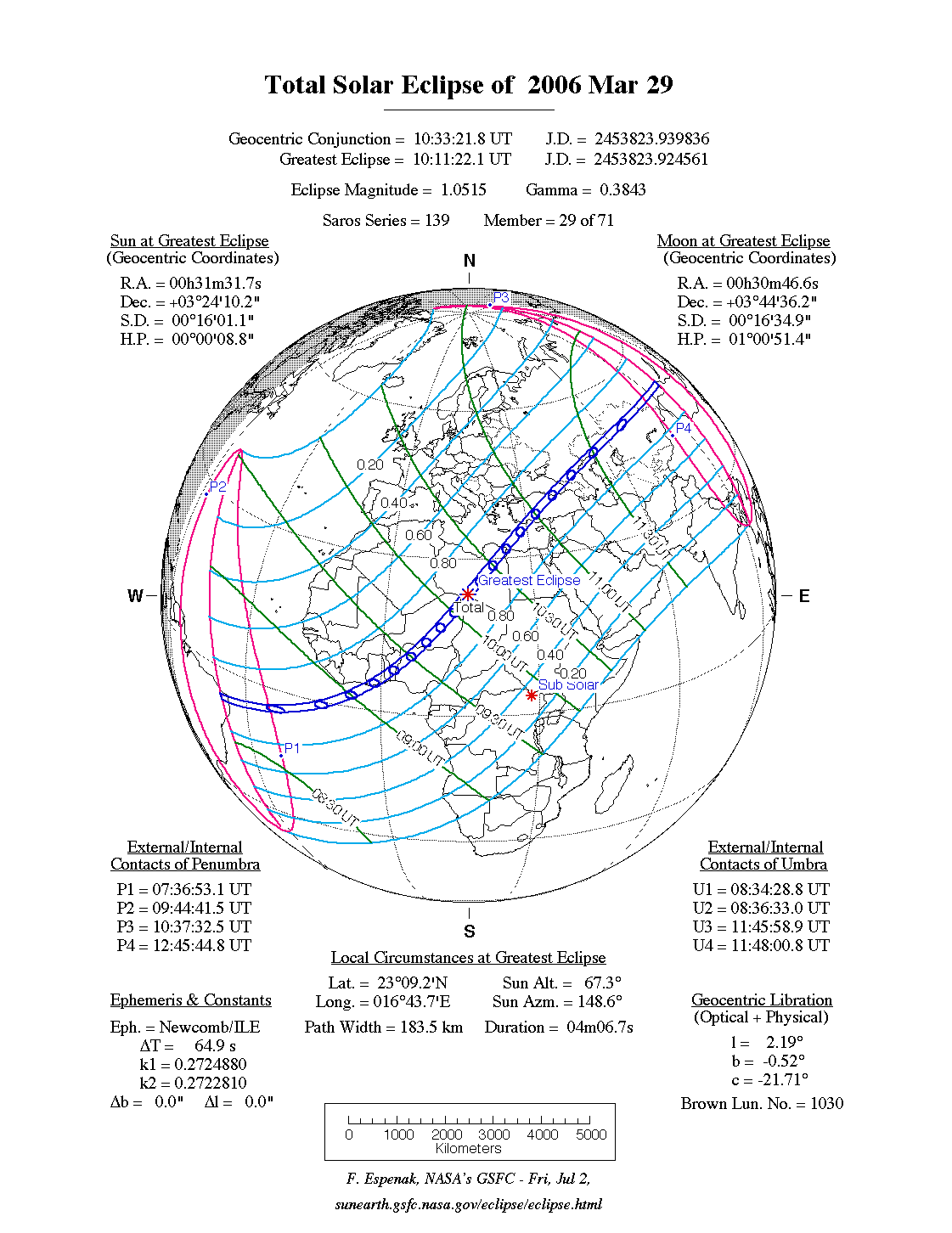
Template:Short description Script error: No such module "Solar eclipse". A total solar eclipse occurred at the Moon’s ascending node of orbit on Wednesday, March 29, 2006,[1][2][3] with a magnitude of 1.0515. A solar eclipse occurs when the Moon passes between Earth and the Sun, thereby totally or partly obscuring the image of the Sun for a viewer on Earth. A total solar eclipse occurs when the Moon's apparent diameter is larger than the Sun's, blocking all direct sunlight, turning day into darkness. Totality occurs in a narrow path across Earth's surface, with the partial solar eclipse visible over a surrounding region thousands of kilometres wide. Occurring about 1.1 days after perigee (on March 28, 2006, at 8:10 UTC), the Moon's apparent diameter was larger.[4]
This was the second solar eclipse visible in Africa within just 6 months.
Visibility

The path of totality of the Moon's shadow began at sunrise in Brazil and extended across the Atlantic to Africa, traveling across Ghana, the southeastern tip of Ivory Coast, Togo, Benin, Nigeria, Niger, Chad, Libya, and a small corner of northwest Egypt, from there across the Mediterranean Sea to Greece (Kastellórizo) and Turkey, then across the Black Sea via Georgia, Russia, and Kazakhstan to Western Mongolia, where it ended at sunset. A partial eclipse was seen from the much broader path of the Moon's penumbra, including eastern South America, the northern two-thirds of Africa, the whole of Europe, the Middle East, Central Asia, and South Asia.
Observations
People around the world gathered in areas where the eclipse was visible to view the event. The Manchester Astronomical Society, the Malaysian Space Agency, the Astronomical Society of the Pacific, as well as dozens of tour groups met at the Apollo temple and the theater in Side, Turkey. The San Francisco Exploratorium featured a live webcast from the site, where thousands of observers were seated in the ancient, Roman-style theater.[5]
Almost all actively visited areas in the path of totality had perfect weather. Many observers reported an unusually beautiful eclipse, with many or all effects visible, and a very nice corona, despite the proximity to the solar minimum. The partial phase of the eclipse was also visible from the International Space Station, where the astronauts on board took spectacular pictures of the moon's shadow on Earth's surface. It initially appeared as though an orbit correction set for the middle of March would bring the ISS into the path of totality, but this correction was postponed.
The Paris Observatory sent a team of students and coordinators to Savalou, Benin. The team took clear images of the corona. A team of Williams College, Massachusetts did many experiments and took images of the corona on the Greek island of Kastellórizo with 3 minutes of totality, which is close to the coast of Turkey and the only place in the European Union covered by the path of totality. The Solar and Heliospheric Observatory also made auxiliary observations to compare images taken from space and from the ground.[6][7][8] Another research simulated the changing colours of the sky in the path of totality with a three-dimensional model while considering multiple scattering. Monte Carlo method was used in the experiment to predict the colour and brightness of the sky. In addition, the direct irradiation of the corona was also studied. The goal was to plan and optimise studies on incoming solar irradiance.[9] Russian scientists studied on coronal polarization in the Baksan River Gorge surrounded by snow mountains in the North Caucasus. The location has an altitude of 1,800 metres and is 25 kilometres from Mount Elbrus, the highest peak in Russia and also Europe.[10]
Libya under Muammar Gaddafi was under sanctions because of bombing the Pan Am Flight 103 and had a strict alcohol ban. It was the least visited region around the Mediterranean. To promote tourism, the Libyan government mobilized 5 state-owned tourism companies to attract more tourists, and built a tent village that could accommodate 7,000 people in Waw an Namus inside the Sahara Desert with excellent observation conditions. However, it was only open to astronomers, while ordinary tourists were directed to Patan, near the border with Egypt. Despite Libya's desire to attract tourists from all over the world, Israelis were still banned from entering the country.[11][12] NASA scientists also did joint observation and research with Libyan scientists, taking images and videos.[8][13]
A team of 20 people from the Template:Ill took images of Baily's beads, corona and prominences in Sallum, Egypt. The weather conditions were good in Sallum and also neighbouring Libya. Then Egyptian President Hosni Mubarak, Minister of Defense Muhammad Tantawi and other officials also went there by helicopter and observed the eclipse with scientists and tourists.[14][15]
Satellite failure
Script error: No such module "Labelled list hatnote". The satellite responsible for SKY Network Television, a New Zealand pay TV company, failed the day after this eclipse at around 1900 local time. While SKY didn't directly attribute the failure to the eclipse, they said in a media release that it took longer to resolve the issue because of it, but this claim was rejected by astronomers. The main reason for the failure was because of an aging and increasingly faulty satellite.[16]
Gallery
-
Cape Coast, Ghana (9:10 UTC)
-
Murzuq District, Libya (10:16 UTC)
-
Valencia, Spain (10:16 UTC)
-
Oria, Italy (10:39 UTC)
-
The Moon's shadow as seen from the International Space Station (10:50 UTC)
-
Berkhamsted, England (11:01 UTC)
-
Marousi, Greece (11:01 UTC)
-
Krasnoyarsk, Russia (11:20 UTC)
-
Lagan, Russia (11:23 UTC)
-
Novosibirsk, Russia (11:42 UTC)
-
Kathmandu, Nepal (12:01 UTC)
-
Degania A, Israel: Partial Solar Eclipse
-
Animation from Sallum, Egypt


Eclipse details
Shown below are two tables displaying details about this particular solar eclipse. The first table outlines times at which the moon's penumbra or umbra attains the specific parameter, and the second table describes various other parameters pertaining to this eclipse.[17]
| Event | Time (UTC) |
|---|---|
| First Penumbral External Contact | 2006 March 29 at 07:37:53.6 UTC |
| First Umbral External Contact | 2006 March 29 at 08:35:29.4 UTC |
| First Central Line | 2006 March 29 at 08:36:31.5 UTC |
| First Umbral Internal Contact | 2006 March 29 at 08:37:33.6 UTC |
| First Penumbral Internal Contact | 2006 March 29 at 09:45:42.2 UTC |
| Greatest Eclipse | 2006 March 29 at 10:12:22.7 UTC |
| Greatest Duration | 2006 March 29 at 10:12:45.5 UTC |
| Ecliptic Conjunction | 2006 March 29 at 10:16:20.0 UTC |
| Equatorial Conjunction | 2006 March 29 at 10:34:22.4 UTC |
| Last Penumbral Internal Contact | 2006 March 29 at 10:38:33.1 UTC |
| Last Umbral Internal Contact | 2006 March 29 at 11:46:59.6 UTC |
| Last Central Line | 2006 March 29 at 11:48:00.6 UTC |
| Last Umbral External Contact | 2006 March 29 at 11:49:01.5 UTC |
| Last Penumbral External Contact | 2006 March 29 at 12:46:45.7 UTC |
| Parameter | Value |
|---|---|
| Eclipse Magnitude | 1.05152 |
| Eclipse Obscuration | 1.10569 |
| Gamma | 0.38433 |
| Sun Right Ascension | 00h31m31.7s |
| Sun Declination | +03°24'10.3" |
| Sun Semi-Diameter | 16'01.1" |
| Sun Equatorial Horizontal Parallax | 08.8" |
| Moon Right Ascension | 00h30m46.6s |
| Moon Declination | +03°44'36.2" |
| Moon Semi-Diameter | 16'34.9" |
| Moon Equatorial Horizontal Parallax | 1°00'51.4" |
| ΔT | 64.9 s |
Eclipse season
Script error: No such module "Labelled list hatnote". This eclipse is part of an eclipse season, a period, roughly every six months, when eclipses occur. Only two (or occasionally three) eclipse seasons occur each year, and each season lasts about 35 days and repeats just short of six months (173 days) later; thus two full eclipse seasons always occur each year. Either two or three eclipses happen each eclipse season. In the sequence below, each eclipse is separated by a fortnight.
| March 14 Descending node (full moon) |
March 29 Ascending node (new moon) |
|---|---|
| File:Lunar eclipse chart close-06mar14.png | File:SE2006Mar29T.png |
| Penumbral lunar eclipse Lunar Saros 113 |
Total solar eclipse Solar Saros 139 |


Related eclipses
Eclipses in 2006
- A penumbral lunar eclipse on March 14.
- A total solar eclipse on March 29.
- A partial lunar eclipse on September 7.
- An annular solar eclipse on September 22.
Metonic
- Preceded by: Solar eclipse of June 10, 2002
- Followed by: Solar eclipse of January 15, 2010
Tzolkinex
- Preceded by: Solar eclipse of February 16, 1999
- Followed by: Solar eclipse of May 10, 2013
Half-Saros
- Preceded by: Lunar eclipse of March 24, 1997
- Followed by: Lunar eclipse of April 4, 2015
Tritos
- Preceded by: Solar eclipse of April 29, 1995
- Followed by: Solar eclipse of February 26, 2017
Solar Saros 139
- Preceded by: Solar eclipse of March 18, 1988
- Followed by: Solar eclipse of April 8, 2024
Inex
- Preceded by: Solar eclipse of April 18, 1977
- Followed by: Solar eclipse of March 9, 2035
Triad
- Preceded by: Solar eclipse of May 29, 1919
- Followed by: Solar eclipse of January 27, 2093
Solar eclipses of 2004–2007
This eclipse is a member of a semester series. An eclipse in a semester series of solar eclipses repeats approximately every 177 days and 4 hours (a semester) at alternating nodes of the Moon's orbit.[18]
| Solar eclipse series sets from 2004 to 2007 | ||||||
|---|---|---|---|---|---|---|
| Ascending node | Descending node | |||||
| Saros | Map | Gamma | Saros | Map | Gamma | |
| 119 | April 19, 2004 File:SE2004Apr19P.png Partial |
−1.13345 | 124 | October 14, 2004 File:SE2004Oct14P.png Partial |
1.03481 | |
| 129 File:Solar eclipse at sunset (2937676527) (cropped).jpg Partial in Naiguatá, Venezuela |
April 8, 2005 File:SE2005Apr08H.png Hybrid |
−0.34733 | 134 File:Ecl-ann.jpg Annularity in Madrid, Spain |
October 3, 2005 File:SE2005Oct03A.png Annular |
0.33058 | |
| 139 File:Diamondring-eclipse-March03-29-2006.jpg Totality in Side, Turkey |
March 29, 2006 File:SE2006Mar29T.png Total |
0.38433 | 144 File:Helder da Rocha - Partial solar eclipse (by-sa).jpg Partial in São Paulo, Brazil |
September 22, 2006 File:SE2006Sep22A.png Annular |
−0.40624 | |
| 149 File:Solar Eclipse (3445953058) (cropped).jpg Partial in Jaipur, India |
March 19, 2007 File:SE2007Mar19P.png Partial |
1.07277 | 154 File:Eclipse solar 01 (1360685468) (cropped).jpg Partial in Córdoba, Argentina |
September 11, 2007 File:SE2007Sep11P.png Partial |
−1.12552 | |


Saros 139
This eclipse is a part of Saros series 139, repeating every 18 years, 11 days, and containing 71 events. The series started with a partial solar eclipse on May 17, 1501. It contains hybrid eclipses from August 11, 1627 through December 9, 1825 and total eclipses from December 21, 1843 through March 26, 2601. There are no annular eclipses in this set. The series ends at member 71 as a partial eclipse on July 3, 2763. Its eclipses are tabulated in three columns; every third eclipse in the same column is one exeligmos apart, so they all cast shadows over approximately the same parts of the Earth.
The longest duration of totality will be produced by member 61 at 7 minutes, 29.22 seconds on July 16, 2186. This date is the longest solar eclipse computed between 4000 BC and AD 6000.[19] All eclipses in this series occur at the Moon’s ascending node of orbit.[20]
| Series members 18–39 occur between 1801 and 2200: | ||
|---|---|---|
| 18 | 19 | 20 |
| File:SE1807Nov29H.png November 29, 1807 |
File:SE1825Dec09H.png December 9, 1825 |
File:SE1843Dec21T.png December 21, 1843 |
| 21 | 22 | 23 |
| File:SE1861Dec31T.png December 31, 1861 |
File:SE1880Jan11T.png January 11, 1880 |
File:SE1898Jan22T.png January 22, 1898 |
| 24 | 25 | 26 |
| File:SE1916Feb03T.png February 3, 1916 |
File:SE1934Feb14T.png February 14, 1934 |
File:SE1952Feb25T.png February 25, 1952 |
| 27 | 28 | 29 |
| File:SE1970Mar07T.png March 7, 1970 |
File:SE1988Mar18T.png March 18, 1988 |
File:SE2006Mar29T.png March 29, 2006 |
| 30 | 31 | 32 |
| File:SE2024Apr08T.png April 8, 2024 |
File:SE2042Apr20T.png April 20, 2042 |
File:SE2060Apr30T.png April 30, 2060 |
| 33 | 34 | 35 |
| File:SE2078May11T.png May 11, 2078 |
File:SE2096May22T.png May 22, 2096 |
File:SE2114Jun03T.png June 3, 2114 |
| 36 | 37 | 38 |
| File:SE2132Jun13T.png June 13, 2132 |
File:SE2150Jun25T.png June 25, 2150 |
File:SE2168Jul05T.png July 5, 2168 |
| 39 | ||
| File:SE2186Jul16T.png July 16, 2186 | ||


Metonic series
The metonic series repeats eclipses every 19 years (6939.69 days), lasting about 5 cycles. Eclipses occur in nearly the same calendar date. In addition, the octon subseries repeats 1/5 of that or every 3.8 years (1387.94 days). All eclipses in this table occur at the Moon's ascending node.
| 20 eclipse events between June 10, 1964 and August 21, 2036 | ||||
|---|---|---|---|---|
| June 10–11 | March 28–29 | January 14–16 | November 3 | August 21–22 |
| 117 | 119 | 121 | 123 | 125 |
| File:SE1964Jun10P.png June 10, 1964 |
File:SE1968Mar28P.png March 28, 1968 |
File:SE1972Jan16A.png January 16, 1972 |
File:SE1975Nov03P.png November 3, 1975 |
File:SE1979Aug22A.png August 22, 1979 |
| 127 | 129 | 131 | 133 | 135 |
| File:SE1983Jun11T.png June 11, 1983 |
File:SE1987Mar29H.png March 29, 1987 |
File:SE1991Jan15A.png January 15, 1991 |
File:SE1994Nov03T.png November 3, 1994 |
File:SE1998Aug22A.png August 22, 1998 |
| 137 | 139 | 141 | 143 | 145 |
| File:SE2002Jun10A.png June 10, 2002 |
File:SE2006Mar29T.png March 29, 2006 |
File:SE2010Jan15A.png January 15, 2010 |
File:SE2013Nov03H.png November 3, 2013 |
File:SE2017Aug21T.png August 21, 2017 |
| 147 | 149 | 151 | 153 | 155 |
| File:SE2021Jun10A.png June 10, 2021 |
File:SE2025Mar29P.png March 29, 2025 |
File:SE2029Jan14P.png January 14, 2029 |
File:SE2032Nov03P.png November 3, 2032 |
File:SE2036Aug21P.png August 21, 2036 |


Tritos series
Template:Solar Tritos series 2006 March 29
Inex series
Template:Solar Inex series 2006 March 29
Notes
<templatestyles src="Reflist/styles.css" />
- ↑ Script error: No such module "citation/CS1".
- ↑ Script error: No such module "citation/CS1".
- ↑ Script error: No such module "citation/CS1".
- ↑ Script error: No such module "citation/CS1".
- ↑ Total Solar Eclipse: Live from Turkey in 2006
- ↑ Script error: No such module "citation/CS1".
- ↑ Script error: No such module "citation/CS1".
- ↑ a b Script error: No such module "citation/CS1".
- ↑ C. Emde, B. Mayer: Simulation of solar radiation during a total eclipse: a challenge for radiative transfer [28 August 2015]
- ↑ Script error: No such module "citation/CS1".
- ↑ Script error: No such module "citation/CS1".
- ↑ Script error: No such module "citation/CS1".
- ↑ Script error: No such module "citation/CS1".
- ↑ Script error: No such module "citation/CS1".
- ↑ Script error: No such module "citation/CS1".
- ↑ Press release by Sky TV. Solar eclipse interferes with satellite restoration Script error: No such module "webarchive". Friday, 31 March 2006.
- ↑ Script error: No such module "citation/CS1".
- ↑ Script error: No such module "citation/CS1".
- ↑ Ten Millennium Catalog of Long Solar Eclipses, −3999 to +6000 (4000 BCE to 6000 CE) Fred Espenak.
- ↑ Script error: No such module "citation/CS1".
Script error: No such module "Check for unknown parameters".
References
- Fred Espenak and Jay Anderson. "Total Solar Eclipse of 2006 March 29". NASA Technical publication (NASA/TP-2004-212762), November 2004.
- NASA – Total Solar Eclipse of 2006 March 29
- Earth visibility chart and eclipse statistics Eclipse Predictions by Fred Espenak, NASA/GSFC
- solar-eclipse-2006.info Information about the March 29th Solar Eclipse.
- Interactive 2006 March 29 Total Solar Eclipse map with local circumstances
- Eclipse.za.net, Umbral Paths of March 29 Eclipse in Africa
Photos:
- Prof. Druckmüller's eclipse photography site. Turkey, Cappadocia
- Prof. Druckmüller's eclipse photography site. Egypt
- Prof. Druckmüller's eclipse photography site. Libya
- Total eclipse photographs from Turkey
- Another set of total eclipse photographs from Turkey
- Photo gallery from Turkey
- Phases of solar eclipse view from Antalya
- NASA videos and photos from Libya and Turkey
- Pictures taken from Smolyan, Bulgaria
- NASA video of eclipse Script error: No such module "webarchive".
- Solar eclipse images and videos from Libya by traveling NASA employees and scientists
- Images by Crayford Manor House Astronomical Society from Libya and Turkey Script error: No such module "webarchive".
- Spaceweather.com Eclipse gallery
- Antwrp.gsfc.nasa.gov APOD, March 30, 2006, When Diamonds Aren't Forever, totality from Greek island of Kastelorizo in the eastern Aegean
- Antwrp.gsfc.nasa.gov APOD, April 4, 2006, A Total Solar Eclipse over Turkey, totality from Adrasan, Kumluca, Antalya Province, Turkey
- Antwrp.gsfc.nasa.gov APOD, April 7, 2006, totality from Side, Turkey, a larger version of the same picture chosen as APOD again on July 26, 2009, The Big Corona, Koenvangorp.be
- Antwrp.gsfc.nasa.gov APOD, April 8, 2006, Vanishing Umbra, from Mount Hasan southeast of İncesu, Aksaray, Turkey
- The 2006 Eclipse in Turkey
- Russian scientist observed eclipse
- University of Athens – Solar Eclipse 29/3/2006, Solar Party
- Solar Total Eclipse of 2006 March 29
- Tubitak.gov.tr, 29 March 2006 Total Solar Eclipse, Scientific and Technological Research Council of Turkey (TÜBİTAK)
- Solar Eclipse over Kemer, Turkey 060329
External links
Template:Sister-inline Script error: No such module "Navbox".