Solar eclipse of June 30, 1992
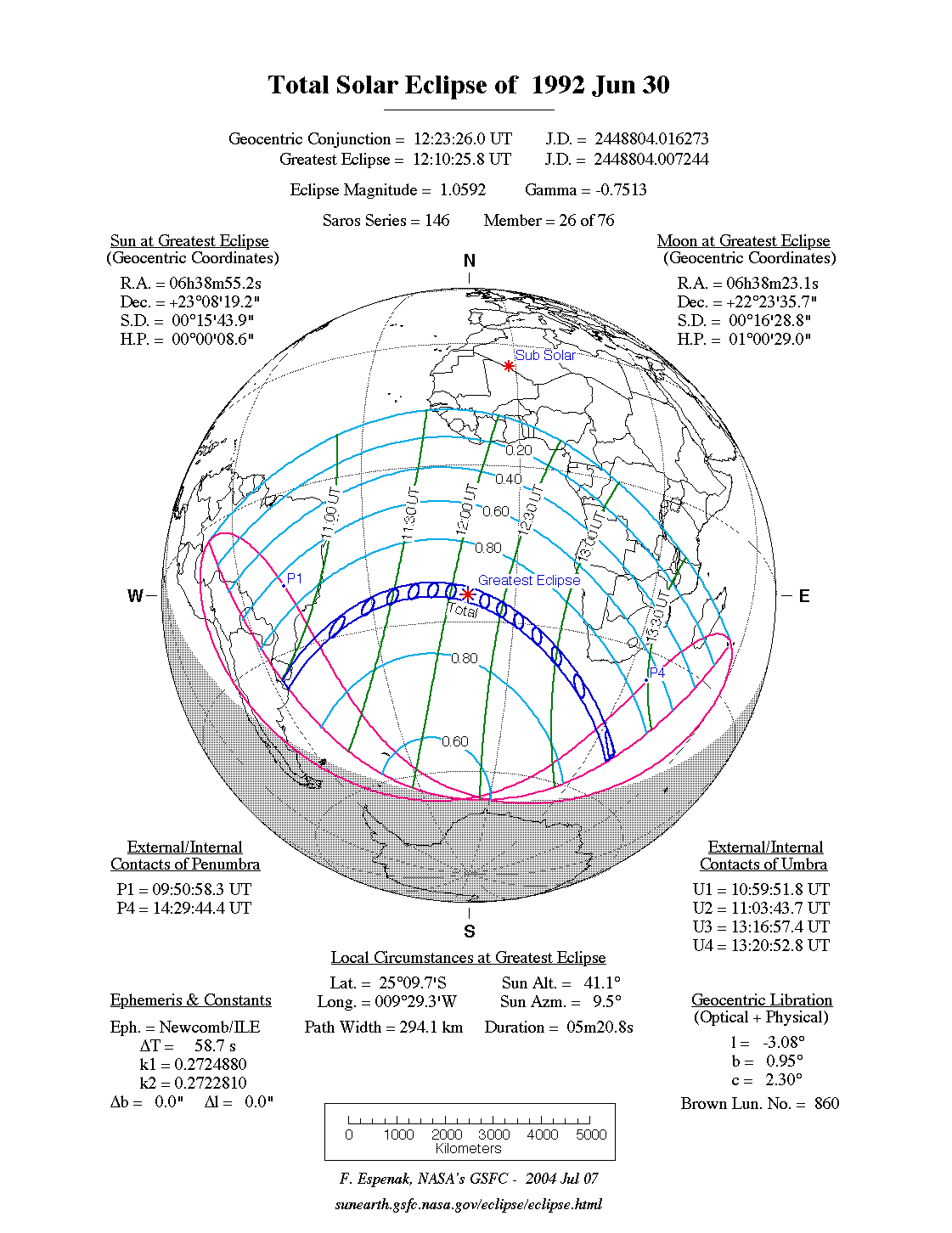
Template:Short description Script error: No such module "Unsubst". Script error: No such module "Solar eclipse". A total solar eclipse occurred at the Moon's descending node of orbit on Tuesday, June 30, 1992,[1] with a magnitude of 1.0592. A solar eclipse occurs when the Moon passes between Earth and the Sun, thereby totally or partly obscuring the image of the Sun for a viewer on Earth. A total solar eclipse occurs when the Moon's apparent diameter is larger than the Sun's, blocking all direct sunlight, turning day into darkness. Totality occurs in a narrow path across Earth's surface, with the partial solar eclipse visible over a surrounding region thousands of kilometres wide. Occurring about 1.5 days before perigee (on July 2, 1992, at 1:30 UTC), the Moon's apparent diameter was larger.[2]
Totality was visible in southeastern Uruguay and southern tip of Rio Grande do Sul, Brazil. A partial eclipse was visible for parts of central South America, West Africa, Central Africa, and Southern Africa.
Observations
The path of totality was mostly on the sea and covered very little land. From the only land covered by it in southeasern Uruguay and southern tip of Brazil, totality occurred shortly after sunrise, with the solar zenith angle less than 3°. Observation from an airplane over the middle of South Atlantic Ocean, near the location of maximum eclipse, could offer a duration of totality of up to 10 minutes with the guarantee of clear weather. However, due to the limitations in the cruising capabilities and the economic cost, a feasible flight plan was to see 5 to 6 minutes of totality on the airplane. 48 people from the United States, Canada, Brazil, Germany, Japan and Great Britain boarded a VASP airline DC-10 plane, departing from Rio de Janeiro, Brazil, flying over the South Atlantic Ocean and returning to Rio de Janeiro. The passengers got off and the captain flew the airplane back to São Paulo. Although adjustment in the flying speed had to be made according to the take-off time and wind speed, the pilot flew the airplane into Moon's umbra within 1 second of the predicted time, and the passengers on board successfully saw the total eclipse. Accidentally, one of the ground support personnel did not exit the airplane before takeoff, and she also saw the eclipse. The pilots were also attracted by the eclipse, still watching the moon shadow moving into the distance and forgetting to fly the airplane back return even minutes after the third contact (the end of the total phase). The captain described this as the most unusual flight he ever commanded. VASP airline also provided a Boeing 737 plane to the Template:Ill. Planetarium staff, of their astronomy club, local dignitaries, politicians and celebrities were also invited.[3]
Images

Eclipse details
Shown below are two tables displaying details about this particular solar eclipse. The first table outlines times at which the moon's penumbra or umbra attains the specific parameter, and the second table describes various other parameters pertaining to this eclipse.[4]
| Event | Time (UTC) |
|---|---|
| First Penumbral External Contact | 1992 June 30 at 09:51:53.8 UTC |
| First Umbral External Contact | 1992 June 30 at 11:00:47.0 UTC |
| First Central Line | 1992 June 30 at 11:02:41.9 UTC |
| First Umbral Internal Contact | 1992 June 30 at 11:04:38.8 UTC |
| Greatest Duration | 1992 June 30 at 12:10:22.2 UTC |
| Greatest Eclipse | 1992 June 30 at 12:11:21.8 UTC |
| Ecliptic Conjunction | 1992 June 30 at 12:18:59.8 UTC |
| Equatorial Conjunction | 1992 June 30 at 12:24:21.9 UTC |
| Last Umbral Internal Contact | 1992 June 30 at 13:17:54.3 UTC |
| Last Central Line | 1992 June 30 at 13:19:52.9 UTC |
| Last Umbral External Contact | 1992 June 30 at 13:21:49.6 UTC |
| Last Penumbral External Contact | 1992 June 30 at 14:30:41.0 UTC |
| Parameter | Value |
|---|---|
| Eclipse Magnitude | 1.05916 |
| Eclipse Obscuration | 1.12183 |
| Gamma | −0.75120 |
| Sun Right Ascension | 06h38m55.2s |
| Sun Declination | +23°08'19.2" |
| Sun Semi-Diameter | 15'43.9" |
| Sun Equatorial Horizontal Parallax | 08.6" |
| Moon Right Ascension | 06h38m23.1s |
| Moon Declination | +22°23'36.1" |
| Moon Semi-Diameter | 16'28.8" |
| Moon Equatorial Horizontal Parallax | 1°00'29.0" |
| ΔT | 58.7 s |
Eclipse season
Script error: No such module "Labelled list hatnote". This eclipse is part of an eclipse season, a period, roughly every six months, when eclipses occur. Only two (or occasionally three) eclipse seasons occur each year, and each season lasts about 35 days and repeats just short of six months (173 days) later; thus two full eclipse seasons always occur each year. Either two or three eclipses happen each eclipse season. In the sequence below, each eclipse is separated by a fortnight.
| June 15 Ascending node (full moon) |
June 30 Descending node (new moon) |
|---|---|
| File:Lunar eclipse chart close-1992Jun15.png | File:SE1992Jun30T.png |
| Partial lunar eclipse Lunar Saros 120 |
Total solar eclipse Solar Saros 146 |


Related eclipses
Eclipses in 1992
- An annular solar eclipse on January 4.
- A partial lunar eclipse on June 15.
- A total solar eclipse on June 30.
- A total lunar eclipse on December 9.
- A partial solar eclipse on December 24.
Metonic
- Preceded by: Solar eclipse of September 11, 1988
- Followed by: Solar eclipse of April 17, 1996
Tzolkinex
- Preceded by: Solar eclipse of May 19, 1985
- Followed by: Solar eclipse of August 11, 1999
Half-Saros
- Preceded by: Lunar eclipse of June 25, 1983
- Followed by: Lunar eclipse of July 5, 2001
Tritos
- Preceded by: Solar eclipse of July 31, 1981
- Followed by: Solar eclipse of May 31, 2003
Solar Saros 146
- Preceded by: Solar eclipse of June 20, 1974
- Followed by: Solar eclipse of July 11, 2010
Inex
- Preceded by: Solar eclipse of July 20, 1963
- Followed by: Solar eclipse of June 10, 2021
Triad
- Preceded by: Solar eclipse of August 30, 1905
- Followed by: Solar eclipse of May 1, 2079
Solar eclipses of 1990–1992
This eclipse is a member of a semester series. An eclipse in a semester series of solar eclipses repeats approximately every 177 days and 4 hours (a semester) at alternating nodes of the Moon's orbit.[5]
| Solar eclipse series sets from 1990 to 1992 | ||||||
|---|---|---|---|---|---|---|
| Ascending node | Descending node | |||||
| Saros | Map | Gamma | Saros | Map | Gamma | |
| 121 | January 26, 1990 File:SE1990Jan26A.png Annular |
−0.9457 | 126 File:1990.04 Pimennys (28866343838) (cropped).jpg Partial in Finland |
July 22, 1990 File:SE1990Jul22T.png Total |
0.7597 | |
| 131 | January 15, 1991 File:SE1991Jan15A.png Annular |
−0.2727 | 136 File:Eclipse CR 1991 a zoom.jpg Totality in Playas del Coco, Costa Rica |
July 11, 1991 File:SE1991Jul11T.png Total |
−0.0041 | |
| 141 | January 4, 1992 File:SE1992Jan04A.png Annular |
0.4091 | 146 | June 30, 1992 File:SE1992Jun30T.png Total |
−0.7512 | |
| 151 | December 24, 1992 File:SE1992Dec24P.png Partial |
1.0711 | ||||


Saros 146
Template:Solar Saros series 146
Metonic series
The metonic series repeats eclipses every 19 years (6939.69 days), lasting about 5 cycles. Eclipses occur in nearly the same calendar date. In addition, the octon subseries repeats 1/5 of that or every 3.8 years (1387.94 days). All eclipses in this table occur at the Moon's descending node.


Tritos series
Template:Solar Tritos series 2003 May 31
Inex series
Template:Solar Inex series 2021 June 10
Notes
<templatestyles src="Reflist/styles.css" />
Script error: No such module "Check for unknown parameters".
References
- Earth visibility chart and eclipse statistics Eclipse Predictions by Fred Espenak, NASA/GSFC
Script error: No such module "Navbox".