Solar eclipse of June 21, 2020
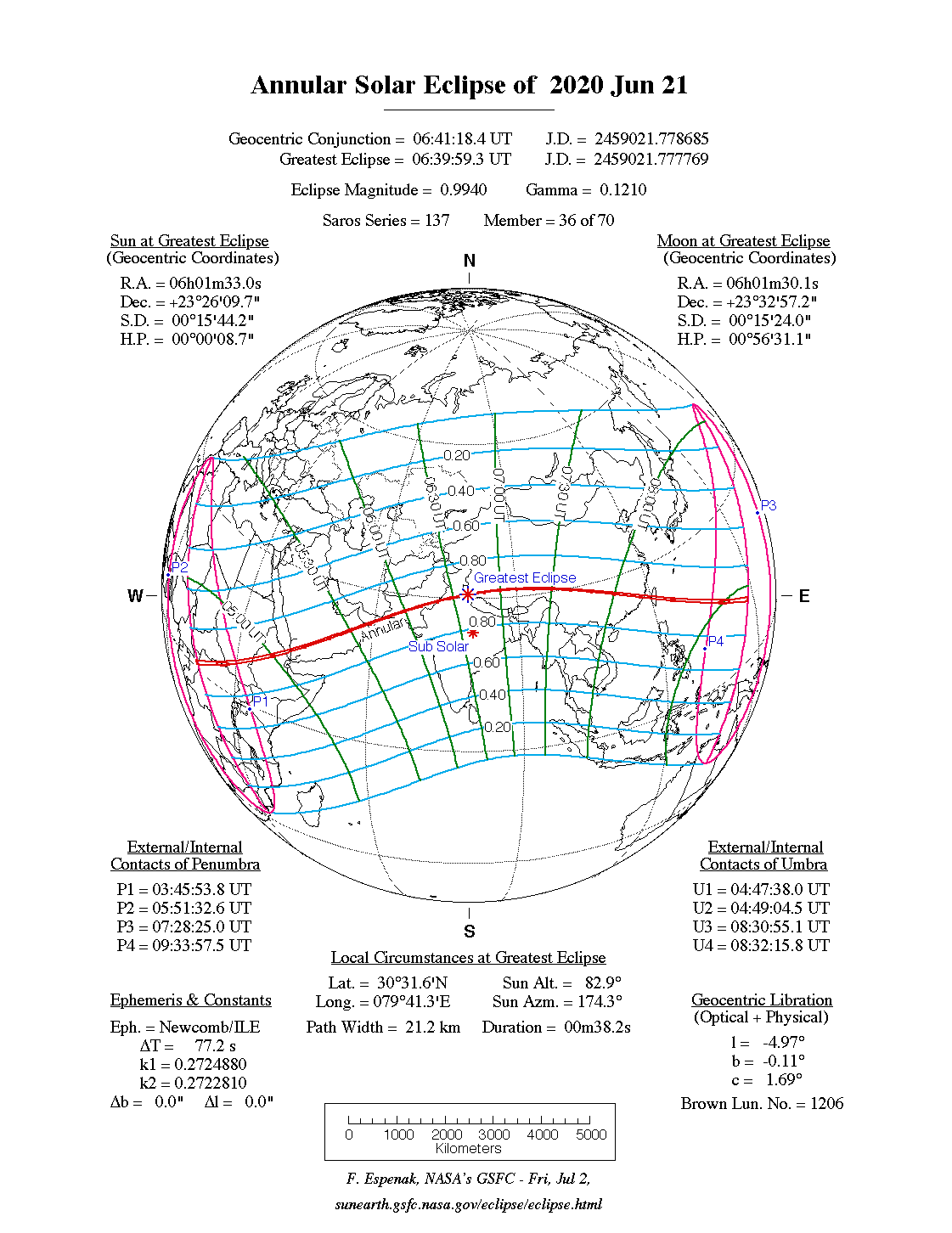
Template:Short description Script error: No such module "Solar eclipse". An annular solar eclipse occurred at the Moon’s ascending node of orbit on Sunday, June 21, 2020,[1][2][3][4][5][6][7] with a magnitude of 0.994. A solar eclipse occurs when the Moon passes between Earth and the Sun, thereby totally or partly obscuring the Sun for a viewer on Earth. An annular solar eclipse occurs when the Moon's apparent diameter is smaller than the Sun's, blocking most of the Sun's light and causing the Sun to look like an annulus (ring). An annular eclipse appears as a partial eclipse over a region of the Earth thousands of kilometres wide. Occurring about 6.2 days after apogee (on June 15, 2020, at 1:55 UTC), the Moon's apparent diameter was smaller.[8]

Path
The path of this annular eclipse passed through parts of the Democratic Republic of the Congo, South Sudan, Ethiopia, and Eritrea in Africa; the southern Arabian Peninsula, including Yemen, Oman, and southern Saudi Arabia; parts of South Asia and the Himalayas, including southern Pakistan and northern India; and parts of East Asia, including South China and Taiwan.[9] A partial eclipse was visible throughout much of the rest of Africa, Southeast Europe, most of Asia, and in New Guinea and northern Australia just before sunset. In Europe, the partial eclipse was visible to places southeast of the line passing through parts of Italy, Hungary, Ukraine, and southwestern Russia.[9] Script error: No such module "Multiple image".
Gallery
-
Partial from Addis Ababa, Ethiopia, 4:53 UTC
-
Partial from Sana'a, Yemen, 5:09 UTC
-
Partial from Riyadh, Saudi Arabia, 5:11 UTC
-
Eclipse progression from Tehran, Iran
-
Partial from Gyumri, Armenia, 5:45 UTC
-
Partial from Colombo, Sri Lanka, 5:48 UTC
-
Partial from Lahore, Pakistan, 6:49 UTC
-
Partial from Kathmandu, Nepal, 6:51 UTC
-
Partial from Irkutsk, Russia, ~7:22 UTC
-
Partial from Bacoor, Philippines, 7:31 UTC
-
Partial from Kolkata, India, 7:42 UTC
-
Telescopic view from Chennai, India
-
Partial from Beijing, China, 7:51 UTC
-
Partial from Jinan, China, 7:56 UTC
-
Partial from Tai'an, China, 7:57 UTC
-
Partial from Gandara, Samar, Philippines, 8:01 UTC
-
Partial from Kaohsiung, Taiwan, 8:05 UTC
-
Partial from Yau Tong, Hong Kong, 8:08 UTC
-
Partial from Taichung, Taiwan, 8:09 UTC
-
Partial from Pangkalpinang, Indonesia, 8:10 UTC
-
Xiamen, China, 8:11 UTC
-
Time-lapse image of the eclipse in Xiamen, China
-
Partial from Fukuoka, Japan, 8:12 UTC
-
Chiayi, Taiwan, 8:13 UTC
-
Partial from Hsinchu, Taiwan, 8:18 UTC
-
Partial from Surabaya, Indonesia, 8:22 UTC
-
Partial from San Jose del Monte, Philippines, 8:23 UTC
-
Eclipse progression from Oria, Italy


Eclipse details
Shown below are two tables displaying details about this particular solar eclipse. The first table outlines times at which the moon's penumbra or umbra attains the specific parameter, and the second table describes various other parameters pertaining to this eclipse.[10]
| Event | Time (UTC) |
|---|---|
| First Penumbral External Contact | 2020 June 21 at 03:47:09.9 UTC |
| First Umbral External Contact | 2020 June 21 at 04:48:54.2 UTC |
| First Central Line | 2020 June 21 at 04:49:37.4 UTC |
| Greatest Duration | 2020 June 21 at 04:49:37.4 UTC |
| First Umbral Internal Contact | 2020 June 21 at 04:50:20.7 UTC |
| First Penumbral Internal Contact | 2020 June 21 at 05:52:48.7 UTC |
| Greatest Eclipse | 2020 June 21 at 06:41:15.4 UTC |
| Equatorial Conjunction | 2020 June 21 at 06:42:34.5 UTC |
| Ecliptic Conjunction | 2020 June 21 at 06:42:36.6 UTC |
| Last Penumbral Internal Contact | 2020 June 21 at 07:29:41.2 UTC |
| Last Umbral Internal Contact | 2020 June 21 at 08:32:11.3 UTC |
| Last Central Line | 2020 June 21 at 08:32:51.7 UTC |
| Last Umbral External Contact | 2020 June 21 at 08:33:32.0 UTC |
| Last Penumbral External Contact | 2020 June 21 at 09:35:13.9 UTC |
| Parameter | Value |
|---|---|
| Eclipse Magnitude | 0.99401 |
| Eclipse Obscuration | 0.98806 |
| Gamma | 0.12090 |
| Sun Right Ascension | 06h01m33.0s |
| Sun Declination | +23°26'09.7" |
| Sun Semi-Diameter | 15'44.2" |
| Sun Equatorial Horizontal Parallax | 08.7" |
| Moon Right Ascension | 06h01m30.2s |
| Moon Declination | +23°32'56.7" |
| Moon Semi-Diameter | 15'24.0" |
| Moon Equatorial Horizontal Parallax | 0°56'31.1" |
| ΔT | 70.0 s |
Eclipse season
Script error: No such module "Labelled list hatnote". This eclipse is part of an eclipse season, a period, roughly every six months, when eclipses occur. Only two (or occasionally three) eclipse seasons occur each year, and each season lasts about 35 days and repeats just short of six months (173 days) later; thus two full eclipse seasons always occur each year. Either two or three eclipses happen each eclipse season. In the sequence below, each eclipse is separated by a fortnight. The first and last eclipse in this sequence is separated by one synodic month.
| June 5 Descending node (full moon) |
June 21 Ascending node (new moon) |
July 5 Descending node (full moon) |
|---|---|---|
| File:Lunar eclipse chart close-2020Jun05.png | File:SE2020Jun21A.png | File:Lunar eclipse chart close-2020Jul05.png |
| Penumbral lunar eclipse Lunar Saros 111 |
Annular solar eclipse Solar Saros 137 |
Penumbral lunar eclipse Lunar Saros 149 |


Related eclipses
Eclipses in 2020
- A penumbral lunar eclipse on January 10.
- A penumbral lunar eclipse on June 5.
- An annular solar eclipse on June 21.
- A penumbral lunar eclipse on July 5.
- A penumbral lunar eclipse on November 30.
- A total solar eclipse on December 14.
Metonic
- Preceded by: Solar eclipse of September 1, 2016
- Followed by: Solar eclipse of April 8, 2024
Tzolkinex
- Preceded by: Solar eclipse of May 10, 2013
- Followed by: Solar eclipse of August 2, 2027
Half-Saros
- Preceded by: Lunar eclipse of June 15, 2011
- Followed by: Lunar eclipse of June 26, 2029
Tritos
- Preceded by: Solar eclipse of July 22, 2009
- Followed by: Solar eclipse of May 21, 2031
Solar Saros 137
- Preceded by: Solar eclipse of June 10, 2002
- Followed by: Solar eclipse of July 2, 2038
Inex
- Preceded by: Solar eclipse of July 11, 1991
- Followed by: Solar eclipse of May 31, 2049
Triad
- Preceded by: Solar eclipse of August 21, 1933
- Followed by: Solar eclipse of April 23, 2107
Solar eclipses of 2018–2021
This eclipse is a member of a semester series. An eclipse in a semester series of solar eclipses repeats approximately every 177 days and 4 hours (a semester) at alternating nodes of the Moon's orbit.[11]
The partial solar eclipses on February 15, 2018 and August 11, 2018 occur in the previous lunar year eclipse set.


Saros 137
Template:Solar Saros series 137
Metonic series
The metonic series repeats eclipses every 19 years (6939.69 days), lasting about 5 cycles. Eclipses occur in nearly the same calendar date. In addition, the octon subseries repeats 1/5 of that or every 3.8 years (1387.94 days). All eclipses in this table occur at the Moon's ascending node.
| 21 eclipse events between June 21, 1982 and June 21, 2058 | ||||
|---|---|---|---|---|
| June 21 | April 8–9 | January 26 | November 13–14 | September 1–2 |
| 117 | 119 | 121 | 123 | 125 |
| File:SE1982Jun21P.png June 21, 1982 |
File:SE1986Apr09P.png April 9, 1986 |
File:SE1990Jan26A.png January 26, 1990 |
File:SE1993Nov13P.png November 13, 1993 |
File:SE1997Sep02P.png September 2, 1997 |
| 127 | 129 | 131 | 133 | 135 |
| File:SE2001Jun21T.png June 21, 2001 |
File:SE2005Apr08H.png April 8, 2005 |
File:SE2009Jan26A.png January 26, 2009 |
File:SE2012Nov13T.png November 13, 2012 |
File:SE2016Sep01A.png September 1, 2016 |
| 137 | 139 | 141 | 143 | 145 |
| File:SE2020Jun21A.png June 21, 2020 |
File:SE2024Apr08T.png April 8, 2024 |
File:SE2028Jan26A.png January 26, 2028 |
File:SE2031Nov14H.png November 14, 2031 |
File:SE2035Sep02T.png September 2, 2035 |
| 147 | 149 | 151 | 153 | 155 |
| File:SE2039Jun21A.png June 21, 2039 |
File:SE2043Apr09T.png April 9, 2043 |
File:SE2047Jan26P.png January 26, 2047 |
File:SE2050Nov14P.png November 14, 2050 |
File:SE2054Sep02P.png September 2, 2054 |
| 157 | ||||
| File:SE2058Jun21P.png June 21, 2058 | ||||


Tritos series
Template:Solar Tritos series 2009 July 22
Inex series
This eclipse is a part of the long period inex cycle, repeating at alternating nodes, every 358 synodic months (≈ 10,571.95 days, or 29 years minus 20 days). Their appearance and longitude are irregular due to a lack of synchronization with the anomalistic month (period of perigee). However, groupings of 3 inex cycles (≈ 87 years minus 2 months) comes close (≈ 1,151.02 anomalistic months), so eclipses are similar in these groupings.
| Series members between 1801 and 2200 | ||
|---|---|---|
| File:SE1817Nov09T.png November 9, 1817 (Saros 130) |
File:SE1846Oct20A.png October 20, 1846 (Saros 131) |
File:SE1875Sep29A.png September 29, 1875 (Saros 132) |
| File:SE1904Sep09T.png September 9, 1904 (Saros 133) |
File:SE1933Aug21A.png August 21, 1933 (Saros 134) |
File:SE1962Jul31A.png July 31, 1962 (Saros 135) |
| File:SE1991Jul11T.png July 11, 1991 (Saros 136) |
File:SE2020Jun21A.png June 21, 2020 (Saros 137) |
File:SE2049May31A.png May 31, 2049 (Saros 138) |
| File:SE2078May11T.png May 11, 2078 (Saros 139) |
File:SE2107Apr23A.png April 23, 2107 (Saros 140) |
File:SE2136Apr01A.png April 1, 2136 (Saros 141) |
| File:SE2165Mar12T.png March 12, 2165 (Saros 142) |
File:SE2194Feb21A.png February 21, 2194 (Saros 143) |
|


References
<templatestyles src="Reflist/styles.css" />
- ↑ Script error: No such module "citation/CS1".
- ↑ Script error: No such module "citation/CS1".
- ↑ Script error: No such module "citation/CS1".
- ↑ Script error: No such module "citation/CS1".
- ↑ Script error: No such module "citation/CS1".
- ↑ Script error: No such module "citation/CS1".
- ↑ Script error: No such module "citation/CS1".
- ↑ Script error: No such module "citation/CS1".
- ↑ a b Script error: No such module "citation/CS1".
- ↑ Script error: No such module "citation/CS1".
- ↑ Script error: No such module "citation/CS1".
Script error: No such module "Check for unknown parameters".
External links
- Earth visibility chart and eclipse statistics Eclipse Predictions by Fred Espenak, NASA/GSFC
Script error: No such module "Side box".
- solar-eclipse.de: The annular solar eclipse of 06/21/2020
- Annular Solar Eclipse 2020
- Chinese satellite images (via twitter)
Script error: No such module "Navbox".