Solar eclipse of June 17, 1909
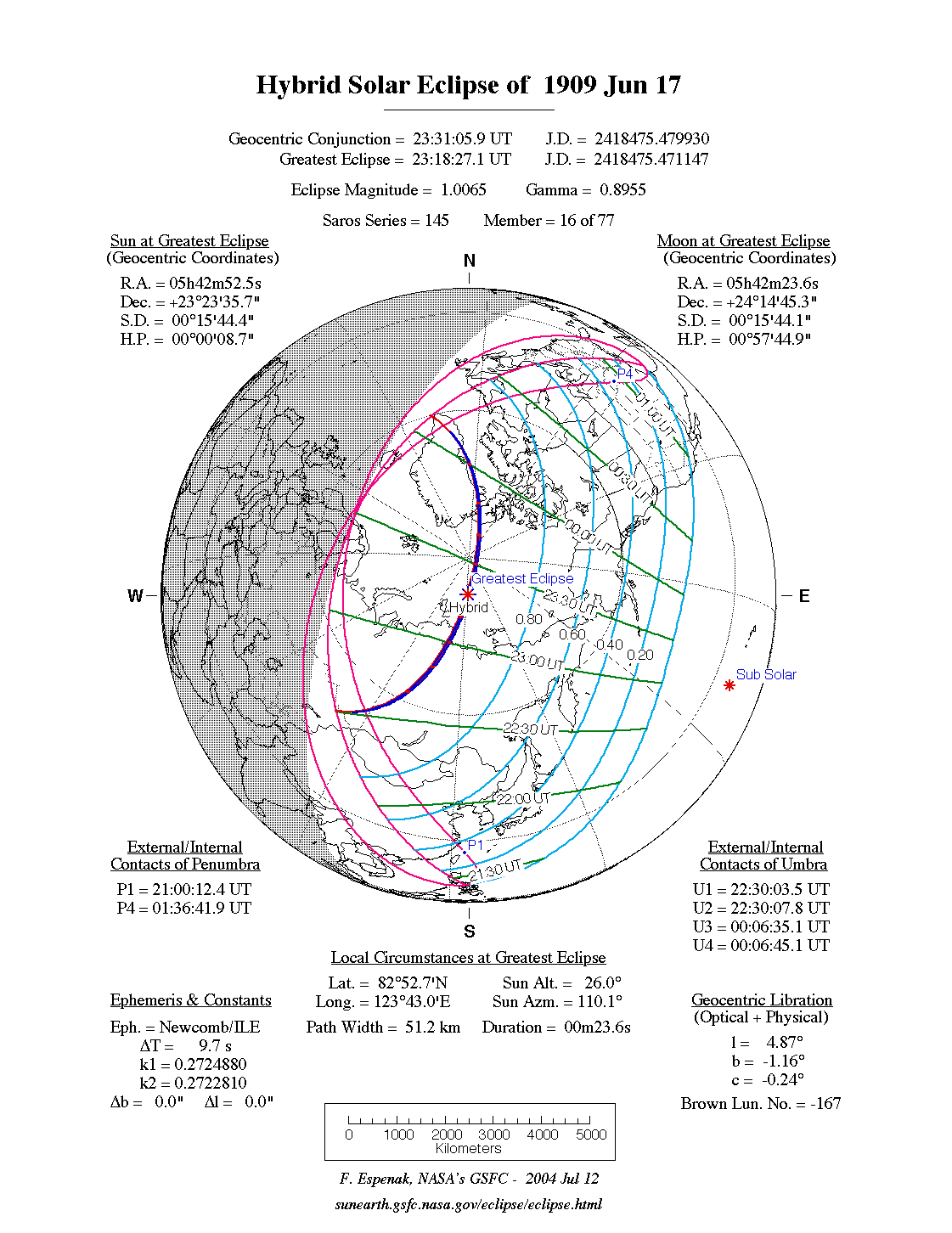
Template:Short description Script error: No such module "Solar eclipse". A total solar eclipse occurred at the Moon's ascending node of orbit between Thursday, June 17 and Friday, June 18, 1909,[1][2][3][4] with a magnitude of 1.0065. It was a hybrid event, with a long section of its path as total, and smaller sections at the start and end as an annular eclipse. A solar eclipse occurs when the Moon passes between Earth and the Sun, thereby totally or partly obscuring the image of the Sun for a viewer on Earth. A total solar eclipse occurs when the Moon's apparent diameter is larger than the Sun's, blocking all direct sunlight, turning day into darkness. Totality occurs in a narrow path across Earth's surface, with the partial solar eclipse visible over a surrounding region thousands of kilometres wide. The Moon's apparent diameter was near the average diameter because it occurred 5.4 days after perigee (on June 12, 1909, at 16:00 UTC) and 7.5 days before apogee (on June 25, 1909, at 12:00 UTC).[5]
The path of totality crossed central Russia, the Arctic Ocean, northeastern Ellesmere Island in Canada, Greenland, and annularity crossed southern Siberia in Russia (now in northeastern Kazakhstan and southern Russia) and southern Greenland. A partial eclipse was visible for parts of East Asia and northern North America.
Eclipse details
Shown below are two tables displaying details about this particular solar eclipse. The first table outlines times at which the moon's penumbra or umbra attains the specific parameter, and the second table describes various other parameters pertaining to this eclipse.[6]
| Event | Time (UTC) |
|---|---|
| First Penumbral External Contact | 1909 June 17 at 21:00:24.0 UTC |
| First Umbral External Contact | 1909 June 17 at 22:30:16.6 UTC |
| First Central Line | 1909 June 17 at 22:30:18.7 UTC |
| First Umbral Internal Contact | 1909 June 17 at 22:30:20.9 UTC |
| Greatest Duration | 1909 June 17 at 23:16:41.2 UTC |
| Greatest Eclipse | 1909 June 17 at 23:18:38.1 UTC |
| Ecliptic Conjunction | 1909 June 17 at 23:28:20.1 UTC |
| Equatorial Conjunction | 1909 June 17 at 23:31:17.2 UTC |
| Last Umbral Internal Contact | 1909 June 18 at 00:06:44.2 UTC |
| Last Central Line | 1909 June 18 at 00:06:49.2 UTC |
| Last Umbral External Contact | 1909 June 18 at 00:06:54.2 UTC |
| Last Penumbral External Contact | 1909 June 18 at 01:36:52.5 UTC |
| Parameter | Value |
|---|---|
| Eclipse Magnitude | 1.00647 |
| Eclipse Obscuration | 1.01299 |
| Gamma | 0.89568 |
| Sun Right Ascension | 05h42m52.5s |
| Sun Declination | +23°23'35.6" |
| Sun Semi-Diameter | 15'44.3" |
| Sun Equatorial Horizontal Parallax | 08.7" |
| Moon Right Ascension | 05h42m23.6s |
| Moon Declination | +24°14'45.8" |
| Moon Semi-Diameter | 15'44.1" |
| Moon Equatorial Horizontal Parallax | 0°57'44.9" |
| ΔT | 9.7 s |
Eclipse season
Script error: No such module "Labelled list hatnote". This eclipse is part of an eclipse season, a period, roughly every six months, when eclipses occur. Only two (or occasionally three) eclipse seasons occur each year, and each season lasts about 35 days and repeats just short of six months (173 days) later; thus two full eclipse seasons always occur each year. Either two or three eclipses happen each eclipse season. In the sequence below, each eclipse is separated by a fortnight.
| June 4 Descending node (full moon) |
June 17 Ascending node (new moon) |
|---|---|
| File:Lunar eclipse chart close-1909Jun04.png | File:SE1909Jun17H.png |
| Total lunar eclipse Lunar Saros 119 |
Hybrid solar eclipse Solar Saros 145 |


Related eclipses
Eclipses in 1909
- A total lunar eclipse on June 4.
- A hybrid solar eclipse on June 17.
- A total lunar eclipse on November 27.
- A partial solar eclipse on December 12.
Metonic
- Preceded by: Solar eclipse of August 30, 1905
- Followed by: Solar eclipse of April 6, 1913
Tzolkinex
- Preceded by: Solar eclipse of May 7, 1902
- Followed by: Solar eclipse of July 30, 1916
Half-Saros
- Preceded by: Lunar eclipse of June 13, 1900
- Followed by: Lunar eclipse of June 24, 1918
Tritos
- Preceded by: Solar eclipse of July 18, 1898
- Followed by: Solar eclipse of May 18, 1920
Solar Saros 145
- Preceded by: Solar eclipse of June 6, 1891
- Followed by: Solar eclipse of June 29, 1927
Inex
- Preceded by: Solar eclipse of July 7, 1880
- Followed by: Solar eclipse of May 29, 1938
Triad
- Preceded by: Solar eclipse of August 16, 1822
- Followed by: Solar eclipse of April 17, 1996
Solar eclipses of 1906–1909
This eclipse is a member of a semester series. An eclipse in a semester series of solar eclipses repeats approximately every 177 days and 4 hours (a semester) at alternating nodes of the Moon's orbit.[7]
The partial solar eclipses on February 23, 1906 and August 20, 1906 occur in the previous lunar year eclipse set.
| Solar eclipse series sets from 1906 to 1909 | ||||||
|---|---|---|---|---|---|---|
| Ascending node | Descending node | |||||
| Saros | Map | Gamma | Saros | Map | Gamma | |
| 115 | July 21, 1906 File:SE1906Jul21P.png Partial |
−1.3637 | 120 | January 14, 1907 File:SE1907Jan14T.png Total |
0.8628 | |
| 125 | July 10, 1907 File:SE1907Jul10A.png Annular |
−0.6313 | 130 | January 3, 1908 File:SE1908Jan03T.png Total |
0.1934 | |
| 135 | June 28, 1908 File:SE1908Jun28A.png Annular |
0.1389 | 140 | December 23, 1908 File:SE1908Dec23H.png Hybrid |
−0.4985 | |
| 145 | June 17, 1909 File:SE1909Jun17H.png Hybrid |
0.8957 | 150 | December 12, 1909 File:SE1909Dec12P.png Partial |
−1.2456 | |


Saros 145
This eclipse is a part of Saros series 145, repeating every 18 years, 11 days, and containing 77 events. The series started with a partial solar eclipse on January 4, 1639. It contains an annular eclipse on June 6, 1891; a hybrid eclipse on June 17, 1909; and total eclipses from June 29, 1927 through September 9, 2648. The series ends at member 77 as a partial eclipse on April 17, 3009. Its eclipses are tabulated in three columns; every third eclipse in the same column is one exeligmos apart, so they all cast shadows over approximately the same parts of the Earth.
The longest duration of annularity was produced by member 15 at 6 seconds (by default) on June 6, 1891, and the longest duration of totality will be produced by member 50 at 7 minutes, 12 seconds on June 25, 2522. All eclipses in this series occur at the Moon’s ascending node of orbit.[8]
| Series members 10–32 occur between 1801 and 2200: | ||
|---|---|---|
| 10 | 11 | 12 |
| File:SE1801Apr13P.png April 13, 1801 |
File:SE1819Apr24P.png April 24, 1819 |
File:SE1837May04P.png May 4, 1837 |
| 13 | 14 | 15 |
| File:SE1855May16P.png May 16, 1855 |
File:SE1873May26P.png May 26, 1873 |
File:SE1891Jun06A.png June 6, 1891 |
| 16 | 17 | 18 |
| File:SE1909Jun17H.png June 17, 1909 |
File:SE1927Jun29T.png June 29, 1927 |
File:1945Jul09T.png July 9, 1945 |
| 19 | 20 | 21 |
| File:SE1963Jul20T.png July 20, 1963 |
File:SE1981Jul31T.png July 31, 1981 |
File:SE1999Aug11T.png August 11, 1999 |
| 22 | 23 | 24 |
| File:SE2017Aug21T.png August 21, 2017 |
File:SE2035Sep02T.png September 2, 2035 |
File:SE2053Sep12T.png September 12, 2053 |
| 25 | 26 | 27 |
| File:SE2071Sep23T.png September 23, 2071 |
File:SE2089Oct04T.png October 4, 2089 |
File:SE2107Oct16T.png October 16, 2107 |
| 28 | 29 | 30 |
| File:SE2125Oct26T.png October 26, 2125 |
File:SE2143Nov07T.png November 7, 2143 |
File:SE2161Nov17T.png November 17, 2161 |
| 31 | 32 | |
| File:SE2179Nov28T.png November 28, 2179 |
File:SE2197Dec09T.png December 9, 2197 | |


Metonic series
Template:Solar Metonic series 1837–1928
Tritos series
Template:Solar Tritos series 2007 September 11
Inex series
Template:Solar Inex series 2025 March 29
External links
<templatestyles src="Reflist/styles.css" />
- ↑ Script error: No such module "citation/CS1".
- ↑ Script error: No such module "citation/CS1".
- ↑ Script error: No such module "citation/CS1".
- ↑ Script error: No such module "citation/CS1".
- ↑ Script error: No such module "citation/CS1".
- ↑ Script error: No such module "citation/CS1".
- ↑ Script error: No such module "citation/CS1".
- ↑ Script error: No such module "citation/CS1".
Script error: No such module "Check for unknown parameters".
- Earth visibility chart and eclipse statistics Eclipse Predictions by Fred Espenak, NASA/GSFC
Script error: No such module "Navbox".