Solar eclipse of July 22, 2028
Template:Short description Script error: No such module "Solar eclipse". Script error: No such module "Unsubst".

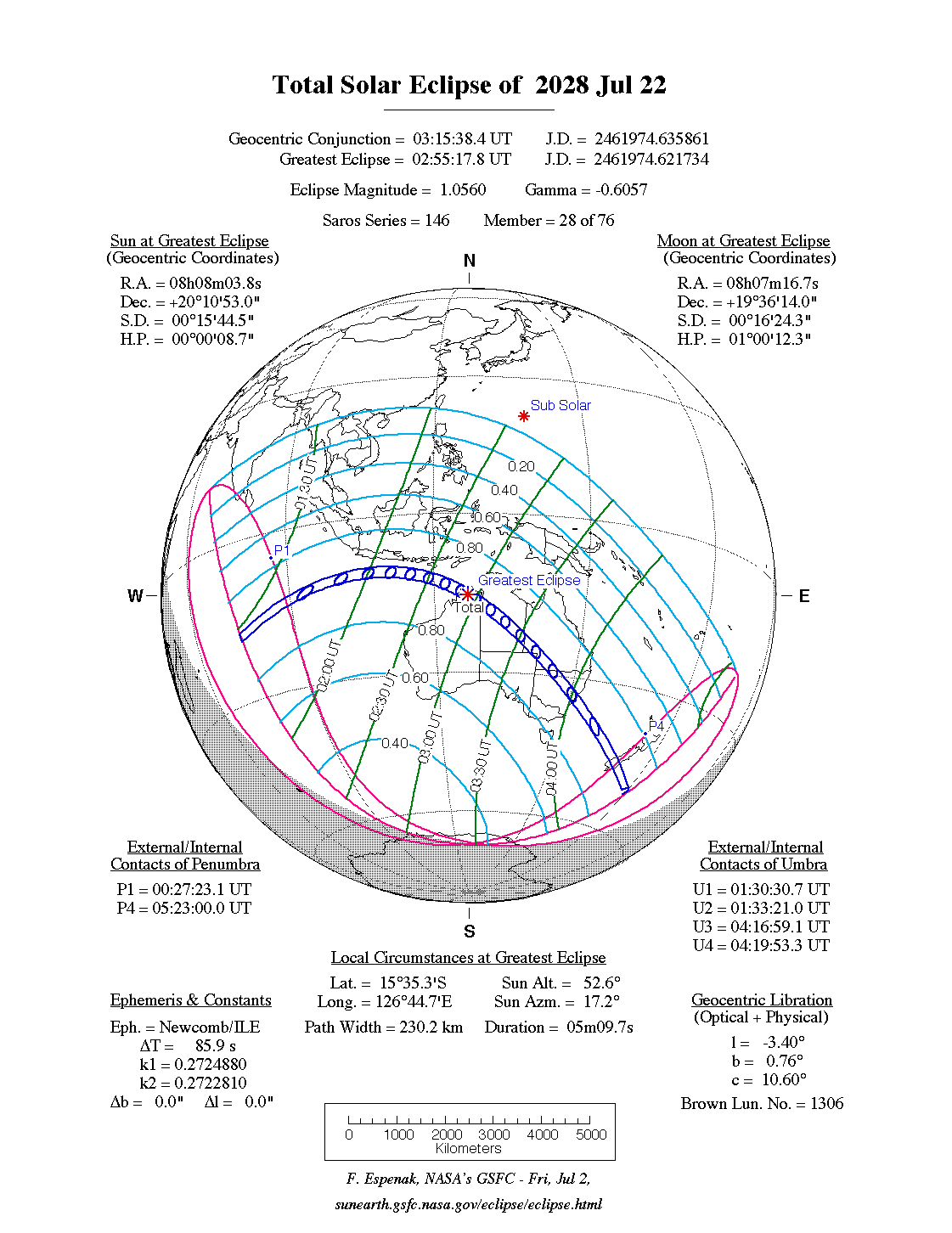
A total solar eclipse will occur at the Moon's descending node of orbit on Saturday, 22 July 2028,[1] with a magnitude of 1.056. A solar eclipse occurs when the Moon passes between Earth and the Sun, thereby totally or partly obscuring the image of the Sun for a viewer on Earth. A total solar eclipse occurs when the Moon's apparent diameter is larger than the Sun's, blocking all direct sunlight, turning day into darkness. Totality occurs in a narrow path across Earth's surface, with the partial solar eclipse visible over a surrounding region thousands of kilometres wide. Occurring about 1.8 days before perigee (on 23 July 2028, at 23:20 UTC), the Moon's apparent diameter will be larger.[2]
The central line of the path of the eclipse will cross the Australian continent from the Kimberley region in the north-west and continue in a south-easterly direction through Western Australia, the Northern Territory, south-west Queensland and New South Wales, close to the towns of Wyndham, Kununurra, Tennant Creek, Birdsville, Bourke and Dubbo, and continuing on through the centre of Sydney, where the eclipse will have a duration of over three minutes. It will also cross Queenstown and Dunedin, New Zealand. Totality will also be viewable from two of Australia's external territories: Christmas Island and the Cocos (Keeling) Islands. A partial eclipse will be visible for parts of Southeast Asia, Australia, and Oceania.Script error: No such module "Unsubst".
This is the first time Sydney will experience a total solar eclipse since 26 March 1857 and will be the last until 3 June 2858.[3]
Details of the totality by location
| Country or Territory | City or Town | Start of partial eclipse (Local Time) |
Start of total eclipse (Local Time) |
End of total eclipse (Local Time) |
Duration of total eclipse |
End of partial eclipse (Local Time) |
Magnitude |
|---|---|---|---|---|---|---|---|
| File:Flag of the Cocos (Keeling) Islands.svg Cocos Islands | West Island | 07:03:37 | 08:12:03 | 08:15:29 | 3 min 27 s | 09:35:13 | 1,048 |
| File:Flag of Christmas Island.svg Christmas Island | Flying Fish Cove | 07:39:41 | 08:54:49 | 08:58:42 | 3 min 53 s | 10:25:35 | 1,052 |
| Script error: No such module "flag". | Wyndham, Western Australia | 09:25:54 | 10:57:53 | 11:00:48 | 3 min 22 s | 12:31:30 | 1,056 |
| Script error: No such module "flag". | Kununurra, Western Australia | 09:27:48 | 10:59:41 | 11:02:35 | 2 min 54 s | 12:33:09 | 1,056 |
| Script error: No such module "flag". | Tennant Creek, Northern Territory | 11:16:50 | 12:48:01 | 12:51:25 | 3 min 23 s | 14:17:33 | 1,056 |
| Script error: No such module "flag". | Bedourie, Queensland | 12:06:46 | 13:34:24 | 13:38:55 | 4 min 31 s | 14:59:30 | 1,054 |
| Script error: No such module "flag". | Bourke, New South Wales | 12:27:18 | 13:50:11 | 13:54:16 | 4 min 05 s | 15:09:54 | 1,052 |
| Script error: No such module "flag". | Nyngan, New South Wales | 12:31:11 | 13:53:15 | 13:56:30 | 3 min 15 s | 15:10:53 | 1,052 |
| Script error: No such module "flag". | Dubbo, New South Wales | 12:34:35 | 13:55:23 | 13:59:13 | 3 min 51 s | 15:12:20 | 1,051 |
| Script error: No such module "flag". | Orange, New South Wales | 12:36:16 | 13:57:09 | 13:59:29 | 2 min 18 s | 15:12:48 | 1,051 |
| Script error: No such module "flag". | Wollongong, New South Wales | 12:40:27 | 13:59:42 | 14:02:33 | 2 min 51 s | 15:14:21 | 1,051 |
| Script error: No such module "flag". | Sydney, New South Wales | 12:40:42 | 13:59:33 | 14:03:22 | 3 min 48 s | 15:14:40 | 1,051 |
| Script error: No such module "flag". | Central Coast, New South Wales | 12:40:56 | 14:00:37 | 14:03:11 | 2 min 54 s | 15:14:54 | 1,051 |
| Script error: No such module "flag". | Queenstown | 15:07:26 | 16:15:07 | 16:18:01 | 2 min 55 s | 17:20:06 | 1,045 |
| Script error: No such module "flag". | Dunedin | 15:09:01 | 16:15:48 | 16:18:39 | 2 min 51 s | 17:15:24 (sunset) | 1,045 |
| Script error: No such module "flag". | Antipodes Islands | 15:14:08 | 16:17:21 | 16:19:55 | 2 min 34 s | 16:28:47 (sunset) | 1,042 |


Eclipse details
Shown below are two tables displaying details about this particular solar eclipse. The first table outlines times at which the moon's penumbra or umbra attains the specific parameter, and the second table describes various other parameters pertaining to this eclipse.[4]
| Event | Time (UTC) |
|---|---|
| First Penumbral External Contact | 2028 July 22 at 00:28:44.4 UTC |
| First Umbral External Contact | 2028 July 22 at 01:31:51.9 UTC |
| First Central Line | 2028 July 22 at 01:33:16.8 UTC |
| First Umbral Internal Contact | 2028 July 22 at 01:34:42.2 UTC |
| Greatest Duration | 2028 July 22 at 02:53:30.9 UTC |
| Greatest Eclipse | 2028 July 22 at 02:56:39.6 UTC |
| Ecliptic Conjunction | 2028 July 22 at 03:02:52.3 UTC |
| Equatorial Conjunction | 2028 July 22 at 03:17:00.0 UTC |
| Last Umbral Internal Contact | 2028 July 22 at 04:18:21.6 UTC |
| Last Central Line | 2028 July 22 at 04:19:49.0 UTC |
| Last Umbral External Contact | 2028 July 22 at 04:21:15.8 UTC |
| Last Penumbral External Contact | 2028 July 22 at 05:24:22.4 UTC |
| Parameter | Value |
|---|---|
| Eclipse Magnitude | 1.05602 |
| Eclipse Obscuration | 1.11518 |
| Gamma | −0.60557 |
| Sun Right Ascension | 08h08m03.8s |
| Sun Declination | +20°10'53.0" |
| Sun Semi-Diameter | 15'44.5" |
| Sun Equatorial Horizontal Parallax | 08.7" |
| Moon Right Ascension | 08h07m16.7s |
| Moon Declination | +19°36'14.4" |
| Moon Semi-Diameter | 16'24.3" |
| Moon Equatorial Horizontal Parallax | 1°00'12.3" |
| ΔT | 73.2 s |
Eclipse season
Script error: No such module "Labelled list hatnote". This eclipse is part of an eclipse season, a period, roughly every six months, when eclipses occur. Only two (or occasionally three) eclipse seasons occur each year, and each season lasts about 35 days and repeats just short of six months (173 days) later; thus two full eclipse seasons always occur each year. Either two or three eclipses happen each eclipse season. In the sequence below, each eclipse is separated by a fortnight.
| July 6 Ascending node (full moon) |
July 22 Descending node (new moon) |
|---|---|
| File:Lunar eclipse chart close-2028Jul06.png | File:SE2028Jul22T.png |
| Partial lunar eclipse Lunar Saros 120 |
Total solar eclipse Solar Saros 146 |


Related eclipses
Eclipses in 2028
- A partial lunar eclipse on January 12.
- An annular solar eclipse on January 26.
- A partial lunar eclipse on July 6.
- A total solar eclipse on 22 July.
- A total lunar eclipse on December 31.
Metonic
- Preceded by: Solar eclipse of October 2, 2024
- Followed by: Solar eclipse of May 9, 2032
Tzolkinex
- Preceded by: Solar eclipse of June 10, 2021
- Followed by: Solar eclipse of September 2, 2035
Half-Saros
- Preceded by: Lunar eclipse of July 16, 2019
- Followed by: Lunar eclipse of July 27, 2037
Tritos
- Preceded by: Solar eclipse of August 21, 2017
- Followed by: Solar eclipse of June 21, 2039
Solar Saros 146
- Preceded by: Solar eclipse of July 11, 2010
- Followed by: Solar eclipse of August 2, 2046
Inex
- Preceded by: Solar eclipse of August 11, 1999
- Followed by: Solar eclipse of July 1, 2057
Triad
- Preceded by: Solar eclipse of September 21, 1941
- Followed by: Solar eclipse of May 24, 2115
Solar eclipses of 2026–2029
This eclipse is a member of a semester series. An eclipse in a semester series of solar eclipses repeats approximately every 177 days and 4 hours (a semester) at alternating nodes of the Moon's orbit.[5]
The partial solar eclipses on June 12, 2029 and December 5, 2029 occur in the next lunar year eclipse set.
| Solar eclipse series sets from 2026 to 2029 | ||||||
|---|---|---|---|---|---|---|
| Ascending node | Descending node | |||||
| Saros | Map | Gamma | Saros | Map | Gamma | |
| 121 | February 17, 2026 File:SE2026Feb17A.png Annular |
−0.97427 | 126 | August 12, 2026 File:SE2026Aug12T.png Total |
0.89774 | |
| 131 | February 6, 2027 File:SE2027Feb06A.png Annular |
−0.29515 | 136 | August 2, 2027 File:SE2027Aug02T.png Total |
0.14209 | |
| 141 | January 26, 2028 File:SE2028Jan26A.png Annular |
0.39014 | 146 | July 22, 2028 File:SE2028Jul22T.png Total |
−0.60557 | |
| 151 | January 14, 2029 File:SE2029Jan14P.png Partial |
1.05532 | 156 | July 11, 2029 File:SE2029Jul11P.png Partial |
−1.41908 | |


Saros 146
Template:Solar Saros series 146
Metonic series
The metonic series repeats eclipses every 19 years (6939.69 days), lasting about 5 cycles. Eclipses occur in nearly the same calendar date. In addition, the octon subseries repeats 1/5 of that or every 3.8 years (1387.94 days). All eclipses in this table occur at the Moon's descending node.
| 21 eclipse events between July 22, 1971 and July 22, 2047 | ||||
|---|---|---|---|---|
| July 22 | May 9–11 | February 26–27 | December 14–15 | October 2–3 |
| 116 | 118 | 120 | 122 | 124 |
| File:SE1971Jul22P.png July 22, 1971 |
File:SE1975May11P.png May 11, 1975 |
File:SE1979Feb26T.png February 26, 1979 |
File:SE1982Dec15P.png December 15, 1982 |
File:SE1986Oct03H.png October 3, 1986 |
| 126 | 128 | 130 | 132 | 134 |
| File:SE1990Jul22T.png July 22, 1990 |
File:SE1994May10A.png May 10, 1994 |
File:SE1998Feb26T.png February 26, 1998 |
File:SE2001Dec14A.png December 14, 2001 |
File:SE2005Oct03A.png October 3, 2005 |
| 136 | 138 | 140 | 142 | 144 |
| File:SE2009Jul22T.png July 22, 2009 |
File:SE2013May10A.png May 10, 2013 |
File:SE2017Feb26A.png February 26, 2017 |
File:SE2020Dec14T.png December 14, 2020 |
File:SE2024Oct02A.png October 2, 2024 |
| 146 | 148 | 150 | 152 | 154 |
| File:SE2028Jul22T.png July 22, 2028 |
File:SE2032May09A.png May 9, 2032 |
File:SE2036Feb27P.png February 27, 2036 |
File:SE2039Dec15T.png December 15, 2039 |
File:SE2043Oct03A.png October 3, 2043 |
| 156 | ||||
| File:SE2047Jul22P.png July 22, 2047 | ||||


Tritos series
Template:Solar Tritos series 2006 September 22
Inex series
Template:Solar Inex series 2028 July 22
References
<templatestyles src="Reflist/styles.css" />
Script error: No such module "Check for unknown parameters".
External links
- Earth visibility chart and eclipse statistics Eclipse Predictions by Fred Espenak, NASA/GSFC
Script error: No such module "Side box".
Script error: No such module "Navbox".