Solar eclipse of July 2, 2019
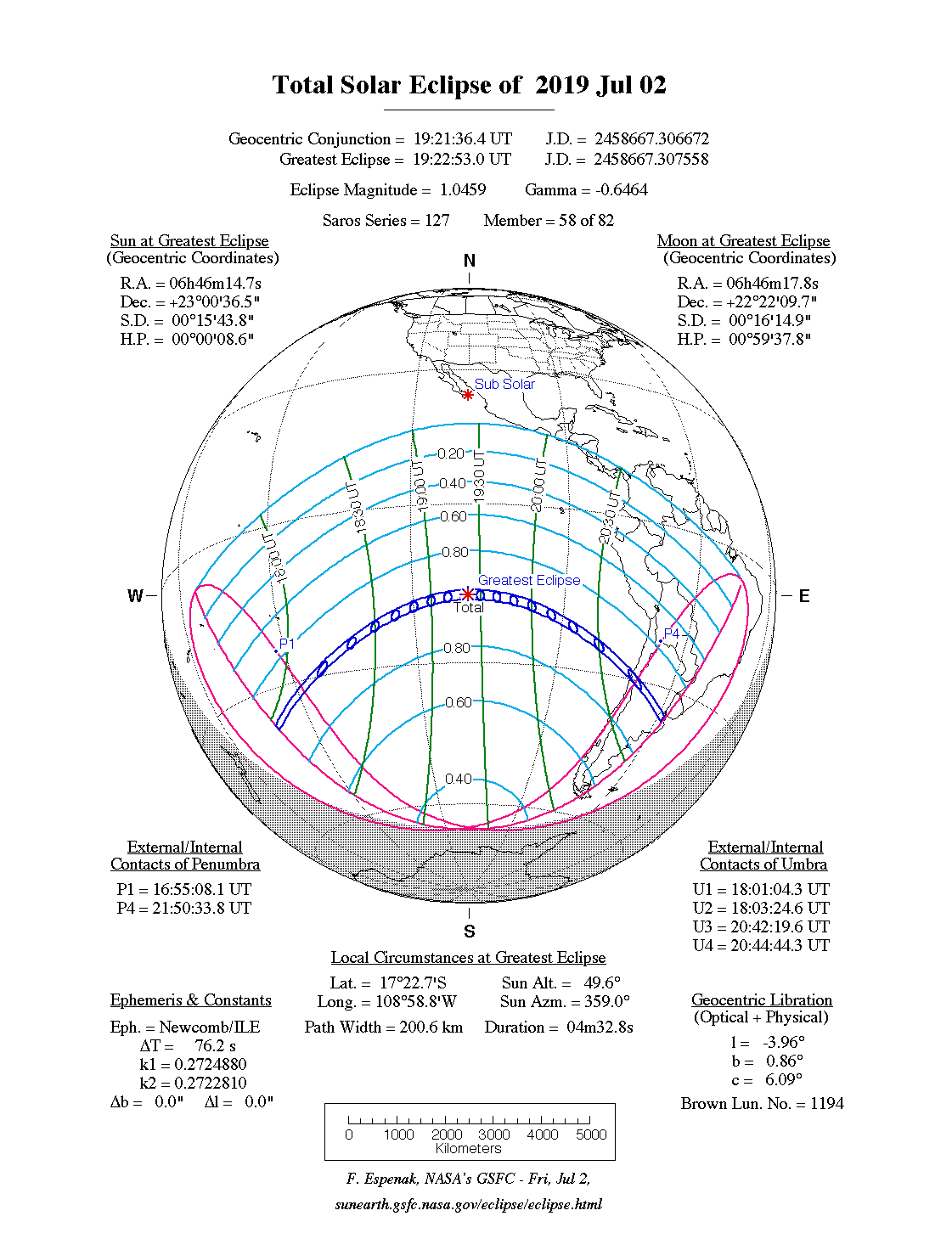
Template:Short description Script error: No such module "Solar eclipse". A total solar eclipse occurred at the Moon's ascending node of orbit on Tuesday, July 2, 2019,[1][2][3][4][5] with a magnitude of 1.0459. A total solar eclipse occurs when the Moon's apparent diameter is larger than the Sun's and the apparent path of the Sun and Moon intersect, blocking all direct sunlight and turning daylight into darkness; the Sun appears to be black with a halo around it. Totality occurs in a narrow path across Earth's surface, with the partial solar eclipse visible over a surrounding region thousands of kilometres wide. Occurring about 2.4 days before perigee (on July 5, 2019, at 6:00 UTC), the Moon's apparent diameter was larger.[6]
Totality was visible from the southern Pacific Ocean east of New Zealand to the Pitcairn Islands and the Tuamotu Archipelago and finally reaching the Coquimbo Region in Chile and central Argentina near sunset, with the maximum of 4 minutes 33 seconds visible from the Pacific Ocean. A partial eclipse was visible for parts of eastern Oceania, South America, and southern Central America. A total solar eclipse crossed a similar region of the Earth about a year and a half later on December 14, 2020.
List of major cities in the path of totality
- La Serena, Chile
- San Juan, San Juan, Argentina
- Bella Vista, Buenos Aires, Argentina
- San José de Jáchal, San Juan, Argentina
- Bragado, Buenos Aires, Argentina
- Junín, Buenos Aires, Argentina[7]
Images
Script error: No such module "Multiple image".
Visibility
A solar eclipse occurs when the Moon passes between Earth and the Sun, thereby totally or partly obscuring the image of the Sun for a viewer on Earth. A total solar eclipse occurs when the Moon's apparent diameter is larger than the Sun's, blocking all direct sunlight, turning day into darkness. Totality occurs in a narrow path across Earth's surface, with the partial solar eclipse visible over a surrounding region thousands of kilometres wide.
Following the North American solar eclipse of August 21, 2017, Astronomers Without Borders collected eclipse glasses for redistribution to Latin America and Asia for the 2019 eclipses.[8]
Totality travelled over areas with low levels of humidity and light pollution, allowing for very good observations. Several major observatories experienced totality, including the European Southern Observatory.[9][10]
Oeno Island
The first land surface and the only Pacific island from which totality was visible is Oeno Island, an uninhabited atoll in the Pitcairn Islands.[10]
Chile
Totality was visible in a large portion of Coquimbo Region and small parts of Atacama Region. Cities in the path included La Serena and La Higuera. Approximately 300,000 people visited La Serena to view the event.[9] Tickets to view the eclipse from the European Southern Observatory were sold for US$2000 each.[10]
Argentina
Totality was visible in the provinces of San Juan, La Rioja, San Luis, Córdoba, Santa Fe, and Buenos Aires. Cities in the path included San Juan and Río Cuarto.[10] The path of totality finished at the Samborombon Bay, where the eclipsed sunset was observed from San Clemente del Tuyu.
Gallery
-
Eclipse progression from Huechuraba, Chile

-
Totality over La Silla Observatory, Chile
-
Partial from Temuco, Chile, 19:42 UTC
-
Partial from Buenos Aires, Argentina, 20:10 UTC
-
Totality as seen from La Silla Observatory, 20:39 UTC
-
From Ñuñoa, Chile, 20:41 UTC, near greatest eclipse
-
Time-lapse image from Marcos Juárez, Argentina
-
The total solar eclipse diamond ring from ESO's La Silla Observatory on July 2, 2019 at the moment when most of its face is occulted by the moon. Image was taken by Mahdi Zamani by the NTT telescope viewpoint.


Eclipse details
Shown below are two tables displaying details about this particular solar eclipse. The first table outlines times at which the moon's penumbra or umbra attains the specific parameter, and the second table describes various other parameters pertaining to this eclipse.[11]
| Event | Time (UTC) |
|---|---|
| First Penumbral External Contact | 2019 July 2 at 16:56:22.9 UTC |
| First Umbral External Contact | 2019 July 2 at 18:02:19.5 UTC |
| First Central Line | 2019 July 2 at 18:03:29.5 UTC |
| First Umbral Internal Contact | 2019 July 2 at 18:04:39.8 UTC |
| Ecliptic Conjunction | 2019 July 2 at 19:17:21.9 UTC |
| Equatorial Conjunction | 2019 July 2 at 19:22:51.0 UTC |
| Greatest Eclipse | 2019 July 2 at 19:24:07.5 UTC |
| Greatest Duration | 2019 July 2 at 19:25:18.8 UTC |
| Last Umbral Internal Contact | 2019 July 2 at 20:43:33.5 UTC |
| Last Central Line | 2019 July 2 at 20:44:46.0 UTC |
| Last Umbral External Contact | 2019 July 2 at 20:45:58.2 UTC |
| Last Penumbral External Contact | 2019 July 2 at 21:51:48.1 UTC |
| Parameter | Value |
|---|---|
| Eclipse Magnitude | 1.04593 |
| Eclipse Obscuration | 1.09398 |
| Gamma | −0.64656 |
| Sun Right Ascension | 06h46m14.8s |
| Sun Declination | +23°00'36.4" |
| Sun Semi-Diameter | 15'43.8" |
| Sun Equatorial Horizontal Parallax | 08.6" |
| Moon Right Ascension | 06h46m17.9s |
| Moon Declination | +22°22'09.2" |
| Moon Semi-Diameter | 16'14.9" |
| Moon Equatorial Horizontal Parallax | 0°59'37.8" |
| ΔT | 69.6 s |
Eclipse season
Script error: No such module "Labelled list hatnote". This eclipse is part of an eclipse season, a period, roughly every six months, when eclipses occur. Only two (or occasionally three) eclipse seasons occur each year, and each season lasts about 35 days and repeats just short of six months (173 days) later; thus two full eclipse seasons always occur each year. Either two or three eclipses happen each eclipse season. In the sequence below, each eclipse is separated by a fortnight.
| July 2 Ascending node (new moon) |
July 16 Descending node (full moon) |
|---|---|
| File:SE2019Jul02T.png | File:Lunar eclipse chart close-2019Jul16.png |
| Total solar eclipse Solar Saros 127 |
Partial lunar eclipse Lunar Saros 139 |


Related eclipses
Eclipses in 2019
- A partial solar eclipse on January 6.
- A total lunar eclipse on January 21.
- A total solar eclipse on July 2.
- A partial lunar eclipse on July 16.
- An annular solar eclipse on December 26.
Metonic
- Preceded by: Solar eclipse of September 13, 2015
- Followed by: Solar eclipse of April 20, 2023
Tzolkinex
- Preceded by: Solar eclipse of May 20, 2012
- Followed by: Solar eclipse of August 12, 2026
Half-Saros
- Preceded by: Lunar eclipse of June 26, 2010
- Followed by: Lunar eclipse of July 6, 2028
Tritos
- Preceded by: Solar eclipse of August 1, 2008
- Followed by: Solar eclipse of June 1, 2030
Solar Saros 127
- Preceded by: Solar eclipse of June 21, 2001
- Followed by: Solar eclipse of July 13, 2037
Inex
- Preceded by: Solar eclipse of July 22, 1990
- Followed by: Solar eclipse of June 11, 2048
Triad
- Preceded by: Solar eclipse of August 31, 1932
- Followed by: Solar eclipse of May 3, 2106
Solar eclipses of 2018–2021
This eclipse is a member of a semester series. An eclipse in a semester series of solar eclipses repeats approximately every 177 days and 4 hours (a semester) at alternating nodes of the Moon's orbit.[12]
The partial solar eclipses on February 15, 2018 and August 11, 2018 occur in the previous lunar year eclipse set.


Saros 127
This eclipse is a part of Saros series 127, repeating every 18 years, 11 days, and containing 82 events. The series started with a partial solar eclipse on October 10, 991 AD. It contains total eclipses from May 14, 1352 through August 15, 2091. There are no annular or hybrid eclipses in this set. The series ends at member 82 as a partial eclipse on March 21, 2452. Its eclipses are tabulated in three columns; every third eclipse in the same column is one exeligmos apart, so they all cast shadows over approximately the same parts of the Earth.
The longest duration of totality was produced by member 31 at 5 minutes, 40 seconds on August 30, 1532. All eclipses in this series occur at the Moon’s ascending node of orbit.[13]


Metonic series
The metonic series repeats eclipses every 19 years (6939.69 days), lasting about 5 cycles. Eclipses occur in nearly the same calendar date. In addition, the octon subseries repeats 1/5 of that or every 3.8 years (1387.94 days). All eclipses in this table occur at the Moon's ascending node.
| 21 eclipse events between July 1, 2000 and July 1, 2076 | ||||
|---|---|---|---|---|
| July 1–2 | April 19–20 | February 5–7 | November 24–25 | September 12–13 |
| 117 | 119 | 121 | 123 | 125 |
| File:SE2000Jul01P.png July 1, 2000 |
File:SE2004Apr19P.png April 19, 2004 |
File:SE2008Feb07A.png February 7, 2008 |
File:SE2011Nov25P.png November 25, 2011 |
File:SE2015Sep13P.png September 13, 2015 |
| 127 | 129 | 131 | 133 | 135 |
| File:SE2019Jul02T.png July 2, 2019 |
File:SE2023Apr20H.png April 20, 2023 |
File:SE2027Feb06A.png February 6, 2027 |
File:SE2030Nov25T.png November 25, 2030 |
File:SE2034Sep12A.png September 12, 2034 |
| 137 | 139 | 141 | 143 | 145 |
| File:SE2038Jul02A.png July 2, 2038 |
File:SE2042Apr20T.png April 20, 2042 |
File:SE2046Feb05A.png February 5, 2046 |
File:SE2049Nov25H.png November 25, 2049 |
File:SE2053Sep12T.png September 12, 2053 |
| 147 | 149 | 151 | 153 | 155 |
| File:SE2057Jul01A.png July 1, 2057 |
File:SE2061Apr20T.png April 20, 2061 |
File:SE2065Feb05P.png February 5, 2065 |
File:SE2068Nov24P.png November 24, 2068 |
File:SE2072Sep12T.png September 12, 2072 |
| 157 | ||||
| File:SE2076Jul01P.png July 1, 2076 | ||||


Tritos series
Template:Solar Tritos series 2008 August 1
Inex series
Template:Solar Inex series 2019 July 2
References
<templatestyles src="Reflist/styles.css" />
- ↑ Script error: No such module "citation/CS1".
- ↑ Script error: No such module "citation/CS1".
- ↑ Script error: No such module "citation/CS1".
- ↑ Script error: No such module "citation/CS1".
- ↑ Script error: No such module "citation/CS1".
- ↑ Script error: No such module "citation/CS1".
- ↑ Script error: No such module "citation/CS1".
- ↑ Script error: No such module "citation/CS1".
- ↑ a b Script error: No such module "citation/CS1".
- ↑ a b c d Script error: No such module "citation/CS1".
- ↑ Script error: No such module "citation/CS1".
- ↑ Script error: No such module "citation/CS1".
- ↑ Script error: No such module "citation/CS1".
Script error: No such module "Check for unknown parameters".
Additional sources
- Earth visibility chart and eclipse statistics Eclipse Predictions by Fred Espenak, NASA/GSFC
External links
Script error: No such module "Side box".
- solar-eclipse.de: The total solar eclipse of 07/02/2019
- eclipseportal.com: Total Solar Eclipse July, 02, 2019
- JulyEclipse.com has free educational materials aimed at teaching children about the July 2019 Solar Eclipse. They are available in English, Spanish, and Portuguese.
Script error: No such module "Navbox".