Solar eclipse of January 14, 1907
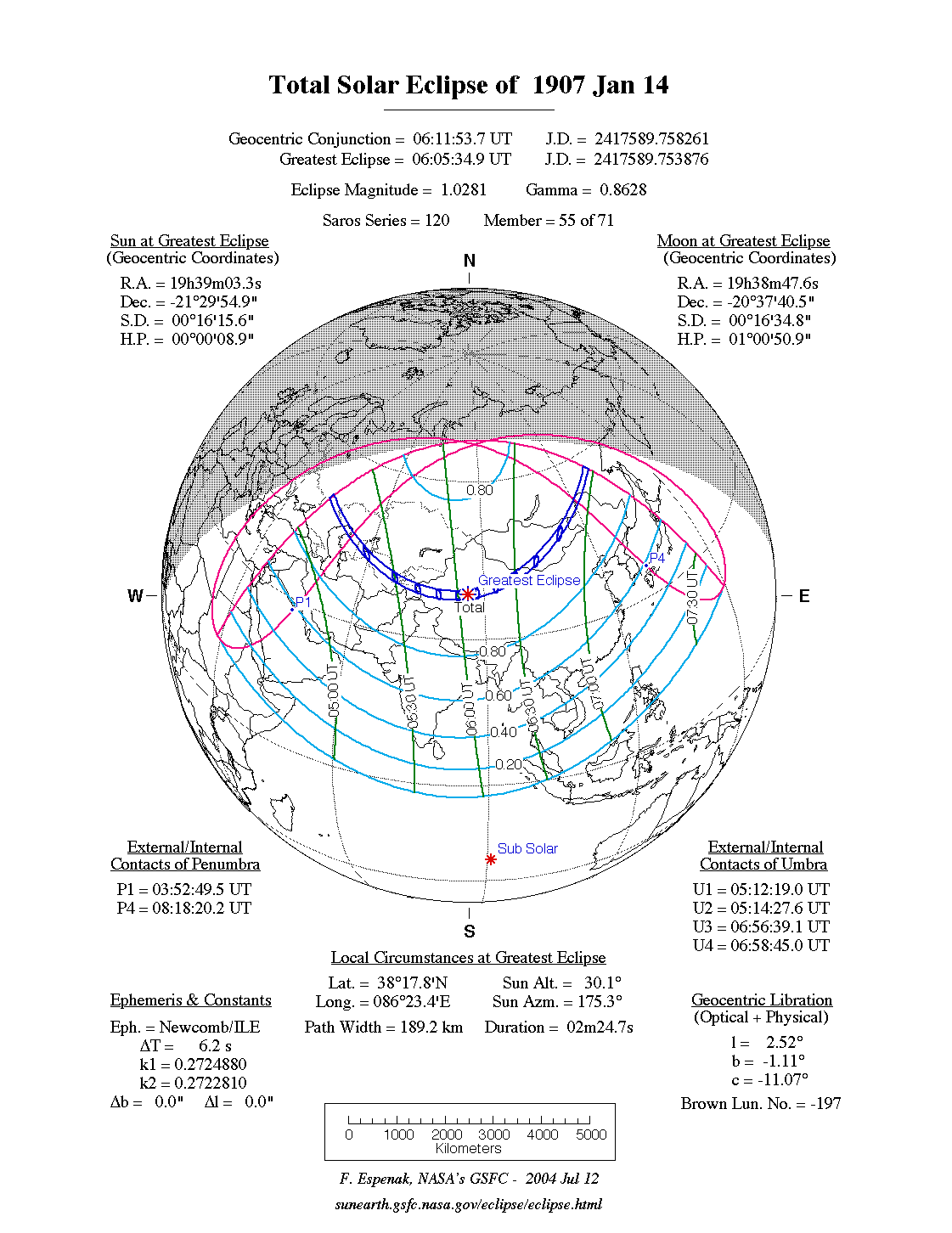
Template:Short description Script error: No such module "Solar eclipse". A total solar eclipse occurred at the Moon's descending node of orbit on Monday, January 14, 1907,[1] with a magnitude of 1.0281. A solar eclipse occurs when the Moon passes between Earth and the Sun, thereby totally or partly obscuring the image of the Sun for a viewer on Earth. A total solar eclipse occurs when the Moon's apparent diameter is larger than the Sun's, blocking all direct sunlight, turning day into darkness. Totality occurs in a narrow path across Earth's surface, with the partial solar eclipse visible over a surrounding region thousands of kilometres wide. Occurring about 1.2 days after perigee (on January 13, 1906, at 2:20 UTC), the Moon's apparent diameter was larger.[2]
Totality was visible from Russian Empire (the parts now belonging to Russia, Kazakhstan, Uzbekistan, Tajikistan and Kyrgyzstan) and China (now northwestern China, Mongolia and northern part of northeastern China).[3] A partial eclipse was visible for most of Asia.
The Camden Morning Post described its path as such:[4]
The shadow track begins on the banks of the Don, in Southern Russia, where the sun rises as totality is ending. It passes over the northern part of the Caspian Sea, where totality begins at sunrise, ant then over the Aral Sea and through Russian Turkestan, Samarkand being the principal town on the shadow track. Then it passes through the Pamirs and into Central Asia, through the desert of Gobi, ending finally on the River Amur, where totality commences at sunset.[4]
Confusion
At the time, "some confusion" existed about the date of the event: "the astronomical day begins at noon, the civil day at midnight, twelve hours earlier. Hence, according to the one system the eclipse will occur on Jan. 13, and according to the other on Jan. 14."[4]
Observations

The day of the eclipse, it was reported in the Roanoke Times that:
<templatestyles src="Template:Blockquote/styles.css" />
according to the cable dispatches, astronomers, physicists, photographers and scientists of all branches have pitched their camps to take observations. Near the city of Tashkent eminent groups of scientists under the patronage of universities and royal societies of France, Germany, Russia and other countries have set up their instruments with long, unpronouncable names in order to observe the eclipse.[5]
Script error: No such module "Check for unknown parameters".
Apart from ground-based observations, the researchers also attempted to perform atmospheric studies with the aid of weather balloons.[6] The Hamburg Observatory sent an expedition to Samarkand, to the south of Tashkent, which was expected to join up with the rest. The expedition from Paris was carried out by the Meudon Observatory, under M. Stefanik, and the British expedition by the British Astronomical Association.[4] According to journalist Mary Proctor, despite the recent construction of railways in the region, an attempt to join one of the expeditions and report on the eclipse from the location of observation had proven fruitless: "The Russian representatives in this country refused to take any responsibility if the writer ventured into Western Turkestan [...] According to information received from the Secretary of State, who lived in China twenty-three years, it would require a month to journey from Peking to Tsair-Osu. The desert of Gobi had to be crossed, and the journey made on horseback, an armed escort being necessary, as this region is also under Russian government."[4]
The Guardian reported that the eclipse was observed by "special scientific expeditions at Samarkand and Tashkent, in Russian Turkestan"; a Reuters correspondent telegraphed from Samarkand that the eclipse had been observed from the railway between the stations of Kuropatkin and Mijulnskaja, as snow fell.[3] Meanwhile, a visit by Afghan amir Habibullah Khan and Lord Kitchener to Agra[7][8] took place under a "distinct three-quarter eclipse of the sun".[8] On the western edge of the path, the eclipse was observed from Yessentuki.[9]
Eclipse details
Shown below are two tables displaying details about this particular solar eclipse. The first table outlines times at which the moon's penumbra or umbra attains the specific parameter, and the second table describes various other parameters pertaining to this eclipse.[10]
| Event | Time (UTC) |
|---|---|
| First Penumbral External Contact | 1907 January 14 at 03:52:57.4 UTC |
| First Umbral External Contact | 1907 January 14 at 05:12:27.1 UTC |
| First Central Line | 1907 January 14 at 05:13:31.0 UTC |
| First Umbral Internal Contact | 1907 January 14 at 05:14:35.8 UTC |
| Ecliptic Conjunction | 1907 January 14 at 05:56:57.5 UTC |
| Greatest Duration | 1907 January 14 at 06:04:51.3 UTC |
| Greatest Eclipse | 1907 January 14 at 06:05:43.0 UTC |
| Equatorial Conjunction | 1907 January 14 at 06:12:01.9 UTC |
| Last Umbral Internal Contact | 1907 January 14 at 06:56:47.3 UTC |
| Last Central Line | 1907 January 14 at 06:57:50.7 UTC |
| Last Umbral External Contact | 1907 January 14 at 06:58:53.2 UTC |
| Last Penumbral External Contact | 1907 January 14 at 08:18:28.4 UTC |
| Parameter | Value |
|---|---|
| Eclipse Magnitude | 1.02812 |
| Eclipse Obscuration | 1.05702 |
| Gamma | 0.86277 |
| Sun Right Ascension | 19h39m03.3s |
| Sun Declination | -21°29'55.0" |
| Sun Semi-Diameter | 16'15.6" |
| Sun Equatorial Horizontal Parallax | 08.9" |
| Moon Right Ascension | 19h38m47.6s |
| Moon Declination | -20°37'40.5" |
| Moon Semi-Diameter | 16'34.8" |
| Moon Equatorial Horizontal Parallax | 1°00'50.9" |
| ΔT | 6.2 s |
Eclipse season
Script error: No such module "Labelled list hatnote". This eclipse is part of an eclipse season, a period, roughly every six months, when eclipses occur. Only two (or occasionally three) eclipse seasons occur each year, and each season lasts about 35 days and repeats just short of six months (173 days) later; thus two full eclipse seasons always occur each year. Either two or three eclipses happen each eclipse season. In the sequence below, each eclipse is separated by a fortnight.
| January 14 Descending node (new moon) |
January 29 Ascending node (full moon) |
|---|---|
| File:SE1907Jan14T.png | File:Lunar eclipse chart close-1907Jan29.png |
| Total solar eclipse Solar Saros 120 |
Partial lunar eclipse Lunar Saros 132 |


Related eclipses
Eclipses in 1907
- A total solar eclipse on January 14.
- A partial lunar eclipse on January 29.
- An annular solar eclipse on July 10.
- A partial lunar eclipse on July 25.
Metonic
- Preceded by: Solar eclipse of March 29, 1903
- Followed by: Solar eclipse of November 2, 1910
Tzolkinex
- Preceded by: Solar eclipse of December 3, 1899
- Followed by: Solar eclipse of February 25, 1914
Half-Saros
- Preceded by: Lunar eclipse of January 8, 1898
- Followed by: Lunar eclipse of January 20, 1916
Tritos
- Preceded by: Solar eclipse of February 13, 1896
- Followed by: Solar eclipse of December 14, 1917
Solar Saros 120
- Preceded by: Solar eclipse of January 1, 1889
- Followed by: Solar eclipse of January 24, 1925
Inex
- Preceded by: Solar eclipse of February 2, 1878
- Followed by: Solar eclipse of December 25, 1935
Triad
- Preceded by: Solar eclipse of March 14, 1820
- Followed by: Solar eclipse of November 13, 1993
Solar eclipses of 1906–1909
This eclipse is a member of a semester series. An eclipse in a semester series of solar eclipses repeats approximately every 177 days and 4 hours (a semester) at alternating nodes of the Moon's orbit.[11]
The partial solar eclipses on February 23, 1906 and August 20, 1906 occur in the previous lunar year eclipse set.
| Solar eclipse series sets from 1906 to 1909 | ||||||
|---|---|---|---|---|---|---|
| Ascending node | Descending node | |||||
| Saros | Map | Gamma | Saros | Map | Gamma | |
| 115 | July 21, 1906 File:SE1906Jul21P.png Partial |
−1.3637 | 120 | January 14, 1907 File:SE1907Jan14T.png Total |
0.8628 | |
| 125 | July 10, 1907 File:SE1907Jul10A.png Annular |
−0.6313 | 130 | January 3, 1908 File:SE1908Jan03T.png Total |
0.1934 | |
| 135 | June 28, 1908 File:SE1908Jun28A.png Annular |
0.1389 | 140 | December 23, 1908 File:SE1908Dec23H.png Hybrid |
−0.4985 | |
| 145 | June 17, 1909 File:SE1909Jun17H.png Hybrid |
0.8957 | 150 | December 12, 1909 File:SE1909Dec12P.png Partial |
−1.2456 | |


Saros 120
This eclipse is a part of Saros series 120, repeating every 18 years, 11 days, and containing 71 events. The series started with a partial solar eclipse on May 27, 933 AD. It contains annular eclipses from August 11, 1059 through April 26, 1492; hybrid eclipses from May 8, 1510 through June 8, 1564; and total eclipses from June 20, 1582 through March 30, 2033. The series ends at member 71 as a partial eclipse on July 7, 2195. Its eclipses are tabulated in three columns; every third eclipse in the same column is one exeligmos apart, so they all cast shadows over approximately the same parts of the Earth.
The longest duration of annularity was produced by member 11 at 6 minutes, 24 seconds on September 11, 1113, and the longest duration of totality was produced by member 60 at 2 minutes, 50 seconds on March 9, 1997. All eclipses in this series occur at the Moon’s descending node of orbit.[12]


Metonic series
Template:Solar Metonic series 1884–1971
Tritos series
Template:Solar Tritos series 2005 April 8
Inex series
Template:Solar Inex series 2022 October 25
Notes
<templatestyles src="Reflist/styles.css" />
- ↑ Script error: No such module "citation/CS1".
- ↑ Script error: No such module "citation/CS1".
- ↑ a b Script error: No such module "citation/CS1".
- ↑ a b c d e Script error: No such module "citation/CS1".
- ↑ Script error: No such module "citation/CS1".
- ↑ Script error: No such module "citation/CS1".
- ↑ https://www.newspapers.com/article/the-daily-telegraph-ameer-in-india-moto/133686529/
- ↑ a b Script error: No such module "citation/CS1".
- ↑ Script error: No such module "citation/CS1".
- ↑ Script error: No such module "citation/CS1".
- ↑ Script error: No such module "citation/CS1".
- ↑ Script error: No such module "citation/CS1".
Script error: No such module "Check for unknown parameters".
External links
Script error: No such module "Side box".
- Earth visibility chart and eclipse statistics Eclipse Predictions by Fred Espenak, NASA/GSFC
- Photo of observations solar eclipse of January 14, 1907
- Solar eclipse of January 14, 1907 in Russia
- Solar eclipse of January 14, 1907
Script error: No such module "Navbox".