Solar eclipse of February 26, 2017
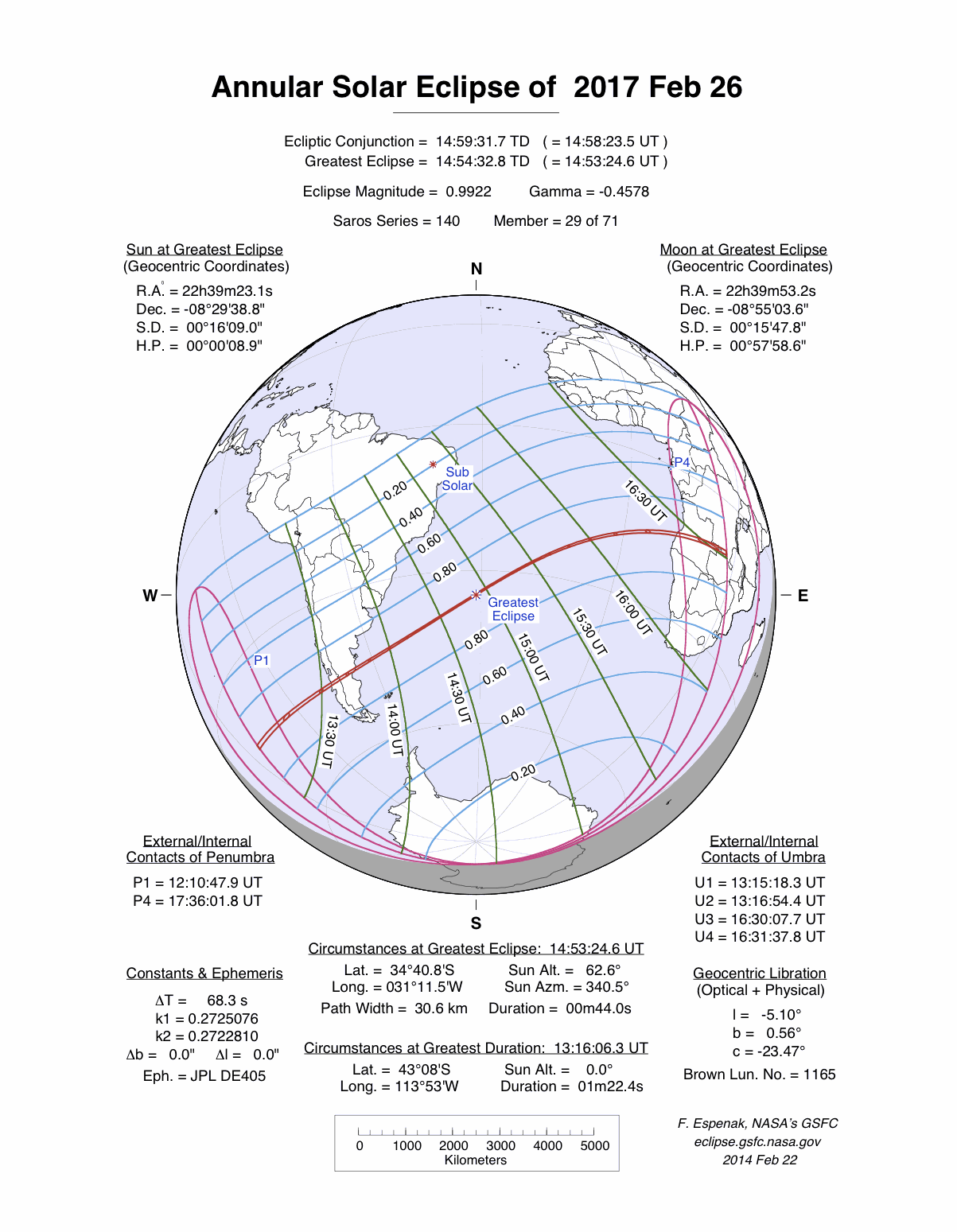
Template:Short description Script error: No such module "Solar eclipse". An annular solar eclipse occurred at the Moon's descending node of orbit on Sunday, February 26, 2017,[1][2][3][4] with a magnitude of 0.9922. A solar eclipse occurs when the Moon passes between Earth and the Sun, thereby totally or partly obscuring the image of the Sun for a viewer on Earth. An annular solar eclipse occurs when the Moon's apparent diameter is smaller than the Sun's, blocking most of the Sun's light and causing the Sun to look like an annulus (ring). An annular eclipse appears as a partial eclipse over a region of the Earth thousands of kilometres wide. Occurring about 4.9 days before perigee (on March 3, 2017, at 13:30 UTC), the Moon's apparent diameter was larger.[5]
The eclipse was visible across southern Chile and Argentina in the morning and ended in Angola and southwestern Katanga, Democratic Republic of the Congo at sunset. In Argentina, the best places to see the eclipse were located in the south of the Chubut Province, in the towns of Facundo, Sarmiento and Camarones. A partial eclipse was visible for parts of southern South America, southern and western Africa, and Antarctica.
Images
Script error: No such module "Multiple image".
Gallery
-
Partial from Villa Gesell, Argentina, 13:18 GMT
-
Coyhaique, Chile, 13:35 GMT, 1 minute before annularity
-
Partial from Pisco Elqui, Chile, 13:48 GMT
-
Partial from Punta del Este, Uruguay, 13:56 GMT
-
Partial from Puerto Cisnes, Chile, 14:17 GMT
-
Composed image as seen from Paraná, Argentina
-
Time lapse images as seen from Villa Gesell, Argentina
-
Animation of the eclipse as seen from Montevideo, Uruguay


Eclipse details
Shown below are two tables displaying details about this particular solar eclipse. The first table outlines times at which the moon's penumbra or umbra attains the specific parameter, and the second table describes various other parameters pertaining to this eclipse.[6]
| Event | Time (UTC) |
|---|---|
| First Penumbral External Contact | 2017 February 26 at 12:11:56.1 UTC |
| First Umbral External Contact | 2017 February 26 at 13:16:26.6 UTC |
| First Central Line | 2017 February 26 at 13:17:14.6 UTC |
| Greatest Duration | 2017 February 26 at 13:17:14.6 UTC |
| First Umbral Internal Contact | 2017 February 26 at 13:18:02.7 UTC |
| Equatorial Conjunction | 2017 February 26 at 14:39:54.4 UTC |
| Greatest Eclipse | 2017 February 26 at 14:54:32.8 UTC |
| Ecliptic Conjunction | 2017 February 26 at 14:59:31.7 UTC |
| Last Umbral Internal Contact | 2017 February 26 at 16:31:16.0 UTC |
| Last Central Line | 2017 February 26 at 16:32:01.1 UTC |
| Last Umbral External Contact | 2017 February 26 at 16:32:46.1 UTC |
| Last Penumbral External Contact | 2017 February 26 at 17:37:10.0 UTC |
| Parameter | Value |
|---|---|
| Eclipse Magnitude | 0.99223 |
| Eclipse Obscuration | 0.98451 |
| Gamma | −0.45780 |
| Sun Right Ascension | 22h39m23.1s |
| Sun Declination | -08°29'38.8" |
| Sun Semi-Diameter | 16'09.0" |
| Sun Equatorial Horizontal Parallax | 08.9" |
| Moon Right Ascension | 22h39m53.2s |
| Moon Declination | -08°55'03.6" |
| Moon Semi-Diameter | 15'47.8" |
| Moon Equatorial Horizontal Parallax | 0°57'58.6" |
| ΔT | 68.6 s |
Eclipse season
Script error: No such module "Labelled list hatnote". This eclipse is part of an eclipse season, a period, roughly every six months, when eclipses occur. Only two (or occasionally three) eclipse seasons occur each year, and each season lasts about 35 days and repeats just short of six months (173 days) later; thus two full eclipse seasons always occur each year. Either two or three eclipses happen each eclipse season. In the sequence below, each eclipse is separated by a fortnight.
| February 11 Ascending node (full moon) |
February 26 Descending node (new moon) |
|---|---|
| File:Lunar eclipse chart close-2017Feb11.png | File:SE2017Feb26A.png |
| Penumbral lunar eclipse Lunar Saros 114 |
Annular solar eclipse Solar Saros 140 |


Related eclipses
Eclipses in 2017
- A penumbral lunar eclipse on February 11.
- An annular solar eclipse on February 26.
- A partial lunar eclipse on August 7.
- A total solar eclipse on August 21.
Metonic
- Preceded by: Solar eclipse of May 10, 2013
- Followed by: Solar eclipse of December 14, 2020
Tzolkinex
- Preceded by: Solar eclipse of January 15, 2010
- Followed by: Solar eclipse of April 8, 2024
Half-Saros
- Preceded by: Lunar eclipse of February 21, 2008
- Followed by: Lunar eclipse of March 3, 2026
Tritos
- Preceded by: Solar eclipse of March 29, 2006
- Followed by: Solar eclipse of January 26, 2028
Solar Saros 140
- Preceded by: Solar eclipse of February 16, 1999
- Followed by: Solar eclipse of March 9, 2035
Inex
- Preceded by: Solar eclipse of March 18, 1988
- Followed by: Solar eclipse of February 5, 2046
Triad
- Preceded by: Solar eclipse of April 28, 1930
- Followed by: Solar eclipse of December 29, 2103
Solar eclipses of 2015–2018
This eclipse is a member of a semester series. An eclipse in a semester series of solar eclipses repeats approximately every 177 days and 4 hours (a semester) at alternating nodes of the Moon's orbit.[7]
The partial solar eclipse on July 13, 2018 occurs in the next lunar year eclipse set.


Saros 140
Template:Solar Saros series 140
Metonic series
The metonic series repeats eclipses every 19 years (6939.69 days), lasting about 5 cycles. Eclipses occur in nearly the same calendar date. In addition, the octon subseries repeats 1/5 of that or every 3.8 years (1387.94 days). All eclipses in this table occur at the Moon's descending node.
| 21 eclipse events between July 22, 1971 and July 22, 2047 | ||||
|---|---|---|---|---|
| July 22 | May 9–11 | February 26–27 | December 14–15 | October 2–3 |
| 116 | 118 | 120 | 122 | 124 |
| File:SE1971Jul22P.png July 22, 1971 |
File:SE1975May11P.png May 11, 1975 |
File:SE1979Feb26T.png February 26, 1979 |
File:SE1982Dec15P.png December 15, 1982 |
File:SE1986Oct03H.png October 3, 1986 |
| 126 | 128 | 130 | 132 | 134 |
| File:SE1990Jul22T.png July 22, 1990 |
File:SE1994May10A.png May 10, 1994 |
File:SE1998Feb26T.png February 26, 1998 |
File:SE2001Dec14A.png December 14, 2001 |
File:SE2005Oct03A.png October 3, 2005 |
| 136 | 138 | 140 | 142 | 144 |
| File:SE2009Jul22T.png July 22, 2009 |
File:SE2013May10A.png May 10, 2013 |
File:SE2017Feb26A.png February 26, 2017 |
File:SE2020Dec14T.png December 14, 2020 |
File:SE2024Oct02A.png October 2, 2024 |
| 146 | 148 | 150 | 152 | 154 |
| File:SE2028Jul22T.png July 22, 2028 |
File:SE2032May09A.png May 9, 2032 |
File:SE2036Feb27P.png February 27, 2036 |
File:SE2039Dec15T.png December 15, 2039 |
File:SE2043Oct03A.png October 3, 2043 |
| 156 | ||||
| File:SE2047Jul22P.png July 22, 2047 | ||||


Tritos series
Template:Solar Tritos series 2006 March 29
Inex series
Template:Solar Inex series 2017 February 26
Notes and references
<templatestyles src="Reflist/styles.css" />
- ↑ Script error: No such module "citation/CS1".
- ↑ Script error: No such module "citation/CS1".
- ↑ Script error: No such module "citation/CS1".
- ↑ Script error: No such module "citation/CS1".
- ↑ Script error: No such module "citation/CS1".
- ↑ Script error: No such module "citation/CS1".
- ↑ Script error: No such module "citation/CS1".
Script error: No such module "Check for unknown parameters".
References
- www.solar-eclipse.de - The annular solar eclipse of 02/26/2017
- NASA graphics
- hermet.org: Annular Solar Eclipse: February 26 2017
External links
Script error: No such module "Side box".
- www.solar-eclipse.de - Average cloud coverage and cities along the eclipse path
Script error: No such module "Navbox".