Solar eclipse of February 26, 1979
Template:Short description Script error: No such module "Solar eclipse". A total solar eclipse occurred at the Moon's descending node of orbit on Monday, February 26, 1979,[1] with a magnitude of 1.0391. A solar eclipse is an astronomical phenomenon that occurs when the Moon passes between Earth and the Sun, thereby totally or partly obscuring the image of the Sun for a viewer on Earth. A total solar eclipse occurs when the Moon's apparent diameter is larger than the Sun's, blocking all direct sunlight, turning day into darkness. Totality occurs in a narrow path across Earth's surface, with the partial solar eclipse visible over a surrounding region thousands of kilometres wide. Occurring about 19 hours after perigee (on February 25, 1979, at 22:20 UTC), the Moon's apparent diameter was larger.[2]
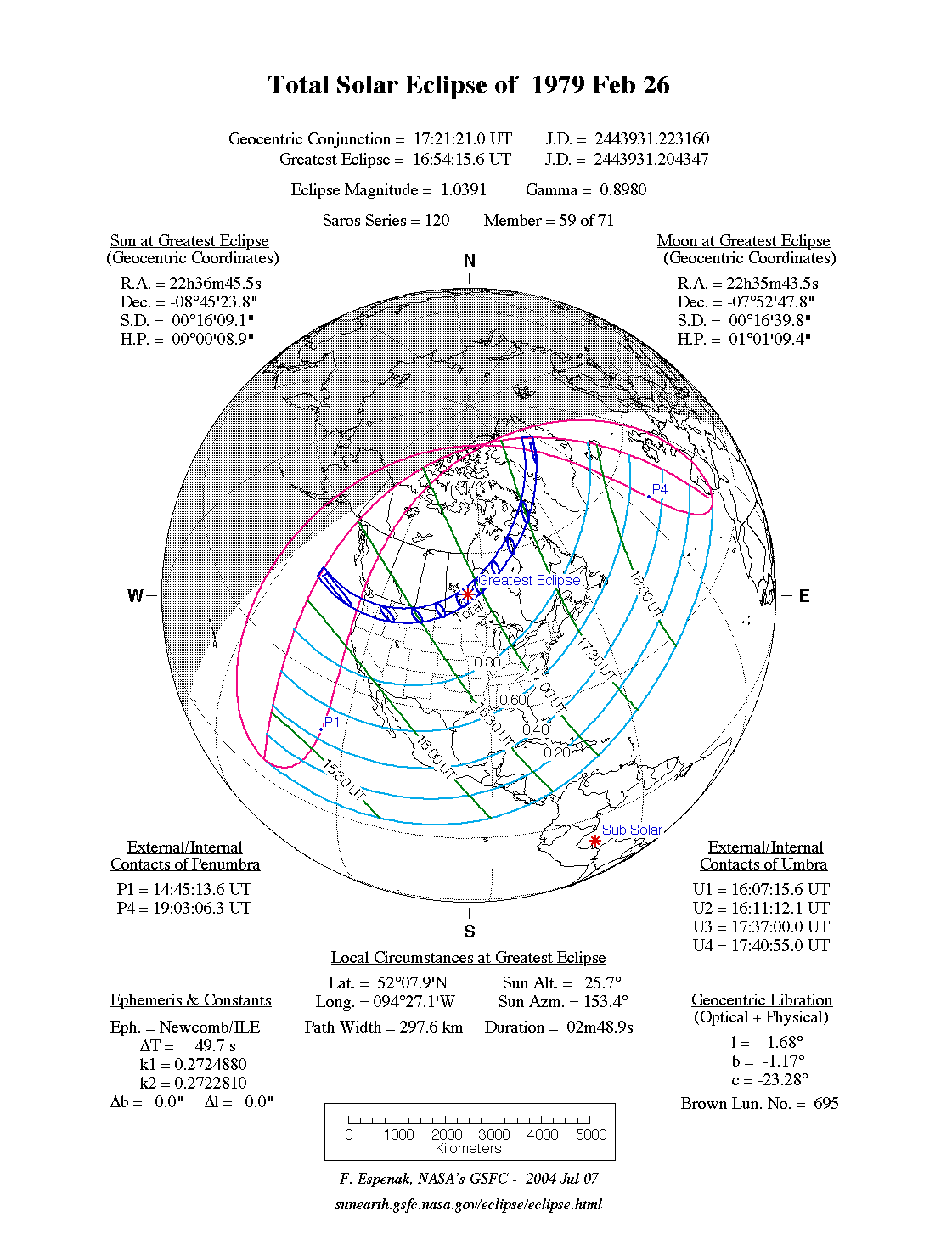
The central shadow of the Moon passed through Washington, Oregon, Idaho, Montana (where totality covered almost the entire state), North Dakota, Saskatchewan, Manitoba, Ontario, Quebec, the Northwest Territories of Canada (the portion that is now Nunavut), and Greenland. A partial eclipse was visible for parts of North America, Central America, the Caribbean, and Western Europe.
Visibility

United States
Many visitors traveled to the Pacific Northwest to view the Monday morning eclipse,[3] as it was the last chance to view a total solar eclipse in the contiguous United States for 38 years, 5 months, 26 days. The next opportunity was on August 21, 2017.[4] Several cities, including Lewiston, Idaho, and Goldendale, Washington, organized viewing events amid an expected bump in tourist traffic.[4] Television station KING-TV of Seattle produced a live broadcast of the eclipse from Goldendale and other cities in the Northwest.[5]
Although the path of totality passed through Portland shortly after sunrise (maximum at 8:14 am PST),[4] it was not directly observable due to overcast skies in northwestern Oregon.[6][7] At the Goldendale Observatory State Park in Washington, an estimated 10,000 people were able to view the eclipse after the overcast skies parted during totality.[8][9] Over 1,000 aircraft were guided around the path of totality by local air traffic control offices; the volume of flights in the area caused delays to passenger service at Seattle–Tacoma International Airport and Portland International Airport.[10][11] The Seattle-based Pacific Science Center chartered a Boeing 727 with 94 passengers to chase the eclipse.[12]
Canada
About a half hour later, the path of totality was in Manitoba and passed through cloudless Winnipeg in the late morning, maximum was at 10:48 am CST.[13] The greatest eclipse occurred seven minutes later at 10:55 am CST.
Canada's next total solar eclipse took place on August 1, 2008, after which Canada did not see another total solar eclipse until April 8, 2024.[14]
Observations
Portland, Oregon was the largest city within the path of totality. However, the thick clouds made observation unsuccessful. Only some areas outside the city could see the sun through the holes in the clouds. There were also charter flights allowing passengers to observe from the air.[15] Clouds covered most areas of the states of Oregon and Washington, and there were some clouds in western Montana. Observations were successful in places including North Dakota.[16][17] Jay Pasachoff led a team from Williams College in Massachusetts to Brandon University in Manitoba, Canada and successfully observed the total eclipse there.[18]
In literature
Writer Annie Dillard viewed the eclipse from the Yakima River Valley in central Washington state. She described her impressions of the eclipse in an essay, "Total Eclipse," first published in the magazine Antaeus and then in her collection, Teaching a Stone to Talk (1982). It was later selected for inclusion in The Best American Essays of the [20th] Century (2000).[19] Dillard describes a nearly overwhelming emotional experience, as suggested in this quotation: "I pray you will never see anything more awful in the sky." Describing the reactions of other onlookers, she relates "I heard screams."
The 1979 eclipse was also referenced in the opening pages of Douglas Coupland's novel, Generation X.
-
Totality from Bozeman, Montana
-
Projected partial eclipse from Scenic, South Dakota

Eclipse details
Shown below are two tables displaying details about this particular solar eclipse. The first table outlines times at which the moon's penumbra or umbra attains the specific parameter, and the second table describes various other parameters pertaining to this eclipse.[20]
| Event | Time (UTC) |
|---|---|
| First Penumbral External Contact | 1979 February 26 at 14:46:04.0 UTC |
| First Umbral External Contact | 1979 February 26 at 16:08:06.6 UTC |
| First Central Line | 1979 February 26 at 16:10:02.8 UTC |
| First Umbral Internal Contact | 1979 February 26 at 16:12:03.2 UTC |
| Ecliptic Conjunction | 1979 February 26 at 16:46:02.6 UTC |
| Greatest Duration | 1979 February 26 at 16:54:19.3 UTC |
| Greatest Eclipse | 1979 February 26 at 16:55:05.7 UTC |
| Equatorial Conjunction | 1979 February 26 at 17:22:11.4 UTC |
| Last Umbral Internal Contact | 1979 February 26 at 17:37:49.2 UTC |
| Last Central Line | 1979 February 26 at 17:39:48.9 UTC |
| Last Umbral External Contact | 1979 February 26 at 17:41:44.4 UTC |
| Last Penumbral External Contact | 1979 February 26 at 19:03:56.4 UTC |
| Parameter | Value |
|---|---|
| Eclipse Magnitude | 1.03907 |
| Eclipse Obscuration | 1.07966 |
| Gamma | 0.89811 |
| Sun Right Ascension | 22h36m45.5s |
| Sun Declination | -08°45'23.7" |
| Sun Semi-Diameter | 16'09.1" |
| Sun Equatorial Horizontal Parallax | 08.9" |
| Moon Right Ascension | 22h35m43.5s |
| Moon Declination | -07°52'47.4" |
| Moon Semi-Diameter | 16'39.8" |
| Moon Equatorial Horizontal Parallax | 1°01'09.4" |
| ΔT | 49.7 s |
Eclipse season
Script error: No such module "Labelled list hatnote". This eclipse is part of an eclipse season, a period, roughly every six months, when eclipses occur. Only two (or occasionally three) eclipse seasons occur each year, and each season lasts about 35 days and repeats just short of six months (173 days) later; thus two full eclipse seasons always occur each year. Either two or three eclipses happen each eclipse season. In the sequence below, each eclipse is separated by a fortnight.
| February 26 Descending node (new moon) |
March 13 Ascending node (full moon) |
|---|---|
| File:SE1979Feb26T.png | File:Lunar eclipse chart close-1979Mar13.png |
| Total solar eclipse Solar Saros 120 |
Partial lunar eclipse Lunar Saros 132 |


Related eclipses
Eclipses in 1979
- A total solar eclipse on February 26.
- A partial lunar eclipse on March 13.
- An annular solar eclipse on August 22.
- A total lunar eclipse on September 6.
Metonic
- Preceded by: Solar eclipse of May 11, 1975
- Followed by: Solar eclipse of December 15, 1982
Tzolkinex
- Preceded by: Solar eclipse of January 16, 1972
- Followed by: Solar eclipse of April 9, 1986
Half-Saros
- Preceded by: Lunar eclipse of February 21, 1970
- Followed by: Lunar eclipse of March 3, 1988
Tritos
- Preceded by: Solar eclipse of March 28, 1968
- Followed by: Solar eclipse of January 26, 1990
Solar Saros 120
- Preceded by: Solar eclipse of February 15, 1961
- Followed by: Solar eclipse of March 9, 1997
Inex
- Preceded by: Solar eclipse of March 18, 1950
- Followed by: Solar eclipse of February 7, 2008
Triad
- Preceded by: Solar eclipse of April 26, 1892
- Followed by: Solar eclipse of December 27, 2065
Solar eclipses of 1979–1982
This eclipse is a member of a semester series. An eclipse in a semester series of solar eclipses repeats approximately every 177 days and 4 hours (a semester) at alternating nodes of the Moon's orbit.[21]
The partial solar eclipses on June 21, 1982 and December 15, 1982 occur in the next lunar year eclipse set.
| Solar eclipse series sets from 1979 to 1982 | ||||||
|---|---|---|---|---|---|---|
| Descending node | Ascending node | |||||
| Saros | Map | Gamma | Saros | Map | Gamma | |
| 120 File:1979 Solar eclipse, Brandon Manitoba Canada (35907221663).jpg Totality in Brandon, MB, Canada |
February 26, 1979 File:SE1979Feb26T.png Total |
0.8981 | 125 | August 22, 1979 File:SE1979Aug22A.png Annular |
−0.9632 | |
| 130 | February 16, 1980 File:SE1980Feb16T.png Total |
0.2224 | 135 | August 10, 1980 File:SE1980Aug10A.png Annular |
−0.1915 | |
| 140 | February 4, 1981 File:SE1981Feb04A.png Annular |
−0.4838 | 145 | July 31, 1981 File:SE1981Jul31T.png Total |
0.5792 | |
| 150 | January 25, 1982 File:SE1982Jan25P.png Partial |
−1.2311 | 155 | July 20, 1982 File:SE1982Jul20P.png Partial |
1.2886 | |


Saros 120
This eclipse is a part of Saros series 120, repeating every 18 years, 11 days, and containing 71 events. The series started with a partial solar eclipse on May 27, 933 AD. It contains annular eclipses from August 11, 1059 through April 26, 1492; hybrid eclipses from May 8, 1510 through June 8, 1564; and total eclipses from June 20, 1582 through March 30, 2033. The series ends at member 71 as a partial eclipse on July 7, 2195. Its eclipses are tabulated in three columns; every third eclipse in the same column is one exeligmos apart, so they all cast shadows over approximately the same parts of the Earth.
The longest duration of annularity was produced by member 11 at 6 minutes, 24 seconds on September 11, 1113, and the longest duration of totality was produced by member 60 at 2 minutes, 50 seconds on March 9, 1997. All eclipses in this series occur at the Moon’s descending node of orbit.[22]


Metonic series
The metonic series repeats eclipses every 19 years (6939.69 days), lasting about 5 cycles. Eclipses occur in nearly the same calendar date. In addition, the octon subseries repeats 1/5 of that or every 3.8 years (1387.94 days). All eclipses in this table occur at the Moon's descending node.
| 21 eclipse events between July 22, 1971 and July 22, 2047 | ||||
|---|---|---|---|---|
| July 22 | May 9–11 | February 26–27 | December 14–15 | October 2–3 |
| 116 | 118 | 120 | 122 | 124 |
| File:SE1971Jul22P.png July 22, 1971 |
File:SE1975May11P.png May 11, 1975 |
File:SE1979Feb26T.png February 26, 1979 |
File:SE1982Dec15P.png December 15, 1982 |
File:SE1986Oct03H.png October 3, 1986 |
| 126 | 128 | 130 | 132 | 134 |
| File:SE1990Jul22T.png July 22, 1990 |
File:SE1994May10A.png May 10, 1994 |
File:SE1998Feb26T.png February 26, 1998 |
File:SE2001Dec14A.png December 14, 2001 |
File:SE2005Oct03A.png October 3, 2005 |
| 136 | 138 | 140 | 142 | 144 |
| File:SE2009Jul22T.png July 22, 2009 |
File:SE2013May10A.png May 10, 2013 |
File:SE2017Feb26A.png February 26, 2017 |
File:SE2020Dec14T.png December 14, 2020 |
File:SE2024Oct02A.png October 2, 2024 |
| 146 | 148 | 150 | 152 | 154 |
| File:SE2028Jul22T.png July 22, 2028 |
File:SE2032May09A.png May 9, 2032 |
File:SE2036Feb27P.png February 27, 2036 |
File:SE2039Dec15T.png December 15, 2039 |
File:SE2043Oct03A.png October 3, 2043 |
| 156 | ||||
| File:SE2047Jul22P.png July 22, 2047 | ||||


Tritos series
Template:Solar Tritos series 2000 December 25
Inex series
Template:Solar Inex series 2008 February 7
Notes
<templatestyles src="Reflist/styles.css" />
- ↑ Script error: No such module "citation/CS1".
- ↑ Script error: No such module "citation/CS1".
- ↑ Script error: No such module "citation/CS1".
- ↑ a b c Script error: No such module "citation/CS1".
- ↑ Script error: No such module "citation/CS1".
- ↑ Script error: No such module "citation/CS1".
- ↑ Script error: No such module "citation/CS1".
- ↑ Script error: No such module "citation/CS1".
- ↑ Script error: No such module "citation/CS1".
- ↑ Script error: No such module "citation/CS1".
- ↑ Script error: No such module "citation/CS1".
- ↑ Script error: No such module "citation/CS1".
- ↑ Script error: No such module "citation/CS1".
- ↑ Script error: No such module "citation/CS1".
- ↑ Script error: No such module "citation/CS1".
- ↑ Script error: No such module "Citation/CS1".
- ↑ Script error: No such module "citation/CS1".
- ↑ Script error: No such module "citation/CS1".
- ↑ Script error: No such module "citation/CS1".
- ↑ Script error: No such module "citation/CS1".
- ↑ Script error: No such module "citation/CS1".
- ↑ Script error: No such module "citation/CS1".
Script error: No such module "Check for unknown parameters".
References
- Earth visibility chart and eclipse statistics Eclipse Predictions by Fred Espenak, NASA/GSFC
- eclipse.org.uk Total Eclipse of the Sun: 1979 February 26 Script error: No such module "webarchive".
- Predictions for the 1979 solar eclipse Royal Astronomical Society of Canada, Journal, vol. 72, June 1978, pp. 149–161 Fred Espenak
External links
Photos/observations:
- Eclipse Chaser's Journal: Part 1, My First Total Solar Eclipse: February 26. 1979, Jeffrey R. Charles
- http://nicmosis.as.arizona.edu:8000/ECLIPSE_WEB/ECLIPSE_79/ECLIPSE_79.html
- 1979 Solar Eclipse – ABC News Coverage Excerpts from an ABC News Special Report that aired at 11:00–11:29 a.m. EST on Monday, Feb. 26, 1979
- 1979 Total Solar Eclipse Report on CBS News with Walter Cronkite The February 26, 1979, total solar eclipse story as reported on the CBS Evening News with Walter Cronkite.
- Solar Eclipse Photo Gallery 1, 1970 – 1984 Fred Espenak
- Solar eclipse 1979, Manitoba, Canada
Narrative Descriptions:
Script error: No such module "Navbox". Script error: No such module "Side box".