Solar eclipse of December 4, 2002
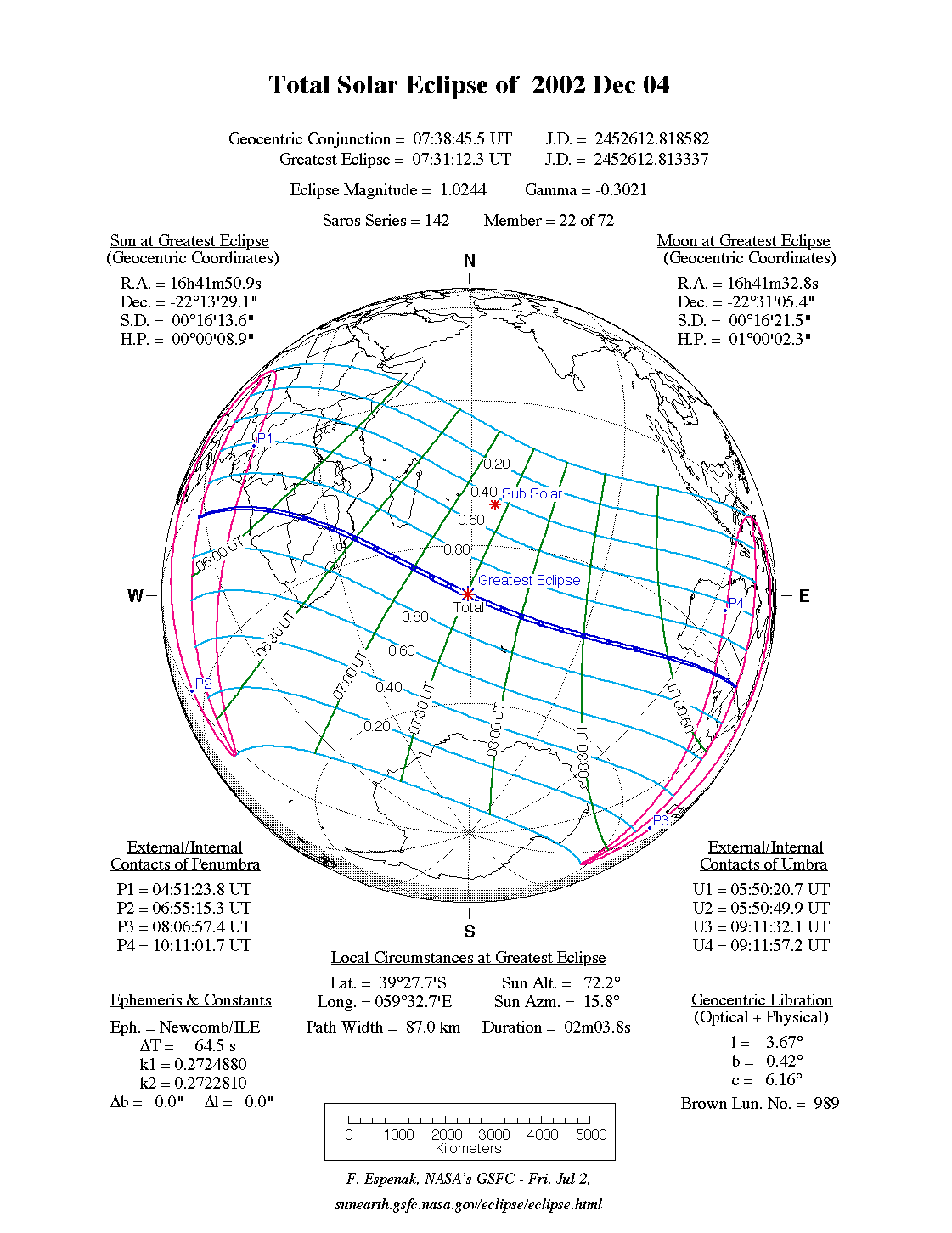
Template:Short description Script error: No such module "Solar eclipse". A total solar eclipse occurred at the Moon's descending node of orbit on Wednesday, December 4, 2002,[1][2][3] with a magnitude of 1.0244. A solar eclipse occurs when the Moon passes between Earth and the Sun, thereby totally or partly obscuring the image of the Sun for a viewer on Earth. A total solar eclipse occurs when the Moon's apparent diameter is larger than the Sun's, blocking all direct sunlight, turning day into darkness. Totality occurs in a narrow path across Earth's surface, with the partial solar eclipse visible over a surrounding region thousands of kilometres wide. Occurring about 1.9 days after perigee (on December 2, 2002, at 8:50 UTC), the Moon's apparent diameter was larger.[4]
The eclipse was visible from a narrow corridor in parts of Angola, Botswana, Zimbabwe, South Africa, Mozambique, the Indian Ocean and South Australia. A partial eclipse was seen from the much broader path of the Moon's penumbra, including most of Africa and Australia in addition to parts of Indonesia and Antarctica. During the sunset after the eclipse many observers in Australia saw numerous and unusual forms of a green flash.[5]
In some parts of Angola, it was the second total eclipse of the Sun within 18 months, following the solar eclipse of June 21, 2001.
Observations
The Chinese Academy of Sciences sent a team to Australia, to study the gravity anomalies[6] first recorded by Indian scientists during the total solar eclipse of October 24, 1995.[7] The Chinese Academy of Sciences also studied it during previous total solar eclipses of March 9, 1997 in Mohe County and June 21, 2001 in Zambia. With continuous observation for more than 10 years after that, China obtained the first observational evidence that the gravity field propagates at the speed of light.[8]
Images

Gallery
-
Via eclipse glasses in Ceduna, South Australia
.jpg)
Eclipse details
Shown below are two tables displaying details about this particular solar eclipse. The first table outlines times at which the moon's penumbra or umbra attains the specific parameter, and the second table describes various other parameters pertaining to this eclipse.[9]
| Event | Time (UTC) |
|---|---|
| First Penumbral External Contact | 2002 December 4 at 04:52:27.3 UTC |
| First Umbral External Contact | 2002 December 4 at 05:51:24.0 UTC |
| First Central Line | 2002 December 4 at 05:51:38.6 UTC |
| First Umbral Internal Contact | 2002 December 4 at 05:51:53.2 UTC |
| First Penumbral Internal Contact | 2002 December 4 at 06:56:18.4 UTC |
| Greatest Eclipse | 2002 December 4 at 07:32:15.7 UTC |
| Greatest Duration | 2002 December 4 at 07:33:01.0 UTC |
| Ecliptic Conjunction | 2002 December 4 at 07:35:26.3 UTC |
| Equatorial Conjunction | 2002 December 4 at 07:39:48.9 UTC |
| Last Penumbral Internal Contact | 2002 December 4 at 08:08:01.3 UTC |
| Last Umbral Internal Contact | 2002 December 4 at 09:12:35.9 UTC |
| Last Central Line | 2002 December 4 at 09:12:48.5 UTC |
| Last Umbral External Contact | 2002 December 4 at 09:13:01.0 UTC |
| Last Penumbral External Contact | 2002 December 4 at 10:12:05.5 UTC |
| Parameter | Value |
|---|---|
| Eclipse Magnitude | 1.02437 |
| Eclipse Obscuration | 1.04934 |
| Gamma | −0.30204 |
| Sun Right Ascension | 16h41m50.9s |
| Sun Declination | -22°13'29.2" |
| Sun Semi-Diameter | 16'13.6" |
| Sun Equatorial Horizontal Parallax | 08.9" |
| Moon Right Ascension | 16h41m32.9s |
| Moon Declination | -22°31'05.2" |
| Moon Semi-Diameter | 16'21.5" |
| Moon Equatorial Horizontal Parallax | 1°00'02.3" |
| ΔT | 64.4 s |
Eclipse season
Script error: No such module "Labelled list hatnote". This eclipse is part of an eclipse season, a period, roughly every six months, when eclipses occur. Only two (or occasionally three) eclipse seasons occur each year, and each season lasts about 35 days and repeats just short of six months (173 days) later; thus two full eclipse seasons always occur each year. Either two or three eclipses happen each eclipse season. In the sequence below, each eclipse is separated by a fortnight.
| November 20 Ascending node (full moon) |
December 4 Descending node (new moon) |
|---|---|
| File:Lunar eclipse chart close-2002Nov20.png | File:SE2002Dec04T.png |
| Penumbral lunar eclipse Lunar Saros 116 |
Total solar eclipse Solar Saros 142 |


Related eclipses
Eclipses in 2002
- A penumbral lunar eclipse on May 26.
- An annular solar eclipse on June 10.
- A penumbral lunar eclipse on June 24.
- A penumbral lunar eclipse on November 20.
- A total solar eclipse on December 4.
Metonic
- Preceded by: Solar eclipse of February 16, 1999
- Followed by: Solar eclipse of September 22, 2006
Tzolkinex
- Preceded by: Solar eclipse of October 24, 1995
- Followed by: Solar eclipse of January 15, 2010
Half-Saros
- Preceded by: Lunar eclipse of November 29, 1993
- Followed by: Lunar eclipse of December 10, 2011
Tritos
- Preceded by: Solar eclipse of January 4, 1992
- Followed by: Solar eclipse of November 3, 2013
Solar Saros 142
- Preceded by: Solar eclipse of November 22, 1984
- Followed by: Solar eclipse of December 14, 2020
Inex
- Preceded by: Solar eclipse of December 24, 1973
- Followed by: Solar eclipse of November 14, 2031
Triad
- Preceded by: Solar eclipse of February 3, 1916
- Followed by: Solar eclipse of October 4, 2089
Solar eclipses of 2000–2003
This eclipse is a member of a semester series. An eclipse in a semester series of solar eclipses repeats approximately every 177 days and 4 hours (a semester) at alternating nodes of the Moon's orbit.[10]
The partial solar eclipses on February 5, 2000 and July 31, 2000 occur in the previous lunar year eclipse set.


.jpg)


.jpg)

Saros 142
This eclipse is a part of Saros series 142, repeating every 18 years, 11 days, and containing 72 events. The series started with a partial solar eclipse on April 17, 1624. It contains a hybrid eclipse on July 14, 1768, and total eclipses from July 25, 1786 through October 29, 2543. There are no annular eclipses in this set. The series ends at member 72 as a partial eclipse on June 5, 2904. Its eclipses are tabulated in three columns; every third eclipse in the same column is one exeligmos apart, so they all cast shadows over approximately the same parts of the Earth.
The longest duration of totality will be produced by member 38 at 6 minutes, 34 seconds on May 28, 2291. All eclipses in this series occur at the Moon’s descending node of orbit.[11]
| Series members 11–32 occur between 1801 and 2200: | ||
|---|---|---|
| 11 | 12 | 13 |
| File:SE1804Aug05T.png August 5, 1804 |
File:SE1822Aug16T.png August 16, 1822 |
File:SE1840Aug27T.png August 27, 1840 |
| 14 | 15 | 16 |
| File:SE1858Sep07T.png September 7, 1858 |
File:SE1876Sep17T.png September 17, 1876 |
File:SE1894Sep29T.png September 29, 1894 |
| 17 | 18 | 19 |
| File:SE1912Oct10T.png October 10, 1912 |
File:SE1930Oct21T.png October 21, 1930 |
File:SE1948Nov01T.png November 1, 1948 |
| 20 | 21 | 22 |
| File:SE1966Nov12T.png November 12, 1966 |
File:SE1984Nov22T.png November 22, 1984 |
File:SE2002Dec04T.png December 4, 2002 |
| 23 | 24 | 25 |
| File:SE2020Dec14T.png December 14, 2020 |
File:SE2038Dec26T.png December 26, 2038 |
File:SE2057Jan05T.png January 5, 2057 |
| 26 | 27 | 28 |
| File:SE2075Jan16T.png January 16, 2075 |
File:SE2093Jan27T.png January 27, 2093 |
File:SE2111Feb08T.png February 8, 2111 |
| 29 | 30 | 31 |
| File:SE2129Feb18T.png February 18, 2129 |
File:SE2147Mar02T.png March 2, 2147 |
File:SE2165Mar12T.png March 12, 2165 |
| 32 | ||
| File:SE2183Mar23T.png March 23, 2183 | ||


Metonic series
The metonic series repeats eclipses every 19 years (6939.69 days), lasting about 5 cycles. Eclipses occur in nearly the same calendar date. In addition, the octon subseries repeats 1/5 of that or every 3.8 years (1387.94 days). All eclipses in this table occur at the Moon's descending node.
| 21 eclipse events between July 11, 1953 and July 11, 2029 | ||||
|---|---|---|---|---|
| July 10–11 | April 29–30 | February 15–16 | December 4 | September 21–23 |
| 116 | 118 | 120 | 122 | 124 |
| File:SE1953Jul11P.png July 11, 1953 |
File:SE1957Apr30A.png April 30, 1957 |
File:SE1961Feb15T.png February 15, 1961 |
File:SE1964Dec04P.png December 4, 1964 |
File:SE1968Sep22T.png September 22, 1968 |
| 126 | 128 | 130 | 132 | 134 |
| File:SE1972Jul10T.png July 10, 1972 |
File:SE1976Apr29A.png April 29, 1976 |
File:SE1980Feb16T.png February 16, 1980 |
File:SE1983Dec04A.png December 4, 1983 |
File:SE1987Sep23A.png September 23, 1987 |
| 136 | 138 | 140 | 142 | 144 |
| File:SE1991Jul11T.png July 11, 1991 |
File:SE1995Apr29A.png April 29, 1995 |
File:SE1999Feb16A.png February 16, 1999 |
File:SE2002Dec04T.png December 4, 2002 |
File:SE2006Sep22A.png September 22, 2006 |
| 146 | 148 | 150 | 152 | 154 |
| File:SE2010Jul11T.png July 11, 2010 |
File:SE2014Apr29A.png April 29, 2014 |
File:SE2018Feb15P.png February 15, 2018 |
File:SE2021Dec04T.png December 4, 2021 |
File:SE2025Sep21P.png September 21, 2025 |
| 156 | ||||
| File:SE2029Jul11P.png July 11, 2029 | ||||


Tritos series
Template:Solar Tritos series 2002 December 4
Inex series
Template:Solar Inex series 2002 December 4
Notes
<templatestyles src="Reflist/styles.css" />
- ↑ Script error: No such module "citation/CS1".
- ↑ Script error: No such module "citation/CS1".
- ↑ Script error: No such module "citation/CS1".
- ↑ Script error: No such module "citation/CS1".
- ↑ Script error: No such module "citation/CS1".
- ↑ Script error: No such module "citation/CS1".
- ↑ Script error: No such module "citation/CS1".
- ↑ Script error: No such module "citation/CS1".
- ↑ Script error: No such module "citation/CS1".
- ↑ Script error: No such module "citation/CS1".
- ↑ Script error: No such module "citation/CS1".
Script error: No such module "Check for unknown parameters".
References
- Fred Espenak and Jay Anderson. "Total Solar Eclipse of 2002 December 4". NASA, November 2004.
- Earth visibility chart and eclipse statistics Eclipse Predictions by Fred Espenak, NASA/GSFC
- Google Map
Photos:
- Spaceweather.com: Dec. 4, 2002, Solar Eclipse Gallery and [1]
- Prof. Druckmüller's eclipse photography site. Australia
- Prof. Druckmüller's eclipse photography site. South Africa and Mozambique
- KryssTal - Eclipse from Botswana.
- Images from Australia by Crayford Manor House Astronomical Society Script error: No such module "webarchive".
- Total Solar Eclipse of 4 December 2002 seen in EUMETSAT satellite imagery Script error: No such module "webarchive"..
- Zimbabwe Solar Eclipse, APOD 12/6/2002, Corona from Zimbabwe-South Africa border
- The Crown of the Sun, APOD 12/13/2002, Corona of total eclipse from Musina, South Africa
- Shadow Cone of a Total Solar Eclipse, APOD 1/6/2003, totality from South Australia
Script error: No such module "Navbox". Script error: No such module "Side box".