Solar eclipse of August 18, 1868
Template:Short description Script error: No such module "Solar eclipse". A total solar eclipse occurred at the Moon's ascending node of orbit on Tuesday, August 18, 1868 (also known as "The King of Siam's eclipse"), with a magnitude of 1.0756. A solar eclipse occurs when the Moon passes between Earth and the Sun, thereby totally or partly obscuring the image of the Sun for a viewer on Earth. A total solar eclipse occurs when the Moon's apparent diameter is larger than the Sun's, blocking all direct sunlight, turning day into darkness. Totality occurs in a narrow path across Earth's surface, with the partial solar eclipse visible over a surrounding region thousands of kilometres wide. Occurring about 6.5 days after perigee (on August 17, 1868, at 22:35 UTC), the Moon's apparent diameter was larger.[1]
The path of totality was visible from parts of modern-day Ethiopia, Eritrea, Djibouti, Yemen, India, the Andaman and Nicobar Islands, Myanmar, Thailand, Cambodia, Vietnam, Malaysia, Brunei, Indonesia, and Papua New Guinea. A partial solar eclipse was also visible for parts of East Africa, the Middle East, Central Asia, South Asia, Southeast Asia, Australia, and western Oceania.
The eclipse was predicted more precisely by King Mongkut of Thailand than it was by French astronomers. The eclipse allowed for the discovery of helium by both Pierre Janssen and Norman Lockyer, who observed Solar prominences with spectroscopes.
Observations
Script error: No such module "Location map/multi".
-
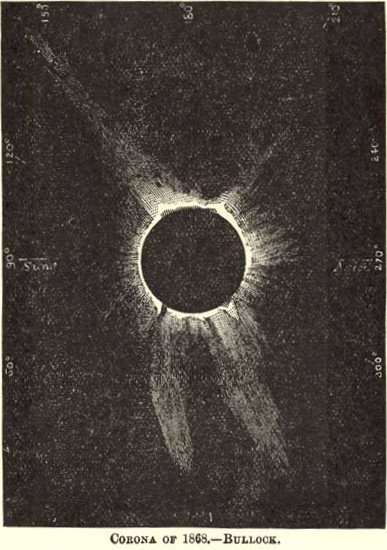
Bullock sketch of the eclipse, Total Eclipses of the Sun, 1900.
-
M. Stephan sketches of the eclipse, Archives des missions scientifiques et littéraires, 1868.
-
Map of the forecast path of the total eclipse, Archives des missions scientifiques et littéraires, 1868.


Several expeditions were sent to observe the eclipse.
- One of two expeditions from Germany was sent to Aden. The expedition was led by Gustav Spörer.[2]
- The second expedition was sent to the west coast of India. The expedition was led by Friedrich Tietjen.[3]
- Captain Bullock observed from the Celebes sea, sketching the appearance of the corona,[4] while Gustav Fritsch accompanied an expedition to Aden.[5]
Discovery of helium
French astronomer Pierre Janssen observed the eclipse from Guntur in Madras State, British India. It was the first total eclipse since Gustav Kirchhoff's 1859 theory that the Fraunhofer lines in the solar spectrum correspond to the emission line of the different chemical elements present in the Sun. Correspondingly, Janssen observed the eclipse with the aid of a spectroscope. He noticed a bright yellow line (λ = 587.49 nm) in the spectra of the solar prominences that could not be due to sodium as had previously been assumed, and was subsequently able to observe the same line even without the need for an eclipse. The same result was found independently by British astronomer Norman Lockyer, and both Janssen's and Lockyer's communications were presented to the French Academy of Sciences on October 26, 1868.[6][7]
King Mongkut's calculation

King Mongkut, also known as Rama IV of Siam, was able to calculate and predict the solar eclipse two years earlier.[8] The calculations were correct as to the place, the time and the type of the solar eclipse that would happen. The eclipse took place precisely as the king had predicted, the total phase lasting six minutes and 46 seconds. In fact, his calculations were better — by about two seconds — than those of the French astronomers, who acknowledged his accuracy. Mongkut was exposed to malaria, then developed chills and fever. He died on October 1, 1868.[9] According to the Thai Astronomical Society and NASA, this eclipse is known as "The King of Siam's eclipse".[8][10]
Eclipse details
Shown below are two tables displaying details about this particular solar eclipse. The first table outlines times at which the moon's penumbra or umbra attains the specific parameter, and the second table describes various other parameters pertaining to this eclipse.[11]
| Event | Time (UTC) |
|---|---|
| First Penumbral External Contact | 1868 August 18 at 02:34:50.2 UTC |
| First Umbral External Contact | 1868 August 18 at 03:27:59.0 UTC |
| First Central Line | 1868 August 18 at 03:29:29.6 UTC |
| First Umbral Internal Contact | 1868 August 18 at 03:31:00.1 UTC |
| First Penumbral Internal Contact | 1868 August 18 at 04:24:13.7 UTC |
| Greatest Duration | 1868 August 18 at 05:08:35.7 UTC |
| Ecliptic Conjunction | 1868 August 18 at 05:11:42.5 UTC |
| Greatest Eclipse | 1868 August 18 at 05:12:09.6 UTC |
| Equatorial Conjunction | 1868 August 18 at 05:13:17.9 UTC |
| Last Penumbral Internal Contact | 1868 August 18 at 06:00:03.7 UTC |
| Last Umbral Internal Contact | 1868 August 18 at 06:53:18.8 UTC |
| Last Central Line | 1868 August 18 at 06:54:49.0 UTC |
| Last Umbral External Contact | 1868 August 18 at 06:56:19.2 UTC |
| Last Penumbral External Contact | 1868 August 18 at 07:49:29.4 UTC |
| Parameter | Value |
|---|---|
| Eclipse Magnitude | 1.07561 |
| Eclipse Obscuration | 1.15693 |
| Gamma | −0.04434 |
| Sun Right Ascension | 09h51m00.1s |
| Sun Declination | +13°02'06.8" |
| Sun Semi-Diameter | 15'48.4" |
| Sun Equatorial Horizontal Parallax | 08.7" |
| Moon Right Ascension | 09h50m57.4s |
| Moon Declination | +12°59'28.9" |
| Moon Semi-Diameter | 16'42.8" |
| Moon Equatorial Horizontal Parallax | 1°01'20.3" |
| ΔT | 2.2 s |
Eclipse season
Script error: No such module "Labelled list hatnote". This eclipse is part of an eclipse season, a period, roughly every six months, when eclipses occur. Only two (or occasionally three) eclipse seasons occur each year, and each season lasts about 35 days and repeats just short of six months (173 days) later; thus two full eclipse seasons always occur each year. Either two or three eclipses happen each eclipse season. In the sequence below, each eclipse is separated by a fortnight.
| August 3 Descending node (full moon) |
August 18 Ascending node (new moon) |
September 2 Descending node (full moon) |
|---|---|---|
| File:SE1868Aug18T.png | ||
| Penumbral lunar eclipse Lunar Saros 107 |
Total solar eclipse Solar Saros 133 |
Penumbral lunar eclipse Lunar Saros 145 |

Related eclipses
Eclipses in 1868
- A penumbral lunar eclipse on February 8.
- An annular solar eclipse on February 23.
- A penumbral lunar eclipse on March 8.
- A penumbral lunar eclipse on August 3.
- A total solar eclipse on August 18.
- A penumbral lunar eclipse on September 2.
Metonic
- Preceded by: Solar eclipse of October 30, 1864
- Followed by: Solar eclipse of June 6, 1872
Tzolkinex
- Preceded by: Solar eclipse of July 8, 1861
- Followed by: Solar eclipse of September 29, 1875
Half-Saros
- Preceded by: Lunar eclipse of August 13, 1859
- Followed by: Lunar eclipse of August 23, 1877
Tritos
- Preceded by: Solar eclipse of September 18, 1857
- Followed by: Solar eclipse of July 19, 1879
Solar Saros 133
- Preceded by: Solar eclipse of August 7, 1850
- Followed by: Solar eclipse of August 29, 1886
Inex
- Preceded by: Solar eclipse of September 7, 1839
- Followed by: Solar eclipse of July 29, 1897
Triad
- Preceded by: Solar eclipse of October 17, 1781
- Followed by: Solar eclipse of June 20, 1955
Solar eclipses of 1866–1870
This eclipse is a member of a semester series. An eclipse in a semester series of solar eclipses repeats approximately every 177 days and 4 hours (a semester) at alternating nodes of the Moon's orbit.[12]
The partial solar eclipses on April 15, 1866 and October 8, 1866 occur in the previous lunar year eclipse set, and the solar eclipses on June 28, 1870 (partial) and December 22, 1870 (total) occur in the next lunar year eclipse set.
| Solar eclipse series sets from 1866 to 1870 | ||||||
|---|---|---|---|---|---|---|
| Descending node | Ascending node | |||||
| Saros | Map | Gamma | Saros | Map | Gamma | |
| 108 | March 16, 1866 File:SE1866Mar16P.gif Partial |
1.4241 | 113 | |||
| 118 | March 6, 1867 File:SE1867Mar06A.gif Annular |
0.7716 | 123 | August 29, 1867 File:SE1867Aug29T.png Total |
−0.7940 | |
| 128 | February 23, 1868 File:SE1868Feb23A.gif Annular |
0.0706 | 133 | August 18, 1868 File:SE1868Aug18T.png Total |
−0.0443 | |
| 138 | February 11, 1869 File:SE1869Feb11A.gif Annular |
−0.6251 | 143 | August 7, 1869 File:SE1869Aug07T.png Total |
0.6960 | |
| 148 | January 31, 1870 File:SE1870Jan31P.gif Partial |
−1.2829 | 153 | July 28, 1870 File:SE1870Jul28Pb.gif Partial |
1.5044 | |


Saros 133
This eclipse is a part of Saros series 133, repeating every 18 years, 11 days, and containing 72 events. The series started with a partial solar eclipse on July 13, 1219. It contains annular eclipses from November 20, 1435 through January 13, 1526; a hybrid eclipse on January 24, 1544; and total eclipses from February 3, 1562 through June 21, 2373. The series ends at member 72 as a partial eclipse on September 5, 2499. Its eclipses are tabulated in three columns; every third eclipse in the same column is one exeligmos apart, so they all cast shadows over approximately the same parts of the Earth.
The longest duration of annularity was produced by member 25 at 1 minutes, 14 seconds on November 30, 1453, and the longest duration of totality was produced by member 61 at 6 minutes, 50 seconds on August 7, 1850. All eclipses in this series occur at the Moon’s ascending node of orbit.[13]
| Series members 34–55 occur between 1801 and 2200: | ||
|---|---|---|
| 34 | 35 | 36 |
| File:SE1814Jul17T.png July 17, 1814 |
File:SE1832Jul27T.png July 27, 1832 |
File:SE1850Aug07T.png August 7, 1850 |
| 37 | 38 | 39 |
| File:SE1868Aug18T.png August 18, 1868 |
File:SE1886Aug29T.png August 29, 1886 |
File:SE1904Sep09T.png September 9, 1904 |
| 40 | 41 | 42 |
| File:SE1922Sep21T.png September 21, 1922 |
File:SE1940Oct01T.png October 1, 1940 |
File:SE1958Oct12T.png October 12, 1958 |
| 43 | 44 | 45 |
| File:SE1976Oct23T.png October 23, 1976 |
File:SE1994Nov03T.png November 3, 1994 |
File:SE2012Nov13T.png November 13, 2012 |
| 46 | 47 | 48 |
| File:SE2030Nov25T.png November 25, 2030 |
File:SE2048Dec05T.png December 5, 2048 |
File:SE2066Dec17T.png December 17, 2066 |
| 49 | 50 | 51 |
| File:SE2084Dec27T.png December 27, 2084 |
File:SE2103Jan08T.png January 8, 2103 |
File:SE2121Jan19T.png January 19, 2121 |
| 52 | 53 | 54 |
| File:SE2139Jan30T.png January 30, 2139 |
File:SE2157Feb09T.png February 9, 2157 |
File:SE2175Feb21T.png February 21, 2175 |
| 55 | ||
| File:SE2193Mar03T.png March 3, 2193 | ||


Metonic series
The metonic series repeats eclipses every 19 years (6939.69 days), lasting about 5 cycles. Eclipses occur in nearly the same calendar date. In addition, the octon subseries repeats 1/5 of that or every 3.8 years (1387.94 days). All eclipses in this table occur at the Moon's ascending node.


Tritos series
Template:Solar Tritos series 2010 July 11
Inex series
Template:Solar Inex series 2013 May 10
Notes
<templatestyles src="Reflist/styles.css" />
- ↑ Script error: No such module "citation/CS1".
- ↑ Script error: No such module "citation/CS1".
- ↑ Script error: No such module "citation/CS1".
- ↑ Script error: No such module "citation/CS1".
- ↑ Standard Encyclopaedia of Southern Africa
- ↑ Script error: No such module "citation/CS1"..
- ↑ Script error: No such module "citation/CS1"..
- ↑ a b ๒๐๐ ปี พระบาทสมเด็จพระจอมเกล้าเจ้าอยู่หัว พระบิดาแห่งวิทยาศาสตร์ไทย. Template:In lang
- ↑ Script error: No such module "citation/CS1".
- ↑ Script error: No such module "citation/CS1".
- ↑ Script error: No such module "citation/CS1".
- ↑ Script error: No such module "citation/CS1".
- ↑ Script error: No such module "citation/CS1".
Script error: No such module "Check for unknown parameters".
References
- NASA chart graphics
- www.starwrite.org: Solar Astronomy in 1868 Script error: No such module "webarchive".
- Observations of the Total Solar Eclipse of August 18, 1868 by Charles G. Perrins
- Drawing of Corona
- Script error: No such module "citation/CS1".

Script error: No such module "Navbox". Script error: No such module "Side box".