Solar eclipse of August 12, 2045
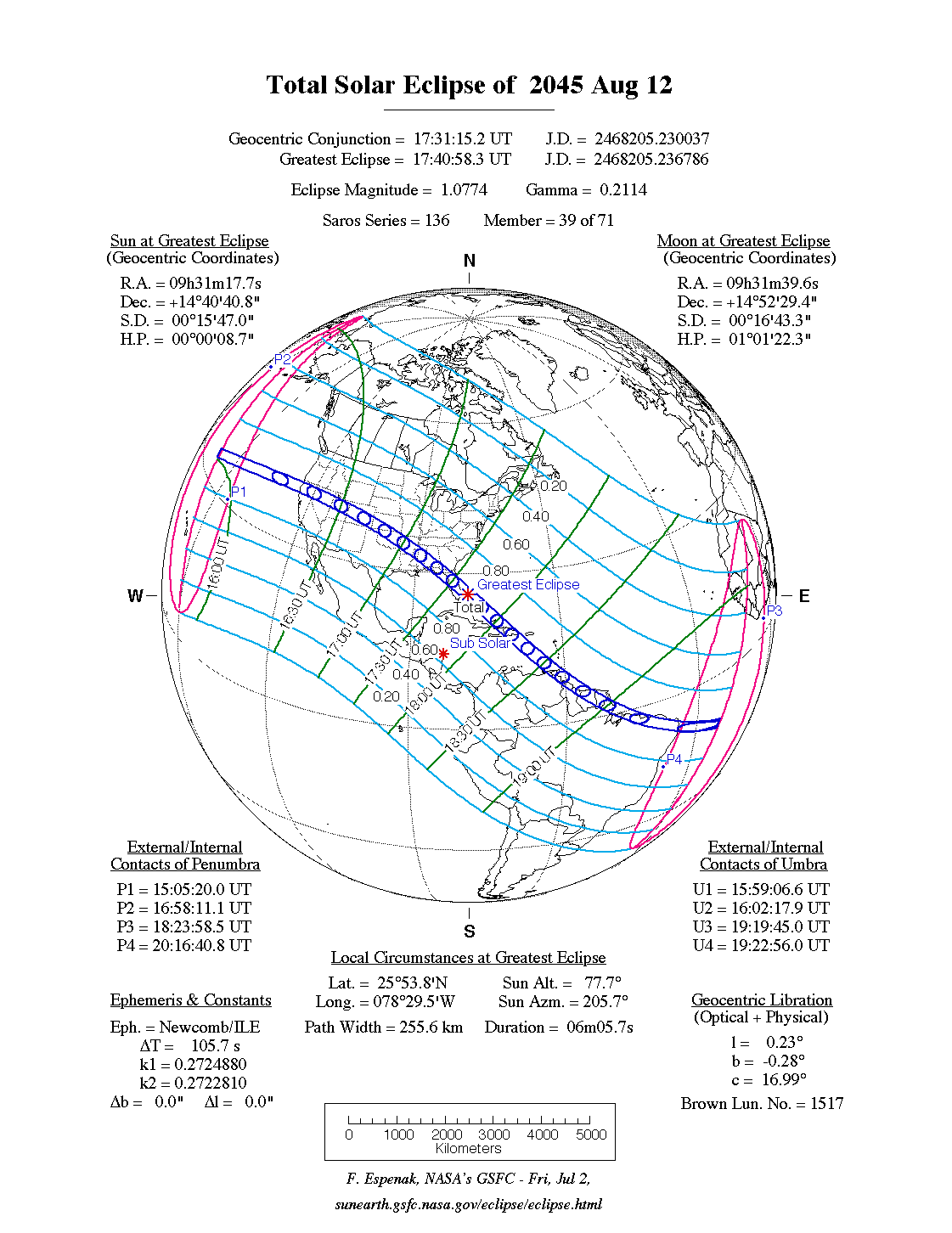
Template:Short description Script error: No such module "Solar eclipse". A total solar eclipse will occur at the Moon's descending node of orbit on Saturday, August 12, 2045,[1] with a magnitude of 1.0774. A solar eclipse occurs when the Moon passes between Earth and the Sun, thereby totally or partly obscuring the image of the Sun for a viewer on Earth. A total solar eclipse occurs when the Moon's apparent diameter is larger than the Sun's, blocking all direct sunlight, turning day into darkness. Totality occurs in a narrow path across Earth's surface, with the partial solar eclipse visible over a surrounding region thousands of kilometres wide. Occurring about 7 minutes after perigee (on August 12, 2045, at 17:35 UTC), the Moon's apparent diameter will be near its maximum.[2]
It will be the fourth longest eclipse of the 21st century with a magnitude of 1.0774. It will be visible throughout much of the continental United States, with a path of totality running through northern California, Nevada, Utah, Colorado, Kansas, Oklahoma, Texas, Arkansas, northeastern Louisiana, Mississippi, Alabama, Georgia and Florida. The total eclipse will be greatest over the Bahamas, before continuing over the Turks and Caicos Islands, the Dominican Republic, Haiti, northeastern Venezuela, Trinidad and Tobago, Guyana, Suriname, French Guiana, and northeastern Brazil. A partial solar eclipse will also be visible for parts of the Russian Far East, Hawaii, North America, Central America, the Caribbean, northern and central South America, and West Africa.
The path of totality of this eclipse will be seen over many major cities, including Reno, Salt Lake City, Colorado Springs, Oklahoma City, Tulsa, Jackson, Montgomery, Tallahassee, Tampa, Orlando, Fort Lauderdale, Miami, Nassau, Santo Domingo, Porlamar, Port of Spain, Georgetown, Paramaribo, Belém, São Luís, Joāo Pessoa and Recife.[3] It will also be the second total eclipse visible from Little Rock in 21.3 years.[3] Totality will last for at least 6 minutes along the part of the path that starts at Camden, Alabama, crossing Florida and ending near the southernmost Bahama Islands. The longest duration of totality will be 6 minutes 5.5 seconds at Script error: No such module "Coordinates"., which is over the Atlantic Ocean east of Fort Lauderdale and south of Freeport, Bahamas.[3]
The solar eclipse of August 21, 2017 had a very similar path of totality over the U.S., about Script error: No such module "convert". to the northeast, also crossing the Pacific coast and Atlantic coast of the country. This is because when a solar eclipse crosses the U.S. in mid-August at an ascending node (i.e. moves from south to north during odd-numbered saros), the path of the eclipse tracks from coast to coast. When a solar eclipse crosses the U.S. in mid-August at descending node (even numbered saros), the path tracks a large distance southward.[4]
Details of the totality in some places or cities
| Country or Territory | City or Town | Start
of |
Start of total eclipse (Local Time) |
End of total eclipse (Local Time) |
Duration of total eclipse |
End of partial eclipse (Local Time) |
Magnitude |
|---|---|---|---|---|---|---|---|
| Script error: No such module "flag". | Eureka, California | 07:13:02 | 08:14:21 | 08:18:28 | 4 min 07s | 09:25:23 | 1,069 |
| Script error: No such module "flag". | Redding, California | 07:13:45 | 08:15:43 | 08:20:07 | 4 min 25 s | 09:27:43 | 1,069 |
| Script error: No such module "flag". | Reno, Nevada | 07:14:41 | 08:18:43 | 08:21:30 | 2 min 46 s | 09:31:21 | 1,070 |
| Script error: No such module "flag". | Salt Lake City, Utah | 08:20:54 | 09:28:15 | 09:30:32 | 2 min 17 s | 10:43:03 | 1,072 |
| Script error: No such module "flag". | Colorado Springs, Colorado | 08:27:14 | 09:36:48 | 09:41:54 | 5 min 06 s | 10:55:58 | 1,073 |
| Script error: No such module "flag". | Oklahoma City, Oklahoma | 09:36:37 | 10:51:13 | 10:54:39 | 3 min 26 s | 12:12:22 | 1,075 |
| Script error: No such module "flag". | Tulsa, Oklahoma | 09:38:39 | 10:52:22 | 10:57:58 | 5 min 36 s | 12:14:22 | 1,075 |
| Script error: No such module "flag". | Little Rock, Arkansas | 09:44:40 | 11:00:05 | 11:05:43 | 5 min 38 s | 12:22:42 | 1,076 |
| Script error: No such module "flag". | Jackson, Mississippi | 09:49:31 | 11:07:44 | 11:11:07 | 3 min 23 s | 12:30:05 | 1,076 |
| Script error: No such module "flag". | Montgomery, Alabama | 09:56:11 | 11:14:28 | 11:18:51 | 4 min 23 s | 12:36:40 | 1,077 |
| Script error: No such module "flag". | Tallahassee, Florida | 11:01:35 | 12:20:12 | 12:26:07 | 5 min 55 s | 13:43:20 | 1,077 |
| Script error: No such module "flag". | Tampa, Florida | 11:07:45 | 12:27:56 | 12:32:53 | 4 min 57s | 13:50:40 | 1,077 |
| Script error: No such module "flag". | Orlando, Florida | 11:09:09 | 12:28:38 | 12:34:24 | 5 min 46 s | 13:51:17 | 1,077 |
| Script error: No such module "flag". | Miami, Florida | 11:14:54 | 12:36:43 | 12:39:43 | 3 min 00 s | 13:58:03 | 1,077 |
| Script error: No such module "flag". | Jensen Beach, Florida | 11:12:59 | 12:32:45 | 12:38:51 | 6 min 6 s | 13:55:27 | 1,077 |
| Script error: No such module "flag". | Freeport | 11:17:05 | 12:37:08 | 12:42:49 | 5 min 41 s | 13:59:07 | 1,077 |
| Script error: No such module "flag". | Nassau | 11:21:48 | 12:41:58 | 12:48:02 | 6 min 04 s | 14:03:50 | 1,077 |
| Script error: No such module "flag". | Providenciales | 11:37:30 | 12:58:48 | 13:01:21 | 2 min 34 s | 14:16:38 | 1,077 |
| Script error: No such module "flag". | Cap-Haïtien | 11:41:01 | 13:01:02 | 13:06:44 | 5 min 32 s | 14:20:32 | 1,077 |
| Script error: No such module "flag". | Santo Domingo | 12:47:54 | 14:07:15 | 14:13:01 | 5 min 47 s | 15:25:31 | 1,077 |
| Script error: No such module "flag". | Porlamar | 13:14:00 | 14:31:31 | 14:34:47 | 3 min 16 s | 15:44:20 | 1,075 |
| Script error: No such module "flag". | Port of Spain | 13:18:48 | 14:34:13 | 14:39:09 | 4 min 57 s | 15:46:07 | 1,074 |
| Script error: No such module "flag". | Tucupita | 13:20:52 | 14:38:08 | 14:39:29 | 1 min 21 s | 15:48:42 | 1,074 |
| Script error: No such module "flag". | Georgetown | 13:31:37 | 14:44:37 | 14:49:33 | 4 min 56 s | 15:54:35 | 1,073 |
| Script error: No such module "flag". | Paramaribo | 13:38:08 | 14:50:14 | 14:53:13 | 3 min 00 s | 15:57:03 | 1,072 |
| File:Flag of France.svg French Guiana | Apatou | 13:40:28 | 14:52:04 | 14:54:53 | 2 min 49 s | 15:58:46 | 1,071 |
| Script error: No such module "flag". | Belém, Pará | 14:58:25 | 16:05:53 | 16:07:56 | 2 min 03 s | 117:08:20 | 1,069 |
| Script error: No such module "flag". | Sāo Luis, Maranhāo | 15:04:34 | 16:08:41 | 16:12:41 | 4 min 00 s | 17:10:10 | 1,067 |
| Script error: No such module "flag". | Joāo Pessoa, Paraíba | 15:17:29 | 16:16:37 | 16:20:02 | 3 min 26 s | 17:13:36 | 1,063 |
| Script error: No such module "flag". | Recife, Pernambuco | 15:18:22 | 16:17:42 | 16:20:26 | 2 min 44 s | 17:14:15 | 1,063 |

Images
File:Solar eclipse aug12 2045 spaceview.gif
Animated path: Small dark circle represents umbra, much larger grey circle represents penumbra.

Eclipse details
Shown below are two tables displaying details about this particular solar eclipse. The first table outlines times at which the moon's penumbra or umbra attains the specific parameter, and the second table describes various other parameters pertaining to this eclipse.[5]
| Event | Time (UTC) |
|---|---|
| First Penumbral External Contact | 2045 August 12 at 15:07:00.8 UTC |
| First Umbral External Contact | 2045 August 12 at 16:00:47.6 UTC |
| First Central Line | 2045 August 12 at 16:02:23.2 UTC |
| First Umbral Internal Contact | 2045 August 12 at 16:03:58.9 UTC |
| First Penumbral Internal Contact | 2045 August 12 at 16:59:52.7 UTC |
| Equatorial Conjunction | 2045 August 12 at 17:32:55.3 UTC |
| Greatest Duration | 2045 August 12 at 17:36:50.7 UTC |
| Ecliptic Conjunction | 2045 August 12 at 17:40:30.1 UTC |
| Greatest Eclipse | 2045 August 12 at 17:42:39.1 UTC |
| Last Penumbral Internal Contact | 2045 August 12 at 18:25:38.4 UTC |
| Last Umbral Internal Contact | 2045 August 12 at 19:21:25.5 UTC |
| Last Central Line | 2045 August 12 at 19:23:01.0 UTC |
| Last Umbral External Contact | 2045 August 12 at 19:24:36.5 UTC |
| Last Penumbral External Contact | 2045 August 12 at 20:18:21.5 UTC |
| Parameter | Value |
|---|---|
| Eclipse Magnitude | 1.07736 |
| Eclipse Obscuration | 1.16069 |
| Gamma | 0.21161 |
| Sun Right Ascension | 09h31m17.7s |
| Sun Declination | +14°40'40.5" |
| Sun Semi-Diameter | 15'47.0" |
| Sun Equatorial Horizontal Parallax | 08.7" |
| Moon Right Ascension | 09h31m39.7s |
| Moon Declination | +14°52'29.9" |
| Moon Semi-Diameter | 16'43.3" |
| Moon Equatorial Horizontal Parallax | 1°01'22.3" |
| ΔT | 81.6 s |
Eclipse season
Script error: No such module "Labelled list hatnote". This eclipse is part of an eclipse season, a period, roughly every six months, when eclipses occur. Only two (or occasionally three) eclipse seasons occur each year, and each season lasts about 35 days and repeats just short of six months (173 days) later; thus two full eclipse seasons always occur each year. Either two or three eclipses happen each eclipse season. In the sequence below, each eclipse is separated by a fortnight.
| August 12 Descending node (new moon) |
August 27 Ascending node (full moon) |
|---|---|
| File:SE2045Aug12T.png | File:Lunar eclipse chart close-2045Aug27.png |
| Total solar eclipse Solar Saros 136 |
Penumbral lunar eclipse Lunar Saros 148 |


Related eclipses
Eclipses in 2045
- An annular solar eclipse on February 16.
- A penumbral lunar eclipse on March 3.
- A total solar eclipse on August 12.
- A penumbral lunar eclipse on August 27.
Metonic
- Preceded by: Solar eclipse of October 25, 2041
- Followed by: Solar eclipse of May 31, 2049
Tzolkinex
- Preceded by: Solar eclipse of July 2, 2038
- Followed by: Solar eclipse of September 22, 2052
Half-Saros
- Preceded by: Lunar eclipse of August 7, 2036
- Followed by: Lunar eclipse of August 18, 2054
Tritos
- Preceded by: Solar eclipse of September 12, 2034
- Followed by: Solar eclipse of July 12, 2056
Solar Saros 136
- Preceded by: Solar eclipse of August 2, 2027
- Followed by: Solar eclipse of August 24, 2063
Inex
- Preceded by: Solar eclipse of September 1, 2016
- Followed by: Solar eclipse of July 24, 2074
Triad
- Preceded by: Solar eclipse of October 12, 1958
- Followed by: Solar eclipse of June 13, 2132
Solar eclipses of 2044–2047
This eclipse is a member of a semester series. An eclipse in a semester series of solar eclipses repeats approximately every 177 days and 4 hours (a semester) at alternating nodes of the Moon's orbit.[6]
The partial solar eclipses on June 23, 2047 and December 16, 2047 occur in the next lunar year eclipse set.
| Solar eclipse series sets from 2044 to 2047 | ||||||
|---|---|---|---|---|---|---|
| Ascending node | Descending node | |||||
| Saros | Map | Gamma | Saros | Map | Gamma | |
| 121 | February 28, 2044 File:SE2044Feb28A.png Annular |
−0.9954 | 126 | August 23, 2044 File:SE2044Aug23T.png Total |
0.9613 | |
| 131 | February 16, 2045 File:SE2045Feb16A.png Annular |
−0.3125 | 136 | August 12, 2045 File:SE2045Aug12T.png Total |
0.2116 | |
| 141 | February 5, 2046 File:SE2046Feb05A.png Annular |
0.3765 | 146 | August 2, 2046 File:SE2046Aug02T.png Total |
−0.535 | |
| 151 | January 26, 2047 File:SE2047Jan26P.png Partial |
1.045 | 156 | July 22, 2047 File:SE2047Jul22P.png Partial |
−1.3477 | |


Saros 136
This eclipse is a part of Saros series 136, repeating every 18 years, 11 days, and containing 71 events. The series started with a partial solar eclipse on June 14, 1360. It contains annular eclipses from September 8, 1504 through November 12, 1594; hybrid eclipses from November 22, 1612 through January 17, 1703; and total eclipses from January 27, 1721 through May 13, 2496. The series ends at member 71 as a partial eclipse on July 30, 2622. Its eclipses are tabulated in three columns; every third eclipse in the same column is one exeligmos apart, so they all cast shadows over approximately the same parts of the Earth.
The longest duration of annularity was produced by member 9 at 32 seconds on September 8, 1504, and the longest duration of totality was produced by member 34 at 7 minutes, 7.74 seconds on June 20, 1955. All eclipses in this series occur at the Moon’s descending node of orbit.[7]
| Series members 26–47 occur between 1801 and 2200: | ||
|---|---|---|
| 26 | 27 | 28 |
| File:SE1811Mar24T.png March 24, 1811 |
File:SE1829Apr03T.png April 3, 1829 |
File:SE1847Apr15T.png April 15, 1847 |
| 29 | 30 | 31 |
| File:SE1865Apr25T.gif April 25, 1865 |
File:SE1883May06T.png May 6, 1883 |
File:SE1901May18T.png May 18, 1901 |
| 32 | 33 | 34 |
| File:SE1919May29T.png May 29, 1919 |
File:SE1937Jun08T.png June 8, 1937 |
File:SE1955Jun20T.png June 20, 1955 |
| 35 | 36 | 37 |
| File:SE1973Jun30T.png June 30, 1973 |
File:SE1991Jul11T.png July 11, 1991 |
File:SE2009Jul22T.png July 22, 2009 |
| 38 | 39 | 40 |
| File:SE2027Aug02T.png August 2, 2027 |
File:SE2045Aug12T.png August 12, 2045 |
File:SE2063Aug24T.png August 24, 2063 |
| 41 | 42 | 43 |
| File:SE2081Sep03T.png September 3, 2081 |
File:SE2099Sep14T.png September 14, 2099 |
File:SE2117Sep26T.png September 26, 2117 |
| 44 | 45 | 46 |
| File:SE2135Oct07T.png October 7, 2135 |
File:SE2153Oct17T.png October 17, 2153 |
File:SE2171Oct29T.png October 29, 2171 |
| 47 | ||
| File:SE2189Nov08T.png November 8, 2189 | ||


Metonic series
The metonic series repeats eclipses every 19 years (6939.69 days), lasting about 5 cycles. Eclipses occur in nearly the same calendar date. In addition, the octon subseries repeats 1/5 of that or every 3.8 years (1387.94 days). All eclipses in this table occur at the Moon's descending node.


Tritos series
Template:Solar Tritos series 2001 December 14
Inex series
Template:Solar Inex series 2016 September 1
See also
References
<templatestyles src="Reflist/styles.css" />
- ↑ Script error: No such module "citation/CS1".
- ↑ Script error: No such module "citation/CS1".
- ↑ a b c Script error: No such module "citation/CS1".
- ↑ Google Earth Gallery for Solar and Lunar Eclipses, Xavier M. Jubier, 2011
- ↑ Script error: No such module "citation/CS1".
- ↑ Script error: No such module "citation/CS1".
- ↑ Script error: No such module "citation/CS1".
Script error: No such module "Check for unknown parameters".
External links
Script error: No such module "Navbox".