Solar eclipse of April 28, 1930
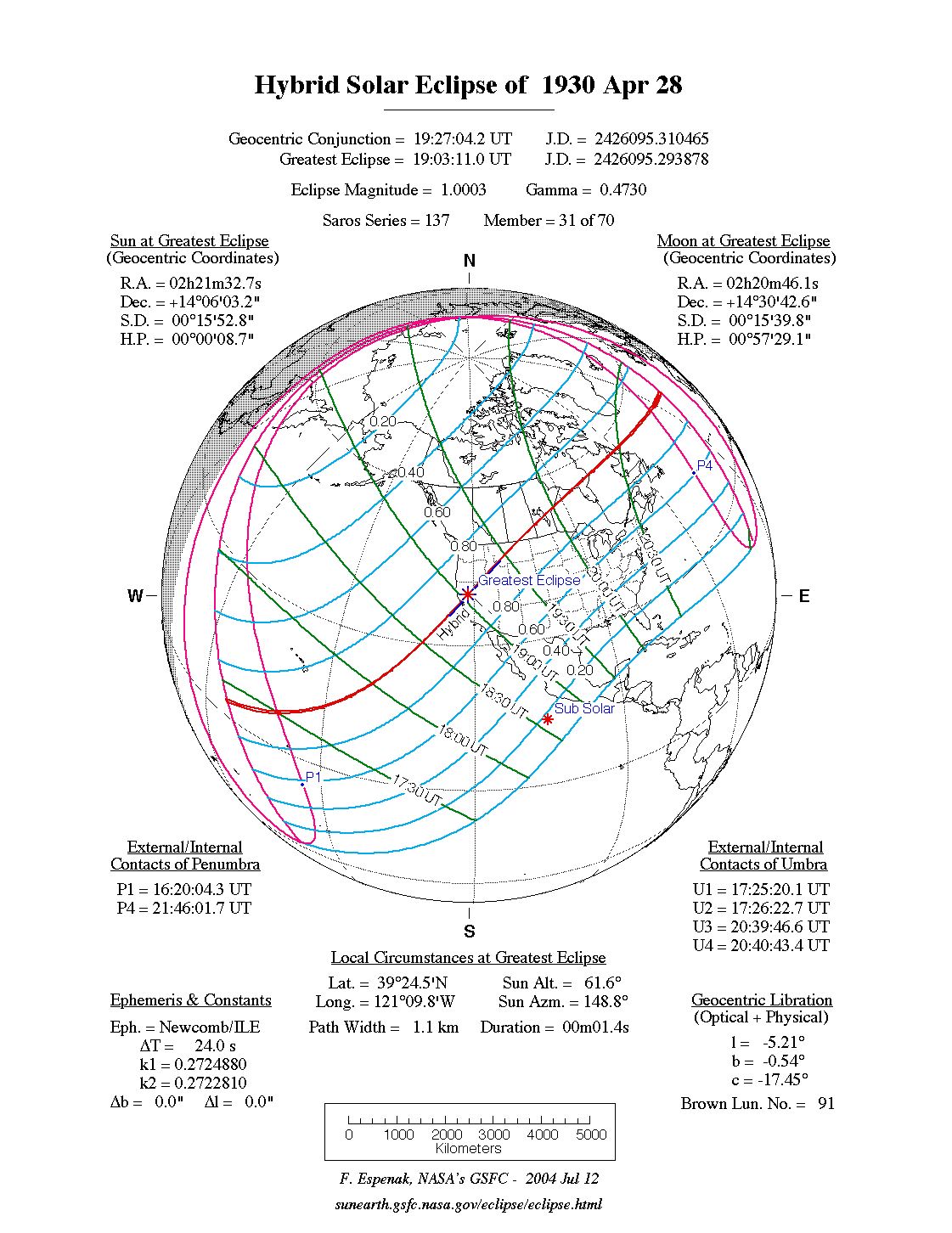
Template:Short description Script error: No such module "Solar eclipse". A total solar eclipse occurred at the Moon's ascending node of orbit on Monday, April 28, 1930,[1] with a magnitude of 1.0003. It was a hybrid event, with only a fraction of its path as total, and longer sections at the start and end as an annular eclipse. A solar eclipse occurs when the Moon passes between Earth and the Sun, thereby totally or partly obscuring the image of the Sun for a viewer on Earth. A total solar eclipse occurs when the Moon's apparent diameter is larger than the Sun's, blocking all direct sunlight, turning day into darkness. Totality occurs in a narrow path across Earth's surface, with the partial solar eclipse visible over a surrounding region thousands of kilometres wide. The Moon's apparent diameter was near the average diameter because it occurred 7.2 days after apogee (on April 21, 1930, at 13:50 UTC) and 6 days before perigee (on May 4, 1930, at 19:50 UTC).[2]
Annularity was first visible in the eastern Pacific Ocean, then totality from California, Nevada, Oregon, Idaho and Montana, with annularity continuing northeast across the remainder of Montana and into central and eastern Canada and northern Labrador of the Dominion of Newfoundland (today's Newfoundland and Labrador in Canada). A partial eclipse was visible for parts of Hawaii, North America, and the northern Soviet Union.
Observations
During a hybrid solar eclipse, the apex of the moon's umbral cone was very close to the Earth's surface, and the magnitude was very large. The edges of the moon and the sun were very close to each other as seen from the Earth in both the total and annular portion of the path. A series of Baily's beads on the lunar limb provided an excellent opportunity to measure the size and shape of the Earth, as well as the mountains and valleys on the lunar limb. Scientists recorded the precise time of each phase of the eclipse in Camptonville, California. Because the duration of totality was just more than 1 second, the photographic film needed to be inserted quickly after the start of totality. In addition, scientists recorded audio images with a long-wave receiver on an aircraft at the Mare Island Naval Shipyard. Each image had a time accurate to 1/5 second.
Prior to it, the hybrid solar eclipse of April 17, 1912, also belonging to Solar Saros 137, also occurred with a magnitude close to 1. Observations were made near Paris, France. Similar observations were also made during the annular solar eclipses of May 9, 1948 in Rebun Island, Japan and May 20, 1966 in Greece and Turkey, also belonging to the same solar Saros cycle.[3]
Eclipse details
Shown below are two tables displaying details about this particular solar eclipse. The first table outlines times at which the moon's penumbra or umbra attains the specific parameter, and the second table describes various other parameters pertaining to this eclipse.[4]
| Event | Time (UTC) |
|---|---|
| First Penumbral External Contact | 1930 April 28 at 16:20:27.5 UTC |
| First Umbral External Contact | 1930 April 28 at 17:25:43.5 UTC |
| First Central Line | 1930 April 28 at 17:26:14.8 UTC |
| Greatest Duration | 1930 April 28 at 17:26:14.8 UTC |
| First Umbral Internal Contact | 1930 April 28 at 17:26:46.1 UTC |
| Greatest Eclipse | 1930 April 28 at 19:03:34.0 UTC |
| Ecliptic Conjunction | 1930 April 28 at 19:08:43.9 UTC |
| Equatorial Conjunction | 1930 April 28 at 19:27:27.4 UTC |
| Last Umbral Internal Contact | 1930 April 28 at 20:40:09.2 UTC |
| Last Central Line | 1930 April 28 at 20:40:37.6 UTC |
| Last Umbral External Contact | 1930 April 28 at 20:41:06.0 UTC |
| Last Penumbral External Contact | 1930 April 28 at 21:46:24.5 UTC |
| Parameter | Value |
|---|---|
| Eclipse Magnitude | 1.00026 |
| Eclipse Obscuration | 1.00053 |
| Gamma | 0.47305 |
| Sun Right Ascension | 02h21m32.7s |
| Sun Declination | +14°06'03.1" |
| Sun Semi-Diameter | 15'52.8" |
| Sun Equatorial Horizontal Parallax | 08.7" |
| Moon Right Ascension | 02h20m46.1s |
| Moon Declination | +14°30'42.8" |
| Moon Semi-Diameter | 15'39.8" |
| Moon Equatorial Horizontal Parallax | 0°57'29.0" |
| ΔT | 24.0 s |
Eclipse season
Script error: No such module "Labelled list hatnote". This eclipse is part of an eclipse season, a period, roughly every six months, when eclipses occur. Only two (or occasionally three) eclipse seasons occur each year, and each season lasts about 35 days and repeats just short of six months (173 days) later; thus two full eclipse seasons always occur each year. Either two or three eclipses happen each eclipse season. In the sequence below, each eclipse is separated by a fortnight.
| April 13 Descending node (full moon) |
April 28 Ascending node (new moon) |
|---|---|
| File:Lunar eclipse chart close-1930Apr13.png | File:SE1930Apr28H.png |
| Partial lunar eclipse Lunar Saros 111 |
Hybrid solar eclipse Solar Saros 137 |


Related eclipses
Eclipses in 1930
- A partial lunar eclipse on April 13.
- A hybrid solar eclipse on April 28.
- A partial lunar eclipse on October 7.
- A total solar eclipse on October 21.
Metonic
- Preceded by: Solar eclipse of July 9, 1926
- Followed by: Solar eclipse of February 14, 1934
Tzolkinex
- Preceded by: Solar eclipse of March 17, 1923
- Followed by: Solar eclipse of June 8, 1937
Half-Saros
- Preceded by: Lunar eclipse of April 22, 1921
- Followed by: Lunar eclipse of May 3, 1939
Tritos
- Preceded by: Solar eclipse of May 29, 1919
- Followed by: Solar eclipse of March 27, 1941
Solar Saros 137
- Preceded by: Solar eclipse of April 17, 1912
- Followed by: Solar eclipse of May 9, 1948
Inex
- Preceded by: Solar eclipse of May 18, 1901
- Followed by: Solar eclipse of April 8, 1959
Triad
- Preceded by: Solar eclipse of June 27, 1843
- Followed by: Solar eclipse of February 26, 2017
Solar eclipses of 1928–1931
This eclipse is a member of a semester series. An eclipse in a semester series of solar eclipses repeats approximately every 177 days and 4 hours (a semester) at alternating nodes of the Moon's orbit.[5]
The partial solar eclipse on June 17, 1928 occurs in the previous lunar year eclipse set, and the partial solar eclipse on September 12, 1931 occurs in the next lunar year eclipse set.
| Solar eclipse series sets from 1928 to 1931 | ||||||
|---|---|---|---|---|---|---|
| Ascending node | Descending node | |||||
| Saros | Map | Gamma | Saros | Map | Gamma | |
| 117 | May 19, 1928 File:SE1928May19T.png Total (non-central) |
1.0048 | 122 | November 12, 1928 File:SE1928Nov12P.png Partial |
1.0861 | |
| 127 | May 9, 1929 File:SE1929May09T.png Total |
−0.2887 | 132 | November 1, 1929 File:SE1929Nov01A.png Annular |
0.3514 | |
| 137 | April 28, 1930 File:SE1930Apr28H.png Hybrid |
0.473 | 142 | October 21, 1930 File:SE1930Oct21T.png Total |
−0.3804 | |
| 147 | April 18, 1931 File:SE1931Apr18P.png Partial |
1.2643 | 152 | October 11, 1931 File:SE1931Oct11P.png Partial |
−1.0607 | |


Saros 137
Template:Solar Saros series 137
Metonic series
Template:Solar Metonic series 1880–1964
Tritos series
Template:Solar Tritos series 2006 September 22
Inex series
Template:Solar Inex series 2017 February 26
Notes
<templatestyles src="Reflist/styles.css" />
Script error: No such module "Check for unknown parameters".
References
- Earth visibility chart and eclipse statistics Eclipse Predictions by Fred Espenak, NASA/GSFC
- The solar eclipse of April 28, 1930 Popular Astronomy, Vol. 38, p. 537, Makemson, Maud W. [1]
- The Central Solar Eclipse of April 28, 1930 Journal of the Royal Astronomical Society of Canada, Vol. 24, p. 55 [2]
Script error: No such module "Navbox".