Rock wren
Template:Short description Script error: No such module "about". Script error: No such module "Hatnote". Template:Speciesbox
The rock wren (Salpinctes obsoletus) is a small songbird of the wren family native to western North America. It is the only species in the genus Salpinctes. They are notable for their variable song, as well as their habit of building "pavements" leading up to their nest during nest-building.
Taxonomy
The genus name of the rock wren, Salpinctes, comes from the Greek word for "trumpeter". There are 8 subspecies, split into 2 groups(obsoletus and guttatus).[1] Template:Subspecies bullet list itemTemplate:Subspecies bullet list itemTemplate:Subspecies bullet list itemTemplate:Subspecies bullet list itemTemplate:Subspecies bullet list itemTemplate:Subspecies bullet list itemTemplate:Subspecies bullet list itemTemplate:Subspecies bullet list item
Description
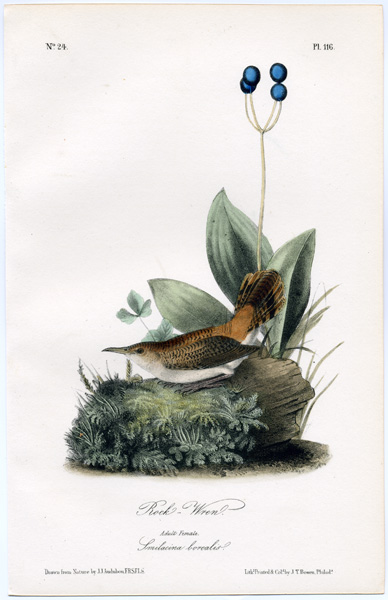
Rock wrens are 4.9-5.9 in (12.5-15 cm) in length, 0.5-0.6 oz (15-18 g) in weight, and 8.7-9.4 in (22-24 cm) in wingspan. They have grey-brown upperparts with small black and white spots and pale grey underparts with a light brown rump.[2] Additional distinctive features include a light grey line over the eye, a long and sharp bill,[3] a long barred tail and dark legs. The male rock wren has one song, however, it has been noted to be extremely variable. Songs last for around 1.5 seconds, with 3-5 seconds between songs. The individual syllables of each song are a spit-tee, a trill, and sometimes a chatter.[4][1] Female rock wrens do not sing.[1]
Rock wrens are commonly found in rocky open habitats, on exposed rock, canyons, cliffs, and similar. They are less common in urban areas, preferring to nest away from roads or buildings.[1] They are also largely terrestrial, only flying for short durations, instead using a very rapid gait to move around.[5][1] They probe with their bill as their extraction tool, and mainly eat insects.[1]
Breeding
Little is known about their nesting habits.[6] Nest-building begins in March, and the first brood occurs late April to June. Rock wrens usually nest in crevices or other similar sheltered areas, on stone surfaces. They usually lay 5-6 eggs per clutch, with incubation and nestling periods around 14-16 days.[7] Incubation is handled by the female. Nests are usually located in cavities, such as holes or pipes, and are made with stones, plant material, trash, and other debris.[8] Nests often include a "pavement" made with stones leading up to the nest, of which the purpose is not known.[1][8]
Distribution
Rock wrens are permanent residents in the south of their range, but northern populations migrate to warmer areas from the central United States and southwest Canada southwards.[9] They are occasional vagrants in the eastern United States. During the breeding season they move from southwestern Canada south to Costa Rica to nest.[10]
Conservation
The rock wren is a least-concern species on the IUCN Red List.[11] Little is known about the causes of mortality or lifespan,[12] however, nests are subject to the risk of landslides,[13][1] as well as predation. Observed nest predators included the striped racer, the desert woodrat, and the white-tailed antelope squirrel.[1]
References
<templatestyles src="Reflist/styles.css" />
- ↑ a b c d e f g h i Script error: No such module "Citation/CS1".
- ↑ Script error: No such module "citation/CS1".
- ↑ Script error: No such module "citation/CS1".
- ↑ Script error: No such module "citation/CS1".
- ↑ Script error: No such module "Citation/CS1".
- ↑ Script error: No such module "citation/CS1".
- ↑ Script error: No such module "citation/CS1".
- ↑ a b Script error: No such module "Citation/CS1".
- ↑ Script error: No such module "citation/CS1".
- ↑ Script error: No such module "citation/CS1".
- ↑ Script error: No such module "Citation/CS1".
- ↑ Script error: No such module "Citation/CS1".
- ↑ Script error: No such module "Citation/CS1".
Script error: No such module "Check for unknown parameters".
External links
Script error: No such module "Side box".
- Rock Wren by John Audubon
- Rock Wren - Cornell Lab of Ornithology
- Rock Wren - eNature.com
- Rock Wren - USGS Patuxent Bird Information
- Rock Wren photo gallery VIREO
See also
- San Benedicto rock wren, a subspecies of Salpinctes that went extinct in 1952
Template:Passerida Template:Taxonbar Script error: No such module "Authority control".