Hwasong-7
Template:Use dmy dates Script error: No such module "Infobox".Template:Template otherScript error: No such module "Check for unknown parameters". The Hwasong-7Template:SfnTemplate:Efn (Korean: Script error: No such module "Lang".; lit. Mars Type 7Template:Category handler) is a single-stage, mobile liquid propellant medium-range ballistic missile developed by North Korea. Developed in the mid-1980s, it is a scaled-up adaptation of the Soviet R-17 Elbrus missiles, more commonly known by its NATO reporting name "Scud". The inventory is estimated to be around 200–300 missiles.[1] US Air Force National Air and Space Intelligence Center estimates that as of June 2017 fewer than 100 launchers were operationally deployed.Template:Sfn
It influenced the design of Pakistan's Ghauri-1 missile,[2] as well as the Iranian ghadr-110.[3][4]
Overview

It is believed North Korea obtained R-17 designs from Egypt, and possibly modified designs from China, allowing them to reverse-engineer them into a larger and longer-distance weapon. United States reconnaissance satellites first detected this type in May 1990 at the Musudan-ri test launch facility, in northeastern North Korea.[6] In the same year, North Korea began producing Hwasong-7, and eight years later, Hwasong-7 became operational.[7][8]
The precise capabilities and specifications of the missile are unknown; even the fact of its production and deployment are controversial. It is a larger variant of the R-17, scaled up so its cross-sectional area is about doubled, with a diameter of Script error: No such module "convert". and a length of Script error: No such module "convert"..[9]
Its aerodynamic design is stable, reducing the need for modern active stabilization systems while the missile is flying in the denser lower atmosphere. The Hwasong-7 uses the liquid propellant combination of TM-185 (20% gasoline and 80% kerosene) and AK-27I (27% Template:Chem2 and 73% Template:Chem2), therefore, Hwasong-7 can only be fueled when vertical, therefore it cannot be fueled before transport as is normal for modern missiles. Its range is estimated as Template:Cvt with a Template:Cvt payload to Template:Cvt.[9][8][10]
It has an estimated circular error probable (CEP) of Template:Cvt, but it can be reduced to between Script error: No such module "convert". and Script error: No such module "convert". with GPS guidance.[10][11] North Korea is believed to possess some 300 Hwasong-7 missiles and fewer than 50 mobile launchers.[12][13]
The Hwasong-7's technology has been exported to foreign nations (such as Iran and Pakistan) in secrecy on the basis of mutual exchange of technologies, with Iran being one of the largest beneficiaries of such technology. Successful variants were tested and deployed by Iran after developing the Shahab-3 which is roughly based on Hwasong-7.[3]Template:Sfn Some press reports (including The Sunday Telegraph, Jerusalem Post, and Janes) claimed that Libya signed a contract for a total of 50 Nodong systems in October 1999, with the first batch delivered in July 2000, however such rumors proved to be false when Libya voluntarily dismantled its weapons of mass destruction programs in December 2003 and invited foreign inspectors to verify the disarmament process. In that same year, US inspectors learned that Iraq attempted to buy Nodong missiles, but the North Koreans never delivered the missiles and refused to refund the $10 million down payment.Template:Sfn
North Korea test-fired Hwasong-7 missiles in 2006 and 2014, in which North Korea fires two missiles that flew Template:Cvt.[14][15]
Although it has an estimated range of Script error: No such module "convert"., launches in March 2014 flew only Script error: No such module "convert"., as the missiles flew to an altitude of Template:Cvt because of lofted trajectory. The missiles achieved a maximum speed of Template:Cvt. U.S. and South Korean Patriot PAC-2/3 interceptors are more specialized to hit ballistic missiles up to Template:Cvt.[16]
On 5 September 2016, North Korea fired three missiles into the Sea of Japan, these missiles achieved about Script error: No such module "convert". range. Initially, these missiles were believed to be Hwasong-7,[17] however, it was later revealed that the missiles used for this launch were Hwasong-9 (Scud-ER).[18][19] The United States strongly condemned the launch.[17]
To enable interception at higher altitudes, South Korea is indigenously developing the long-range surface-to-air missile (L-SAM),[16] and on 8 July 2016 the U.S. agreed to deploy one Terminal High Altitude Area Defense missile defense system in Seongju County, in the south of South Korea, by the end of 2017.[20]
Variant for reconnaissance satellite testing
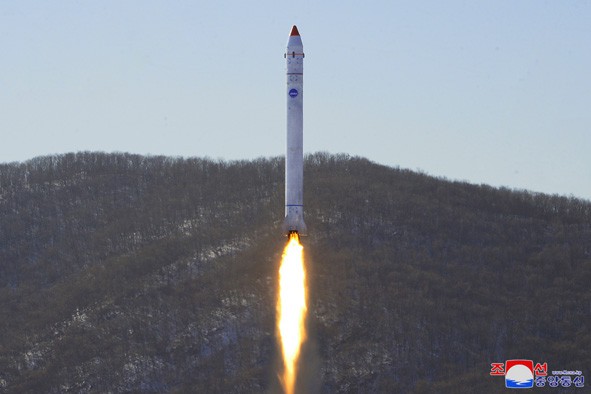
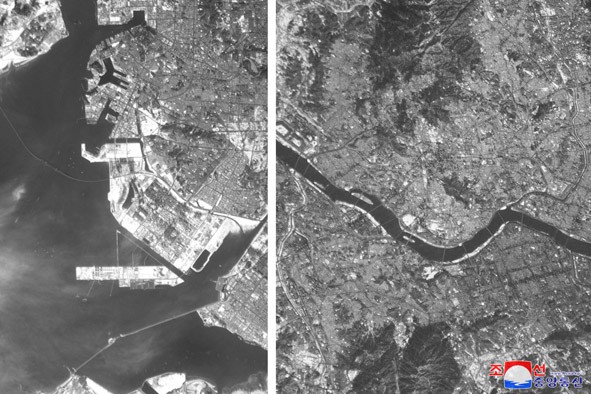
Script error: No such module "Labelled list hatnote". Hwasong-7 has a variant with white livery for reconnaissance satellite cameras testing.[21]
On 18 December 2022, North Korea launched two medium-range ballistic missiles from Sohae Satellite Launching Station. These missiles flew Template:Cvt with an apogee of Template:Cvt.[19]
According to North Korea, the missiles were test-fired by National Aerospace Technology Administration (then National Aerospace Development Administration) for testing reconnaissance satellite cameras.[22]
Based on photos released by North Korea, the missiles appear to be derived from Hwasong-7 (or Scud).[19]
Operators
Current
- File:Flag of Iran.svg Iran − Ghadr-110 used by the Islamic Revolutionary Guard Corps Aerospace Force.Template:Sfn
- File:Flag of North Korea.svg North Korea − Used by the Korean People's Army Strategic Force.Template:Sfn According to the International Institute for Strategic Studies (IISS), as of 2025, North Korea is possessing about 10 Hwasong-7 launchers.[23]Template:Rp
- File:Flag of Pakistan.svg Pakistan − Hatf 5 Ghauri used by the Army Strategic Forces Command.Template:Sfn


Unconfirmed
- File:Flag of Egypt.svg Egypt − Reportedly was interested in buying Nodong missiles, but photographic evidence only shows Scud-Bs or possibly Scud-Cs in use.[24]
- File:Flag of the Syrian revolution.svg Syria − Developed a localized version of the Nodong missile. Reportedly received 50 missiles and 7 TELs from North Korea in 2000.[25] According to the International Institute for Strategic Studies, the Syrian Arab Army doesn't operate MRBMs as of 2024Template:Sfn


Failed bids
- File:Flag of Iraq (1991–2004).svg Iraq − Prior to the 2003 invasion of Iraq, Baghdad placed an order for Nodong missiles and made a $10 million down payment, but North Korea never delivered the missiles.Template:Sfn
.svg)
See also
- Strategic Rocket Forces (North Korea)
- North Korean missile tests
- North Korean defense industry
- Military of North Korea
Notes
References
<templatestyles src="Reflist/styles.css" />
- ↑ Script error: No such module "citation/CS1".
- ↑ Script error: No such module "citation/CS1".
- ↑ a b Script error: No such module "citation/CS1".
- ↑ Script error: No such module "citation/CS1".
- ↑ Script error: No such module "citation/CS1".
- ↑ Script error: No such module "citation/CS1".
- ↑ Script error: No such module "citation/CS1".
- ↑ a b Script error: No such module "citation/CS1".
- ↑ a b Script error: No such module "citation/CS1".
- ↑ a b Script error: No such module "citation/CS1".
- ↑ Script error: No such module "citation/CS1".
- ↑ Script error: No such module "citation/CS1".
- ↑ Script error: No such module "citation/CS1".
- ↑ Script error: No such module "citation/CS1".
- ↑ Script error: No such module "citation/CS1".
- ↑ a b Script error: No such module "citation/CS1".
- ↑ a b Script error: No such module "citation/CS1".
- ↑ Script error: No such module "citation/CS1".
- ↑ a b c Script error: No such module "citation/CS1".
- ↑ Script error: No such module "citation/CS1".
- ↑ Script error: No such module "citation/CS1".
- ↑ Script error: No such module "citation/CS1". For images, see 1 and 2.
- ↑ Script error: No such module "citation/CS1".
- ↑ Script error: No such module "citation/CS1".
- ↑ Script error: No such module "citation/CS1".
Script error: No such module "Check for unknown parameters".
Bibliography
- Script error: No such module "citation/CS1".
- Script error: No such module "Citation/CS1".
- Script error: No such module "Citation/CS1".
- Script error: No such module "citation/CS1".