Mount Qasioun
Template:Short description Template:Use dmy dates Template:Infobox mountain
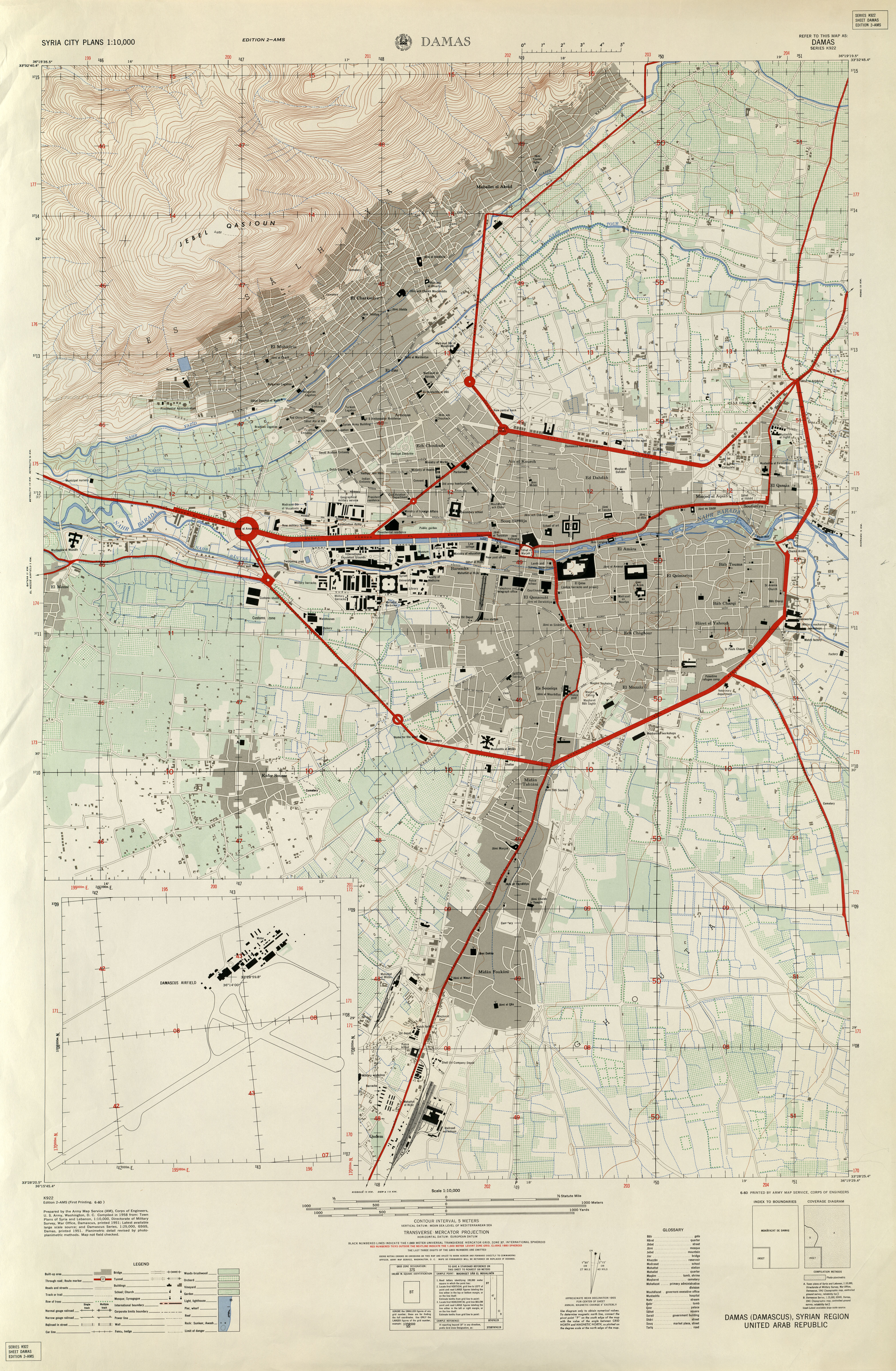
Mount Qasioun (Template:Langx) is a mountain overlooking the city of Damascus, Syria. It has a range of restaurants, from which the whole city can be viewed. Due to its high elevation, several communications and broadcasting networks constructed relay stations at the summit for the city's communications. As the city has expanded over the years, some districts have been established at the foot of the mountain. Its highest point is Script error: No such module "convert"..[1]
Etymology
The term Qasioun might mean "hard and dry" in Syriac language, which is the characteristic of the bare rocky mountain that has no grass, greenery, or water.[2]Template:Citation not found
History
The mountain was heavily entrenched with Syrian government forces from the start of the Syrian Civil War, as it was a strategic site in the battle for the outskirts of Damascus.[3][4] A network of tunnels was dug into the mountain by the Syrian Arab Army to serve as a garrison for the Republican Guard and was also used as firing positions for snipers and artillery targeting rebel positions in Damascus. The tunnels were also said to have led to the Presidential Palace.[5] Public access was restricted until the fall of the Assad regime in December 2024.[6]
Conservation
The mountain is also host to an endemic species of iris, Iris damascena, which can be found on the steep eastern slopes, at high elevation.[7] The Syrian government has not given the species any protected status but part of the habitat of the species lies within a military area near the Qassioun Republican Guards Military Base and other military facilities, which prevents civilians from accessing the area.[8] The base and steepness of the habitat also prevent construction or development, but it is still classified as "critically endangered".[9]
Religious significance


Cave of Blood
On the slopes of Jabal Qasiun is a cave steeped in legend. It is said to have been inhabited at one point by the first human being, Adam, and there are various stories told about Abraham and Jesus also having prayed in it. It is mentioned however in Medieval Arab history books as having been the place where Cain killed Abel.[10][11] It was known for hundreds of years as a place where prayers were immediately accepted, and especially in times of drought rulers of Damascus would climb to the cave and pray for rain. Because of the association with Cain's murder of Abel, claimed to be the first murder committed, the cave is called Maghārat al-Dam (the Cave of Blood).[12]
According to Sunni Muslims, Mount Qasioun is the site of the mihrab (prayer niches) of the 40 arch-saints known as the Abdāl, who are said to pray the night vigil prayers every night. A small mosque has been built over the Cave of Blood containing these miḥrābs.[13]
Cave of Hunger
Further down the mountain from the 'Cave of Blood', there was another cave known as Maghārat al-Jūˁ (the Cave of Hunger). Stories about this cave are somewhat confusing. Some say that forty saints died there of hunger;Script error: No such module "Unsubst". al-Harawī, however, who lived in the 13th century, wrote that it was said that forty prophets had died there of hunger.[12] At present, the cave has been concealed by surrounding houses, but that spot is called al-Juyūˁīyah (Roughly 'the Place of the Hungry').[14]
Cave of the Seven Sleepers
On another flank of the same mountain is yet another cave, which has come down in local legend as being the cave of the Seven Sleepers, mentioned in early Christian sources, as well as in the Quran,[15] where they are known as the Aṣḥāb al-Kahf (Companions of the Cave). This is rather dubious, however, and it is only one of many caves in this part of the world that share the claim. A madrassah has been built over the cave, but pilgrims are still granted access.[16]Template:Sister project
References
<templatestyles src="Reflist/styles.css" />
- ↑ Profile, lib.utexas.edu. Accessed 8 April 2024.
- ↑ Script error: No such module "citation/CS1".
- ↑ Script error: No such module "citation/CS1".
- ↑ Sam Dagher, "Assad Readies for U.S. Strike Despite Delay", The Wall Street Journal, 3 September 2013, p. A6
- ↑ Script error: No such module "citation/CS1".
- ↑ Script error: No such module "citation/CS1".
- ↑ Script error: No such module "citation/CS1".
- ↑ Script error: No such module "citation/CS1".
- ↑ Script error: No such module "Citation/CS1".
- ↑ Script error: No such module "citation/CS1".
- ↑ Script error: No such module "citation/CS1".
- ↑ a b Josef W. Meri (Trans.): A Lonely Wayfarer's Guide to Pilgrimage. 'Ali ibn Abī Bakr al-Harawī's: Kitāb al-Ishārāt ilā Ma'rifat al-Ziyārāt. Pp. 24-25. Princeton, 2004.
- ↑ Script error: No such module "citation/CS1".
- ↑ Script error: No such module "citation/CS1".
- ↑ Quran 18:7-26
- ↑ Script error: No such module "citation/CS1".
Script error: No such module "Check for unknown parameters".Template:Damascus