Nymphaea mexicana
Template:Short description Template:Speciesbox
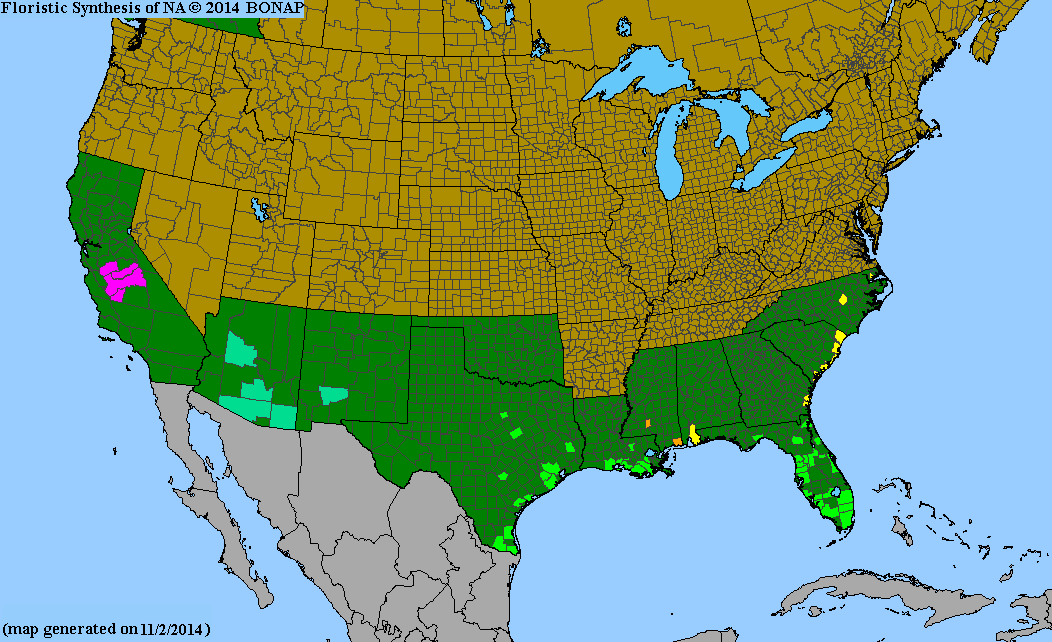
Nymphaea mexicana is a species of aquatic plant that is native to the Southern United States and Mexico as far south as Michoacán.[1][2] Common names include yellow water lily, Mexican water lily and banana water lily.
Description


.jpg)
_1200.jpg)
Vegetative characteristics
Nymphaea mexicana is a rhizomatous,[3] aquatic,[4] perennial herb[5] with stoloniferous,[6][3] up to 30 cm long, and 4 cm wide rhizomes.[6] The rhizomes bear leaf and root scars.[7] The stolons are 15–100 cm long, and 0.5–1 cm wide.[8] The ovate, suborbicular,[7] or elliptic lamina is 7–18(–27) cm long, and 7–14(–18) cm wide.[3] The long, cylindrical petiole[7] is glabrous.[3]
Generative characteristics
The floating or emersed,[3] yellow, 6–13 cm wide flowers have peduncles with 4 primary air canals.[8] The flowers have four sepals[4] and 12-30 yellow petals.[3] The androeceum consists of 50 stamens.[6] The gynoecium consists of 7-10 carpels.[3] The spheroid or ovoid fruit bears 3–5 mm long, and 3–5 mm wide seeds[9] with hairlike papillae.[9][3] Tuberiferous flowers or proliferating pseudanthia can be present.[10]
Cytology
The chromosome count is n = 28. The genome size is 586.80 Mb.[11] The chloroplast genome is 159962 bp long.[12]
Taxonomy
It was published by Joseph Gerhard Zuccarini in 1832.[7][13] Within the subgenus Nymphaea subg. Nymphaea[14] it is placed in the section Nymphaea sect. Xanthantha.[15][8]
Etymology
The specific epithet mexicana refers to Mexico.[4]
Hybridisation
Together with Nymphaea odorata, it forms the natural hybrid Nymphaea × thiona.[3]
Reproduction
Vegetative reproduction
Nymphaea mexicana reproduces vegetatively through stolons. Their structure, resembling bananas, consists of leaf buds and thick, starchy roots.[16] Additionally, tuberiferous flowers or proliferating pseudanthia can be present.[10]
Conservation
The NatureServe conservation status is Vulnerable (G3).[17]
Ecology
Habitat
It occurs in up to 4 m deep water[18] in lagoons, canals[19] swamps, and rivers.[20] It can occur in brackish water.[19]
Herbivory
The canvasback duck, Aythya valisineria, feeds on the banana-like roots of the plant.[21]
As an invasive species
Together with its hybrids, it has become an invasive species outside of its natural range.[22][23] For instance, it has been recorded in Australia,[6][20] South Africa,[22] New Zealand,[9][4] and the Iberian Peninsula.[24]
References
<templatestyles src="Reflist/styles.css" />
- ↑ Template:GRIN
- ↑ Biota of North America Program 2014 county distribution map
- ↑ a b c d e f g h i Nymphaea mexicana Zuccarini. (n.d.). Flora of North America @ efloras.org. Retrieved December 2, 2024, from http://www.efloras.org/florataxon.aspx?flora_id=1&taxon_id=233500827
- ↑ a b c d Manaaki Whenua – Landcare Research. (n.d.-b). Nymphaea mexicana Zucc. Biota of New Zealand. Retrieved December 2, 2024, from https://biotanz.landcareresearch.co.nz/scientific-names/7170dae4-4e51-4868-be42-e5d9fa735353
- ↑ The Calflora Database. (n.d.). Nymphaea mexicana Zucc. Calflora. Retrieved December 2, 2024, from https://www.calflora.org/app/taxon?crn=5875
- ↑ a b c d Royal Botanic Gardens Victoria. (n.d.-b). Nymphaea mexicana Zucc. VicFlora Flora of Victoria. Retrieved December 2, 2024, from https://vicflora.rbg.vic.gov.au/flora/taxon/fc0766f3-a2f3-432d-b997-48256d588310
- ↑ a b c d Königlich Bayerische Akademie der Wissenschaften. & Königlich Bayerische Akademie der Wissenschaften. (1832). Abhandlungen der Mathematisch-Physikalischen Klasse der Königlich Bayerischen Akademie der Wissenschaften (Vol. 1, p. 365). https://www.biodiversitylibrary.org/page/11355625
- ↑ a b c Conard, Henry S. (1905). The waterlilies: a monograph of the genus Nymphaea (pp. 163–167). Pub. by the Carnegie Institution of Washington. https://www.biodiversitylibrary.org/page/35044992
- ↑ a b c Manaaki Whenua – Landcare Research. (n.d.-c). Nymphaea mexicana Zucc. Flora of New Zealand. Retrieved December 3, 2024, from https://www.nzflora.info/factsheet/taxon/Nymphaea-mexicana.html
- ↑ a b Grob, V., Moline, P., Pfeifer, E., Novelo, A. R., & Rutishauser, R. (2006). Developmental morphology of branching flowers in Nymphaea prolifera. Journal of Plant Research, 119, 561-570.
- ↑ Script error: No such module "Citation/CS1".
- ↑ Gruenstaeudl, M., Nauheimer, L., & Borsch, T. (2017). Plastid genome structure and phylogenomics of Nymphaeales: conserved gene order and new insights into relationships. Plant systematics and evolution, 303, 1251-1270.
- ↑ Cite error: Script error: No such module "Namespace detect".Script error: No such module "Namespace detect".
- ↑ Pellicer, J., Kelly, L. J., Magdalena, C., & Leitch, I. J. (2013). Insights into the dynamics of genome size and chromosome evolution in the early diverging angiosperm lineage Nymphaeales (water lilies). Genome, 56(8), 437-449.
- ↑ Borsch, T., Hilu, K. W., Wiersema, J. H., Löhne, C., Barthlott, W., & Wilde, V. (2007). Phylogeny of Nymphaea (Nymphaeaceae): evidence from substitutions and microstructural changes in the chloroplast trnT-trnF region. International Journal of Plant Sciences, 168(5), 639-671.
- ↑ Wiersema, J. H. (1988). Reproductive Biology of Nymphaea (Nymphaeaceae). Annals of the Missouri Botanical Garden, 75(3), 795–804. https://doi.org/10.2307/2399367
- ↑ Cite error: Script error: No such module "Namespace detect".Script error: No such module "Namespace detect".
- ↑ S.W.L. Jacobs & C.L. Porter. Nymphaea mexicana, in (ed.), Flora of Australia. Australian Biological Resources Study, Department of Climate Change, Energy, the Environment and Water: Canberra. https://profiles.ala.org.au/opus/foa/profile/Nymphaea%20mexicana [Date Accessed: 04 December 2024]
- ↑ a b Alabama Herbarium Consortium & University of West Alabama. (n.d.). Nymphaea mexicana. Alabama Plant Atlas. Retrieved December 3, 2024, from http://floraofalabama.org/Plant.aspx?id=2705
- ↑ a b Western Australian Herbarium & Department of Biodiversity, Conservation and Attractions. (n.d.-c). Nymphaea mexicana Zucc. Florabase—the Western Australian Flora. Retrieved December 3, 2024, from https://florabase.dbca.wa.gov.au/browse/profile/2922
- ↑ Script error: No such module "citation/CS1".
- ↑ a b Reid, M. K., Paterson, I. D., Coetzee, J. A., Gettys, L. A., & Hill, M. P. (2023). Know thy enemy: Investigating genetic contributions from putative parents of invasive Nymphaea mexicana hybrids in South Africa as part of efforts to develop biological control. Biological Control, 184, 105291.
- ↑ Reid, M. K., Naidu, P., Paterson, I. D., Mangan, R., & Coetzee, J. A. (2021). Population genetics of invasive and native Nymphaea mexicana Zuccarini: Taking the first steps to initiate a biological control programme in South Africa. Aquatic Botany, 171, 103372.
- ↑ Script error: No such module "Citation/CS1".
Script error: No such module "Check for unknown parameters".