Leônidas (footballer, born 1913)
Template:Short description Script error: No such module "about". Template:Family name hatnote Script error: No such module "Unsubst". Template:Use dmy dates Template:Infobox football biography Leônidas da Silva (Script error: No such module "IPA".; 6 September 1913 – 24 January 2004) was a Brazilian professional footballer who played as a forward. He is regarded as one of the most important players of the first half of the 20th century. At the height of his career, Leônidas was very popular amongst the people of Brazil and Rio de Janeiro. Leônidas played for Brazil national team in the 1934 and 1938 World Cups, and was the top scorer of the latter tournament. He was known as the "Black Diamond" and the "Rubber Man" due to his agility.
Club career
Leônidas started his career at São Cristóvão. He then played for Carioca side Sírio e Libanez, where he was coached by Gentil Cardoso. When Cardoso left to coach Bonsucesso, he brought Leônidas with him.[1] Between 1931 and 1932, he played for Bonsucesso before joining Peñarol in Uruguay in 1933. After one year, Leônidas returned to Brazil to play for Vasco da Gama. He helped them win the Rio State Championship. After playing in the 1934 World Cup, he joined Botafogo and won another Rio State Championship in 1935. The following year, he joined Flamengo, where he stayed until 1941. Once again, in 1939, the team won the Rio State Championship. He was also at the forefront of the movement against prejudice in football, being one of the first black players to join the then-elitist Flamengo team. Leônidas joined São Paulo in 1942 and stayed at the club until his retirement from playing in 1950.
Bicycle kick
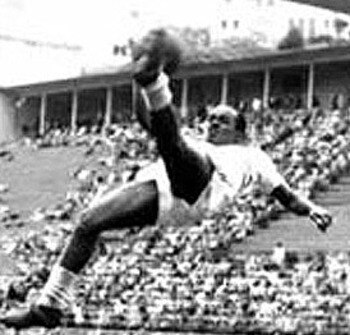
Leônidas is one of several possible players credited for inventing the "Bicycle kick". The first time Leônidas used this technique was on 24 April 1932, in a match between Bonsucesso and Carioca. In Flamengo he used this move only once, in 1939, against the Argentinian team Independiente. The unusual volley gained huge fame at the time, propelling it into the football mainstream. For São Paulo, Leônidas used the bicycle kick on two occasions: the first on 14 June 1942 in the defeat against Palestra Italia (currently Palmeiras). Most famously of all, he used it on 13 November 1948 in the massive 8–0 victory over Juventus. The play and the goal was captured in an image,[2] and is regarded as the most famous picture of the player.Script error: No such module "Unsubst".. In the 1938 World Cup, he also used the bicycle kick, to the delight of the spectators. When he did it, the referee was so shocked by the volley that he was unsure whether it was within the rules or not.
International career
Leônidas played 19 times for the Brazil national team between 1932 and 1946, scoring 21 goals in total, and scoring twice on his debut. In 1938, he was the World Cup's top scorer with 7 goals, scoring at least three times in the 6–5 extra time win over Poland.Template:Refn Nevertheless, his performance also made him be frequently fouled by the Poles. For the next match, against Czechoslovakia, he was not in the ideal conditions, but the Brazilian staff, concerned for possible punishment in using Niginho in Leônidas place, preferred to keep Leônidas in the team; the Italian Football Federation had warned FIFA about Niginho's irregular condition: this player, who had Italian citizenship, was still legally attached to Lazio, the club he left without permission in 1936, due to fear of being recruited by the Italian Army to the Second Italo-Ethiopian War. Leônidas managed to score against the Czechs, but his injuries got worse, making him definitely unable to be used in the next game – the semifinal against Italy. Brazil lost the match 2–1 and for many years the coach Adhemar Pimenta was criticized as many fans, not aware of Lêonidas true poor conditions, believed his absence was just an option arrogantly made by Pimenta "to rest the player for the final". This version still circulates, despite the fact that Leônidas had written a letter, which was published by certain newspapers at the time, in which he clarified that Pimenta had no choice but to rest him due to the Niginho affair.[3] The Niginho affair also prevented either of the players from playing in the semi-final. In their place, Romeu was chosen as the team's improvised center-forward for the match, scoring Brazil's goal late in the game.[4] Leônidas returned for the third place match and scored two more goals in a 4–2 win against Sweden.
1934 World Cup statistics
The scores contain links to the article on the 1934 FIFA World Cup and the round in question. The matches' numbers reflect the number of World Cup matches Leônidas played during his career.
| Game no. | Round | Date | Opponent | Score | Leônidas' goals | Times | Leônidas' playing time | Notes | Venue | Report |
|---|---|---|---|---|---|---|---|---|---|---|
| 1 | 1st R. | 27 May 1934 | Template:Flagicon Spain | 1–3 (0–3) | 1 | <templatestyles src="Goal/styles.css"/>File:Soccerball shade.svg 55' | 90 min. | Stadio Luigi Ferraris, Genoa | [1] |

1938 World Cup statistics
The scores contain links to the article on the 1938 FIFA World Cup and the round in question. When there is a special article on the match in question, the link is in the column for round.
| Game no. | Round | Date | Opponent | Score | Leônidas' goals | Times | Leônidas' playing time | Notes | Venue | Report | |||||||||||||||||||||||||||||||
|---|---|---|---|---|---|---|---|---|---|---|---|---|---|---|---|---|---|---|---|---|---|---|---|---|---|---|---|---|---|---|---|---|---|---|---|---|---|---|---|---|---|
| 2 | 1st R. | 5 June 1938 | {{ Template:Yesno | alias = Poland | flag alias = Flag of Poland.svg | flag alias-state = Flag of Poland (with coat of arms).svg | flag alias-1815 = Flag of the Congress of Poland.svg | flag alias-1919 = Flag of Poland (1919-1928).svg | flag alias-1928 = Flag of Poland (1928–1980).svg | flag alias-1955 = Flag of Poland (with coat of arms, 1955-1980).svg | flag alias-1980 = Flag of Poland (with coat of arms, 1980-1990).svg | flag alias-1990 = Flag of Poland (with coat of arms).svg | flag alias-naval = PL navy flag IIIRP.svg | border-naval = | flag alias-naval-1919 = Naval Ensign of IIRP v1.svg | border-naval-1919 = | flag alias-naval-1946 = Naval Ensign of PRL v1.svg | border-naval-1946 = | flag alias-naval-auxiliary = Flaga pomocniczych jednostek pływających Polskiej Marynarki Wojennej.svg | flag alias-naval-auxiliary-1955 = POL Bandera pjp PRL v1.svg | link alias-naval = Polish Navy | flag alias-navy = Naval Ensign of Poland.svg | border-navy = | link alias-navy = Polish Navy | flag alias-marines = Flag of the Polish Land Forces.svg | border-marines = | link alias-marines = Polish 7th Coastal Defense Brigade | flag alias-air force = Flag of the Polish Air Force.svg | border-air force = | link alias-air force = Polish Air Force | flag alias-army = Flag of the Polish Land Forces.svg | border-army = | link alias-army = Polish Land Forces | size = | size flag alias-naval = 25px | size flag alias-naval-1919 = 25px | size flag alias-naval-1946 = 25px | size flag alias-air force = 25px | name = | altlink = national football team | variant =
}} || 6–5 a.e.t. |
| 3 | QF | 12 June 1938 | {{safesubst: Template:Yesno | alias = Czechoslovakia | flag alias = Flag of the Czech Republic.svg | flag alias-1918 = Flag of Bohemia.svg | flag alias-naval = Naval_Ensign_of_Czechoslovakia_1935-1939_1945-1955.svg | link alias-naval = Czechoslovakian Naval Forces | link alias-army = Czechoslovak Army | flag alias-navy = Naval_Ensign_of_Czechoslovakia_1935-1939_1945-1955.svg | link alias-navy = Czechoslovakian Naval Forces | size = | name = | variant = | altlink = national football team | altvar = football
}} || 1–1 a.e.t. | |||||||||||||||||||||||||
| 4 | Replay | 14 June 1938 | {{safesubst: Template:Yesno | alias = Czechoslovakia | flag alias = Flag of the Czech Republic.svg | flag alias-1918 = Flag of Bohemia.svg | flag alias-naval = Naval_Ensign_of_Czechoslovakia_1935-1939_1945-1955.svg | link alias-naval = Czechoslovakian Naval Forces | link alias-army = Czechoslovak Army | flag alias-navy = Naval_Ensign_of_Czechoslovakia_1935-1939_1945-1955.svg | link alias-navy = Czechoslovakian Naval Forces | size = | name = | variant = | altlink = national football team | altvar = football
}} || 2–1 (0–1) ||1 ||align=left| <templatestyles src="Goal/styles.css"/>File:Soccerball shade.svg 57' || 90 min. || || Parc Lescure, Bordeaux || [4] | |||||||||||||||||||||||||
| – | SF | 16 June 1938 | {{ Template:Yesno | alias = Italy | flag alias = Flag of Italy.svg | flag alias-1861 = Flag of Italy (1861–1946).svg | flag alias-1943 = War flag of the Italian Social Republic.svg | flag alias-2003 = Flag of Italy (2003–2006).svg | flag alias-civil = Civil Ensign of Italy.svg | flag alias-naval = Naval Ensign of Italy.svg | flag alias-navy-1947 = Naval Ensign of Italy (1947-2013).svg | link alias-naval = Italian Navy | link alias-air force = Italian Air Force | link alias-army = Italian Army | flag alias-navy = Naval Ensign of Italy.svg | link alias-navy = Italian Navy | link alias-roller hockey = Italy {{{mw}}} national roller hockey team | size = | name = | variant = 1861 | altlink = national football team | altvar = football
}} || 1–2 (0–0)|| 0 || || Did not play || Injured|| Stade Vélodrome, Marseille ||[5] | |||||||||||||||||||
| 5 | 3rd pl. | 19 June 1938 | {{ Template:Yesno | alias = Sweden | flag alias = Flag of Sweden.svg | flag alias-army = Naval Ensign of Sweden.svg | flag alias-air force =Naval Ensign of Sweden.svg | flag alias-1818 = Swedish and Norwegian merchant flag 1818-1844.svg | flag alias-1844 = Swedish civil ensign (1844–1905).svg | flag alias-1905 = Flag of Sweden (pre-1906).svg | flag alias-naval = Naval Ensign of Sweden.svg | flag alias-naval-1844 = Naval Ensign of Sweden (1844-1905).svg | flag alias-naval-1815 = Ensign of Sweden and Norway (1815–1844).svg | link alias-army = Swedish Army | link alias-air force = Swedish Air Force | link alias-naval = Swedish Navy | flag alias-navy = Naval Ensign of Sweden.svg | link alias-navy = Swedish Navy | link alias-football = Sweden men's national football team | border-army = | border-air force = | border-naval = | border-navy = | border-naval-1815 = | border-naval-1844 = | size = | name = | altlink = national football team | altvar = football | variant =
}} || 4–2 (1–2) || 2 ||align=left| <templatestyles src="Goal/styles.css"/>File:Soccerball shade.svg 63' <templatestyles src="Goal/styles.css"/>File:Soccerball shade.svg 74' || 90 min. || || Parc Lescure, Bordeaux || [6] |
Personal life
At the height of his career, Leônidas was very popular amongst the people of Brazil and Rio de Janeiro. In the 1930s and 1940s, Leônidas was a celebrity against the backdrop of controversy and racial discrimination looming within Brazil during this time.[5] Leônidas had a major impact on and off the field because of his ability to relate to the working classes of Brazil, and his humble beginnings and racial representation led to this national popularity.[5] When his team won the Brazilian Club Championship in 1931, the people of Rio de Janeiro greeted Leônidas and his team in the streets of the city with cheerful crowds dancing and celebrating their victory.[5]
Historically, Leônidas is well known for his contributions to the relationship between consumerism and the business side of football within the country of Brazil.[6] In the year 1938, Leônidas especially gained massive popularity after his appearance in the World Cup tournament and it was around this time he started to receive numerous advertisement offers, such as for watches and cigarettes.[6] His willingness to participate in interviews and being a constant within the public eye helped his fans feel personally connected to Leônidas.[6] Later that same year, a voting popularity contest was held including Leônidas and he received 249,080 votes in his favor, thus winning the contest.[6]
During the 1938 World Cup, Leônidas was nicknamed "Black Diamond" (Diamante Negro). In the next year, Brazilian chocolate manufacturer Lacta purchased from him the right to name a chocolate bar as Diamante Negro.[7] This chocolate brand became a commercial success in Brazil.[8][9] Leônidas joined São Paulo as manager the 1950s before leaving football to become a radio reporter and then the owner of a furniture store in São Paulo. He died in Cotia, São Paulo, in 2004,[10] due to complications due to Alzheimer's disease, from which he had been suffering since 1974. He is buried in the Cemitério da Paz of São Paulo.[11]
Honours
Vasco da Gama
- Campeonato Carioca: 1934[12]
Botafogo
- Campeonato Carioca, 1935[12]
Flamengo
- Campeonato Carioca: 1939[12]
- Torneio Rio-São Paulo: 1940
São Paulo
- Campeonato Paulista: 1943, 1945, 1946, 1948, 1949[12]
Rio de Janeiro State Team
- Campeonato Brasileiro de Seleções Estaduais: 1931, 1938, 1940
São Paulo State Team
Brazil
- FIFA World Cup: third-place 1938
- Copa América runner-up: 1946
Individual
- FIFA World Cup Golden Boot: 1938[12]
- FIFA World Cup Golden Ball: 1938[13]
- FIFA World Cup All-Star Team: 1938
- IFFHS Brazilian Player of the 20th Century (8th place)[14]
Notes
<templatestyles src="Reflist/styles.css" />
Script error: No such module "Check for unknown parameters".
References
<templatestyles src="Reflist/styles.css" />
- ↑ Script error: No such module "citation/CS1".
- ↑ Leônidas da Silva FIFA Worldcup Golden Boot Winner. 1938 Bleacher Report
- ↑ GEHRINGER, Max (nov. 2005). Faltaram os papéis. Placar Especial "A Saga da Jules Rimet" n. 3 - 1938 França. São Paulo: Editora Abril, p. 37
- ↑ GEHRINGER, Max (nov. 2005). Derrota amarga. Placar Especial "A Saga da Jules Rimet" n. 3 - 1938 França. São Paulo: Editora Abril, p. 38
- ↑ a b c Script error: No such module "Citation/CS1".
- ↑ a b c d Script error: No such module "citation/CS1".
- ↑ Script error: No such module "citation/CS1".
- ↑ Script error: No such module "citation/CS1".
- ↑ Script error: No such module "citation/CS1".
- ↑ Script error: No such module "citation/CS1".
- ↑ Script error: No such module "citation/CS1".
- ↑ a b c d e Script error: No such module "citation/CS1".
- ↑ Script error: No such module "citation/CS1".
- ↑ Script error: No such module "citation/CS1".
Script error: No such module "Check for unknown parameters".
External links
Script error: No such module "navboxes". Template:1938 FIFA World Cup Team of the Tournament Template:FIFA World Cup Golden Boot Template:FIFA World Cup Statistical Summary's Best Player Template:Campeonato Carioca top scorers Template:Brazilian Football Museum Hall of Fame Template:São Paulo FC Hall of FameScript error: No such module "navboxes".Script error: No such module "Check for unknown parameters". Script error: No such module "navboxes". Template:Brazil Squad 1934 World Cup Template:Brazil Squad 1938 World Cup Template:Brazil squad 1946 South American ChampionshipScript error: No such module "navboxes".Script error: No such module "Check for unknown parameters". Template:São Paulo Futebol Clube managers Template:Authority control
- Pages with script errors
- Pages with broken file links
- Association football templates needing maintenance
- Bonsucesso Futebol Clube players
- Botafogo FR players
- Brazil men's international footballers
- Brazilian expatriate men's footballers
- Brazilian men's footballers
- Brazilian football managers
- CR Flamengo footballers
- CR Vasco da Gama players
- Deaths from dementia in Brazil
- Deaths from Alzheimer's disease in Brazil
- Expatriate men's footballers in Uruguay
- Brazilian expatriate sportspeople in Uruguay
- São Paulo FC managers
- São Paulo FC players
- São Paulo FC non-playing staff
- São Paulo state football team players
- 1934 FIFA World Cup players
- 1938 FIFA World Cup players
- 1913 births
- 2004 deaths
- São Cristóvão de Futebol e Regatas players
- Men's association football forwards
- Footballers from Rio de Janeiro (city)
- 20th-century Brazilian sportsmen