Pinus bungeana
Template:Use dmy Template:Short description Script error: No such module "Distinguish". Template:Speciesbox
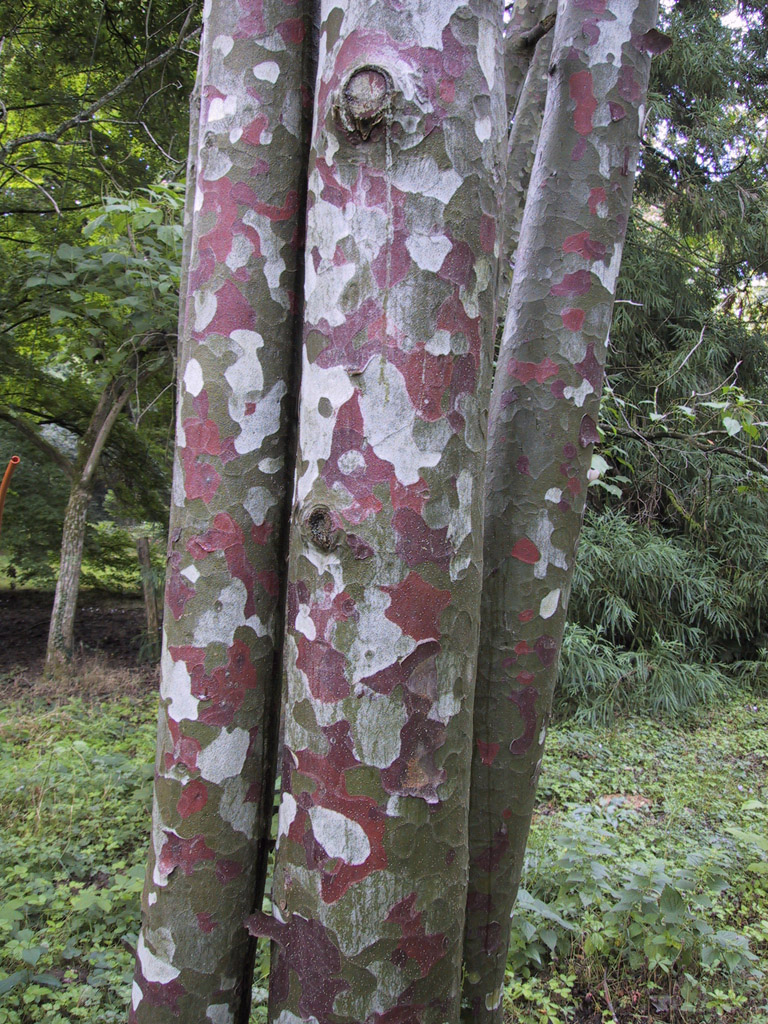
Pinus bungeana (Template:Zh; Japanese: シロマツ; Korean: Script error: No such module "Lang".; RR: Script error: No such module "lang".Script error: No such module "Category handler".), also known by the common names Bunge's pine,[1] lacebark pine and white-barked pine, is a pine tree native to northeastern and central China.[2][3] It is a slow-growing tree that can grow to heights of Script error: No such module "convert". is frost hardy down to below Script error: No such module "convert".. Its smooth, grey-green bark gradually sheds in round scales to reveal patches of pale yellow, which turn olive-brown, red and purple on exposure to light.

Description
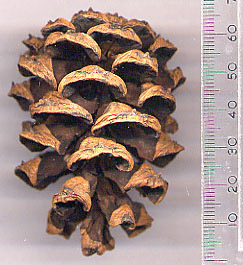
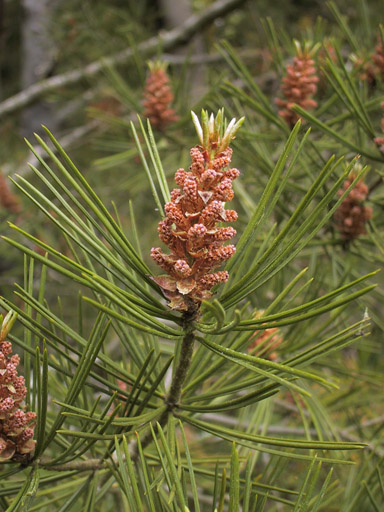
The lacebark pine's trunk can grow either monopodial, as a single growth upwards, or sympodial, forked. Its crown is loosely shaped like a pyramid or umbrella. It has Script error: No such module "convert". long needles in groups of three. Each needles' cross-sections are shaped like a triangular semicircle. The lacebark pine produces cones that turn yellowish brown as they mature and are roughly egg-shaped and Script error: No such module "convert". long. They contain seeds that are grey-brown, slightly egg-shaped, and Script error: No such module "convert". long.[2]

Taxonomy
P. bungeana is synonymous with the name Pinus excorticata, attributed to Lindley and Gordon in William Dallimore's Handbook of Coniferae and Ginkgoaceae. Its name is derived from the surname "Bunge", as one of its early identifications was by botanist Alexander von Bunge in 1831 near Beijing.
P. bungeana is closely related to Pinus gerardiana, another pine species with flaking bark, but P. bungeana has stiffer needles and smaller cones.[4]
Distribution and habitat
Pinus bungeana is native to temperate forests in the mountains of China, but it is also widely cultivated as an ornamental tree, especially for its metallic bark.[5] It grows in the provinces of Shanxi, west Henan, south Gansu, south Hebei, north Sichuan, Shaanxi, west Shandong, and Hubei. It occurs in the wild on limestone rocks and south-facing slopes at relatively high elevations of Script error: No such module "convert"., but has also been planted at lower elevations. In the northern portion of its range, it also occurs in acidic soil. As a light-demanding species, it usually grows in sites less suitable for other tree species.[5]
It was introduced to England in 1843.[5]

Ecology
Pollination of the lacebark pine occurs in the months of April and May, while seeds mature in October and November of the second year.[2]
Uses
In China and Korea, the lacebark pine is traditionally planted near temples and cemeteries.[5] It is also grown as an ornamental tree in classical gardens seeking to imitate Chinese gardens, in which it symbolizes longevity. It can also be seen in botanic gardens and often grows with multiple stems.Script error: No such module "Unsubst".
The wood of the lacebark pine is not commercially used as timber, but it is used locally by populations in northeast China for construction, furniture, and transport structures like pallets. The lacebark pine has edible seeds used in traditional Chinese medicine to provide relief for respiratory ailments.[5]

Cultural significance
In 2009, P. bungeana was named the city tree of Baoji, China.[6]
References
<templatestyles src="Reflist/styles.css" />
- ↑ Script error: No such module "template wrapper".
- ↑ a b c Template:EFloras
- ↑ Template:Gymnosperm Database
- ↑ Script error: No such module "citation/CS1".
- ↑ a b c d e Cite error: Script error: No such module "Namespace detect".Script error: No such module "Namespace detect".
- ↑ Script error: No such module "citation/CS1".
Script error: No such module "Check for unknown parameters".
Further reading
- Script error: No such module "Citation/CS1".
- Script error: No such module "Citation/CS1".
External links
Script error: No such module "Side box". Script error: No such module "Side box".
Template:Taxonbar Script error: No such module "Authority control".