Indium phosphide
Script error: No such module "redirect hatnote". <templatestyles src="Chembox/styles.css"/>
Template:Chembox image cellTemplate:Chembox image cellTemplate:Chembox AllOtherNamesTemplate:Chembox headerbarTemplate:Chembox IndexlistTemplate:Chembox JmolTemplate:Chembox ChEMBLTemplate:Chembox ECHATemplate:Chembox E numberTemplate:Chembox IUPHAR ligandTemplate:Chembox UNIITemplate:Chembox CompToxTemplate:Chembox headerbarTemplate:Chembox headerbarTemplate:Chembox headerbarTemplate:Chembox DeltaGfreeTemplate:Chembox headerbarTemplate:Chembox OHS (set)Template:Chembox SDSTemplate:Chembox headerbarTemplate:Chembox Datapage checkTemplate:Chembox FooterTemplate:Chembox Footer/trackingScript error: No such module "TemplatePar".Template:Short description
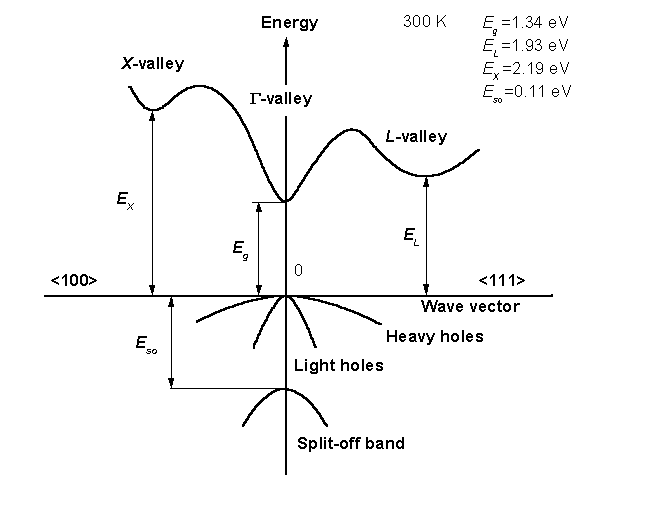
Indium phosphide (InP) is a binary semiconductor composed of indium and phosphorus. It has a face-centered cubic ("zincblende") crystal structure, identical to that of GaAs and most of the III-V semiconductors.
Manufacturing
.jpg)
Indium phosphide can be prepared from the reaction of white phosphorus and indium iodide at 400 °C.,[4] also by direct combination of the purified elements at high temperature and pressure, or by thermal decomposition of a mixture of a trialkyl indium compound and phosphine.[5]
Applications
The application fields of InP splits up into three main areas. It is used as the basis for optoelectronic components,[6] high-speed electronics,[7] and photovoltaics[8]
High-speed optoelectronics
InP is used as a substrate for epitaxial optoelectronic devices based other semiconductors, such as indium gallium arsenide. The devices include pseudomorphic heterojunction bipolar transistors that could operate at 604 GHz.[9]
InP itself has a direct bandgap, making it useful for optoelectronics devices like laser diodes and photonic integrated circuits for the optical telecommunications industry, to enable wavelength-division multiplexing applications.[10] It is used in high-power and high-frequency electronics because of its superior electron velocity with respect to the more common semiconductors silicon and gallium arsenide.
Optical Communications
InP is used in lasers, sensitive photodetectors and modulators in the wavelength window typically used for telecommunications, i.e., 1550 nm wavelengths, as it is a direct bandgap III-V compound semiconductor material. The wavelength between about 1510 nm and 1600 nm has the lowest attenuation available on optical fibre (about 0.2 dB/km).[11] Further, O-band and C-band wavelengths supported by InP facilitate single-mode operation, reducing effects of intermodal dispersion.
Photovoltaics and optical sensing
InP can be used in photonic integrated circuits that can generate, amplify, control and detect laser light.[12]
Optical sensing applications of InP include
- Air pollution control by real-time detection of gases (CO, CO2, NOX [or NO + NO2], etc.).
- Quick verification of traces of toxic substances in gases and liquids, including tap water, or surface contaminations.
- Spectroscopy for non-destructive control of product, such as food. Researchers of Eindhoven University of Technology and MantiSpectra have already demonstrated the application of an integrated near-infrared spectral sensor for milk.[13] In addition, it has been proven that this technology can also be applied to plastics and illicit drugs.[14]
References
<templatestyles src="Reflist/styles.css" />
- ↑ a b Cite error: Script error: No such module "Namespace detect".Script error: No such module "Namespace detect".
- ↑ Script error: No such module "citation/CS1".
- ↑ Script error: No such module "citation/CS1".
- ↑ Indium Phosphide at HSDB. U.S. National Institute of Health
- ↑ InP manufacture. U.S. National Institute of Health
- ↑ Script error: No such module "citation/CS1".
- ↑ Script error: No such module "citation/CS1".
- ↑ Script error: No such module "citation/CS1".
- ↑ Indium Phosphide and Indium Gallium Arsenide Help Break 600 Gigahertz Speed Barrier. Azom. April 2005
- ↑ The Light Brigade appeared in Red Herring in 2002. Script error: No such module "webarchive".
- ↑ Script error: No such module "Citation/CS1".
- ↑ Script error: No such module "citation/CS1".
- ↑ Script error: No such module "Citation/CS1".
- ↑ Script error: No such module "Citation/CS1".
Script error: No such module "Check for unknown parameters".
Cited sources
- Script error: No such module "citation/CS1".
External links
- Extensive site on the physical properties of indium phosphide (Ioffe institute)
- InP conference series at IEEE
- Indium Phosphide: Transcending frequency and integration limits. Semiconductor TODAY Compounds&AdvancedSilicon • Vol. 1 • Issue 3 • September 2006
Script error: No such module "navbox". Script error: No such module "Navbox". Template:Phosphides