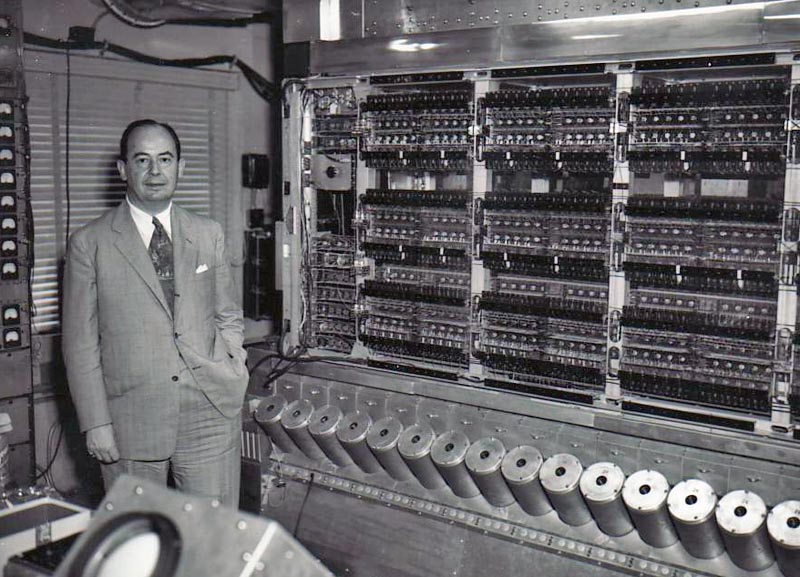
IAS machine
Template:Short description Template:Infobox information appliance Template:Computer architecture bit widths

The IAS machine was the first electronic computer built at the Institute for Advanced Study (IAS) in Princeton, New Jersey. It is sometimes called the von Neumann machine, since the paper describing its design was edited by John von Neumann, a mathematics professor at both Princeton University and IAS. The computer was built under his direction, starting in 1946 and finished in 1951.[1] The general organization is called von Neumann architecture, even though it was both conceived and implemented by others.[2] The computer is in the collection of the Smithsonian National Museum of American History but is not currently on display.[3]
History

In 1944 summer, John von Neumann met Herman Goldstine, a computer architect and a principle investigator of the ENIAC machine. In this meeting, Goldstine presented the ENIAC project to von Neumann. As the result of this meeting, von Neumann wrote a memo called First Draft of a Report on the EDVAC as the proposed IAS computer project. Goldstine typed the report and made a distribution on June 25, 1945. Von Neumann invited Goldstine to join the IAS project in early 1946, as the assistant director and later the director of the project. Arthur Burks, a senior engineer of the ENIAC project came with Goldstine to work in the IAS project. In early summer of 1946, Julian Bigelow was hired as chief engineer,[4] and three other earlier engineers were James H. Pomerene, Ralph J. Slutz, and Willis Ware.[5] After then, more engineers worked in the IAS computer project, including George W. Brown, Hewitt Crane, Gerald Estrin, and others. The machine was in limited operation in the summer of 1951 and fully operational on June 10, 1952.[6][7][8] It was in operation until July 15, 1958.[9]
Description
The IAS machine was a binary computer with a 40-bit word, storing two 20-bit instructions in each word. The memory was 1,024 words (5 kilobytes in modern terminology). Negative numbers were represented in two's complement format. It had two general-purpose registers available: the Accumulator (AC) and Multiplier/Quotient (MQ). It used 1,700 vacuum tubes (triode types: 6J6, 5670, 5687, a few diodes: type 6AL5, 150 pentodes to drive the memory CRTs, and 41 CRTs (type: 5CP1A): 40 used as Williams tubes for memory plus one more to monitor the state of a memory tube).[10] The memory was originally designed for about 2,300 RCA Selectron vacuum tubes. Problems with the development of these complex tubes forced the switch to Williams tubes.
It weighed about Script error: No such module "convert"..[11]
It was an asynchronous machine, meaning that there was no central clock regulating the timing of the instructions. One instruction started executing when the previous one finished. The addition time was 62 microseconds and the multiplication time was 713 microseconds.
Although some claim the IAS machine was the first design to mix programs and data in a single memory, that had been implemented four years earlier by the 1948 Manchester Baby.[12] The Soviet MESM also became operational prior to the IAS machine.
Von Neumann showed how the combination of instructions and data in one memory could be used to implement loops, by modifying branch instructions when a loop was completed, for example. The requirement that instructions, data and input/output be accessed via the same bus later came to be known as the Von Neumann bottleneck.
IAS machine derivatives
Plans for the IAS machine were widely distributed to any schools, businesses, or companies interested in computing machines, resulting in the construction of several derivative computers referred to as "IAS machines", although they were not software compatible.[13]
Some of these "IAS machines" were:[14]
- AVIDAC (Argonne National Laboratory)
- BESK (Stockholm)
- BESM (Moscow)[13]
- Circle Computer (Hogan Laboratories, Inc.),[15][16][17] 1954[18][19]
- CYCLONE (Iowa State University)
- DASK (Regnecentralen, Copenhagen 1958)
- GEORGE (Argonne National Laboratory)
- IBM 701 (19 installations)
- ILLIAC I (University of Illinois at Urbana–Champaign)
- JOHNNIAC (RAND)
- MANIAC I (Los Alamos National Laboratory)
- MISTIC (Michigan State University)
- ORACLE (Oak Ridge National Laboratory)
- ORDVAC (Aberdeen Proving Ground)
- PERM (Munich)[20]
- SARA (SAAB)
- SEAC (Washington, D.C.)[20]
- SILLIAC (University of Sydney)
- SMIL (Lund University)
- TIFRAC (Tata Institute of Fundamental Research)
- WEIZAC (Weizmann Institute)
See also
References
<templatestyles src="Reflist/styles.css" />
- ↑ Script error: No such module "citation/CS1".
- ↑ Script error: No such module "citation/CS1".
- ↑ Smithsonian IAS webpage
- ↑ Script error: No such module "citation/CS1".
- ↑ Script error: No such module "citation/CS1".
- ↑ Script error: No such module "citation/CS1".
- ↑ Script error: No such module "citation/CS1".
- ↑ Script error: No such module "Citation/CS1".
- ↑ Script error: No such module "citation/CS1".
- ↑ The history and development of the electronic computer project at the Institute for Advanced Study. Ware. 1953
- ↑ Script error: No such module "citation/CS1".
- ↑ Script error: No such module "citation/CS1".
- ↑ a b Script error: No such module "citation/CS1".
- ↑ Script error: No such module "citation/CS1".
- ↑
- Script error: No such module "citation/CS1".
- Script error: No such module "citation/CS1".
- ↑ Script error: No such module "citation/CS1".
- ↑ IAS type machine:
- Script error: No such module "Citation/CS1".
- ↑ Script error: No such module "citation/CS1".
- ↑
- Script error: No such module "Citation/CS1".
- Script error: No such module "Citation/CS1".
- ↑ a b Turing's Cathedral, by George Dyson, 2012, p. 287
Script error: No such module "Check for unknown parameters".
Further reading
- Gilchrist, Bruce, "Remembering Some Early Computers, 1948-1960", Columbia University EPIC, 2006, pp. 7–9. (archived 2006) Contains some autobiographical material on Gilchrist's use of the IAS computer beginning in 1952.
- Dyson, George, Turing's Cathedral, 2012, Pantheon, Template:ISBN A book about the history of the Institute of Advanced Study around the making of this computer. Chapters 6 onward deal with this computer specifically.
- Script error: No such module "Citation/CS1".
- Script error: No such module "citation/CS1".
External links
- Oral history interviews concerning the Institute for Advanced Study—see also individual interviews with Willis H. Ware, Arthur Burks, Herman Goldstine, Martin Schwarzschild, and others. Charles Babbage Institute, University of Minnesota.
- Script error: No such module "citation/CS1".
- First Draft of a Report on the EDVAC – Copy of the original draft by John von Neumann
- Photos: JvN standing in front of IAS machine and another view of IAS machine from Script error: No such module "citation/CS1".