Francesco II Gonzaga, Marquis of Mantua
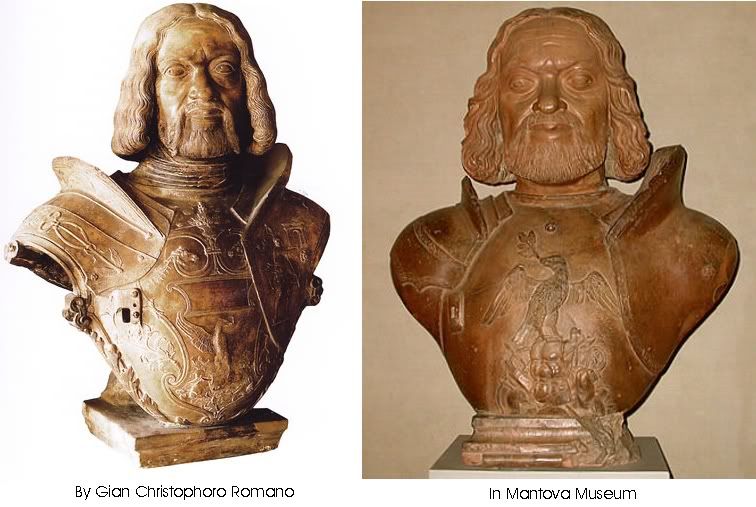
Template:Short description Template:Use dmy dates Script error: No such module "Infobox".Template:Template otherScript error: No such module "Check for unknown parameters". Francesco II Gonzaga (10 August 1466 – 29 March 1519) was Marquis of Mantua from 1484 until his death. A prominent condottiero and statesman during the Italian Wars, he is best known for commanding the Italian league forces at the Battle of Fornovo in 1495. Through his marriage to Isabella d'Este, one of the leading women of the Italian Renaissance, Francesco helped establish Mantua as a significant cultural and artistic center.
Biography
Francesco was born in Mantua, the son of Marquis Federico I Gonzaga.
Francesco had a career as a condottiero acting as Venice's commander from 1489 to 1498. He was the commander-in-chief of the army of the Italian league in the battle of Fornovo, under the tutorage of his more experienced uncle Ridolfo Gonzaga: even though Francesco was unable to stop Charles VIII and his army from returning to France,Template:Sfn he claimed Fornovo as a victory.Template:Sfn Francesco commissioned Andrea Mantegna’s Madonna della Vittoria to honor his self-proclaimed victory at Fornovo.Template:Sfn Francesco was described as "short, pop-eyed, snub-nosed and exceptionally brave, and was regarded as the finest knight in Italy".Template:Sfn
Francesco briefly commanded the Venetian army,Template:Sfn but in 1502 he left to pay his respects to Louis XII who was then at Milan.Template:Sfn By 29 April, he was with Louis XII when Genoa fell to the French army.Template:Sfn Francesco, taking the initiative after the French victory at Agnadello, was occupying lands that he had lost to Venice.Template:Sfn He was marching to Legnago with a company of French lances, when he was captured by the Venetians.Template:Sfn Francesco only gained his freedom by giving his son Federico II as hostage.Template:Sfn Once free, he was placed in command of papal troops, although he was ineffective since he stayed in Mantua. By 17 February 1510, Francesco, no longer involved in the war,Template:Sfn allowed a French army under Gaston of Foix to march through his territory to reach Brescia.Template:Sfn
During Francesco's absences, Mantua was governed by his wife Isabella d'Este,Template:Sfn whom he had married on 12 February 1490. Under their reign, Mantua knew a great age of cultural splendour, with the presence in the city of artists such as Andrea Mantegna and Jacopo Bonacolsi. Francesco had the Palace of St. Sebastian built, where Mantegna's Triumph of Caesar was eventually placed. The Palace was where Francesco lived when in Mantua. His wife, Isabella d'Este remained at the Castello di San Giorgio where she had her own suite of rooms. On completing the decoration of his rooms at the palace, Francesco asked his wife for her views. Isabella commented favourably, though she did say that the decorations were almost as good as those within her studiolo.
Beginning in 1503, he started a long relationship with Lucrezia Borgia.
On 29 March 1519, Francesco, who had suffered from syphilis, died.Template:Sfn He was succeeded by his son Federico, with Isabella acting as regent. Another son, Ferrante Gonzaga originated the branch of the Counts of Guastalla.
Loves
Francesco was known for his passion for women, so much so that, on the occasion of the siege of Novara in 1495, his sister-in-law Beatrice d'Este, wanting to ingratiate herself with him, offered to personally procure him a "femmina di partito" with whom to celebrate the victory, under the pretext of protecting both him and his wife and sister Isabella from malfrancese.[1]
Francis also actively practiced sodomy, according to the ancient Greek custom, very widespread almost everywhere at that time, as he himself proudly claims in his poisonous letter of accusations to Galeazzo Sanseverino, dated 1503: "I am reputed and raised by nobility of birth and good morals; you for human and ass favors (and I usually have a party at the door of others, and not at mine!)".[2]
It is well known that he surrounded himself with ruffians and mezzani, who had the task of procuring for him girls and young ephebes. One of these was, among others, Template:Ill, who therefore ran into the hatred of the Marquise.[3]
Family
Isabella d'Este and Francesco Gonzaga had:
- Eleonora Gonzaga, born 1493, died 1570. Married Francesco Maria I della Rovere Duke of UrbinoTemplate:Sfn
- Margherita, born 1496.
- Livia, born 1501, died 1508.
- Ippolita Gonzaga, born 1503, died 1570. Ippolita became a nun in the Dominican convent of S. Vincenzo.
- Federico II, Duke of Mantua, born 1500, died 1540.Template:Sfn First betrothed to Maria Palaeologina but later married her sister Margaret PalaeologinaTemplate:Sfn
- Ercole Gonzaga, born 1506, died 1565. Became a Cardinal.Template:Sfn
- Ferrante Gonzaga, born 1507, died 1557.Template:Sfn Married Isabella di Capua.
- Livia, later known as Sister Paola, born 1508, died 1569
See also
Notes
<templatestyles src="Reflist/styles.css" />
Script error: No such module "Check for unknown parameters".
Sources
- Script error: No such module "citation/CS1".
- Script error: No such module "Citation/CS1".
- Script error: No such module "Citation/CS1".
- Script error: No such module "citation/CS1".
- Script error: No such module "citation/CS1".
- Script error: No such module "citation/CS1".
- Script error: No such module "citation/CS1".
- Script error: No such module "citation/CS1".
- Script error: No such module "citation/CS1".
External links
- Pages with script errors
- House of Gonzaga
- Marquesses of Mantua
- Military leaders of the Italian Wars
- 15th-century condottieri
- Italian patrons of the arts
- Military personnel from Mantua
- 1466 births
- 1519 deaths
- 16th-century Italian nobility
- Burials in the Church of Santa Paola, Mantua
- Lucrezia Borgia
- People of the Italian War of 1494–1495
- People from the Duchy of Mantua