Ein Gedi Nature Reserve
Template:Short description Script error: No such module "Hatnote".Script error: No such module "Infobox".Script error: No such module "Check for unknown parameters".
.jpg)
Ein Gedi (Template:Langx, Template:Langx), also spelled En Gedi,[1] meaning "spring of the kid",[2] is an oasis and a nature reserve in Israel, located west of the Dead Sea, near Masada and the Qumran Caves. Ein Gedi is a popular tourist attraction and was listed in 2016 as one of the most popular nature sites in Israel.[3] The site attracts about one million visitors a year.[4]
Next to the reserve is the Ein Gedi Archaeological Park, which hosts the remains of the Roman and Byzantine-era Jewish settlement located nearby. Immediately to the south is modern Ein Gedi, a kibbutz (collective community) established in 1954.
Etymology
The name Ein Gedi is composed of two words (In both Arabic and Hebrew): ein means spring or a fountain and gǝdi means goat-kid. Ein Gedi thus means "kid spring" or "fountain of the kid". The Hebrew name is also transliterated as 'En Gedi, En-gedi, Eggadi, Engaddi, and Engedi; the Arabic name as 'Ain Jidi and 'Ein Jidi.[5] The archaeological mound (tell) is known in Hebrew as Tel Goren and in Arabic as Tell el-Jurn or Tell Jurn.[5] The site has been identified with the biblical Hazazon Tamar[5] (חַצְצוֹן תָּמָר ḥaṣṣōn tāmār, "portion [of land] of date palms"), on account of the palm groves which surrounded it.[6] It is also written Hazazon-tamar,[7] Hazazontamar,[5] Hatzatzon-Tamar,[8] Hazezon Tamar,[9] and Hazezontamar.[6]
Overview
Ein Gedi Nature Reserve, declared at the end of 1971 and expanded in 1988,[10] is one of the most important reserves in Israel. It is situated on the eastern slopes of the Judean Desert, bordering to the east on the Dead Sea, and covers an area of 14000 dunams (Script error: No such module "convert". or Script error: No such module "convert".).[10]

The elevation ranges from the level of the Dead Sea at 423 meters (1,388 ft) below sea level, to the plateau of the Judean Desert at 200 meters above sea level. The nature reserve includes two streams flowing year-round and each fed by a perennial spring: Nahal David with Ein David ('David's Spring'), and Nahal Arugot with Ein Arugot ('Terraces Spring'). Two further springs, the Shulamit and Ein Gedi springs, also flow in the reserve. Together, the springs generate approximately three million cubic meters of water per year. Much of the water is used for agriculture or is bottled for consumption.Script error: No such module "Unsubst".
Flora and fauna
The reserve is a sanctuary for many types of plant, bird and animal species. The vegetation includes plants and trees from the tropical, desert, Mediterranean, and steppe regions, such as Sodom apple, acacia, jujube, and poplar. The many species of resident birds are supplemented by over 200 additional species during the migration periods in the spring and fall. Mammal species include the Nubian ibex and the rock hyrax.

Chalcolithic shrine and Iron Age remains
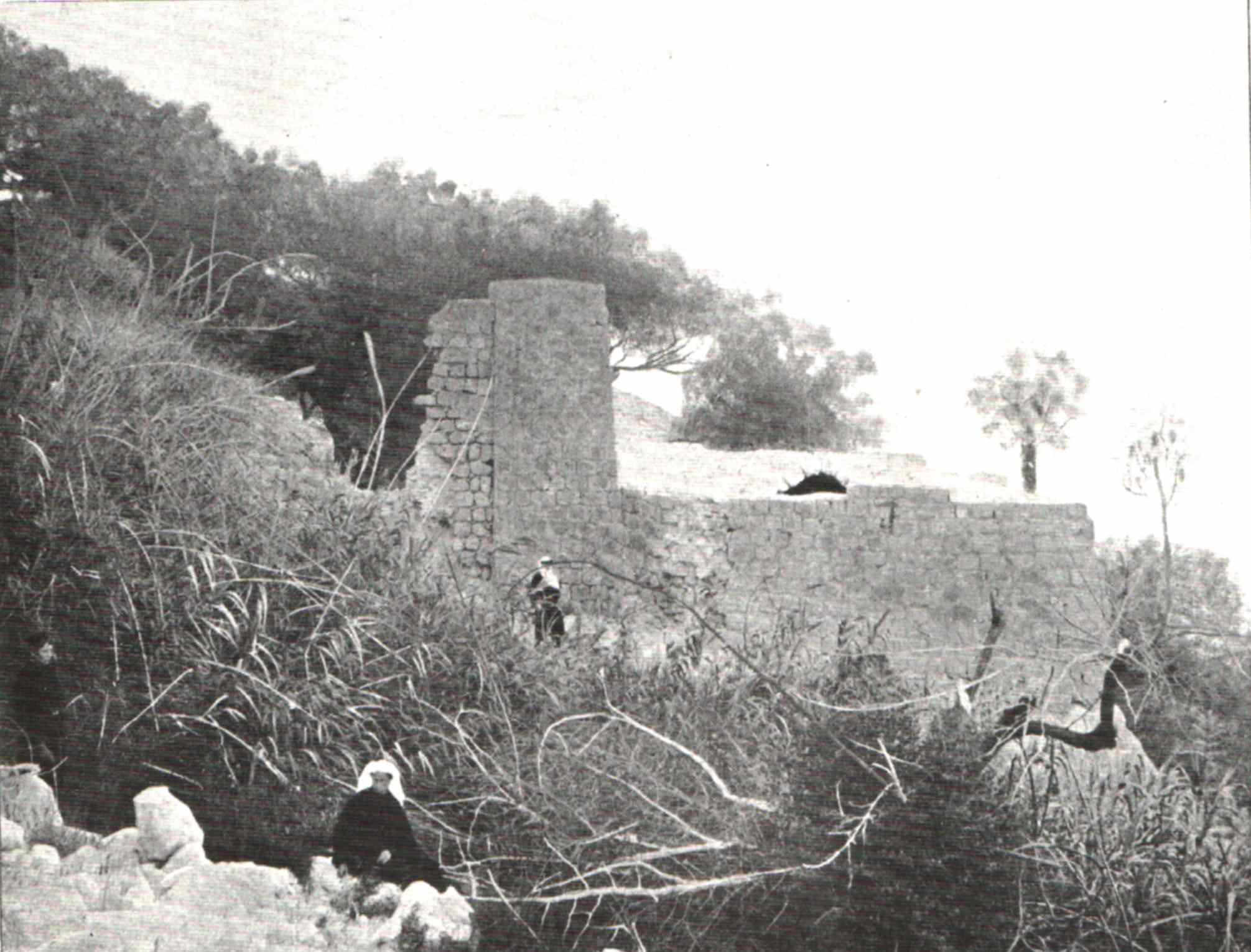
Ein Gedi Nature Reserve, administered separately from the Ein Gedi archaeology park (see above), features several archaeological sites including a rare Chalcolithic shrine, but also Tel Goren, an archaeological mound with Iron Age remains corresponding to Hazazon-tamar, a city mentioned in the Hebrew Bible and inhabited on and off till the Byzantine period, two water-powered flour mills from the Mamluk period, etc.Script error: No such module "Unsubst".
Sinkholes
Ein Gedi has been subject to a large number of sinkholes appearing in the area, which have even damaged the highway built in 2010 which was supposedly built to a "sinkhole-proof" design. The sinkholes are due to the decline in the water level of the Dead Sea, as of 2021[update]Script error: No such module "Check for unknown parameters". at an annual rate of more than a metre, which is attributed to the battle for scarce water resources in the very arid region. The sinkholes form as a result of the receding shoreline (with the surface of the Sea having shrunk by about 33 per cent since the 1960s), where a thick layer of underground salt is left behind. When fresh water arrives in the form of heavy rains, it dissolves the salt as it sinks into the ground, forming an underground cavity, which eventually collapses under the weight of the surface ground layer.[1]

Tourism has been affected by the receding shoreline and the sinkholes, and the amount of water from the rains reaching the sea has diminished since flash floods started pouring into the sinkholes. Huge cave systems called karsts convey water underground between the sinkholes. Scientists in the floodplain area south of Ein Gedi have been using cameras, water testing, videos using drones and satellite monitoring to map the area for safety.[1]
Nearby sites
Antiquities National Park
Script error: No such module "Labelled list hatnote".

The Late Roman- and Byzantine-period synagogue and the village remains around it is run as a separate, archaeological park, distinct from the nature reserve and the antiquities contained therein. The Antiquities National Park centered on the synagogue was declared in 2002 and covers an area of 8 dunams (Script error: No such module "convert". or Script error: No such module "convert".).[10]
Iron Age remains dating to the 7th century BCE have been found at the site, when Ein Gedi was part of the kingdom of Judah.Script error: No such module "Footnotes".Script error: No such module "Check for unknown parameters". It is first mentioned in the Book of Joshua, written in the 7th century BCE.Script error: No such module "Footnotes".Script error: No such module "Check for unknown parameters". Later, the settlement is mentioned as the place where David fled from Saul.Script error: No such module "Footnotes".Script error: No such module "Check for unknown parameters". In Book of Chronicles 2, Ein Gedi is called Hazazon Tamar.Script error: No such module "Footnotes".Script error: No such module "Check for unknown parameters". The settlement was destroyed during the Babylonian exile.Script error: No such module "Footnotes".Script error: No such module "Check for unknown parameters". The Jewish settlement at the site was revived in the 5th century BCE and reached its peak during the Herodian period. It endured the Jewish–Roman wars and continued to exist as a smaller village until the 7th century CE, when it was ultimately destroyed by fire.Script error: No such module "Footnotes".Script error: No such module "Check for unknown parameters".
Modern village
Script error: No such module "Labelled list hatnote". Kibbutz Ein Gedi, founded in 1953, is located about a kilometer from the oasis. It offers various tourist attractions and takes advantage of the local weather patterns and the abundance of natural water to cultivate out-of-season produce.Script error: No such module "Unsubst". Part of the kibbutz's inhabited area is landscaped as an internationally acclaimed botanical garden, covering an area of 100 dunams (10 ha, 24.7 acres) and holding more than 900 species of plants from all over the world. It is the only populated botanical garden in the world.[11] The kibbutz is also home to the Ein Gedi Eco Park, which functions as both a zoo and an environmental education center, demonstrating sustainable technologies such as solar cookers, greywater systems, mud buildings, and compost toilets.Script error: No such module "Unsubst".
See also
- Ein Gedi (archaeological site)
- Cave of the Swords
- Hiking in Israel
- Tourism in Israel
- Wildlife of Israel
References
<templatestyles src="Reflist/styles.css" />
- ↑ a b c Script error: No such module "citation/CS1".
- ↑ Script error: No such module "citation/CS1".
- ↑ Israel nature spots draw 2 million visitors, Haaretz
- ↑ What Israel's nature reserves booking system reveals, Haaretz
- ↑ a b c d En Gedi at bibleplaces.com. Accessed 11 March 2024.
- ↑ a b Script error: No such module "citation/CS1".
- ↑ e.g. ASV, NRSV and CEB
- ↑ e.g. CJB
- ↑ e.g. NKJV
- ↑ a b c Script error: No such module "citation/CS1".
- ↑ "Dead Sea Ein Gedi Botanic Garden", Botanic Gardens Conservation International. Re-accessed 16 Oct 2024.
Script error: No such module "Check for unknown parameters".
Bibliography
<templatestyles src="Refbegin/styles.css" />
- Script error: No such module "citation/CS1". (pp. 384-386)
- Script error: No such module "citation/CS1".
- Script error: No such module "citation/CS1".
- Script error: No such module "citation/CS1".
- Script error: No such module "citation/CS1". (Robinson and Smith, 1841, vol 3, Appendix 2, p. 116)
- Script error: No such module "citation/CS1".
- Script error: No such module "Citation/CS1".
- Script error: No such module "Citation/CS1". (pp. 143-150)
External links
Template:Wikivoyage Script error: No such module "Side box".
- Virtual Tour of Ein Gedi - View from the Ein Gedi Promenade
- Ein Gedi in the Dead Sea Map - Bird's-eye view in Flash
- The Israel Nature and Parks Authority - Site page
- Ein Gedi Travel Guide Script error: No such module "webarchive".
- Pictures of Ein Gedi synagogue
- Ein Gedi mill, 1893
- Survey of Western Palestine, Map 22: IAA, Wikimedia commons
- Photos of Ein Gedi synagogue at the Manar al-Athar photo archive
- Times of Israel - Nature of Ein Gedi - a Photo Essay

Template:Nature reserves of Israel Script error: No such module "Navbox". Template:Towns depopulated during the First Jewish–Roman War
Script error: No such module "Authority control".
- Pages with script errors
- Pages with broken file links
- Articles containing potentially dated statements from 2021
- Articles with invalid date parameter in template
- All articles containing potentially dated statements
- Nature reserves in Israel
- National parks of Israel
- Oases of Israel
- Springs of Israel
- Sites of Special Scientific Interest notified in 1972
- Botanical gardens in Israel
- Protected areas of Southern District (Israel)
- Tells (archaeology)
- Canaanite cities
- Ancient Jewish settlements of Judaea
- Hebrew Bible places
- Israeli mosaics
- Dead Sea basin
- Judaean Desert
- Pre-Pottery Neolithic A
- Ghassulian