Ambrosia artemisiifolia
Template:Short description Template:Speciesbox
Ambrosia artemisiifolia, with the common names common ragweed, annual ragweed, and low ragweed, is a species of the genus Ambrosia native to regions of the Americas.[1][2]
Taxonomy
The species name, artemisiifolia, is given because the leaves were thought to bear a resemblance to the leaves of Artemisia, the true wormwoods.
It has also been called the common names: American wormwood, bitterweed, blackweed, carrot weed, hay fever weed, Roman wormwood, short ragweed, stammerwort, stickweed, tassel weed.[1][3]
Distribution
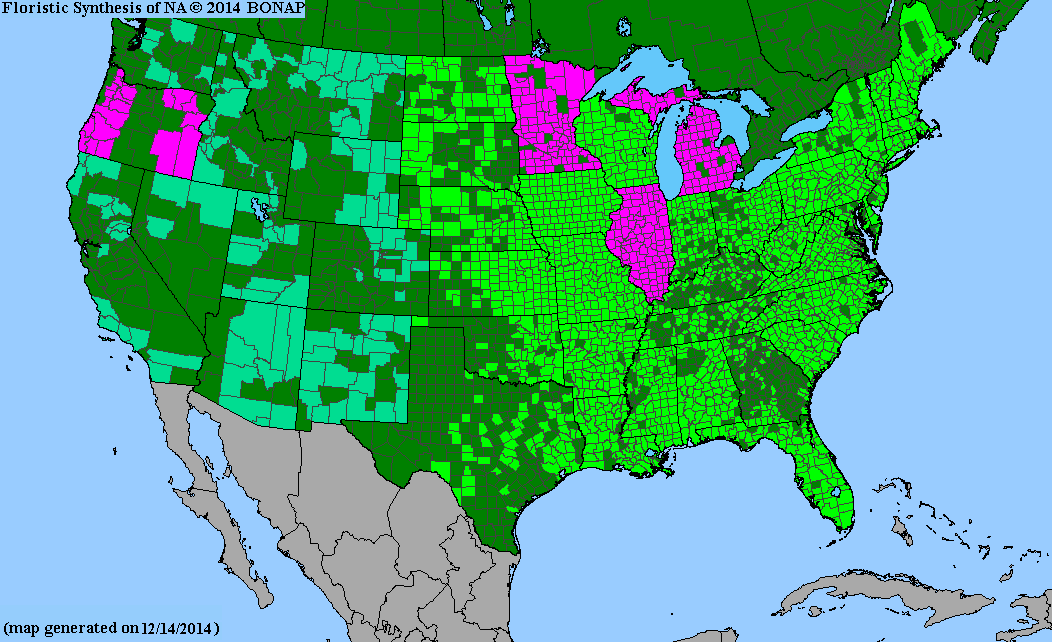
The plant is native to: North America across Canada, the eastern and central United States, the Great Plains, and in Alaska; the Caribbean on Cuba, Hispaniola, and Jamaica; and South America in the southern bioregion (Argentina, Chile, Paraguay, Uruguay), the western bioregion (Bolivia, Peru), and Brazil.[1][4][5][6] The distribution of common ragweed in Europe is expected to expand northwards in the future due to climate change.[7]
It is the most widespread species of the genus in North America, to which most of the other species of Ambrosia are endemic. During the summer it causes allergic reaction in those who are susceptible.
Description
Ambrosia artemisiifolia is an annual plant that emerges in late spring. It propagates mainly by rhizomes,Script error: No such module "Unsubst". but also by seed.[3]
It is much-branched, and grows up to Script error: No such module "convert". in height.[8] The pinnately divided soft and hairy leaves are Script error: No such module "convert". long.[8]
Its bloom period is July to October in North America.[8] Its pollen is wind-dispersed, and can be a strong allergen to people with hay fever.[3][9]
It produces 2–4 mm obconic green to brown fruit.[8] It sets seed in later summer or autumn. Since the seeds persist into winter and are numerous and rich in oil, they are relished by songbirds and upland game birds.[3]
Galls
This species is host to the following insect induced galls:
- Aceria ambrosiae Wilson, 1959 midge that forms bud-galls
- Asphondylia ambrosiae Gagné, 1975
- Aulacidea ambrosiaecola Ragweed stem gall wasp (see image)
- Epiblema strenuana (Walker, 1863) stem borer moth
- Neolasioptera ambrosiae Felt, 1909 small stem midge.
- Procecidochares gibba (Loew, 1873) gall fly
- Rhopalomyia ambrosiae Gagné, 1975 bud gall midge

Invasive species

Common ragweed, Ambrosia artemisiifolia, is a widespread invasive species, and can become a noxious weed, that has naturalized in Europe; temperate Asia and the Indian subcontinent; temperate northern and southern Africa and Macaronesia; Oceania in Australia, New Zealand, and Hawaii; and Southwestern North America in California and the Southwestern United States.[1][8][10][11][12][13][14][15] A scientific study investigated the genomic basis of invasiveness in Ambrosia artemisiifolia, introduced to Europe in the late 19th century, by resequencing 655 ragweed genomes, including 308 herbarium specimens collected up to 190 years ago.[16] In invasive European populations, the study found selection signatures in defense genes and lower prevalence of disease-inducing plant pathogens. Together with temporal changes in population structure associated with introgression from closely related Ambrosia species, escape from specific microbial enemies likely favored the remarkable success of common ragweed as an invasive species.
Common ragweed is a very competitive weed and can produce yield losses in soybeans as high as 30 percent. Control with night tillage reduces emergence by around 45 percent. Small grains in rotation will also suppress common ragweed if they are overseeded with clover. Otherwise, the ragweed will grow and mature and produce seeds in the small grain stubble.
Its wind-blown pollen is highly allergenic.
Ragweed control
since 2005[update]Template:Dated maintenance category (articles)Script error: No such module "Check for unknown parameters". several herbicides were effective against common ragweed, although resistant populations were known to exist.[17] In 2007 several Ambrosia artemisiifolia populations were glyphosate resistant, exclusively in the USA.[18]
since 2014[update]Template:Dated maintenance category (articles)Script error: No such module "Check for unknown parameters". the ragweed leaf beetle, Ophraella communa, has been found south of the Alps in southern Switzerland and northern Italy. Many of the attacked plants were completely defoliated.[19] Calligrapha suturalis was introduced to Russia, and then China, for ragweed control, with very positive initial results.
SMARTER is a European interdisciplinary network of experts involved in the control of ragweed, health care professionals, aerobiologists, ecologists, economists, and atmospheric and agricultural modellers.[20]
Chemical composition, and uses
Sesquiterpene lactones and molluscicide
Three sesquiterpene lactones isolated from the aerial parts of Ambrosia artemisiifolia were identified as psilostachyin A, psilostachyin B and psilostachyin C. All of them have some molluscicidal activity against the small tropical freshwater snail Oncomelania hupensis.[21]
Medicinal
Ambrosia artemisiifolia has been a traditional medicinal plant for Native American tribes, including the Cherokee, Lakota, Iroquois, Dakota, and Delaware.[22]
Historically, A. artemisiifolia was used by the Otoe Native American tribe in the Missouri River region as a remedy for nausea. It was used on the surface of the abdomen, where the patient was scarified and then dressed with the bruised leaves.[23] It was also utilized by the Houma tribe in Louisiana for menstruation pain by making a tea out of the boiled roots.[24]
Phytoremediation
Ambrosia artemisiifolia is used in phytoremediation projects remediating soil pollution, for removing heavy metals such as lead from contaminated soil.[25]
Gallery
-
Plant from distance
-
Close-up of leaf
-
Inflorescence (male capitula)
-
Close-up of male capitula
-
Female flowers in leaf axil
-
Achenes
-
Pollen grain (scanning electron microscope)


References
<templatestyles src="Reflist/styles.css" />
- ↑ a b c d Template:GRIN
- ↑ Calflora: Ambrosia artemisiifolia
- ↑ a b c d NPIN−Lady Bird Johnson Wildflower Center Native Plant Information Network: Ambrosia artemisiifolia
- ↑ Bonap.net: Biota of North America Program county distribution map (2014)
- ↑ Hokche, O., P. E. Berry & O. Huber. (eds.) 2008. Nuevo Catálogo de la Flora Vascular de Venezuela 1–859. Fundación Instituto Botánico de Venezuela, Caracas.
- ↑ Jørgensen, P. M., M. H. Nee & S. G. Beck. (eds.) 2015 en adelante. Catalogo de las plantas vasculares de Bolivia (adiciones).
- ↑ Script error: No such module "Citation/CS1".
- ↑ a b c d e Jepson eFlora (TJM2): Ambrosia artemisiifolia . accessed 26 August 2016.
- ↑ Newscientist.com: "North American ragweed to bring autumn allergy misery to Europe."
- ↑ Flora of North America Vol. 21 Page 15 Ambrosia artemisiifolia Linnaeus, Sp. Pl. 2: 988. 1753.
- ↑ Flora of China Vol. 20-21 Page 876, 877 豚草 tun cao Ambrosia artemisiifolia Linnaeus, Sp. Pl. 2: 988. 1753.
- ↑ Altervista.org: Flora Italiana − Ambrosia artemisiifolia L.
- ↑ Atlas of Living Australia: Ambrosia artemisiifolia (Annual Ragweed)
- ↑ INRA – The common ragweed
- ↑ Circabc.europa.eu; Final report: "EC Assessing and Controlling the spread and the effects of Common ragweed in Europe"
- ↑ Script error: No such module "Citation/CS1".
- ↑ A. Davis, K. Renner, C. Sprague, L. Dyer, D. Mutch (2005). Integrated Weed Management. MSU.
- ↑ Script error: No such module "Citation/CS1".
- ↑ Script error: No such module "Citation/CS1".
- ↑ Cf. www.ragweed.eu Template:Webarchive. The project ran from 2013 to 2017 as part of the EU programme COST. More than 120 participants from 33 countries were active during 2013.
- ↑ Script error: No such module "Citation/CS1".
- ↑ BRIT.org: Native American Ethnobotany Database on Ambrosia artemisiifolia . accessed 26 August 2016.
- ↑ Gilmore, M. R. (1919). Uses of plants by the indians of the Missouri River region. B. o. A. E. Smithsonian Institution. 33rd Annual Report.
- ↑ Speck, F. G. (1941). "A list of plant curatives obtained from the Houma Indians of Louisiana." Primitive Man 14(4): 49-73.
- ↑ Script error: No such module "Citation/CS1".
Script error: No such module "Check for unknown parameters".
External links
- Script error: No such module "Citation/CS1".
- Calflora Database: Ambrosia artemisiifolia (Annual ragweed, Common ragweed, Low ragweed)—non-native/naturalized species in California
- Jepson Manual eFlora (TJM2) treatment of Ambrosia artemisiifolia—non-native/naturalized species in California
- UC CalPhotos gallery: Ambrosia artemisiifolia
- Pages with script errors
- Pages with broken file links
- Ambrosia (plant)
- Flora of Canada
- Flora of the Northeastern United States
- Flora of the North-Central United States
- Flora of the United States
- Flora of the Southeastern United States
- Flora of the Caribbean
- Flora of southern South America
- Flora of western South America
- Flora of the Appalachian Mountains
- Flora of the Great Lakes region (North America)
- Flora of the Great Plains (North America)
- Plants used in traditional Native American medicine
- Plants described in 1753
- Taxa named by Carl Linnaeus
- Phytoremediation plants