Erigeron canadensis
Template:Short description Template:Speciesbox

Erigeron canadensis (synonym Conyza canadensis) is an annual plant native throughout most of North America and Central America. It is also widely naturalized in Eurasia and Australia. Common names include horseweed, Canadian horseweed, Canadian fleabane, coltstail, marestail, and butterweed. It was the first weed to have developed glyphosate resistance, reported in 2001 from Delaware.
Description
Erigeron canadensis is an annual, herbaceous plant growing to Script error: No such module "convert". tall, with sparsely hairy stems. The leaves are unstalked, slender, Script error: No such module "convert". long, and up to Script error: No such module "convert". wide, with a coarsely toothed margin. They grow in an alternate spiral up the stem, and the lower ones wither early. The flower heads are produced in dense inflorescences and are Script error: No such module "convert". in diameter. Each individual flower has a ring of white or pale purple ray florets and a centre of yellow disc florets. The fruit is a cypsela tipped with dirty white down.[1]
Erigeron canadensis can easily be confused with Erigeron sumatrensis, which may grow to a height of Script error: No such module "convert"., and the more hairy Erigeron bonariensis, which does not exceed Script error: No such module "convert".. E. canadensis is distinguished by bracts that have a brownish inner surface with no red dot at the tip, and are free (or nearly free) of the hairs found on the bracts of the other species.[2][3][4]
Distribution and habitat
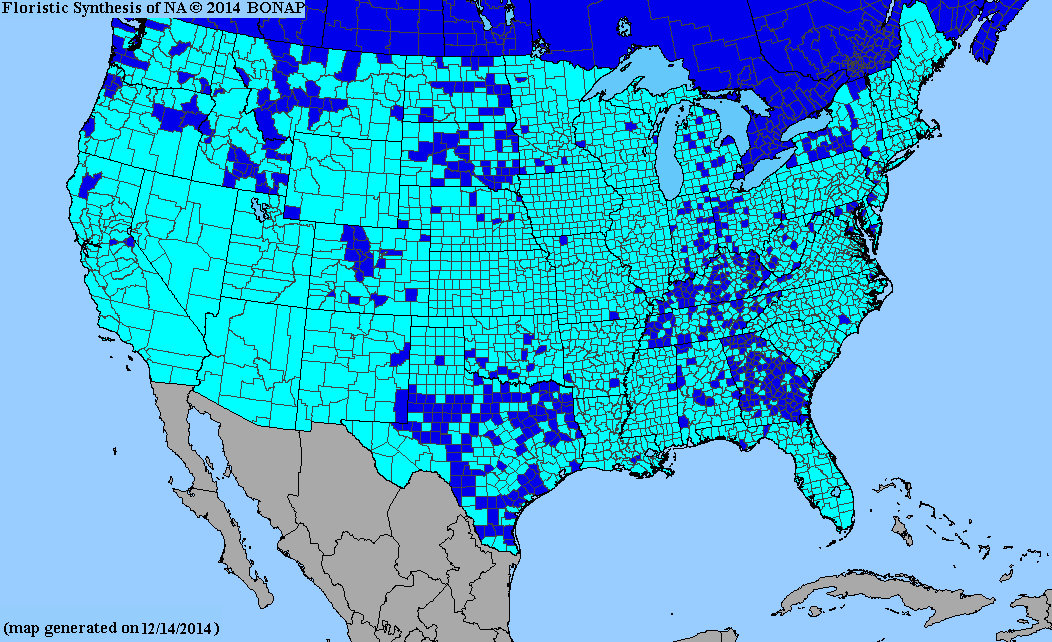
Horseweed originated in North America and Central America and is widespread in its native range.[5] It has spread to inhabited areas of most of the temperate zone of Asia,[6] Europe,[1][7] and Australia.[8] It is found in Britain from northern Scotland to Cornwall, growing as a weed of arable land and man-made environments. It is considered invasive in China.[9]
Weed status
Horseweed is commonly considered a weed, and in Ohio, Oregon, and some other locations,[10] it has been declared a noxious weed.[11][12] It was the first weed to have developed glyphosate resistance, reported in 2001 from Delaware.[13]
It can be found in fields, meadows, and gardens throughout its native range. Horseweed infestations (specifically of 105 plants per 10 ft2) have reduced soybean yields by as much as 83%,[14] with one estimate claiming it can reduce yields by up to 90%.[15] Severe infestations have reduced sugar beet yields by 64%.[14]
It is an especially problematic weed in no-till agriculture, as it is often resistant to glyphosate[13] and other herbicides.[16] Farmers are advised to include 2,4-D or dicamba in a burndown application prior to planting to control horseweed.[17][18]
Uses
The Zuni people insert the crushed flowers of E. canadensis var. canadensis into the nostrils to cause sneezing, relieving rhinitis.[19] OtherScript error: No such module "Unsubst". Native Americans have used a preparation of the plant's leaves to treat sore throat and dysentery.[20] A tincture can be made from the dried flowering tops of the plants.Script error: No such module "Unsubst".
Horseweed is a preferable material for use in the hand drill-method of making friction fire.[1]Script error: No such module "Unsubst".
Gallery
Standard form
-
General form, may be light green, inflorescence fairly tight
-
Stemmy form
-
Flower head, hairless or mostly so, ray petals small but conspicuous, base of head not widely bulging
-
Flower head, angled
-
Flower head face on
-
Individual flowers in the head
-
Hair profile of leaf, projecting at base usually, directed forward at tip
-
Leaf tip with forward hairs not curving inward
-
Leaf surfaces not hairy
-
Leaf bases near stem showing projecting hairs
-
May become large


Other forms
-
Biennial growing in sand by a river from a surviving stem
-
Biennial with ad-hoc branching
-
Form with broken biennial stem top
-
Unusual spike-like form growing in winter
-
seeds


References
<templatestyles src="Reflist/styles.css" />
- ↑ a b c Script error: No such module "citation/CS1".
- ↑ Conyza sumatrensis, International Environmental Weed Foundation.
- ↑ Script error: No such module "citation/CS1".
- ↑ Flora of North America, Conyza canadensis (Linnaeus) Cronquist, Bull. Torrey Bot. Club. 70: 632. 1943. Vergerette du Canada.
- ↑ Biota of North America Program, 2014 county distribution map, Erigeron canadensis.
- ↑ Flora of China, Erigeron canadensis Linnaeus, Sp. Pl. 2: 863. 1753. 小蓬草 xiao peng cao
- ↑ Altervista Flora Italiana, Cespica canadese, avoadinha, Berufkraut, Erigeron canadensis L. includes photos and European distribution map
- ↑ Atlas of Living Australia, Conyza canadensis (L.) Cronquist Canadian Fleabane
- ↑ Script error: No such module "Citation/CS1".
- ↑ Script error: No such module "citation/CS1".
- ↑ Template:GRIN
- ↑ Script error: No such module "citation/CS1".
- ↑ a b Script error: No such module "Citation/CS1".
- ↑ a b Script error: No such module "citation/CS1".
- ↑ Script error: No such module "citation/CS1".
- ↑ Script error: No such module "Citation/CS1".
- ↑ Script error: No such module "Citation/CS1".
- ↑ Script error: No such module "citation/CS1".
- ↑ Stevenson, Matilda Coxe 1915 Ethnobotany of the Zuni Indians. SI-BAE Annual Report #30 (p.55).
- ↑ Script error: No such module "citation/CS1".
<ref> tag with name "POWO_203653-1" defined in <references> is not used in prior text.Script error: No such module "Check for unknown parameters".