Cadair Idris
Template:Short description Script error: No such module "redirect hatnote". Script error: No such module "Unsubst". Template:Infobox mountain
Cadair Idris (Template:ErrorScript error: No such module "Category handler".Script error: No such module "Check for unknown parameters".Script error: No such module "Category handler".) or Cader Idris is a mountain in the Meirionnydd area of Gwynedd, Wales. It lies at the southern end of the Snowdonia National Park near the town of Dolgellau. The peak, which is one of the most popular in Wales for walkers and hikers,[1] is composed largely of Ordovician igneous rocks, with classic glacial erosion features such as cwms, moraines, striated rocks, and roches moutonnées.
Etymology
Script error: No such module "Lang". means 'Idris's Chair'. Idris is usually taken to be the name of a giant or, alternatively, it may refer to Script error: No such module "Lang". (or Script error: No such module "Lang".), a 7th-century prince of Meirionnydd who won a battle against the Irish on the mountain.[2][3] Script error: No such module "Lang". was in fact referred to as Script error: No such module "Lang". ('Idris the Giant') in some mediaeval genealogies of Meirionydd.[2]
The basic meaning of the word Script error: No such module "Lang". (Middle Welsh/Early Modern Welsh Script error: No such module "Lang". or Script error: No such module "Lang".) is 'seat, chair' (borrowed from the Greek Script error: No such module "Lang"., Script error: No such module "Lang"., 'chair'). In place names Script error: No such module "Lang". can mean 'stronghold, fort, fortress' or 'mountain or hill shaped like a chair'. The spelling Script error: No such module "Lang". represents a spoken variant of the standard form Script error: No such module "Lang"..[4][5]
It appears that Script error: No such module "Lang". is the form used in the earliest Welsh-language sources. In a poem in his own hand in the second half of the 15th century, the poet Script error: No such module "Lang". wrote "Script error: No such module "Lang"." ('and then over Cadair Idris').[6] Around 1600, John Jones of Gellilyfdy referred to "Script error: No such module "Lang"." ('the mountain, peak or hill known as Cadeir Idris').[7]
The spoken form represented by Script error: No such module "Lang". had developed by the end of the Middle Ages and as a result the form Script error: No such module "Lang". was often used in English and Latin documents at that time and in more recent documents in English and Welsh.[8]
In his Script error: No such module "Lang". published in 1632, John Davies of Script error: No such module "Lang". differentiated between the two words Script error: No such module "Lang". ('chair') and Script error: No such module "Lang". ('fort, fortress'), referring to Script error: No such module "Lang". and Script error: No such module "Lang".. That interpretation was followed by some later lexicographers, including Thomas Charles[9] and Titus Lewis.[10] It is now accepted, however, that Script error: No such module "Lang". is a spelling of a spoken form of Script error: No such module "Lang"., and that there is no evidence that Script error: No such module "Lang". and Script error: No such module "Lang". are separate words.[11] But as it represents the pronunciation in the local dialect, the spelling Script error: No such module "Lang". is often seen in Welsh and English, and in June 2016 Snowdonia National Park decided to adopt that spelling on its signage, despite advice from the Welsh Language Commissioner and from Park officers, who favoured Script error: No such module "Lang"..[12] The local dialect form is also seen in the name of the local secondary school, Ysgol y Gader. The name of the mountain is typically spelt 'Script error: No such module "Lang". on current maps. The summit of the mountain is known as Script error: No such module "Lang". ('top of the chair/stronghold').
Ascent
Script error: No such module "wide image".Script error: No such module "Check for unknown parameters".
Template:GB summits start
|-
|Mynydd Moel || Template:OS coord || style="text-align:right;" | Script error: No such module "convert". || style="text-align:right;" | Hewitt
Nuttall
|-
|Cyfrwy || Template:OS coord || style="text-align:right;" | Script error: No such module "convert". || style="text-align:right;" | Hewitt
Nuttall
|-
|Craig Cwm Amarch || Template:OS coord || style="text-align:right;" | Script error: No such module "convert". || style="text-align:right;" | Hewitt
Nuttall
|-
|Gau Graig || Template:OS coord || style="text-align:right;" | Script error: No such module "convert". || style="text-align:right;" | Hewitt
Nuttall
|-
|Tyrrau Mawr || Template:OS coord || style="text-align:right;" | Script error: No such module "convert". || style="text-align:right;" | Hewitt
Nuttall
|-
|Craig-y-llyn || Template:OS coord || style="text-align:right;" | Script error: No such module "convert". || style="text-align:right;" | Hewitt
Nuttall
|}Script error: No such module "Check for unknown parameters". There are three main trails that lead to the top of Cadair Idris. The summit, which is covered in scree, is marked by a trig point. There is also a low-standing stone shelter with a roof.
Pony Path
.jpg)
The Pony Path (Welsh: Llwybr Pilin Pwn), which begins in the north from either Dolgellau or the Mawddach estuary, is the easiest but the longest of the main trails. Its length from the mountain's base is Script error: No such module "convert". with a Script error: No such module "convert". climb.[13]
Fox's Path
The Fox's Path (Welsh: Llwybr Madyn), is the most direct way to the summit as the trail leads straight up the northern face. The Script error: No such module "convert". ascent involves a climb up a Script error: No such module "convert". cliff-scree face. However, this part of the Fox's Path has been heavily eroded in recent years making the descent dangerous.
Minffordd Path
The Minffordd Path (Welsh: Llwybr Minffordd) starts on the southern side of the mountain near the glacial Tal-y-llyn Lake. Hikers using this ascent climb past Llyn Cau and along the rim of Craig Cau (rockwall) to Penygadair. Its length is Script error: No such module "convert". and involves two climbs of over Script error: No such module "convert"..
Geology
Script error: No such module "Labelled list hatnote".
Cadair Idris is formed from a complexly fractured and folded pile of both sedimentary rocks and igneous rocks of Ordovician age. They comprise the mudstones and siltstones of the Ceiswyn Formation which form much of the southern part of the mountain, together with the varied rocks of the underlying Aran Volcanic Group. The steep cliffs rising above Llyn Cau to the north are formed from hard-wearing basalts and tuffs of the Pen y Gadair Volcanic Formation whilst those on the south side are acid tuffs of the Craig Cau Formation. The imposing cliffs which characterise the north side of the mountain are formed from a microgranite intruded into the Ty'r Gawen mudstones. In common with the rest of Snowdonia, the faulting and folding of this rock succession took place during the Caledonian Orogeny.[14]

The crater-like shape of Cwm Cau has given rise to the occasional mistaken claim that Cadair Idris is an extinct volcano (though as noted above, some of its bedrock is volcanic in origin). This theory was discounted as early as 1872, when Charles Kingsley commented in his book Town Geology:[15]
<templatestyles src="Template:Blockquote/styles.css" />
I have been told, for instance, that that wonderful little blue Glas Llyn,[16] under the highest cliff of Snowdon, is the old crater of the mountain; and I have heard people insist that a similar lake, of almost equal grandeur, in the south side of Cader Idris, is a crater likewise. But the fact is not so.
Script error: No such module "Check for unknown parameters".
The natural bowl-shaped depression to which the name of chair has been attached, was formed by a cirque glacier during multiple ice ages when snow and ice accumulated on these slopes partly through avalanching. The glacier was up to a square kilometre in size surrounded on three sides by steep cliffs the highest being the headwall. The chair of Cadair Idris is this bowl-shaped hollow in the bedrock formed by the movement of glacial ice across the floor of the hollow, abrading it and the lip over which it then flowed.

There are several tear-drop shaped knolls above the edge of Llyn Cau, each of which is a roche moutonnée formed by the abrasive action of the moving ice. The two highest lakes are Llyn Cau and Llyn y Gader; the latter is thought to have a maximum depth of about Script error: No such module "convert"..
Much of the area around Cadair Idris was designated a National Nature Reserve in 1957, and is home to Arctic–alpine plants such as purple saxifrage and dwarf willow.[17]
Myths, legends and popular culture


There are numerous legends about Cadair Idris. Some nearby lakes are supposed to be bottomless, and anyone who sleeps on its slopes alone will supposedly awaken either a madman or a poet. This tradition (of sleeping on the summit of the mountain) apparently stems from bardic traditions, where bards would sleep on the mountain in hope of inspiration.[18]
Although the mountain's name is typically taken to refer to the mythological giant Idris, who was said to have been skilled in poetry, astronomy and philosophy,[18] it has sometimes been mistranslated as Arthur's Seat, in reference to King Arthur (and to the hill of the same name in Edinburgh),[19] an idea used by author Susan Cooper in her book The Grey King. However, this translation is mistaken and there is no etymological or traditional connection between Idris and Arthur.
In Welsh mythology, Cadair Idris is also said to be one of the hunting grounds of Gwyn ap Nudd and his Cŵn Annwn. The howling of these huge dogs foretold death to anyone who heard them, the pack sweeping up that person's soul and herding it into the underworld. Similarly the Brenin Llwyd is also said to haunt a number of locations including Cadair Idris.[20]
The mountain is mentioned several times and is used as a backdrop to the story of Mary Jones and her Bible. This story is an account of a girl from Llanfihangel-y-Pennant at the foot of the mountain who walked 25 miles to Bala in order to buy a bible, which were scarce at the time. Jones' determined journey to get hold of a copy of the book in 1800 was a major factor behind the foundation of the British and Foreign Bible Society in 1804.[21]
"Tongues of fire on Idris flaring" is mentioned in the opening verse of the John Guard version of the song "Men of Harlech".
In Cassandra Clare's Clockwork Princess Idris is where final battle between the protagonists and antagonist takes place.
References
<templatestyles src="Reflist/styles.css" />
- ↑ Script error: No such module "citation/CS1".
- ↑ a b Script error: No such module "citation/CS1".
- ↑ Script error: No such module "citation/CS1".
- ↑ Geiriadur Prifysgol Cymru s.n. 'cadair'.
- ↑ Script error: No such module "citation/CS1".
- ↑ Aberystwyth, National Library of Wales, Peniarth MS 70, 21a; Dafydd Johnston (ed.), Script error: No such module "Lang". (Caerdydd: Gwasg Prifysgol Cymru), p. 478 (221.16).
- ↑ Script error: No such module "Citation/CS1".
- ↑ Gw. Archif Melville Richards s.n. 'Cadair Idris'.
- ↑ Script error: No such module "citation/CS1".
- ↑ Script error: No such module "citation/CS1".
- ↑ Script error: No such module "citation/CS1".
- ↑ Script error: No such module "citation/CS1".
- ↑ Script error: No such module "citation/CS1".
- ↑ Script error: No such module "citation/CS1".
- ↑ Template:Gutenberg
- ↑ "Glas Llyn" here refers to Glaslyn.
- ↑ Script error: No such module "citation/CS1".
- ↑ a b Script error: No such module "citation/CS1".
- ↑ Script error: No such module "citation/CS1".
- ↑ Script error: No such module "citation/CS1".
- ↑ Script error: No such module "citation/CS1".
Script error: No such module "Check for unknown parameters".
External links
Script error: No such module "Side box". Script error: No such module "Side box".
- "Guide to walking up Cader Idris". Visit Wales
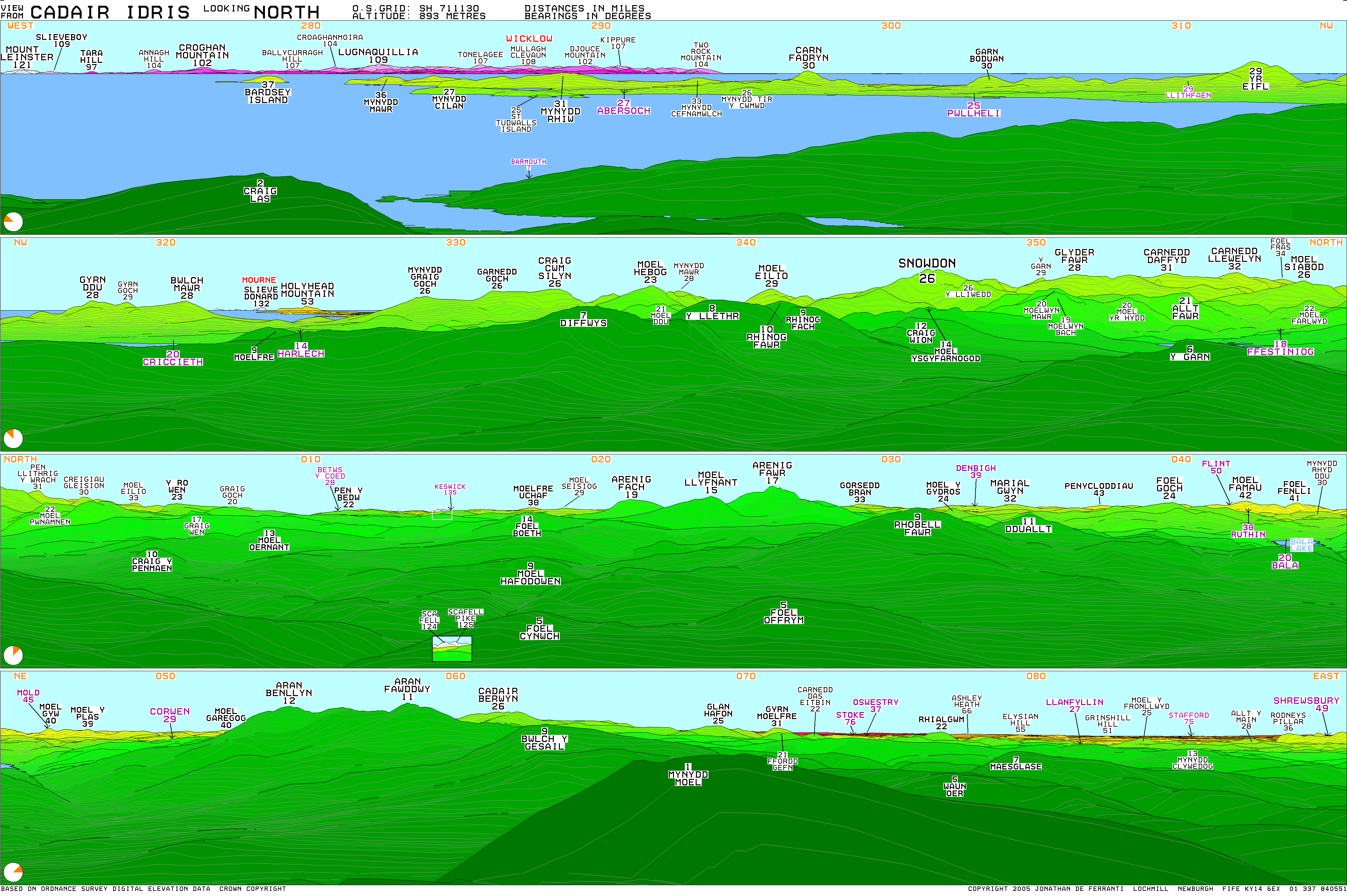
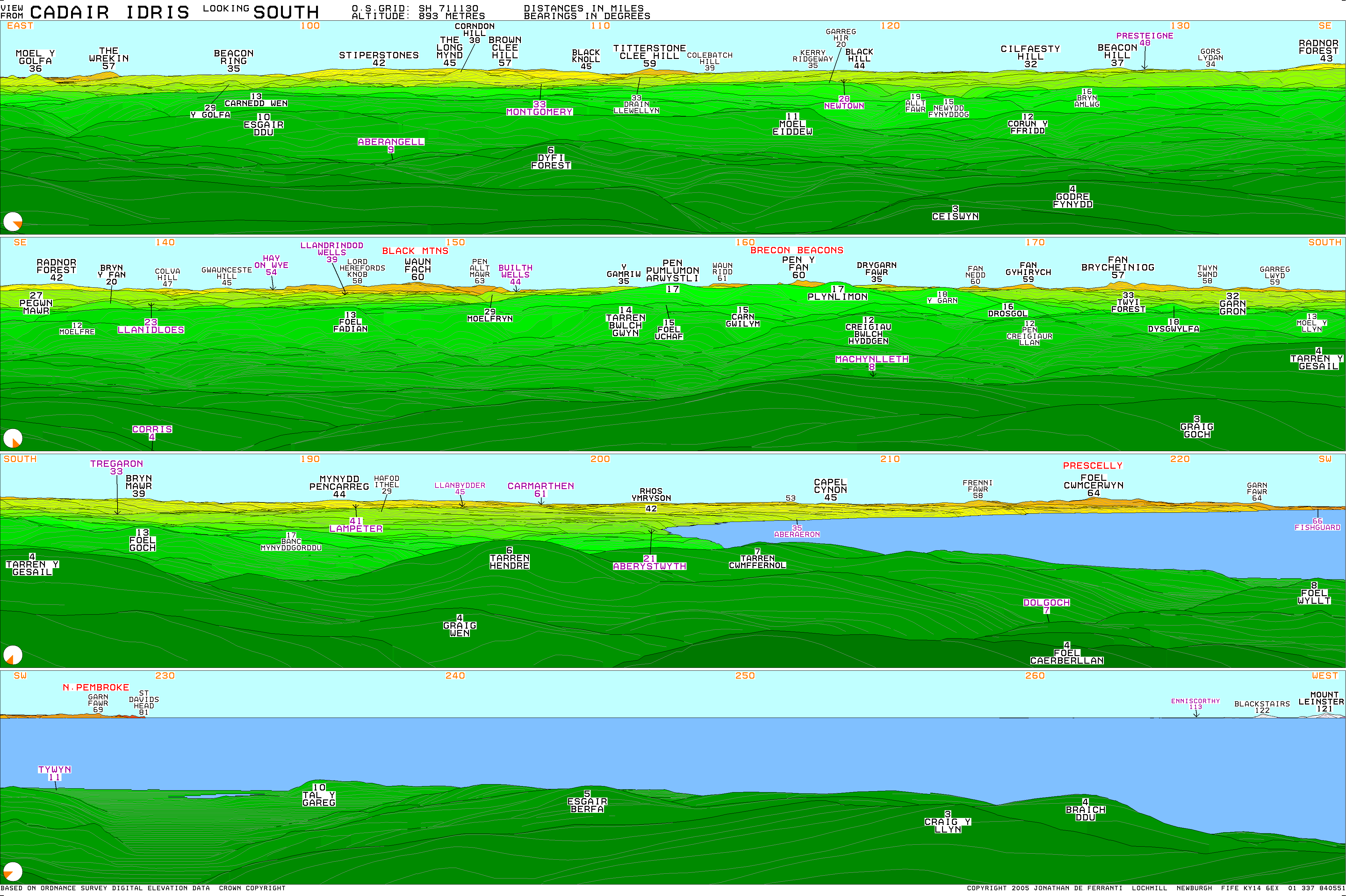
- Computer generated summit panoramas North South index
- A description of and guide to climbing Cadair Idris from h2g2
- Cadair Idris Walk Via the Pony Path
- Cadair Idris Long Walk from Llanfihangel-y-pennant
- Summary of the Walks up Cader Idris
Script error: No such module "Coordinates". Template:British hills Script error: No such module "Authority control".
- Pages with script errors
- Pages with broken file links
- Arthog
- Dolgellau
- Abergynolwyn
- Llanfihangel-y-Pennant
- Mountains and hills of Gwynedd
- Sites of Special Scientific Interest in East Gwynedd
- Mountains and hills of Snowdonia
- Hewitts of Wales
- Landmarks in Wales
- Marilyns of Wales
- National nature reserves in Wales
- Nuttalls