C/2002 V1 (NEAT)
Template:Short description Script error: No such module "redirect hatnote". Script error: No such module "Infobox".Script error: No such module "Check for unknown parameters".
Comet NEAT, formally designated as C/2002 V1, is a non-periodic comet that appeared in November 2002.[1]Template:R/superscript The comet peaked with an apparent magnitude of approximately –0.5, making it the eighth-brightest comet seen since 1935.[2]Template:R/superscript It was seen by SOHO in February 2003. At perihelion the comet was only Script error: No such module "convert". from the Sun, where it was initially expected to be disintegrated, however reanalysis of its orbit has indicated that it has survived many of its previous perihelia, thus making breakup unlikely.[3]Template:R/superscript
Observations
Comet NEAT was discovered from the Template:Cvt Schmidt telescope of the Haleakalā Observatory as a magnitude-17 object on 6 November 2002 on the course of the Near-Earth Asteroid Tracking (NEAT) survey.[4]Template:R/superscript The comet became visible in the naked eye by January 2003.[5]Template:R/superscript[6]Template:R/superscript[7]Template:R/superscript
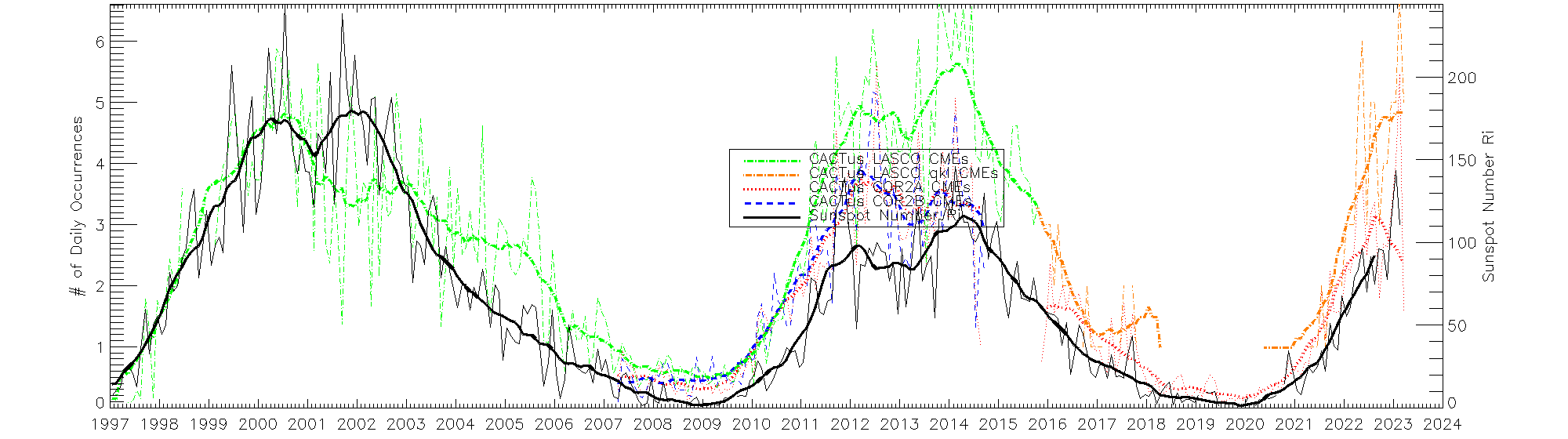
The comet was hit by a coronal mass ejection during its perihelion on 18 February 2003,[8]Template:R/superscript[9]Template:R/superscript where it was only 5.7 degrees from the Sun from Earth's perspective.[10]Template:R/superscript[11]Template:R/superscript Speculation that the CME was caused by the comet's close approach was dismissed by scientists; comets and CMEs occur close together in time only by coincidence,[12]Template:R/superscript[13]Template:R/superscript and there were 56 CMEs recorded in February 2003.[14]Template:R/superscript C/2002 V1 (NEAT) appeared impressive as viewed by the Solar and Heliospheric Observatory (SOHO) as a result of the forward scattering of light off of the dust in the coma and tail. The comet remained observable with telescopes until October 2003.[15]Template:R/superscript
The orbit of a long-period comet is properly obtained when the osculating orbit is computed at an epoch after leaving the planetary region and is calculated with respect to the center of mass of the Solar System. Using JPL Horizons, the barycentric orbital elements for epoch 2020-Jan-01 generate a semi-major axis of 1,100 AU, an apoapsis distance of 2,230 AU, and a period of approximately 37,000 years.[10]Template:R/superscript
References
<templatestyles src="Reflist/styles.css" />
- ↑ Script error: No such module "citation/CS1".
- ↑ Script error: No such module "citation/CS1".
- ↑ Script error: No such module "citation/CS1".
- ↑ Script error: No such module "citation/CS1".
- ↑ Script error: No such module "citation/CS1".
- ↑ Script error: No such module "citation/CS1".
- ↑ Script error: No such module "citation/CS1".
- ↑ Script error: No such module "citation/CS1".
- ↑ Script error: No such module "citation/CS1".
- ↑ a b Script error: No such module "citation/CS1". (Solution using the Solar System Barycenter and barycentric coordinates. Select Ephemeris Type:Elements and Center:@0)
- ↑ Template:Cite APOD
- ↑ Script error: No such module "citation/CS1".
- ↑ Script error: No such module "citation/CS1".
- ↑ Script error: No such module "citation/CS1". (CME rate)
- ↑ Script error: No such module "citation/CS1".
Script error: No such module "Check for unknown parameters".
External links
Script error: No such module "Side box".
- Template:PAGENAMEBASE at the JPL Small-Body DatabaseTemplate:EditAtWikidataTemplate:WikidataCheck
- SOHO Hotshots of Comet NEAT
- HDR Astrophotography: Simulations Atlas of Past Comets (2000 to Today) by Nicolas Lefaudeux
Script error: No such module "Navbox". Script error: No such module "Authority control".