Ambrosia dumosa
Template:Short description Script error: No such module "about". Template:Speciesbox
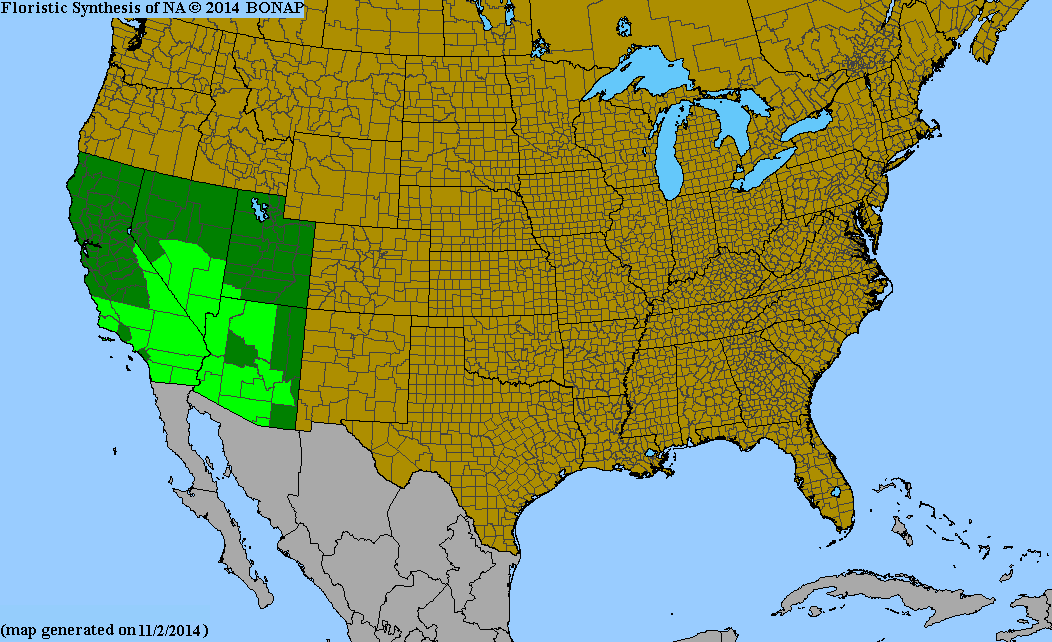
Ambrosia dumosa, the burro-weed or white bursage, a North American species of plants in the family Asteraceae. It is a common constituent of the creosote-bush scrub community throughout the Mojave Desert of California, Nevada, and Utah and the Sonoran Desert of Arizona and northwestern Mexico (Baja California, Baja California Sur, Sonora, Chihuahua).[1][2][3][4]
Ambrosia dumosa has been studied to determine allelopathic interactions with creosote bush, Larrea tridentata, which produces a chemical that inhibits the growth of A. dumosa.Script error: No such module "Unsubst". Other studies have suggested that A. dumosa roots produce a chemical that causes them to grow away from conspecific roots, preventing competition for water resources. In addition to burro-weed, A. dumosa is also commonly called white bursage, and burrobush.
Description
Ambrosia dumosa or white bursage is a form of ragweed, is a highly branched shrub 20 to 90 cm in height. The younger stems are covered with soft gray-white hairs. Approximately obovate leaves are 1 to 3 times pinnately compound or deeply lobed and generally clustered on short branches. The leaves are 0.5 to 4 cm long and also covered in soft gray-white hairs.[1]
Its inflorescence is yellow with staminate and pistillate headson a single plant (monoecious). Staminate heads have many flowers and are 3 to 5 mm in diameter with a 5 to 8 lobed involucre. Pistillate heads are 2 flowered and lack corollas.[1]
Ambrosia dumosa has spherical bur-like fruits ranging in color from golden to purple to brown. Along with microscopic hairs, the fruit has 12 to 35 flat and straight spines which are 5 to 9 mm in length and scattered over the surface.[5][1]
Ambrosia dumosa becomes dormant during drought, losing all of its leaves to prevent water loss by transpiration; drought deciduous. During this time, it can still be recognized by the presence of longitudinal stripes on smaller stems.[5]
Like other types of Ambrosia, this is a ragweed, wind-blown pollen from burro-weed can cause serious allergic reactions. Increasing cases in Mojave Desert as the population grows from Joshua Tree, CA to Las Vegas, NV.
References
<templatestyles src="Reflist/styles.css" />
- ↑ a b c d Flora of North America Vol. 21 Page 13 Bursage Ambrosia dumosa (A. Gray) W. W. Payne, J. Arnold Arbor. 45: 422. 1964.
- ↑ Biota of North America Program 2014 county distribution map
- ↑ Calflora taxon report, University of California, Ambrosia dumosa (A. Gray) Payne Burrobush, burro weed, white bursage
- ↑ Tropicos, specimen listing for Ambrosia dumosa (A. Gray) W.W. Payne
- ↑ a b Allen A.Schoenerr, Allen A. 1992. A Natural History of California. Berkeley: University of California Press. Template:ISBN
Script error: No such module "Check for unknown parameters".
- Jepson Manual Treatment: Ambrosia dumosa
- C.Michael Hogan, species editor. 2010. Ambrosia dumosa. Encyclopedia of Life
External links
- Pages with script errors
- Ambrosia (plant)
- North American desert flora
- Flora of the Southwestern United States
- Flora of Northwestern Mexico
- Flora of the California desert regions
- Flora of the Great Basin
- Flora of the Sonoran Deserts
- Natural history of the Colorado Desert
- Natural history of the Mojave Desert
- Taxa named by Asa Gray
- Flora without expected TNC conservation status