Argentina–Chile relations
Template:Use dmy dates Template:Short descriptionScript error: No such module "Infobox".Template:Template otherScript error: No such module "Check for unknown parameters".
.jpg)
International relations between the Republic of Chile and the Argentine Republic have existed for decades. The border between the two countries is the world's third-longest international border, which is Script error: No such module "convert". long and runs from north to south along the Andes mountains. Although both countries gained their independence during the South American wars of liberation, during much of the 19th and the 20th century, relations between the countries were tense as a result of disputes over the border in Patagonia. Despite this, Chile and Argentina have never been engaged in a war with each other. In recent years, relations have improved. Argentina and Chile have followed quite different economic policies. Chile has signed free trade agreements with countries such as China, the United States, Canada, South Korea, as well as European Union, and it's a member of the APEC. Argentina belongs to the Mercosur regional free trade area. In April 2018, both countries suspended their membership from the UNASUR.
Historical relations (1550–1989)
Rule under Spain and Independence

The relationship between the two countries can be traced back to an alliance during Spanish colonial times. Both colonies were offshoots of the Viceroyalty of Peru, with the Viceroyalty of the Río de la Plata (which Argentina was a part of) being broken off in 1776, and Chile not being broken off until independence. Argentina and Chile were colonized by different processes. Chile was conquered as a southward extension of the original conquest of Peru, while Argentina was colonized from Peru, Chile and from the Atlantic.
Argentina and Chile were close allies during the wars of independence from the Spanish Empire. Chile, like most of the revolting colonies, was defeated at a point by Spanish armies, while Argentina remained independent throughout its war of independence. After the Chilean defeat in the Disaster of Rancagua, the remnants of the Chilean Army led by Bernardo O'Higgins took refuge in Mendoza. Argentine General José de San Martín, by that time governor of the region, included the Chilean exiles in the Army of the Andes, and in 1817 led the crossing of the Andes, defeated the Spaniards, and confirmed the Chilean Independence. While he was in Santiago, Chile a cabildo abierto (open town hall meeting) offered San Martín the governorship of Chile, which he declined, in order to continue the liberating campaign in Peru.
In 1817 Chile began the buildup of its Navy in order to carry the war to the Viceroyalty of Perú. Chile and Argentina signed a treaty in order to finance the enterprise.[1] But Argentina, fallen in a civil war, was unable to contribute. The naval fleet, after being built, launched a sea campaign to fight the Spanish fleet in the Pacific to liberate Peru. After a successful land and sea campaign, San Martín proclaimed the Independence of Peru in 1821.
War against the Peru–Bolivian Confederation
Script error: No such module "Labelled list hatnote". From 1836 to 1839, Chile and Argentina united in a war against the confederation of Peru and Bolivia. The underlying cause was the apprehension of Chile and Argentina against the potential power of the Peru-Bolivia bloc. This resulted from concern over the large territory of Peru-Bolivia as well as the perceived threat that such a rich state would represent to their southern neighbors. Chile declared the war on 11 November 1836 and Argentina on 19 May 1837.[2]Template:Rp
In 1837 Felipe Braun, one of Santa Cruz's most capable generals and highly decorated veteran of the war of independence, defeated an Argentine army sent to topple Santa Cruz. On 12 November 1838 Argentine representatives signed an agreement with the Bolivian troops.[2]Template:Rp However, on 20 January 1839 the Chilean force obtained a decisive victory against Peru-Bolivia at the Battle of Yungay and the short-lived Peru-Bolivian Confederation came to an end.
Potreros of the Andes dispute
Chincha's war
Script error: No such module "Labelled list hatnote".
A series of coastal and high-seas naval battles between Spain and its former colonies of Peru and Chile occurred between 1864 and 1866. These actions began with Spain's seizure of the guano-rich Chincha Islands, part of a strategy by Isabel II of Spain to reassert her country's lost influence in Spain's former South American empire. These actions prompted an alliance between Ecuador, Bolivia, Peru and Chile against Spain. As a result, all Pacific coast ports of South America situated south of Colombia were closed to the Spanish fleet. Argentina, however, refused to join the alliance and maintained amicable relations with Spain[3] and delivered coal to the Spanish fleet.
War of the Pacific
On 6 February 1873, Peru and Bolivia signed a secret treaty of alliance against Chile.[4] On 24 September, Argentine president Domingo Faustino Sarmiento asked the Argentine Chamber of Deputies to join Argentina with the alliance. The Argentine chamber assented by a vote of 48–18. The treaty made available a credit of six million pesos for military expenditures. However, in 1874, after the delivery of the Chilean ironclad Almirante Cochrane and the ironclad Blanco Encalada, the Argentine Senate postponed the matter until late 1874, and Sarmiento was prevented signing the treaty.[5] Consequently, Argentina remained neutral during the war; and the Argentines signed a Border Treaty with Chile in 1881.
Claims on Patagonia
Script error: No such module "Labelled list hatnote".

Border disputes continued between Chile and Argentina, as Patagonia was then a largely unexplored area. The Border Treaty of 1881 established the line of highest mountains dividing the Atlantic and Pacific watersheds as the border between Argentina and Chile. This principle was easily applied in northern Andean border region; but in Patagonia drainage basins crossed the Andes. This led to further disputes over whether the Andean peaks would constitute the frontier (favoring Argentina) or the drainage basins (favoring Chile). Argentina argued that previous documents referring to the boundary always mentioned the Snowy Cordillera as the frontier and not the continental divide. The Argentine explorer Francisco Perito Moreno suggested that many Patagonian lakes draining to the Pacific were in fact part of the Atlantic basin but had been moraine-dammed during the quaternary glaciations changing their outlets to the west. In 1902, war was again avoided when British King Edward VII agreed to mediate between the two nations. He cleverly established the current Argentina-Chile border in Patagonia by dividing many disputed lakes into two equal parts. Several of these lakes still have different names on each side of the frontier, such as the lake known in Chile as Lago O'Higgins and in Argentina as Lago San Martín. A dispute that arose in the northern Puna de Atacama was resolved with the Puna de Atacama Lawsuit of 1899.
1893 Border protocol

The 1893 Boundary Protocol between Argentina and Chile, also known as the Errázuriz-Quirno Costa Protocol, was an agreement signed by Isidoro Errázuriz Errázuriz Errázuriz representing Chile and Norberto Camilo Quirno Costa representing Argentina on May 1, 1893 in Santiago, Chile. It was signed to solve problems that arose during the demarcation of the boundary on the basis of the 1881 Treaty.
This protocol ratified the principle of “Chile to the Pacific and Argentina to the Atlantic” from which, later on, discrepancies arose regarding the limit of both oceans, and whether the principle applies to the south of parallel 52° or not, according to the protocol, it applies to the north of parallel 52° only. In addition, the principle of the “main chain” of the Andes Mountains was established. The areas affected by the protocol were: the Seno Ultima Esperanza and the Isla Grande de Tierra del Fuego.
Southern Patagonian Ice Field border definition in 1898 by experts from both countries
Puna de Atacama dispute (1889-1898)

Arms race and foreign policy cooperation
Script error: No such module "Labelled list hatnote".
Dreadnought race
Script error: No such module "Labelled list hatnote". At the start of the 1900s a naval arms race began amongst the most powerful and wealthy countries in South America: Argentina, Brazil and Chile. It began when the Brazilian government ordered three formidable battleships whose capabilities far outstripped older vessels after the Brazilian Navy found itself well behind the Argentine and Chilean navies in quality and total tonnage.
Baltimore Crisis
Script error: No such module "Labelled list hatnote". During the Baltimore Crisis which brought Chile and the United States to the brink of war in 1891 (at the end of the 1891 Chilean Civil War), the Argentine foreign minister Estanislao Zeballos offered the US-minister in Buenos Aires the Argentine province of Salta as base of operations from which to attack Chile overland.[7]Template:Rp In return, Argentina asked the U.S. for the cession of southern Chile to Argentina.[8] Later, Chile and the United States averted the war.
Pactos de Mayo and 1902 Andes Boundary Case
Script error: No such module "Labelled list hatnote". Script error: No such module "Labelled list hatnote".

The Pactos de Mayo are four protocols signed in Santiago de Chile by Chile and Argentina on 28 May 1902 in order to extend their relations and resolve its territorial disputes. The disputes had led both countries to increase their military budgets and run an arms race in the 1890s. More significantly the two countries divided their influence in South America into two spheres: Argentina would not threaten Chile's Pacific Coast hegemony, and Santiago promised not to intrude east of the Andes.[7]Template:Rp Template:Excerpt
Snipe incident
Script error: No such module "Labelled list hatnote". In 1958 the Argentine Navy shelled a Chilean lighthouse and disembarked infantry in the uninhabitable islet Snipe, at the east entrance of the Beagle Channel.
Laguna del Desierto dispute (1949-1994) and the killing of Hernán Merino Correa
Script error: No such module "Labelled list hatnote".

The Laguna del Desierto incident, in Argentina called also Battle of Laguna del Desierto occurred between four members of Carabineros de Chile and 90 members of the Argentine Gendarmerie and took place in zone south of O'Higgins/San Martín Lake on 6 November 1965, resulting in Lieutenant Hernán Merino Correa killed and Sergeant Miguel Manríquez injured, both members of Carabineros, creating a tense atmosphere between Chile and Argentina.
Encuentro River-Alto Palena boundary dispute (1913-1966)

The Encuentro River-Alto Palena boundary dispute was a territorial dispute between the Republic of Argentina and the Republic of Chile over the delimitation of the boundary between milestones XVI and XVII of their common border in the valleys located north of Lake General Vintter/Palena (formerly Lake General Paz), which was resolved on November 24, 1966 by means of an arbitration decision of Queen Elizabeth II of the United Kingdom.
The ruling divided the disputed territory between the two countries, which was distributed between the commune of Palena in the province of Palena, Región de Los Lagos in Chile and the department of Languiñeo in the province of Chubut in Argentina.[9]
Beagle conflict (1904-1984) and the Argentinian invasion plan "Operation Soberanía"
Script error: No such module "Labelled list hatnote". Script error: No such module "Labelled list hatnote".

Trouble once again began to brew in the 1960s, when Argentina began to claim that the Picton, Lennox and Nueva islands in the Beagle Channel were rightfully theirs, although this was in direct contradiction of the 1881 treaty, as the Beagle Channel Arbitration, and the initial Beagle Channel cartography since 1881 stated.
Both countries submitted the controversy to binding arbitration by the international tribunal. The decision (see Beagle Channel Arbitration between the Republic of Argentina and the Republic of Chile, Report and Decision of the Court of Arbitration) recognized all the islands to be Chilean territory. Argentina unilaterally repudiated the decision of the tribunal and planned a war of aggression against Chile.[10]
Direct negotiations between Chile and Argentina in 1977-78 failed and relations became extremely tense. Argentina sent troops to the border in Patagonia and in Chile large areas were mined. On 22 December, Argentina started Operation Soberanía in order to invade the islands and continental Chile, but after a few hours stopped the operation when Pope John Paul II sent a personal message to both presidents urging a peaceful solution. Both countries agreed that the Pope would mediate the dispute through the offices of Cardinal Antonio Samoré his special envoy (See Papal mediation in the Beagle conflict).
On 9 January 1979 the Act of Montevideo was signed in Uruguay pledging both sides to a peaceful solution and a return to the military situation of early 1977. The conflict was still latent during the Falklands War and was resolved only after the fall of the Argentine military junta.
A number of prominent public officials in Chile still point to past Argentine treaty repudiations when referring to relations between the two neighbors.[11][12][13][14][15][16]
Falklands War
Script error: No such module "Unsubst". Script error: No such module "Labelled list hatnote". Script error: No such module "Labelled list hatnote".
During the Falklands War in 1982, with the Beagle conflict still pending, Chile and Colombia were the only South American countries to abstain from voting in the TIAR.
The Argentine government planned to seize the disputed Beagle Channel islands after the occupation of the Falkland Islands. Basilio Lami Dozo the then Chief of the Argentine Air Force, disclosed that Leopoldo Galtieri told him that:
- "[Chile] have to know what we are doing now, because they will be the next in turn.[17]
Óscar Camilión, the last Argentine Foreign Minister before the war (29 March 1981 to 11 December 1981) has stated that:
- "The military planning was, after the solution of the Falklands case, to invade the disputed islands in the Beagle. That was the determination of the Argentine Navy."[18]
These preparations were public. On 2 June 1982 the newspaper La Prensa published an article by Manfred Schönfeld explaining what would follow Argentina's expected victory in the Falkland Islands:
- "The war will not be finished for us, because after the defeat of our enemies in the Falklands, they must be blown away from South Georgia, the South Sandwich Islands, and all Argentine Austral archipelagos."[19]
Argentine General Osiris Villegas demanded (in April 1982) after the successful Argentine landing in the Falklands that his government stop negotiations with Chile and seize the islands south of the Beagle. In his book La propuesta pontificia y el espacio nacional comprometido, (p. 2), he asked:
- no persistir en una diplomacia bilateral que durante años la ha inhibido para efectuar actos de posesión efectiva en las islas en litigio que son los hechos reales que garantizan el establecimiento de una soberanía usurpada y la preservación de la integridad del territorio nacional.[20]
This intention was probably known to the Chilean government,[21] as the Chileans provided the United Kingdom with 'limited, but significant information' during the conflict. The Chilean Connection is described in detail by Sir Lawrence Freedman in his book The Official History of the Falklands Campaign.
Post-Pinochet democratic governments in Chile have given greater support to the Argentine claim on the Falkland Islands.[22][23][24][25]
In June 2010 (as in 2009[26] and years before[27][28][29][23]) Chile has supported the Argentine position at the United Nations Special Committee on Decolonization calling for direct negotiations between Argentina and the United Kingdom concerning the Falkland Islands dispute.[30]
Peace and Friendship Treaty of 1984
Script error: No such module "Labelled list hatnote". This important treaty (Template:Langx) was an agreement signed in 1984 between Argentina and Chile establishing friendly relations between the two countries. Particularly, the treaty defines the border delineation and freedom of navigation in the Strait of Magellan and gives possession of the Picton, Lennox and Nueva islands and sea located south of Tierra del Fuego to Chile, but the most part of the Exclusive Economic Zone eastwards of the Cape Horn-Meridian to Argentina. After that, other border disputes were resolved by peaceful means.
The 1984 treaty was succeeded by the Maipu Treaty of Integration and Cooperation (Tratado de Maipú de Integración y Cooperación) signed on 30 October 2009.[31]
Post-1990 relations
Argentine support for Bolivia
Despite the Pactos de Mayo agreement, in 2004 Argentina proposed to establish a "corridor" through Chilean territory under partial Argentine administration as a Bolivian outlet to sea. After talks with Chilean ambassador to Argentina, the Kirchner government pulled out of the proposal and declared the issue as "concerning Chile and Bolivia" only.[32][33]
Border issues

In 1898 the border in the Southern Patagonian Ice Field was defined and wasn't objected during the 1902 Arbitral award of the Andes which defined most of the border on the current Province territory. Both experts, Francisco Pascasio Moreno from Argentina and Diego Barros Arana from Chile agreed on the border between Mount Fitz Roy and Cerro Daudet.[34] However the border started being questioned by Argentina later on which started the dispute between both countries.
In the 1990s, relations improved dramatically. The dictator and last president of the Argentine Military Junta, General Reynaldo Bignone, called for democratic elections in 1983, and Augusto Pinochet of Chile did the same in 1989. As a consequence, militaristic tendencies faded in Argentina. The Argentine presidents Carlos Menem and Fernando de la Rúa had particularly good relations with Chile. In a bilateral manner, both countries settled all the remaining disputes except Laguna del Desierto, which was decided by International Arbitration in 1994. That decision favoured Argentine claims.[35][36][37][38][39]
According to a 1998 negotiation held in Buenos Aires, a Script error: No such module "convert". a border redraw is agreed, being pending to this day the part between Mount Fitz Roy and Cerro Murallón,[40] however a new border was drawn between Cerro Murallón and Cerro Daudet.
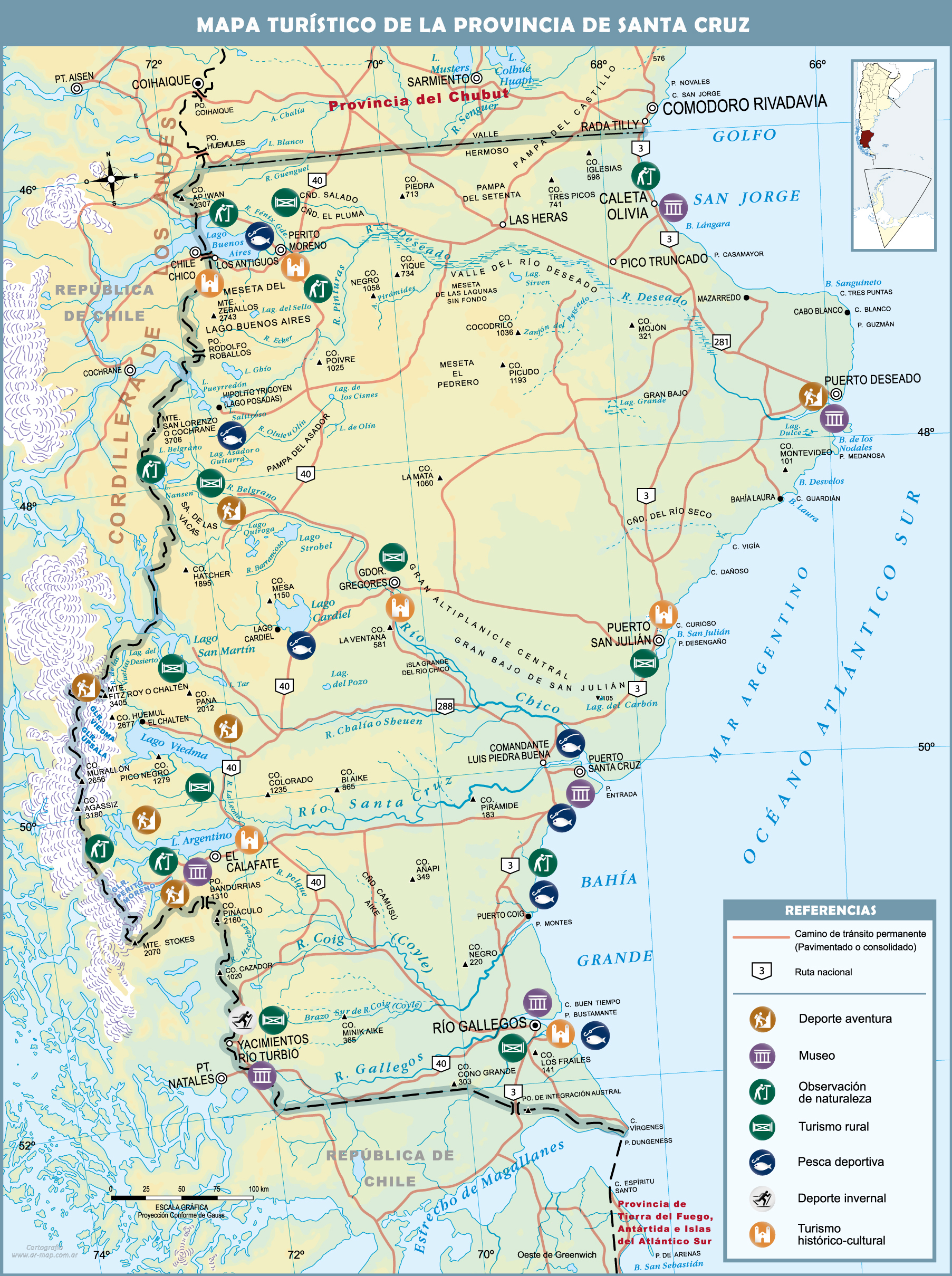
In 2006, president Néstor Kirchner invited Chile to define the border in the pending area, but Michelle Bachelet's government left the invitation unanswered.[41] The same year, the Chilean government sent a note to Argentina complaining that Argentine tourism maps showed the boundary claimed by Argentina in the Southern Patagonian Ice Field prior to the 1998 agreement, placing most of the area in Argentina.
In the maps published in Argentina, until today, the region continues to be shown without the white rectangle, as can be seen in a map of Santa Cruz on a website of an official Argentine agency.[42] While in the official Chilean maps and most tourist maps, the rectangle is shown and it is clarified that the boundary is not demarcated according to the 1998 treaty.[43][44][45]
Officially Chile is a neutral party in the Argentine claim on the Falkland Islands. Although Chile acknowledges the Argentine claim as legal, it does not support any special party continuously calling for peaceful negotiations to resolve the matter.[46]
).svg)
Geopolitics over Antarctica and the control of the passages between the south Atlantic and the south Pacific have led to the founding of cities and towns such as Ushuaia and Puerto Williams, both of which claim to be the southernmost cities in World. Currently, both countries have research stations in Antarctica, as does the United Kingdom. All three nations claim the totality of the Antarctic Peninsula.
Script error: No such module "Labelled list hatnote".
Dispute over the extended continental shelf

Economy and energy
Trade between the two countries is made mostly over the mountain passes that have enough infrastructure for large scale trade. The trade balance shows a great deal of asymmetry. since 2005[update]Template:Dated maintenance category (articles)Script error: No such module "Check for unknown parameters"., Chile was the third export trading partner for Argentina, behind Brazil and the United States.[47]
In 1996, Chile became an associate member of Mercosur, a regional trade agreement that Argentina and Brazil created in the 1990s. This associate membership does not convey full membership to Chile, however. In 2009, approvals were granted for a $3-billion Pascua Lama project to mine an ore body on the border of the two countries.[48] In 2016, Argentina's exports to Chile amounted to US$2.3 billion, while Chile's exports to Argentina amounted to US$689.5 million.[49]
Gas
Argentine president Carlos Menem signed a natural gas exportation treaty with Chilean president Eduardo Frei Ruiz-Tagle in 1996. In 2005, President Néstor Kirchner broke the treaty due to a supply shortage experienced by Argentina. The situation in Argentina was partly resolved when Argentina increased its own imports from Bolivia, a country with no diplomatic relations with Chile since 1978. In the import contract signed with Bolivia it was specified that not even a drop of Bolivian gas could be sold to Chile from Argentina.[50]
Sports
In 2003, Argentine AFA's president suggested that both countries launch a joint bid for the 2014 FIFA World Cup but was abandoned in favor of a CONMEBOL unified posture to allow the tournament be hosted in Brazil.
Beginning in 2009, the Dakar Rally began to be held in South America, and both Argentina and Chile have collaborated in organizing the annual cross-border event multiple times.
Host country Chile and Argentina contested the 2015 Copa America final and Chile was declared Champion after penalty shots. Copa America 2016 trophy was also for Chile against Argentina once again in the penalty shots.[51][52]
Argentina's and Chile's clash in Pool D of the 2023 Rugby World Cup in France marked the first ever encounter between two South American teams since the inception of the tournament in 1987. Los Pumas went on to defeat Los Cóndores 59 points to 5. The encounter is considered a milestone in the development of rugby in South America.[53]
Technology
Argentina announced on 28 August 2009[54] the election of the Japanese/Brazilian ISDB-T digital television standard with Chile following the same direction on 14 September.[55]Script error: No such module "Unsubst".
Military integration
Since the 1990s, both militaries have begun a close defense cooperation and friendship policy. In September 1991 they signed together with Brazil, the Mendoza Declaration, which commits signatories not to use, develop, produce, acquire, stock, or transfer —directly or indirectly— chemical or biological weapons.
Joint exercises were established on an annual basis in the three armed forces alternately in Argentina and Chile territory. An example of such maneuvers is the Patrulla Antártica Naval Combinada (Template:Langx) performed by both Navies to guarantee safety to all touristic and scientific ships that are in transit within the Antarctic Peninsula.
Both nations are highly involved in UN peacekeeping missions. UNFICYP in Cyprus was a precedent where Chilean troops are embedded in the Argentine contingent.[56] They played a key role together at MINUSTAH in Haiti(Video Haiti) and in 2005 they began the formation of a joint force for future United Nations mandates.[57] Named Cruz del Sur (Template:Langx), the new force began assembly in 2008 with headquarters alternately on each country every year.[58]
In 2005, while the Argentine Navy school ship ARA Libertad was under overhaul, Argentine cadets were invited to complete their graduation on the Chilean Navy school ship Esmeralda[59] and in another gesture of confidence, on 24 June 2007, a Gendarmeria Nacional Argentina (Border Guard) patrol was given permission to enter Chile to rescue tourists after their bus became trapped in snow.[60]
Chilean earthquake
On 13 March 2010, following the Chilean earthquake the benefit concert Argentina Abraza Chile (Template:Langx) was hosted in Buenos Aires, and an Argentine Air Force Mobile Field Hospital was deployed to Curicó.
On 8 April 2010 the newly elected Chilean president Sebastián Piñera made his first trip abroad a visit to Buenos Aires where he thanked president Cristina Fernández for the help received. He also stated his commitment to an increased cooperation between the two countries.[61]
Argentina protects fugitive of Chilean justice
In September 2010, CONARE (the Argentine National Refugee Commission, a department of the Argentine Interior Ministry[62]) granted asylum to Chilean citizen Galvarino Apablaza. Apablaza now lives in Argentina where he is married to journalist Paula Chain, and is father to three Argentine-born children. Chain has worked for the Argentine Government press office since 2009.[63] Apablaza is accused by Chile of being involved in the murder of Chilean Senator Jaime Guzmán in 1991, during the government of Patricio Aylwin, as well as the kidnapping of the son of one of the owners of the El Mercurio newspaper. The asylum status has been universally rejected by the Chilean government,[64] as well as by the Argentine political opposition.[65] Some Argentine media and journalists[66] have pointed out that the Argentine government ignored a ruling of the Argentine Supreme Court of Justice allowing the extradition of Apablaza.[64] Chilean state attorney Gustavo Gené has pointed out that there was no question of the Chilean legal system's authority or grounds by the Argentine Commission, and that the reasons for granting political asylum were based exclusively on "humanitarian grounds".[67]
The Argentine decree 256/2010 about the Strait of Magellan
On 17 February 2010 the Argentine executive issued the decree 256/2010[68] pertaining to authorisation requirements placed on shipping to and from Argentina but also to ships going through Argentine jurisdictional water heading for ports in the Falkland Islands, South Georgia and South Sandwich Islands. This decree was implemented by disposition 14/2010[69] of the Prefectura Naval Argentina. On 19 May 2010 the United Kingdom presented a note verbale rejecting the Argentine government's decrees and stipulating that the UK considered the decrees "are not compliant with International Law including the UN Convention on the Law of the Sea ”, and with respect to the Straits of Magellan the note recalls that "the rights of international shipping to navigate these waters expeditiously and without obstacle are affirmed in the 1984 Treaty of Peace and Friendship between Chile and Argentina with respect to the Straits of Magellan".[70]
Article 10 of the 1984 Treaty states "The Argentine Republic undertakes to maintain, at any time and in whatever circumstances, the right of ships of all flags to navigate expeditiously and without obstacles through its jurisdictional waters to and from the Strait of Magellan".
Resident diplomatic missions
- Argentina has an embassy in Santiago and consulates-general in Antofagasta, Concepción, Puerto Montt, Punta Arenas and Valparaíso.[71]
- Chile has an embassy in Buenos Aires and consulates-general in Bariloche, Córdoba, Mendoza, Neuquén, Río Gallegos, Rosario and Salta; and consulates in Bahía Blanca, Comodoro Rivadavia, Mar del Plata, Río Grande and Ushuaia.[72]
-
Embassy of Argentina in Santiago
-
Consulate-General of Argentina in Santiago
-
Consulate-General of Argentina in Valparaïso


-
Embassy of Chile in Buenos Aires
-
Consulate-General of Chile in Buenos Aires
-
Consulate-General of Chile in Comodoro Rivadavia
-
Consulate-General of Chile in Mendoza


See also
- Laguna del Desierto incident
- Southern Patagonian Ice Field dispute
- Beagle conflict
- Puna de Atacama dispute
- Argentina–Chile border
- ABC countries
- Foreign relations of Argentina
- Foreign relations of Chile
- List of ambassadors of Argentina to Chile
References
<templatestyles src="Reflist/styles.css" />
- ↑ The annual register, or, A view of the history, politics, and literature for 1819, Volume 61, John Davis Batchelder Collection (Library of Congress) Template:Trim&pg=PA138 link, page 138
- ↑ a b José María Rosa, Template:Trim Historia argentina: Unitarios y federales (1826–1841) at Google Books
- ↑ Template:Trim&pg=PA99 Spain and the American Civil War: relations at mid-century, 1855–1868, p. 99, at Google Books
- ↑ Script error: No such module "citation/CS1".
- ↑ Script error: No such module "citation/CS1".
- ↑ Script error: No such module "citation/CS1".
- ↑ a b William F. Sater, Chile and the United States, Empires in Conflict, University of Georgia Press, 1990, Template:ISBN
- ↑ Arthur Preston Whitaker, Template:Trim&pg=PA34 The United States and the southern cone: Argentina, Chile, and Uruguay, Harvard University Press, 1976, page 34
- ↑ Script error: No such module "citation/CS1".
- ↑ Clarín de Buenos Aires 20 December 1998
- ↑ See notes of the Chilean Foreign Minister Jose Miguel Insulza, in La Tercera de Santiago de Chile 13 July 1998 "Enfatizó que, si bien la situación es diferente, lo que hoy está ocurriendo con el Tratado de Campo de Hielo Sur hace recordar a la opinión pública lo sucedido en 1977, durante la disputa territorial por el Canal de Beagle"Script error: No such module "Unsubst".
- ↑ See notes of Senator (not elected but named by the Armed Forces) Jorge Martínez Bush in La Tercera de Santiago de Chile 26 July 1998 "El legislador expuso que los chilenos mantienen "muy fresca" en la memoria la situación creada cuando Argentina declaró nulo el arbitraje sobre el canal del Beagle, en 1978"
- ↑ See notes of the Chilean Foreign Minister Ignacio Walker "Y está en la retina de los chilenos el laudo de Su Majestad Británica, en el Beagle, que fue declarado insanablemente nulo por la Argentina. Esa impresión todavía está instalada en la sociedad chilena." Clarin de B.A., 22 July 2005
- ↑ See also "Reciprocidad en las Relaciones Chile - Argentina" of Andrés Fabio Oelckers Sainz. "También en Chile, todavía genera un gran rechazo el hecho que Argentina declarase nulo el fallo arbitral británico y además en una primera instancia postergara la firma del laudo papal por el diferendo del Beagle"
- ↑ See notes of Director académico de la Facultad Latinoamericana de Ciencias Sociales Flacso, Francisco Rojas, in Santiago de Chile, in "Desde la Argentina, cuesta entender el nivel de desconfianza que hoy existe en Chile a propósito de la decisión que tomó en 1978 de declarar nulo el laudo arbitral" Template:Webarchive La Nación de Buenos Aires 26 September 1997
- ↑ See notes of Chilean Defense Minister Edmundo Pérez Yoma in "Centro Superior de Estudios de la Defensa Nacional del Reino de España" " ... Y que la Argentina estuvo a punto de llevar a cabo una invasión sobre territorio de Chile en 1978 ..." Template:Webarchive, appeared in Argentine newspaperEl Cronista Comercial 5 May 1997. These notes were later relativized by the Chilean Government (See Script error: No such module "citation/CS1". Script error: No such module "citation/CS1".)
- ↑ Argentine newspaper Perfil Después de Malvinas, iban a atacar a Chile Template:Webarchive on 22. November 2009, retrieved 22. November 2009:
- Para colmo, Galtieri dijo en un discurso: "Que saquen el ejemplo de lo que estamos haciendo ahora porque después les toca a ellos".
- ↑ Óscar Camilión, Memorias Políticas, Editorial Planeta, Buenos Aires, 1999, page 281:
- "Los planes militares eran, en la hipótesis de resolver el caso Malvinas, invadir las islas en disputa en el Beagle. Esa era la decisión de la Armada ..."
- ↑ All articles of Manfred Schönfeld published by "La Prensa" from 10 January 1982 to 2 August 1982, are compiled in La Guerra Austral, Manfred Schönfeld, Desafío Editores S.A., 1982, Template:ISBN
- ↑ cited in A treinta años de la crisis del Beagle, Desarrollo de un modelo de negociación en la resolución del conflicto by Renato Valenzuela Ugarte and Fernando García Toso, in Chilean Magazine "Política y Estrategia", nr. 115)
- ↑ Spanish newspaper El País on 11. April 1982 Chile teme que Argentina pueda repetir una acción de fuerza en el canal de Beagle retrieved on 11. September 2010
- ↑ President Bachelet:We not only support our sister republic's claims to the Malvinas islands but every year we present its case to the United Nations' Special Committee on Decolonization
- ↑ a b Script error: No such module "citation/CS1".
- ↑ Script error: No such module "citation/CS1".
- ↑ Chilean Foreign Minister Soledad Alvear reaffirms support to Argentine claim Template:Webarchive
- ↑ 2009 calling for direct negotiations over falkland Islands (malvinas)
- ↑ Script error: No such module "citation/CS1".
- ↑ Script error: No such module "citation/CS1".
- ↑ Script error: No such module "citation/CS1".
- ↑ Script error: No such module "citation/CS1".
- ↑ Script error: No such module "citation/CS1".
- ↑ Article Juan Gabriel Valdéz: "Hay resabios de rivalidades anacrónicas" in Argentina newspaper La Nación on 25 January 2004 in Spanish language, retrieved on 10 January 2012
- ↑ Script error: No such module "citation/CS1".
- ↑ Script error: No such module "citation/CS1".
- ↑ Script error: No such module "citation/CS1".
- ↑ Script error: No such module "citation/CS1".
- ↑ Script error: No such module "citation/CS1".
- ↑ Script error: No such module "citation/CS1".
- ↑ Script error: No such module "citation/CS1".
- ↑ Script error: No such module "citation/CS1".
- ↑ Script error: No such module "citation/CS1".
- ↑ Map of Santa Cruz in an official Argentine agency.
- ↑ Script error: No such module "Citation/CS1".
- ↑ Script error: No such module "citation/CS1".
- ↑ Script error: No such module "citation/CS1".
- ↑ [1] Template:Webarchive CHILE REAFIRMA SU POSICIÓN SOBRE ISLAS MALVINAS. La Cancillería reafirmó la política del Gobierno de Chile de respaldar los legítimos derechos de soberanía de la República Argentina en la disputa referida a la cuestión de las Islas Malvinas.
- ↑ Script error: No such module "citation/CS1".
- ↑ Script error: No such module "citation/CS1".
- ↑ Script error: No such module "citation/CS1".
- ↑ Script error: No such module "citation/CS1".
- ↑ Script error: No such module "citation/CS1".
- ↑ Script error: No such module "citation/CS1".
- ↑ Script error: No such module "citation/CS1".
- ↑ Script error: No such module "citation/CS1".
- ↑ [2] Gobierno de Chile adopta norma de Televisión Digital para el País Template:Webarchive
- ↑ Argentine Army: UNFICYP Template:Webarchive
UN: Cyprus - UNFICYP - Facts and Figures
Chilean Army: Misión de la ONU en Chipre desde el año 2003 Template:Webarchive
Brasilian Army: UNFICYP Template:Webarchive - ↑ Script error: No such module "citation/CS1".
- ↑ Script error: No such module "citation/CS1".
- ↑ Script error: No such module "citation/CS1".
- ↑ "Rescatan a 50 pasajeros que quedaron varados por la nieve en el norte chileno" Clarin newspaper: (Spanish)
- ↑ Piñera: "Lo mejor de la relación entre la Argentina y Chile está por venir" Template:Webarchive
- ↑ Argentina: se conforma Comisión para determinar la condición de refugiado y facilitar su integración Template:In lang
- ↑ Script error: No such module "citation/CS1".
- ↑ a b Script error: No such module "citation/CS1".
- ↑ Script error: No such module "citation/CS1".
- ↑ Script error: No such module "Citation/CS1".Template:Cbignore
- ↑ Script error: No such module "citation/CS1".
- ↑ Script error: No such module "citation/CS1".
- ↑ Script error: No such module "citation/CS1".
- ↑ Script error: No such module "citation/CS1".
- ↑ Embajada Argentina en Santiago de Chile
- ↑ Embajada de Chile en Buenos Aires
Script error: No such module "Check for unknown parameters".
Sources
- Template:In lang Historia de las Relaciones Exteriores Argentinas Template:Webarchive by Carlos Escudé and Andrés Cisneros
- Template:In lang Combined Military Force Cruz del Sur - official press release
External links
- Template:In lang Official website of the Argentine Ministry of Foreign Relations, International Trade and Worship
- Template:In lang Official website of the Chilean Ministry of Foreign Relations
- Research Project on the History of the Relations between Argentina and Chile, 1978-2000
Script error: No such module "Navbox". Script error: No such module "Navbox".