Calculating Space: Difference between revisions
imported>GreenC bot Move 2 urls. Wayback Medic 2.5 per WP:URLREQ#citeftp |
imported>Iljhgtn m Copyedit (minor) |
||
| Line 1: | Line 1: | ||
{{short description|Book by Konrad Zuse}} | {{short description|Book by Konrad Zuse}}{{Infobox book | ||
| author = [[Konrad Zuse]] | |||
| language = German | |||
| country = [[Germany]] | |||
| genre = Non-fiction | |||
| pub_date = 1969 | |||
| title_orig = Rechnender Raum | |||
| orig_lang_code = de | |||
| subject = [[Automata theory]] | |||
}} | |||
{{use dmy dates|date=August 2022|cs1-dates=y}} | {{use dmy dates|date=August 2022|cs1-dates=y}} | ||
{{use list-defined references|date=August 2022}} | {{use list-defined references|date=August 2022}} | ||
{{Italic title}} | {{Italic title}} | ||
[[File:Digitalteilchen.svg|thumb|250px|An elementary process in Zuse's Calculating Space: Two digital particles A and B form a new digital particle C.<ref name="Zuse_1967_RR"/>]] | [[File:Digitalteilchen.svg|thumb|250px|An elementary process in Zuse's Calculating Space: Two digital particles A and B form a new digital particle C.<ref name="Zuse_1967_RR"/>]] | ||
'''''Calculating Space''''' ({{langx|de|Rechnender Raum}}) is [[Konrad Zuse]]'s 1969 book on [[automata theory]]. He proposed that all processes in the [[universe]] are computational.<ref name="Mainzer-Chua_2011"/> This view is known today as [[the simulation hypothesis]], digital philosophy, [[digital physics]] or [[pancomputationalism]].<ref name="Müller_2014"/> Zuse proposed that the [[universe]] is being computed by some sort of [[cellular automaton]] or other discrete computing machinery,<ref name="Mainzer-Chua_2011"/> challenging the long-held view that some physical laws are continuous by nature. He focused on cellular automata as a possible substrate of the computation | '''''Calculating Space''''' ({{langx|de|Rechnender Raum}}) is [[Konrad Zuse]]'s 1969 book on [[automata theory]]. He proposed that all processes in the [[universe]] are computational.<ref name="Mainzer-Chua_2011"/> This view is known today as [[the simulation hypothesis]], digital philosophy, [[digital physics]] or [[pancomputationalism]].<ref name="Müller_2014"/> Zuse proposed that the [[universe]] is being computed by some sort of [[cellular automaton]] or other discrete computing machinery,<ref name="Mainzer-Chua_2011"/> challenging the long-held view that some physical laws are continuous by nature. He focused on cellular automata as a possible substrate of the computation and pointed out that the classical notions of [[entropy]] and [[second law of thermodynamics|its growth]] do not make sense in deterministically computed universes. | ||
==See also== | ==See also== | ||
| Line 20: | Line 30: | ||
==Further reading== | ==Further reading== | ||
* {{cite book |author-last=Zuse |author-first=Konrad |author-link=Konrad Zuse |date=1969 |title=Rechnender Raum |language=de |trans-title=Calculating Space |publication-place=Braunschweig, Germany |publisher=[[Friedrich Vieweg & Sohn]] |series=Schriften zur Datenverarbeitung |volume=1 |isbn=3-528-09609-8}} (70+4 pages) | * {{cite book |author-last=Zuse |author-first=Konrad |author-link=Konrad Zuse |date=1969 |title=Rechnender Raum |language=de |trans-title=Calculating Space |publication-place=Braunschweig, Germany |publisher=[[Friedrich Vieweg & Sohn]] |series=Schriften zur Datenverarbeitung |volume=1 |isbn=3-528-09609-8}} (70+4 pages) | ||
* {{cite web |title=Calculating Space - Translation of: Rechnender Raum |series=MIT Technical Translation |id=AZT-70-164-GEMIT (Project MAC) |author-last=Zuse |author-first=Konrad |author-link=Konrad Zuse |translator=Aztec School of Languages, Inc. |location=Cambridge, Massachusetts, USA |date=February 1970 |publisher=[[Massachusetts Institute of Technology]] |url=ftp://ftp.idsia.ch/pub/juergen/zuserechnenderraum.pdf |archive-url=https://web.archive.org/web/20170706021805/ftp://ftp.idsia.ch/pub/juergen/zuserechnenderraum.pdf |archive-date=2017-07-06 |url-status=dead |access-date=2020-03-25 }} (98 pages); {{cite book |chapter=Konrad Zuse's Rechnender Raum (Calculating Space) |language=en |title=A Computable Universe: Understanding & Exploring Nature as Computation |publisher=[[World Scientific]] |author-last=Zuse |author-first=Konrad |author-link=Konrad Zuse |editor-first1=Adrian |editor-last1=German |editor-first2=Hector |editor-last2=Zenil |edition=re-edition in [[LaTeX]] with permission of [[MIT]] and Zuse's family |date=2012 |chapter-url= | * {{cite web |title=Calculating Space - Translation of: Rechnender Raum |series=MIT Technical Translation |id=AZT-70-164-GEMIT (Project MAC) |author-last=Zuse |author-first=Konrad |author-link=Konrad Zuse |translator=Aztec School of Languages, Inc. |location=Cambridge, Massachusetts, USA |date=February 1970 |publisher=[[Massachusetts Institute of Technology]] |url=ftp://ftp.idsia.ch/pub/juergen/zuserechnenderraum.pdf |archive-url=https://web.archive.org/web/20170706021805/ftp://ftp.idsia.ch/pub/juergen/zuserechnenderraum.pdf |archive-date=2017-07-06 |url-status=dead |access-date=2020-03-25 }} (98 pages); {{cite book |chapter=Konrad Zuse's Rechnender Raum (Calculating Space) |language=en |title=A Computable Universe: Understanding & Exploring Nature as Computation |publisher=[[World Scientific]] |author-last=Zuse |author-first=Konrad |author-link=Konrad Zuse |editor-first1=Adrian |editor-last1=German |editor-first2=Hector |editor-last2=Zenil |edition=re-edition in [[LaTeX]] with permission of [[MIT]] and Zuse's family |date=2012 |chapter-url=https://static1.squarespace.com/static/642c4773648f260aef50bc21/t/68c6f74cb4f00f70e4959223/1757869900113/ZuseCalculatingSpace-GermanZenil.pdf |access-date=2025-09-13 |url-status=live |archive-url=https://web.archive.org/web/20220521084904/http://www.mathrix.org/zenil/ZuseCalculatingSpace-GermanZenil.pdf |archive-date=2022-05-21}} (69 pages) | ||
* {{cite book |author-first=Jürgen |author-last=Alex |chapter=Rechnender Raum |title=Zur Entstehung des Computers - Von Alfred Tarski zu Konrad Zuse [...] - Tertium non datur |publisher=[[VDI-Verlag]] |location=Düsseldorf, Germany |date=2007 |pages=251–279 |isbn=978-3-18-150051-4 |issn=0082-2361}} | * {{cite book |author-first=Jürgen |author-last=Alex |chapter=Rechnender Raum |title=Zur Entstehung des Computers - Von Alfred Tarski zu Konrad Zuse [...] - Tertium non datur |publisher=[[VDI-Verlag]] |location=Düsseldorf, Germany |date=2007 |pages=251–279 |isbn=978-3-18-150051-4 |issn=0082-2361}} | ||
Latest revision as of 14:41, 8 October 2025
Template:Short descriptionScript error: No such module "Infobox".Template:Template otherScript error: No such module "Check for unknown parameters".Template:Wikidata image
Template:Use dmy dates Template:Use list-defined references Template:Italic title

Calculating Space (Template:Langx) is Konrad Zuse's 1969 book on automata theory. He proposed that all processes in the universe are computational.[2] This view is known today as the simulation hypothesis, digital philosophy, digital physics or pancomputationalism.[3] Zuse proposed that the universe is being computed by some sort of cellular automaton or other discrete computing machinery,[2] challenging the long-held view that some physical laws are continuous by nature. He focused on cellular automata as a possible substrate of the computation and pointed out that the classical notions of entropy and its growth do not make sense in deterministically computed universes.
See also
References
<templatestyles src="Reflist/styles.css" />
Script error: No such module "Check for unknown parameters".
Further reading
- Script error: No such module "citation/CS1". (70+4 pages)
- Script error: No such module "citation/CS1". (98 pages); Script error: No such module "citation/CS1". (69 pages)
- Script error: No such module "citation/CS1".
External links
- Jürgen Schmidhuber's site Zuse's book and 1967 paper.
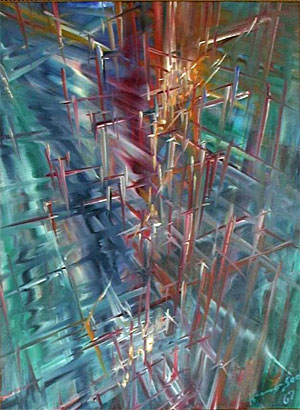
- Calculating Space - a painting by Zuse - Konrad Zuse's visualization of the idea
- Web article and simulation of such a calculating space in C and LIBPNG
- SecondSpace Simulation of waves within a 2D space (time and space are discrete), similar to FDTD. An OpenCL graphic card is needed.