Stickney (crater): Difference between revisions
imported>OAbot m Open access bot: hdl updated in citation with #oabot. |
imported>Monkbot |
||
| Line 12: | Line 12: | ||
[[Image:Phobos Full.png|thumb|250px|Stickney on Phobos (at left)<br /> ([[Viking program|Viking orbiter]], 10 June 1977)]] | [[Image:Phobos Full.png|thumb|250px|Stickney on Phobos (at left)<br /> ([[Viking program|Viking orbiter]], 10 June 1977)]] | ||
'''Stickney''' is the largest [[Impact | '''Stickney''' is the largest [[Impact crater]] on [[Phobos (moon)|Phobos]], the inner [[Moons of Mars|satellite of Mars]]. It is {{convert|9|km|mi|abbr=on}} in diameter, taking up a substantial proportion of the moon's surface. | ||
==Naming== | ==Naming== | ||
| Line 18: | Line 18: | ||
==Formation== | ==Formation== | ||
There are two models for the age of Stickney, based on the differing possible dates at which Phobos began to orbit around Mars. If Phobos has been orbiting for 4.3 [[Gigaannum|Ga]] (billion years) then Stickney formed 4.2 Ga ago, but if Phobos has only been orbiting for 3.5 Ga then it formed 2.6 Ga ago.<ref>{{cite journal|url=https://www.sciencedirect.com/science/article/abs/pii/S003206331400107X|title=The age of Phobos and its largest crater, Stickney|journal=[[Planetary and Space Science]]|last1=Schmedermann|first1=Nico|display-authors=et al|date=November 1, 2014| | There are two models for the age of Stickney, based on the differing possible dates at which Phobos began to orbit around Mars. If Phobos has been orbiting for 4.3 [[Gigaannum|Ga]] (billion years) then Stickney formed 4.2 Ga ago, but if Phobos has only been orbiting for 3.5 Ga then it formed 2.6 Ga ago.<ref>{{cite journal|url=https://www.sciencedirect.com/science/article/abs/pii/S003206331400107X|title=The age of Phobos and its largest crater, Stickney|journal=[[Planetary and Space Science]]|last1=Schmedermann|first1=Nico|display-authors=et al|date=November 1, 2014|access-date=August 9, 2022|pages=152–163|volume=102|publisher=[[Elsevier]]|doi=10.1016/j.pss.2014.04.009|url-access=subscription}}</ref> The impact created a large amount of [[ejecta]] which escaped Phobos's gravity and entered into orbit around Mars for a period not exceeding 1000 years (some crashed back onto Phobos, and creating secondary impact craters).<ref>{{cite journal|url=https://www.sciencedirect.com/science/article/abs/pii/S0032063315300489|title=The Stickney Crater ejecta secondary impact crater spike on Phobos: Implications for the age of Stickney and the surface of Phobos|journal=[[Planetary and Space Science]]|publisher=[[Elsevier]]|last1=Ramsley|first1=Kenneth R.|last2=Head|first2=James W.|date=April 2017|access-date=August 12, 2022|volume=138|pages=7–24|doi=10.1016/j.pss.2017.02.004|url-access=subscription}}</ref> The majority of craters on Phobos that are smaller than 600 meters in diameter were caused by these secondary impacts.<ref>{{cite journal|url=https://www.hou.usra.edu/meetings/lpsc2019/pdf/1339.pdf|title=Stickney Crater: Secondary Impacts, Boulders, Grooves, and the Surface Age of Phobos|publisher=[[Lunar and Planetary Science Conference|50th Lunar and Planetary Science Conference]]|website=[[Brown University]]|last1=Ramsley|first1=Kenneth R.|last2=Head|first2=James W.|year=2019|number=2132|page=1|access-date=August 24, 2022}}</ref> | ||
==Physical features== | ==Physical features== | ||
Grooves and [[crater chain]]s appear to radiate from Stickney. One | Grooves and [[crater chain]]s appear to radiate from Stickney. One hypothesis suggests that they were formed as a result of stresses from the impact that created the crater; if true, this suggests that the impact nearly destroyed Phobos itself. There are however numerous other hypotheses as to how they were made, such as that they were formed by material ejected from impacts on Mars,<ref>{{cite web|last1=Murray|first1=John B.|display-authors=et al|url=http://www.lpi.usra.edu/meetings/lpsc2006/pdf/2195.pdf|title=New evidence on the origin of Phobos's parallel grooves from HRSC Mars Express|website=[[Lunar and Planetary Science Conference]]|publisher=[[Lunar and Planetary Institute]] & [[Johnson Space Center]]|year=2006}}</ref> that they were created by [[tidal forces]] exerted by Mars,<ref>{{cite web|last1=Zubritsky|first1=Elizabeth|title=Mars' Moon Phobos is Slowly Falling Apart|url=http://www.nasa.gov/feature/goddard/phobos-is-falling-apart|website=[[Goddard Space Flight Center]]|publisher=[[NASA]]|access-date=November 11, 2015|date=November 11, 2015}}</ref> or even that they were created by boulders rolling along Phobos's surface following the Stickney impact.<ref name="UT-20181120">{{cite web |last=Gough |first=Evan |title=Strange Grooves on Phobos Were Caused by Boulders Rolling Around on its Surface |url=https://www.universetoday.com/140593/strange-grooves-on-phobos-were-caused-by-boulders-rolling-around-on-its-surface/ |date=20 November 2018 |work=[[Universe Today]] |access-date=21 November 2018 }}</ref><ref name="PSS-20181116">{{cite journal |last1=Ramsley |first1=Kenneth R. |last2=Head |first2=James W. |title=Origin of Phobos grooves: Testing the Stickney Crater ejecta model |date=16 November 2018 |journal=[[Planetary and Space Science]] |publisher=[[Elsevier]]|volume=165 |pages=137–147 |doi=10.1016/j.pss.2018.11.004 |s2cid=86859432 }}</ref> | ||
Regardless of the causes of these grooves, the impact of the object which created Stickney was large enough to have potentially destroyed Phobos; a 2016 study by Syal et al. found that the high [[porosity]] of the moon was critical in preventing it from being destroyed during the collision.<ref>{{cite journal|title=Excavating Stickney crater at Phobos|journal=[[Geophysical Research Letters]]|publisher=[[American Geophysical Union]]|last1=Syal|first1=Megan Bruck|display-authors=et al|date=October 8, 2016|volume=43|issue=20|pages=10595–10601|doi=10.1002/2016GL070749|s2cid=131912268 |doi-access=free}}</ref> It is possible that the area underneath Stickney is much denser and less porous than the rest of Phobos, though models of the moon's interior vary on this.<ref>{{cite journal|url=https://www.sciencedirect.com/science/article/abs/pii/S0019103518304019|title=Signature of Phobos' interior structure in its gravity field and libration|journal=[[Icarus (journal)|Icarus]]|publisher=[[Elsevier]]|date=March 15, 2019|last1=Le Maistre|first1=Simon|last2=Rivoldini|first2=Attilio|last3=Rosenblatt|first3=Pascal| | Regardless of the causes of these grooves, the impact of the object which created Stickney was large enough to have potentially destroyed Phobos; a 2016 study by Syal et al. found that the high [[porosity]] of the moon was critical in preventing it from being destroyed during the collision.<ref>{{cite journal|title=Excavating Stickney crater at Phobos|journal=[[Geophysical Research Letters]]|publisher=[[American Geophysical Union]]|last1=Syal|first1=Megan Bruck|display-authors=et al|date=October 8, 2016|volume=43|issue=20|pages=10595–10601|doi=10.1002/2016GL070749|s2cid=131912268 |doi-access=free}}</ref> It is possible that the area underneath Stickney is much denser and less porous than the rest of Phobos, though models of the moon's interior vary on this.<ref>{{cite journal|url=https://www.sciencedirect.com/science/article/abs/pii/S0019103518304019|title=Signature of Phobos' interior structure in its gravity field and libration|journal=[[Icarus (journal)|Icarus]]|publisher=[[Elsevier]]|date=March 15, 2019|last1=Le Maistre|first1=Simon|last2=Rivoldini|first2=Attilio|last3=Rosenblatt|first3=Pascal|access-date=August 15, 2022|doi=10.1016/j.icarus.2018.11.022|volume=321|pages=272–290|s2cid=125563790 |url-access=subscription|hdl=2078.1/272278|hdl-access=free}}</ref> | ||
Stickney has a noticeable lineated texture on its interior walls, caused by landslides from materials falling into the crater.<ref name=ejection>{{cite web|date=April 9, 2008|title=Phobos from 6,800 Kilometers (Color)|website=[[NASA]]|publisher=[[Jet Propulsion Laboratory]] & [[University of Arizona]]|url=http://www.nasa.gov/mission_pages/MRO/multimedia/pia10368.html|access-date=April 9, 2008|archive-date=April 12, 2008|archive-url=https://web.archive.org/web/20080412015258/http://www.nasa.gov/mission_pages/MRO/multimedia/pia10368.html | Stickney has a noticeable lineated texture on its interior walls, caused by landslides from materials falling into the crater.<ref name=ejection>{{cite web|date=April 9, 2008|title=Phobos from 6,800 Kilometers (Color)|website=[[NASA]]|publisher=[[Jet Propulsion Laboratory]] & [[University of Arizona]]|url=http://www.nasa.gov/mission_pages/MRO/multimedia/pia10368.html|access-date=April 9, 2008|archive-date=April 12, 2008|archive-url=https://web.archive.org/web/20080412015258/http://www.nasa.gov/mission_pages/MRO/multimedia/pia10368.html}}</ref> There is a noticeable blue spectral coloration on the south-western edge of the crater, which is theorized to be a relatively thin layer of rock.<ref>{{cite journal|url=https://www.sciencedirect.com/science/article/abs/pii/S0032063310001200|title=Spectral heterogeneity on Phobos and Deimos: HiRISE observations and comparisons to Mars Pathfinder results|journal=[[Planetary and Space Science]]|publisher=[[Elsevier]]|last1=Thomas|first1=Nathan|display-authors=et al|date=October 2011|access-date=August 18, 2022|pages=1281–1292|volume=59|issue=13|doi=10.1016/j.pss.2010.04.018|url-access=subscription}}</ref><ref name=Ejecta/> Said coloration was likely caused by a combination of material from Stickney itself and from the smaller, interior crater [[Limtoc]].<ref name=Ejecta>{{cite journal|url=https://www.sciencedirect.com/science/article/abs/pii/S0019103520303626|title=Simulating re-impacts from craters at the deepest location of Phobos to generate its blue spectral units|journal=[[Icarus (journal)|Icarus]]|publisher=[[Elsevier]]|volume=354|doi=10.1016/j.icarus.2020.113997|last1=Kikuchi|first1=Hiroshi|date=January 15, 2021|article-number=113997 |s2cid=224926793 |access-date=August 5, 2022|url-access=subscription}}</ref> | ||
==See also== | ==See also== | ||
Latest revision as of 16:30, 4 October 2025
Template:Short description Script error: No such module "Infobox".Script error: No such module "Check for unknown parameters".

(Viking orbiter, 10 June 1977)
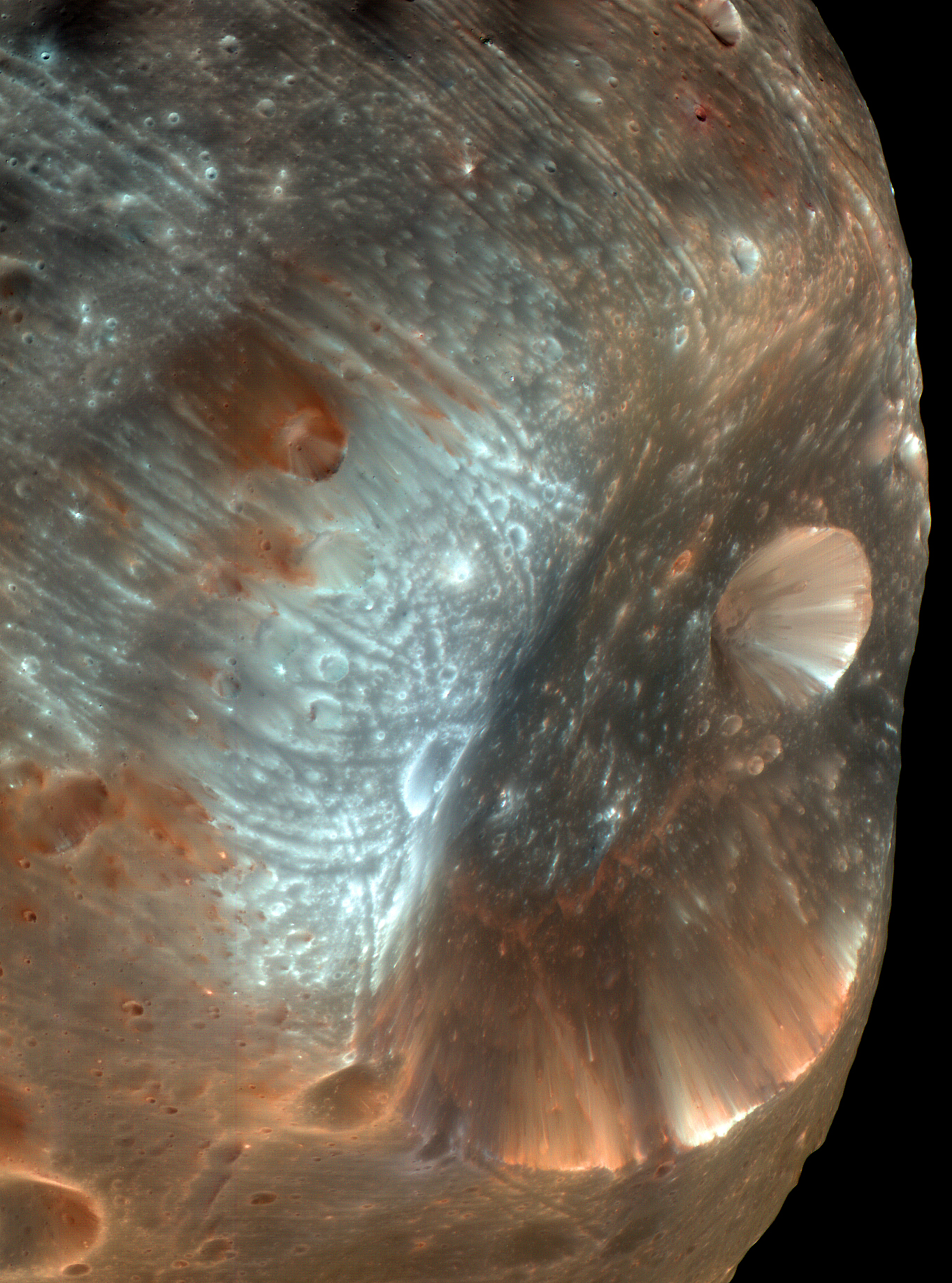
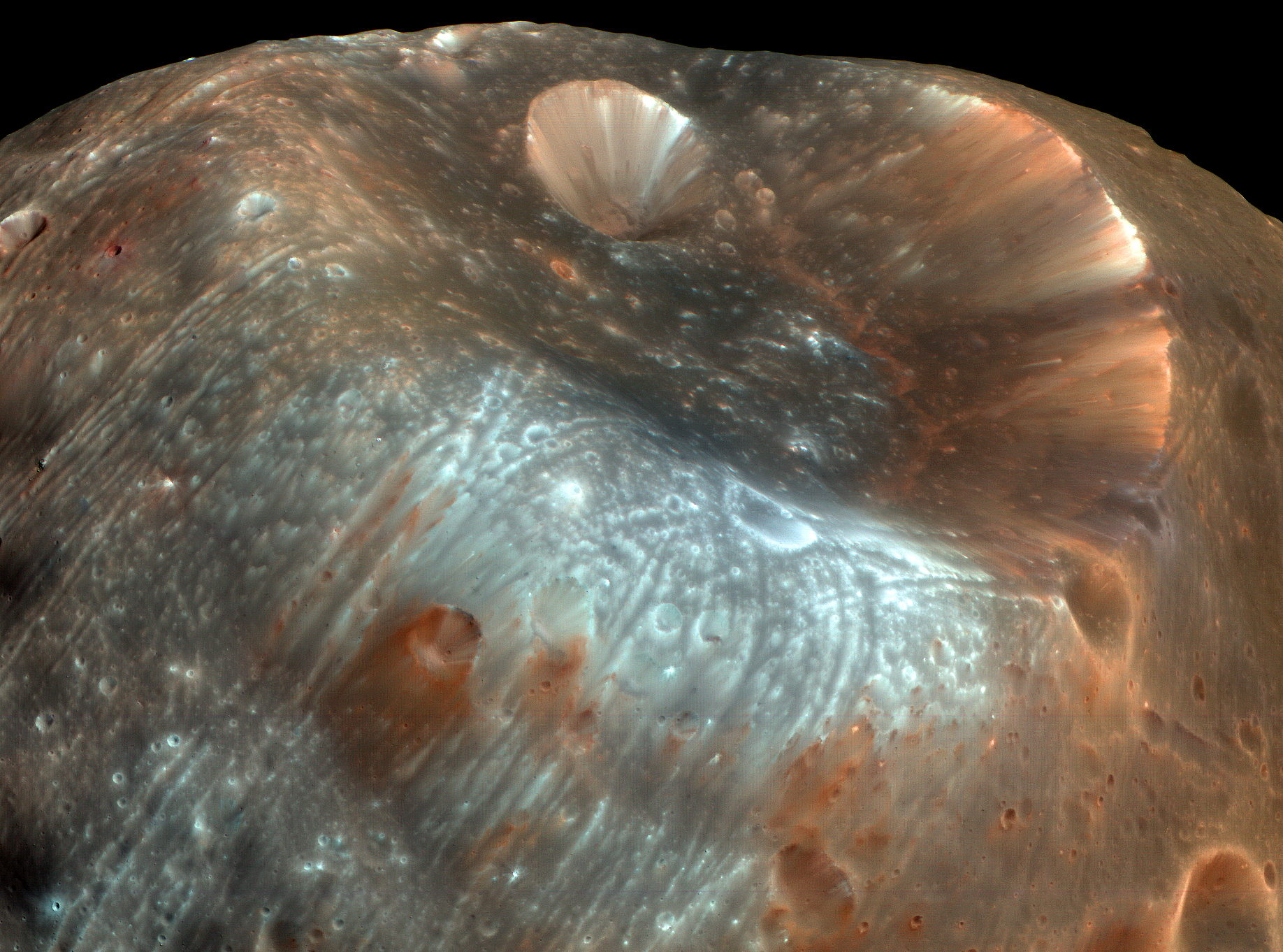
Stickney is the largest Impact crater on Phobos, the inner satellite of Mars. It is Script error: No such module "convert". in diameter, taking up a substantial proportion of the moon's surface.
Naming
The crater is named after mathematician Chloe Angeline Stickney Hall, the wife of Phobos's discoverer Asaph Hall, whose support was credited by her husband as critical for his discovery of the moon.[1][2] The crater was named in 1973, based on Mariner 9 images, by an IAU nomenclature committee chaired by Carl Sagan.[3]
Formation
There are two models for the age of Stickney, based on the differing possible dates at which Phobos began to orbit around Mars. If Phobos has been orbiting for 4.3 Ga (billion years) then Stickney formed 4.2 Ga ago, but if Phobos has only been orbiting for 3.5 Ga then it formed 2.6 Ga ago.[4] The impact created a large amount of ejecta which escaped Phobos's gravity and entered into orbit around Mars for a period not exceeding 1000 years (some crashed back onto Phobos, and creating secondary impact craters).[5] The majority of craters on Phobos that are smaller than 600 meters in diameter were caused by these secondary impacts.[6]
Physical features
Grooves and crater chains appear to radiate from Stickney. One hypothesis suggests that they were formed as a result of stresses from the impact that created the crater; if true, this suggests that the impact nearly destroyed Phobos itself. There are however numerous other hypotheses as to how they were made, such as that they were formed by material ejected from impacts on Mars,[7] that they were created by tidal forces exerted by Mars,[8] or even that they were created by boulders rolling along Phobos's surface following the Stickney impact.[9][10]
Regardless of the causes of these grooves, the impact of the object which created Stickney was large enough to have potentially destroyed Phobos; a 2016 study by Syal et al. found that the high porosity of the moon was critical in preventing it from being destroyed during the collision.[11] It is possible that the area underneath Stickney is much denser and less porous than the rest of Phobos, though models of the moon's interior vary on this.[12]
Stickney has a noticeable lineated texture on its interior walls, caused by landslides from materials falling into the crater.[13] There is a noticeable blue spectral coloration on the south-western edge of the crater, which is theorized to be a relatively thin layer of rock.[14][15] Said coloration was likely caused by a combination of material from Stickney itself and from the smaller, interior crater Limtoc.[15]
See also
References
<templatestyles src="Reflist/styles.css" />
- ↑ Cite error: Script error: No such module "Namespace detect".Script error: No such module "Namespace detect".
- ↑ Script error: No such module "citation/CS1".
- ↑ Script error: No such module "Citation/CS1"..
- ↑ Script error: No such module "Citation/CS1".
- ↑ Script error: No such module "Citation/CS1".
- ↑ Script error: No such module "Citation/CS1".
- ↑ Script error: No such module "citation/CS1".
- ↑ Script error: No such module "citation/CS1".
- ↑ Script error: No such module "citation/CS1".
- ↑ Script error: No such module "Citation/CS1".
- ↑ Script error: No such module "Citation/CS1".
- ↑ Script error: No such module "Citation/CS1".
- ↑ Script error: No such module "citation/CS1".
- ↑ Script error: No such module "Citation/CS1".
- ↑ a b Script error: No such module "Citation/CS1".
Script error: No such module "Check for unknown parameters".
External links
Script error: No such module "Side box".
- Flight around Phobos (animated movie)
- Stickney in High Resolution
- Stickney at APOD, 2018 May 5
- Creation of Stickney Crater on Phobos (VIDEO) Template:Webarchive simulation which shows how Stickney crater was created, and how it affected Phobos, The Lawrence Livermore National Laboratory
Script error: No such module "Navbox". Template:Portal bar